
Guide
Do Stonehenge Health Dynamic Digestive Enzymes work? Eighteen enzymes with units, a renamed formula, and a consumer study with no placebo
Quick answer
Do Stonehenge Health Dynamic Digestive Enzymes work? We could find no trial of this capsule. The brand’s own figure, 90% reporting less bloating, comes from a 30-person at-home study with no placebo group. The label prints a unit for each of 18 enzymes, though all share one 300 mg blend, and the alpha-galactosidase dose is 150 GalU against 1,200 in the trials. Amazon shows 3.9 from 44 ratings. At the label directions it costs about $2.40 a day.
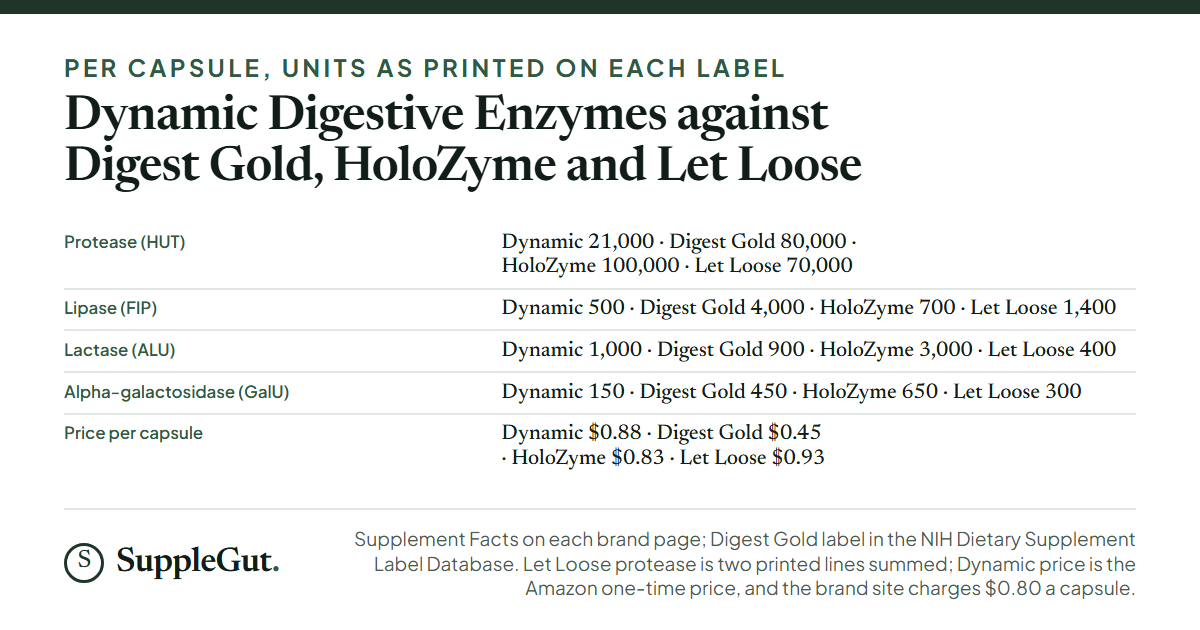
Stonehenge Health Dynamic Digestive Enzymes is a capsule that prints an activity unit beside each of 18 enzymes, taken before each meal rather than once a day. It was sold until recently as Incredible Digestive Enzymes. This page sets out what the label shows, how it compares with Digest Gold, HoloZyme and Let Loose, what the enzyme trials found at their doses, and what the reviews and prices look like.
What Dynamic Digestive Enzymes is, and what it is not
One capsule holds a 300 mg “Stonehenge Enzyme Blend” of 18 enzymes, a 60 mg vegetable blend (PhytoServ, labeled 20% quercetin), 110 mcg of vitamin K1 and 2.2 mg of zinc as zinc bisglycinate. Each enzyme has its own printed unit, but the 300 mg is a single weight for all 18, so the enzyme protein behind each unit cannot be read. The 18 count is 11 enzymes under the BioCore Optimum Complete name, six fiber- and starch-digesting enzymes and papain. Three lines are protease under three different assays, so it is 18 activities rather than 18 distinct proteins.
| Enzyme as printed | Per capsule |
|---|---|
| Protease (three assays) | 21,000 HUT; 4,000 PC; 50 SAPU |
| Amylase; glucoamylase; acid maltase; diastase | 3,500 DU; 9 AGU; 14 MaltU; 1,200 DP |
| Lactase; invertase | 1,000 ALU; 400 SU |
| Alpha-galactosidase; lipase; peptidase | 150 GalU; 500 FIP; 2 AP |
| Cellulase; xylanase; beta-glucanase; pectinase; phytase | 1,000 CU; 1,000 XU; 30 BGU; 34 EndoPG; 20 FTU |
| Papain | 200,000 FCCPU |
There is no probiotic, bile, betaine HCl or pancreatin in it. The capsule is hypromellose, the label prints “Contains: Sulfites”, and the brand says the vitamin K1 and zinc act as cofactors for the enzymes. If the 20% quercetin is by weight, the vegetable blend carries about 12 mg of it; the label does not say. The capsule is not stated to be delayed release.
The change of name
The brand’s review feed shows 22 reviews written for “Incredible Digestive Enzymes” and the rest for Dynamic Digestive Enzymes, which begin in late 2025. One reviewer with IBS writes that the earlier product gave immediate relief and the new one does not. Nothing the brand has posted says whether the formula changed or only the name, and we found no earlier Supplement Facts panel to compare.
The trial of the product itself
There is none. PubMed and ClinicalTrials.gov searches for the capsule and for the brand returned no study of it. What the brand shows instead is a “consumer group study” of 30 people at home for 10 days: 90% reported less bloating after a meal, 90% less post-meal heaviness, 80% less abdominal discomfort, 73% easier burping, reflux and indigestion, and 70% said food was more enjoyable. The footnote says extreme results are not typical and featured customers are compensated. There was no placebo group, and no protocol or publication is linked. These are the brand’s figures as a claim, and with no comparison group they cannot separate the capsule from expectation.
Amazon calls the enzyme system “clinically researched”. We found no human trial of BioCore Optimum Complete. One registry entry from the supplier, a 50-person placebo-controlled trial of a digestive enzyme blend (NCT04917913), does not name the blend and cannot be tied to this one.
The evidence for the enzymes
A multi-enzyme blend in dyspepsia. In a double-blind trial of 120 adults with functional dyspepsia, two capsules a day of a fungal multi-enzyme blend (200 mg each) were compared with placebo for two months. Dyspepsia-index, pain and sleep scores improved more on the enzymes. A 40-patient trial of another blend, 50 mg three times a day for 60 days, also beat placebo. Neither blend is this one.
Lactase. In 30 lactose malabsorbers given 400 ml of milk, a lactase added at 3,000 or 6,000 IU cut peak breath hydrogen from 51.5 ppm on placebo to 12.1 and 14.0 ppm, and the symptom score from 3.7 to 0.36 and 0.96. This capsule carries 1,000 ALU; the trial used a different unit and added the enzyme to the milk, so the match is not direct.
Alpha-galactosidase. In 8 healthy volunteers eating a bean meal, 1,200 GalU lowered breath hydrogen and flatulence. In irritable bowel syndrome, a 12-week trial in 125 patients found no routine benefit over placebo, with more withdrawals on the enzyme (18 against 7), and a trial in 20 patients at 1,200 GalU per meal found no difference. One capsule supplies 150 GalU, an eighth of the 1,200 GalU trial dose, and three capsules supply 450.
For papain, diastase, acid maltase and peptidase we found no relevant human trial. The digestive enzymes guide covers where single-purpose enzymes have trial support.
Dynamic Digestive Enzymes against Digest Gold, HoloZyme and Let Loose
Per capsule, against Digest Gold:
- Lower on Dynamic: protease 21,000 against 80,000 HUT, amylase 3,500 against 23,000 DU, lipase 500 against 4,000 FIP, cellulase 1,000 against 3,000 CU and alpha-galactosidase 150 against 450 GalU. Glucoamylase (9 against 50 AGU) and pectinase (34 against 45) are lower too.
- Higher on Dynamic: xylanase 1,000 against 550 XU, invertase 400 against 240 SU and beta-glucanase 30 against 25 BGU. Lactase is similar, 1,000 against 900 ALU.
- Only on Dynamic: papain, peptidase, diastase and acid maltase, plus the vitamin K1, zinc and vegetable blend.
Against HoloZyme, Dynamic has less protease (100,000 HUT there), lactase (3,000 ALU), alpha-galactosidase (650 GalU) and xylanase (2,000 XU), and slightly less lipase (700 FIP). Let Loose prints 400 ALU of lactase and 300 GalU of alpha-galactosidase. Amylase units differ across the three and cannot be compared. None of these products has a trial of its own formula.
How to take it
The brand’s directions: one capsule up to 30 minutes before each meal, swallowed whole, and no more than three capsules a day. Amazon’s bullet reads “Take 1 capsule per day”, which differs from the brand page. At three capsules a day a 60-capsule bottle lasts 20 days.
Side effects and who should check first
The label says to see a qualified health care professional first if you have a medical condition, take medication, especially blood thinners, or are pregnant or nursing. The capsule has 110 mcg of vitamin K1, 92% of the Daily Value. A one-star reviewer reports stomach upset. The panel prints sulfites and says the product is processed in a facility with products that may contain milk, soy and wheat. Two reviewers say they missed that line and have sensitivities to those foods; it describes the facility, not an ingredient.
What the reviews say
- Amazon: 3.9 from 44 ratings on a listing less than a year old. 56% are five-star and 22% are one or two stars. Of 8 effectiveness mentions, 5 are positive.
- Brand site (Okendo widget): 4.6 from 57 reviews. 22 were written for the earlier name, and 28 of the 57 are flagged by the widget as incentivized. Under the current name there are 35, averaging 4.57, with 23 flagged.
- Trustpilot: 3.4 from 51 reviews for the whole brand, not this product. Canceling a subscription is its most frequent complaint.
Recurring praise: less bloating and gas after meals, and eating dairy and pasta again. Recurring complaints: no noticeable effect, stomach upset, and a weaker result than the earlier version.
Price, subscriptions and the refund
A 60-capsule bottle is $47.95 on the brand site, or $0.80 a capsule and $2.40 a day at three capsules. Subscriptions are $40.76 monthly ($0.68), $35.96 a bottle on the three-month plan ($0.60) and $31.16 on the six-month plan ($0.52). On Amazon it is $52.95 ($0.88 a capsule, $2.65 a day at three) or $47.65 with Subscribe & Save. Digest Gold is $0.45 a capsule, HoloZyme $0.83 and Let Loose $0.93. A monthly subscription ships a bottle every month, while three capsules a day uses one in 20 days.
The brand states a 90-day guarantee that covers opened bottles, with refunds prorated by items returned and every bottle to be sent back for a full refund; the terms are the same as for its probiotic, covered in the Dynamic Biotics guide. Amazon lists the capsules as non-returnable unless damaged or defective.
Who it is for
- Someone whose trigger meals involve dairy, beans or plant fiber, knowing the alpha-galactosidase dose is an eighth of the trial dose.
- Someone who can take a capsule before each meal and is not on a blood thinner without checking first.
For bloating that does not follow particular meals, the quiz starts from symptoms.
The products in this catalog
Common questions
Do Stonehenge Health Dynamic Digestive Enzymes work?
We could find no trial of this capsule. The brand cites a 30-person at-home consumer study with no placebo group, in which 90% reported less bloating after a meal at 10 days. On Amazon, 56% of 44 ratings are five-star, and 5 of 8 effectiveness mentions are positive.
Are Dynamic Digestive Enzymes safe, and what are the side effects?
The label advises talking to a health care professional first if you have a medical condition, take medication, especially blood thinners, or are pregnant or nursing, and the capsule has 110 mcg of vitamin K1. One reviewer reports stomach upset, and the label prints sulfites and a facility line naming milk, soy and wheat. The brand says there are no known adverse effects and to take no more than three capsules a day.
How many Dynamic Digestive Enzymes do you take, and when?
The brand’s directions are one capsule up to 30 minutes before each meal, up to three a day, which makes a 60-capsule bottle last 20 days. Amazon’s bullet says “Take 1 capsule per day”, which differs from the brand page. The capsule is not stated to be delayed release.
Dynamic Digestive Enzymes vs Digest Gold: which has more enzymes?
Stonehenge lists 18 enzyme activities in one 300 mg blend and Digest Gold 13 enzymes. Per capsule Digest Gold has more protease (80,000 against 21,000 HUT), lipase (4,000 against 500 FIP), cellulase (3,000 against 1,000 CU) and alpha-galactosidase (450 against 150 GalU), while Stonehenge has more xylanase and invertase and adds papain, vitamin K1, zinc and a vegetable blend. Neither has a trial of its own formula.
Does it help with lactose?
The capsule has 1,000 ALU of lactase, and the page headline says “Lactose Digestion Support”. A trial of a different lactase at 3,000 to 6,000 units added to milk in 30 lactose malabsorbers cut symptom scores, but the units differ and no trial of this capsule exists. The label also says it is processed in a facility with products that may contain milk.
Did the formula change when Incredible Digestive Enzymes became Dynamic?
The product was sold as Incredible Digestive Enzymes until late 2025, and 22 of the 57 reviews on the brand site were written under that name. One reviewer says the earlier version worked and the new one does not. Nothing the brand has posted confirms whether the formula changed, and we found no earlier panel to compare.
How much does it cost, and can it be returned?
A 60-capsule bottle is $47.95 on the brand site, or $0.80 a capsule and $2.40 a day at three capsules, and $52.95 on Amazon. The brand states a 90-day guarantee that covers opened bottles, with refunds prorated by the items returned. Amazon lists the capsules as non-returnable unless damaged or defective.
Sources
- Ullah H, et al. A multi-enzyme blend from fungal fermentation in 120 adults with functional dyspepsia: randomized, double-blind, placebo-controlled trial. Biomedicine and Pharmacotherapy, 2023. PMID 37976892
- Majeed M, et al. DigeZyme in 40 patients with functional dyspepsia: placebo-controlled trial. Journal of Medicinal Food, 2018. PMID 30156436
- Montalto M, et al. Exogenous lactase in 30 lactose malabsorbers: double-blind placebo-controlled crossover trial. European Journal of Clinical Nutrition, 2005. PMID 15674309
- Di Stefano M, et al. Alpha-galactosidase and gas after a bean meal in 8 healthy volunteers. Digestive Diseases and Sciences, 2007. PMID 17151807
- Hillila M, et al. Alpha-galactosidase in 125 patients with irritable bowel syndrome. Scandinavian Journal of Gastroenterology, 2016. PMID 26133538
- Bohn L, et al. Alpha-galactosidase in 20 patients with irritable bowel syndrome. Neurogastroenterology and Motility, 2021. PMID 33619835
- ClinicalTrials.gov registry entry NCT04917913, “Efficacy of a Digestive Enzyme Blend” (blend not named). clinicaltrials.gov/study/NCT04917913
- Brand page: Supplement Facts, directions, warnings, consumer-study figures, price, subscription and refund terms, and the review widget feed. stonehengehealth.com/products/dynamic-digestive-enzymes; refund policy
- Amazon listing (rating, price, directions bullet, returns) and the Trustpilot profile for the brand. amazon.com/dp/B0FXHMFPMJ; trustpilot.com/review/stonehengehealth.com
- NIH Dietary Supplement Label Database: Enzymedica Digest Gold label; HoloZyme and Let Loose Supplement Facts on the brand pages, used for the unit-by-unit comparison. dsld.od.nih.gov/label/328881; healthygut.com/products/holozyme; takeletloose.com/products/koji-digestive-enzymes
Not sure which product fits your situation?
This guide covers the mechanics. The quiz takes your specific symptoms, routine and preferences and matches you to one product from the catalog.
Take the quiz →