Guide
Ayurveda in the United States and Europe: practitioners, products, regulation and evidence
Quick answer
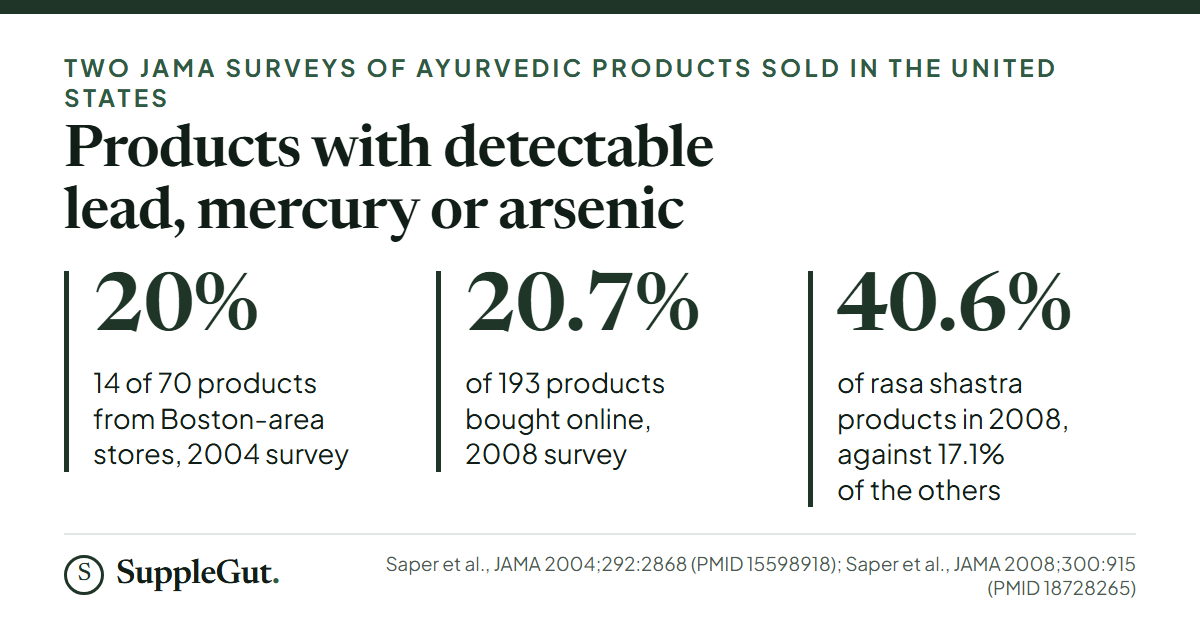
How is Ayurveda regulated in the United States and Europe? In the United States no state requires Ayurvedic practitioners to be licensed, and the products are sold as dietary supplements under DSHEA (1994). In Europe, Directive 2004/24/EC offers a registration for traditional herbal medicines that requires herbal-only active ingredients and 30 years of use, 15 of them in the EU. Two JAMA surveys found lead, mercury or arsenic in 20% of 70 products (2004) and 20.7% of 193 products bought online (2008).
Ayurveda reached the United States and Europe as a set of imported products, a few training schools and a vocabulary, without the state-recognized degrees and ministry it has in India. This guide covers how it arrived, how practitioners are trained and whether they are licensed, how its products are regulated in each place, what the heavy-metal surveys found, how brands position their products and what trials in Western populations show. The system itself is explained in What is Ayurveda? and its vocabulary in the glossary guide; the Ayurveda section lists the rest of the series.
How it arrived
As reported, the route into American popular culture ran through the 1980s. Maharishi Mahesh Yogi, the founder of Transcendental Meditation, launched Maharishi Ayur-Veda in the mid-1980s, and the approach is credited with much of the popularization of Ayurveda in the 1980s and early 1990s. Deepak Chopra was a founding president of Maharishi Ayur-Veda Products International and of the American Association of Ayurvedic Medicine, and medical director of the Maharishi Ayurveda Health Center for Stress Management and Behavioral Medicine.
The period also produced a public dispute. In 1991 JAMA ran an article on Maharishi Ayur-Veda by Hari Sharma, Brihaspati Dev Triguna and Chopra, followed by a report by Andrew Skolnick alleging that the authors had not disclosed financial ties to organizations selling the products they wrote about. Two organizations led by Chopra sued Skolnick, the editor and the American Medical Association for $194 million in 1992; the case was dismissed without prejudice in 1993. Sales at Maharishi Ayur-Veda Products International were reported at $20 million in 1999.
Practitioner training and licensing
The NCCIH states that there is no significant regulation of Ayurvedic practice or education in the United States and that no state requires a practitioner to hold a license. The field relies on voluntary standards instead. The National Ayurvedic Medical Association (NAMA) lists minimum training of 600 hours for an Ayurvedic Health Counselor, 1,500 hours for an Ayurvedic Practitioner and 4,000 hours for an Advanced Ayurvedic Practitioner, with certification through its own board. These credentials are professional titles and carry no legal right to practice medicine. Practitioners trained in India hold the BAMS degree, a four-and-a-half-year course with a one-year internship, which is a medical qualification in India and not in the United States.
Products as dietary supplements in the United States
Ayurvedic products sold in American stores and online are dietary supplements under the Dietary Supplement Health and Education Act of 1994 (DSHEA). Under that law firms are responsible for evaluating the safety and labeling of their products before marketing and are prohibited from marketing adulterated or misbranded products, and the FDA can act against such products after they reach the market. Products that make claims to treat disease can fall outside the supplement category: the FDA uses the phrase “unapproved Ayurvedic drug products” in its warning about heavy-metal poisoning, adds some manufacturers to import alerts (66-41 and 99-42) and says these products typically are not labeled to contain heavy metals.
Europe
The European route for herbal remedies is Directive 2004/24/EC, which created a simplified registration for traditional herbal medicinal products. Registration does not require clinical trials, and it sets conditions that matter for Ayurvedic products:
- The active ingredients must be exclusively herbal substances or preparations; vitamins or minerals are allowed only if their action is ancillary to the herbal ingredients.
- The product must be intended and designed for use without the supervision of a medical practitioner.
- It must have been in medicinal use for at least 30 years, including at least 15 years within the Community. Use outside the Community is weighed for validity and relevance but cannot replace the EU period.
- Products used in the EU for less than 15 years are referred to the Committee on Herbal Medicinal Products.
The European Commission’s own report on the directive notes that Ayurvedic medicinal products “include ingredients of plant, animal and mineral origin,” says some remedies of non-European systems could qualify while others do not, and states that the EU executive did not envisage extending simplified registration to traditional medical systems as such. A herb-only blend that meets the conditions can be registered. A formula whose active ingredients include a mineral or metal cannot take that route, and a product with a shorter EU history goes to the committee for assessment.
The heavy-metal record
| Survey | Sample | With lead, mercury or arsenic |
|---|---|---|
| Saper et al., JAMA, 2004 | 70 South Asian-made products bought in Boston-area stores in 2003 | 14 (20%); lead in 13, mercury in 6, arsenic in 6; all 14 could exceed regulatory intake limits at the label dose |
| Saper et al., JAMA, 2008 | 193 products bought online (230 ordered) | 20.7%; 21.7% of US-made and 19.5% of Indian-made; 40.6% of rasa shastra against 17.1% of the others |
| Cluster summarized by the NCCIH, 2015 | Users of Ayurvedic preparations and the supplements tested | 40% of users with elevated blood lead; about one in four supplements with high lead and almost half with high mercury |
In the 2004 survey the median concentration was 40 µg/g for lead (range 5 to 37,000), 20,225 µg/g for mercury (range 28 to 104,000) and 430 µg/g for arsenic (range 37 to 8,130). In the 2008 survey, 95% of the metal-containing products came from US websites and 75% claimed Good Manufacturing Practices, and every one exceeded at least one standard for acceptable daily intake.
Case reports from the CDC’s Morbidity and Mortality Weekly Report fill in the clinical side. A 2004 report described 12 adults with lead poisoning linked to Ayurvedic medications in five states between 2000 and 2003; the detailed cases had blood lead levels of 80 to 112 µg/dL, and lead in some preparations ranged from 0.4 to 261,200 parts per million. A 2015 report described a 64-year-old Wisconsin woman with a blood lead of 85.8 µg/dL and hemoglobin of 8.3 g/dL after using two Ayurvedic products bought online from India; one contained lead at 48,700 mg/kg, and both had high arsenic and thallium. She improved after a month of chelation therapy. The surveys describe the products sampled and do not extend to every product.
The market
Brands position Ayurvedic gut products in different ways, and the pages state them plainly:
- Pukka was founded in 2001 in Bristol by Tim Westwell and Sebastian Pole and was acquired by Unilever in 2017. Its products on US shelves include herbal teas such as Three Ginger, a blend of ginger, galangal, licorice and turmeric roots.
- Himalaya traces its start to 1930 in Dehradun, India. Its Organic Triphala caplet prints 438 mg of chebulic myrobalan powder plus 250 mg of triphala extract, and the brand page says products are tested for identity, strength and safety without naming a laboratory.
- Banyan Botanicals sells classical powders (hingvastak, avipattikar, trikatu) and tablets named for the doshas, and prints third-party testing for arsenic, cadmium, lead and mercury on its site.
- Organic India sells triphala as a powder, labeled at 2.5 g of its blend per half teaspoon, and as the capsules in this catalog.
What trials in Western populations show
The NCCIH says only a small number of clinical trials of Ayurvedic approaches have been published in Western medical journals, and that most are small or not well designed. For the gut, the trials run in Europe and the United States are few:
- In Berlin, 69 people with irritable bowel syndrome were randomized to Ayurvedic or conventional nutritional therapy including the low-FODMAP diet. At three months the symptom score fell by 123.8 points in the Ayurvedic group and 72.7 in the conventional group (difference 51.1, 95% CI 3.8 to 98.5). Both arms got diet counseling, there was no placebo, and some authors teach Ayurveda courses (Jeitler et al., 2021).
- At the University of California, Davis, 31 healthy adults took 2,000 mg a day of triphala, manjistha or placebo for four weeks; no bacterial group changed uniformly, and responses were individual (Peterson et al., 2020).
- In a Berlin diagnostic study nested in a knee osteoarthritis trial, four experts agreed only fairly to poorly (kappa 0 to 0.4) on prakriti and agni in 30 patients (Kessler et al., 2019).
The larger trials the NCCIH cites, such as 440 people with knee osteoarthritis comparing two Ayurvedic formulations with glucosamine and celecoxib, were run in India and are not gut trials. The herb-by-herb tables are in Does triphala work? and Ayurvedic herbs for digestion: what the trials show.
What a buyer can check
A Supplement Facts panel with amounts, the Latin names of the herbs and a third-party heavy-metal result from the brand are the checkable parts of a label. The NCCIH advises people with a health condition, and people who are pregnant or nursing, to talk with a health care provider before using Ayurvedic products. Are Ayurvedic supplements safe? goes through the surveys product by product.
Products this guide draws on
Common questions
Are Ayurvedic practitioners licensed in the United States?
No. The NCCIH says no state requires an Ayurvedic practitioner to have a license and that there is no significant regulation of the practice or its education. The National Ayurvedic Medical Association sets voluntary training minimums of 600, 1,500 and 4,000 hours for its three levels, and its certificates are professional titles.
How are Ayurvedic products regulated in the United States?
They are dietary supplements under DSHEA (1994). Firms are responsible for evaluating safety and labeling before marketing, and the FDA can act against adulterated or misbranded products after they reach the market. The FDA also says these products typically are not labeled to contain heavy metals.
Can Ayurvedic products be registered as traditional herbal medicines in Europe?
Some can. Directive 2004/24/EC requires herbal-only active ingredients, use without a physician’s supervision, and 30 years of medicinal use that includes 15 years in the EU. The EU executive’s report notes that Ayurvedic products can include animal and mineral ingredients and that only some remedies of non-European systems qualify.
How many Ayurvedic products contain heavy metals?
A 2004 survey found lead, mercury or arsenic in 14 of 70 products (20%) from Boston-area stores. A 2008 survey found them in 20.7% of 193 products bought online, and in 40.6% of rasa shastra products against 17.1% of the others. The surveys describe the products sampled and not every product.
When did Ayurveda become known in the United States?
As reported, Maharishi Ayur-Veda began in the mid-1980s and was central to its popularization in the 1980s and early 1990s, with Deepak Chopra as a founding president of its products company. A 1991 JAMA exchange over undisclosed financial ties and a 1992 lawsuit, dismissed in 1993, followed.
What do trials in Western populations show for Ayurveda and the gut?
Few exist. A Berlin trial of 69 people with IBS found symptom scores fell 123.8 points on Ayurvedic nutritional therapy and 72.7 on conventional nutritional therapy at three months, with no placebo group. A California trial of 31 healthy adults found triphala changed no bacterial group uniformly. The herb-by-herb tables cover the rest.
Who sells Ayurvedic gut products in the West?
Examples include Pukka (founded in 2001, owned by Unilever since 2017), Himalaya (founded in 1930), Banyan Botanicals and Organic India. Banyan prints third-party heavy-metal testing on its site, and Himalaya says its products are tested for identity, strength and safety without naming a laboratory.
Sources
- NCCIH. “Ayurvedic Medicine: In Depth.” Usage, licensing, trials and safety summaries. nccih.nih.gov/health/ayurvedic-medicine-in-depth
- Maharishi Vedic Approach to Health (history, Chopra roles, 1991 JAMA exchange, 1992 suit, 1999 sales), summarized at en.wikipedia.org; Skolnick A. “Maharishi Ayur-Veda: guru’s marketing scheme promises the world eternal perfect health.” JAMA, 1991;266(13):1741–1750, record at indianmedicine.eldoc.ub.rug.nl
- National Ayurvedic Medical Association. Educational programs and minimum training hours. ayurvedanama.org/educational-programs
- Ravishankar B, Shukla VJ. “Indian Systems of Medicine: A Brief Profile.” African Journal of Traditional, Complementary and Alternative Medicines, 2007;4(3):319–337. BAMS course length. pmc.ncbi.nlm.nih.gov/articles/PMC2816487
- FDA. Dietary supplements overview (DSHEA responsibilities). fda.gov/food/dietary-supplements; and “FDA warns about heavy metal poisoning associated with certain unapproved Ayurvedic drug products.” fda.gov
- Directive 2004/24/EC of the European Parliament and of the Council, amending Directive 2001/83/EC as regards traditional herbal medicinal products (Articles 16a and 16c). eur-lex.europa.eu
- European Commission. Report on the experience acquired as a result of the application of Directive 2004/24/EC, COM(2008) 584. eur-lex.europa.eu; European Commission, herbal medicinal products. health.ec.europa.eu
- Saper RB, et al. “Heavy metal content of ayurvedic herbal medicine products.” JAMA, 2004;292(23):2868–2873. PMID 15598918. pubmed.ncbi.nlm.nih.gov/15598918
- Saper RB, et al. “Lead, mercury, and arsenic in US- and Indian-manufactured Ayurvedic medicines sold via the Internet.” JAMA, 2008;300(8):915–923. PMID 18728265. pubmed.ncbi.nlm.nih.gov/18728265
- CDC. “Lead poisoning associated with Ayurvedic medications — five states, 2000–2003.” MMWR, 2004;53(26):582–584. cdc.gov/mmwr
- Meiman J, Thiboldeaux R, Anderson H. “Notes from the field: lead poisoning and anemia associated with use of Ayurvedic medications purchased on the Internet — Wisconsin, 2015.” MMWR, 2015;64(32):883. cdc.gov/mmwr
- Jeitler M, et al. “Ayurvedic vs. Conventional Nutritional Therapy Including Low-FODMAP Diet for Patients With Irritable Bowel Syndrome: A Randomized Controlled Trial.” Frontiers in Medicine, 2021;8:622029. PMID 34552937. pubmed.ncbi.nlm.nih.gov/34552937
- Peterson CT, et al. “Modulatory Effects of Triphala and Manjistha Dietary Supplementation on Human Gut Microbiota.” Journal of Alternative and Complementary Medicine, 2020;26(11):1015–1024. PMID 32955913. pubmed.ncbi.nlm.nih.gov/32955913
- Kessler CS, et al. “Reliability of Ayurvedic Diagnosis for Knee Osteoarthritis Patients.” Journal of Alternative and Complementary Medicine, 2019. PMID 30653338. pubmed.ncbi.nlm.nih.gov/30653338
- Brand pages: Pukka founding and acquisition, nutraingredients.com; Himalaya, himalayawellness.com and himalayausa.com; Banyan Botanicals, quality and testing page; Organic India Triphala powder, Supplement Facts.
From the general to your case
The trials above are the general case. The quiz applies them to yours: symptoms, medicines, routine, and what you have already tried.
Take the quiz →