Guide
What is Ayurveda, and what does it say about digestion?
Quick answer
What is Ayurveda? Ayurveda is a traditional medical system from India, set down in the Charaka Samhita, Sushruta Samhita and Ashtanga Hridaya, with the earliest layers dated by scholars to the last centuries BCE or first centuries CE. It sorts people and foods into three categories, vata, pitta and kapha, and describes digestion as agni, a fire. The NCCIH says about 240,000 American adults use it and that few well-designed trials support it.
Ayurveda is the traditional medical system of India, and it is where the words on a growing share of gut-supplement labels come from: triphala, agni, pitta, ama. This guide covers where the system comes from, how it is organized, how a practitioner approaches a digestive complaint, who uses it, and what the human trials of its gut remedies show. Each term is defined one by one in the glossary guide, and the Ayurveda section lists every guide in the series.
Where Ayurveda comes from
The NCCIH, the US government’s center for complementary health research, describes Ayurveda as one of the world’s oldest medical systems and one that remains among India’s traditional health care systems. Indian accounts trace its principles to the Vedas, with figures as early as 1500 BC; historians date the surviving medical texts much later.
Three works form the classical core, known together as the Brhat Trayi, the “big three”. The Charaka Samhita is the school of internal medicine, the Sushruta Samhita the school of surgery, and the Ashtanga Hridaya of Vagbhata a further major treatise. The dates scholars give are ranges, because all three were reworked by later editors:
- Charaka Samhita. Gerrit Meulenbeld’s history of Indian medical literature places its composition between the 4th century BCE and the 2nd century CE. The version in use today was revised and completed by Dridhabala, whom Philipp Maas dates to the 6th century CE.
- Sushruta Samhita. Meulenbeld finds that composition may have begun in the last centuries BCE. A committee of India’s National Institute of Sciences placed the recension behind the standard commentary in the 3rd to 4th centuries CE, and the oldest surviving manuscript is dated 878 CE. Rudolf Hoernle’s older estimate of about 600 BCE has been challenged.
- Ashtanga Hridaya. Vagbhata is placed in the early medieval period, often around the 6th century CE. Meulenbeld considers it unlikely that the Ashtanga Hridaya and Vagbhata’s longer Ashtanga Sangraha share one author, and the relationship between the two is still debated.
How the system is structured
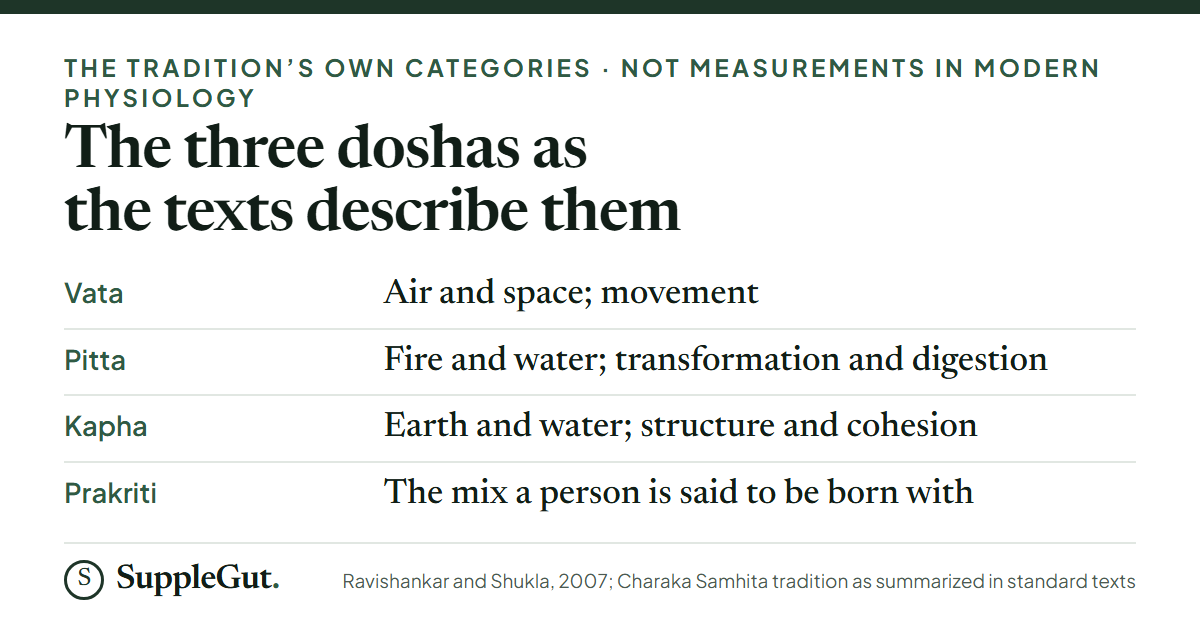
Ayurveda describes the body through a small set of categories. They are the tradition’s own vocabulary, and none of them is a measurement in modern physiology.
- The three doshas. Vata, pitta and kapha are the principles that, in a standard text on the system, “govern and control the basic psycho-biological functions in the body.” In the usual teaching, vata is tied to movement, pitta to transformation and digestion, and kapha to structure and cohesion.
- Prakriti and vikriti. Prakriti is the mix of doshas a person is said to be born with; vikriti is the present state, said to drift away from it when something is out of order.
- Agni. Digestion is described as a fire, agni, that acts on food after it is eaten. The texts say it weakens with irregular meals.
- Ama. When agni is weak, the tradition says a semi-processed residue of digestion, ama, builds up and obstructs the body’s channels (srotas). Modern terms people reach for, such as undigested food or fermentation products, are loose analogies.
- The six tastes. Sweet, sour, salty, bitter, pungent and astringent, each said to act on the doshas, along with a food’s heating or cooling potency (virya) and its effect after digestion (vipaka).
- Dinacharya. The daily routine of waking, eating and sleeping times, with a seasonal counterpart, treated as part of care rather than an extra.
Whether practitioners can apply the categories consistently has been tested once that we could find. In a Berlin study, four Ayurvedic experts each examined 30 patients with knee osteoarthritis; agreement was fair to poor (kappa values between 0 and 0.4) for central items such as prakriti and agni (Kessler et al., Journal of Alternative and Complementary Medicine, 2019).
How a practitioner approaches a gut complaint
In the tradition’s account, care starts with a detailed history: what is eaten and when, bowel habit, sleep, stress and the person’s constitution. An examination follows, including the pulse and the tongue, and the practitioner forms a view of which dosha is out of balance and how strong agni is. Treatment is then ordered, with diet and daily routine first, single herbs and formulas second, and for some patients the five cleansing procedures called panchakarma, which include purgation (virechana) and medicated enemas (basti).
Four gut formulas turn up often enough to show up on retail shelves:
- Triphala blends three fruits, amla, bibhitaki and haritaki, and is the classic bowel formula; the herb page for triphala has the trials.
- Trikatu means “three pungents”: ginger, black pepper and long pepper, used to kindle agni (trikatu).
- Hingvastak churna is a powder led by asafoetida, with ginger, peppers, cumin and salt, used in the tradition for gas and indigestion.
- Avipattikar churna pairs triphala and trikatu with cardamom, clove, cane sugar and a purgative root, Indian jalap, and is aimed at what the tradition calls excess pitta, such as acidity.
Who uses Ayurveda today
In India it is a state-recognized system. Ayurveda, yoga and naturopathy, Unani, Siddha, Sowa Rigpa and homeopathy sit under the Ministry of AYUSH, which was set up as a standalone ministry in 2014. Ayurvedic doctors hold the BAMS degree (Bachelor of Ayurvedic Medicine and Surgery), a four-and-a-half-year course followed by a one-year internship.
In the United States the NCCIH says about 240,000 adults use Ayurvedic medicine. It adds that there is no significant regulation of Ayurvedic practice or education and that no state requires a practitioner to hold a license. Products are sold as dietary supplements; Ayurveda in the United States and Europe covers training, regulation and the market.
What the human evidence looks like
The NCCIH’s summary is that few well-designed clinical trials and systematic reviews suggest Ayurvedic approaches are effective, that most trials are small or not well designed, and that there is little scientific evidence for most health issues. For the gut the picture is similar, and it is mostly trials of single herbs and formulas rather than of the whole system:
- Whole-system care for IBS. In a Berlin trial, 69 people with irritable bowel syndrome were randomized to Ayurvedic nutritional therapy (35) or conventional nutritional therapy including the low-FODMAP diet (34). At three months the symptom score fell by 123.8 points in the Ayurvedic group and 72.7 in the conventional group, a difference of 51.1 (95% CI 3.8 to 98.5). There was no placebo group, both arms received diet counseling, and several authors teach Ayurveda courses (Jeitler et al., Frontiers in Medicine, 2021).
- Triphala and the microbiome. In 31 healthy adults at the University of California, Davis, 2,000 mg a day of triphala for four weeks changed no bacterial group uniformly compared with placebo, and responses were highly individual (Peterson et al., Journal of Alternative and Complementary Medicine, 2020).
- Turmeric for ulcerative colitis. The NCCIH cites two small studies, of 10 and 89 people.
The detailed trial tables sit in Does triphala work? and Ayurvedic herbs for digestion: what the trials show.
Safety, and what a buyer can check
Some Ayurvedic preparations include metals, minerals or gems, a branch of practice called rasa shastra. A 2004 survey bought 70 products made in South Asia from Boston-area stores and found lead, mercury or arsenic in 14 of them, 20% (Saper et al., JAMA, 2004). A 2008 survey of 193 products bought online found 20.7%, and 40.6% of the rasa shastra products (Saper et al., JAMA, 2008). These are findings about the products sampled, not about every product. The FDA says such products typically are not labeled as containing heavy metals.
What a buyer can check is limited: the Latin names on the label, a Supplement Facts panel with amounts, and a third-party heavy-metal test result from the brand. The NCCIH advises people with a health condition, and people who are pregnant or nursing, to talk with a health care provider before using Ayurvedic products. Are Ayurvedic supplements safe? goes through the surveys and the case reports.
The catalog entries behind this guide
Common questions
How old is Ayurveda?
Indian accounts trace its principles to the Vedas, with figures as early as 1500 BC. Historians date the surviving classical texts much later: the Charaka Samhita to a span from the 4th century BCE to the 2nd century CE, with a revision around the 6th century CE, and the Sushruta Samhita to the last centuries BCE through the 3rd to 4th centuries CE. Vagbhata’s Ashtanga Hridaya is placed around the 6th century CE.
What is a dosha?
Vata, pitta and kapha are the three categories Ayurveda uses to describe how the body works and how people differ. In the usual teaching they stand for movement, transformation and structure. They are the tradition’s concepts and do not correspond to an organ or a lab value; in the Berlin study of four Ayurvedic experts, agreement on constitution and agni was fair to poor.
What does Ayurveda say about digestion?
It describes digestion as agni, a fire that acts on food, and says a weak agni leaves a residue called ama that obstructs the body’s channels. Treatment in the tradition starts with meal timing and diet, then moves to herbs and formulas such as triphala, trikatu, hingvastak churna and avipattikar churna.
Does Ayurveda help irritable bowel syndrome?
One Berlin trial of 69 people compared Ayurvedic and conventional nutritional therapy, and symptom scores fell by 123.8 points against 72.7 at three months. Both arms received diet counseling, there was no placebo group, and the trial was described by its authors as explorative. We found no placebo-controlled trial of a whole Ayurvedic program for IBS.
Is Ayurveda licensed or regulated in the United States?
The NCCIH says there is no significant regulation of Ayurvedic practice or education in the United States and that no state requires a practitioner to have a license. Ayurvedic products are sold as dietary supplements. Ayurveda in the United States and Europe covers the rules.
How many people use Ayurvedic medicine in the United States?
The NCCIH puts it at about 240,000 American adults. In India the Ministry of AYUSH, set up as a ministry in 2014, oversees Ayurveda alongside yoga, Unani, Siddha, Sowa Rigpa and homeopathy, and Ayurvedic doctors train for the BAMS degree.
Do Ayurvedic products contain heavy metals?
Some do. A 2004 survey found lead, mercury or arsenic in 14 of 70 products (20%), and a 2008 survey found them in 20.7% of 193 products bought online, and in 40.6% of products made by the metal-and-mineral method called rasa shastra. The surveys describe the products sampled and do not extend to every product.
Sources
- NCCIH. “Ayurvedic Medicine: In Depth.” Origins, usage figure, licensing, evidence and safety summaries. nccih.nih.gov/health/ayurvedic-medicine-in-depth
- Ravishankar B, Shukla VJ. “Indian Systems of Medicine: A Brief Profile.” African Journal of Traditional, Complementary and Alternative Medicines, 2007;4(3):319–337. Doshas, agni, ama, the Brhat Trayi, BAMS course length. pmc.ncbi.nlm.nih.gov/articles/PMC2816487
- Meulenbeld GJ. A History of Indian Medical Literature. Groningen: Egbert Forsten, 1999–2002, and Maas P, 2010, as summarized at Charaka Samhita, Sushruta Samhita and Vagbhata.
- Pushpan R, Nishteswar K. “Rasa Nirdharana (assessment of taste) of Leonotis nepetifolia: a preliminary study in healthy volunteers.” Ancient Science of Life, 2014;33(3):186–191. The six rasas, virya, vipaka. pmc.ncbi.nlm.nih.gov/articles/PMC4264309
- Rao MV, et al. “AYUSHCHARYA 2018: a national conference on Dinacharya and Ritucharya for public health promotion.” Journal of Ayurveda and Integrative Medicine, 2019. PMID 31522839. pubmed.ncbi.nlm.nih.gov/31522839
- Charak Samhita Research, Training and Development Centre. “Panchakarma.” Charak Samhita New Edition. carakasamhitaonline.com/index.php/Panchakarma
- Kessler CS, et al. “Reliability of Ayurvedic Diagnosis for Knee Osteoarthritis Patients: A Nested Diagnostic Study Within a Randomized Controlled Trial.” Journal of Alternative and Complementary Medicine, 2019. PMID 30653338. pubmed.ncbi.nlm.nih.gov/30653338
- Jeitler M, et al. “Ayurvedic vs. Conventional Nutritional Therapy Including Low-FODMAP Diet for Patients With Irritable Bowel Syndrome: A Randomized Controlled Trial.” Frontiers in Medicine, 2021;8:622029. PMID 34552937. pubmed.ncbi.nlm.nih.gov/34552937
- Peterson CT, et al. “Modulatory Effects of Triphala and Manjistha Dietary Supplementation on Human Gut Microbiota.” Journal of Alternative and Complementary Medicine, 2020;26(11):1015–1024. PMID 32955913. pubmed.ncbi.nlm.nih.gov/32955913
- Saper RB, et al. “Heavy metal content of ayurvedic herbal medicine products.” JAMA, 2004;292(23):2868–2873. PMID 15598918. pubmed.ncbi.nlm.nih.gov/15598918
- Saper RB, et al. “Lead, mercury, and arsenic in US- and Indian-manufactured Ayurvedic medicines sold via the Internet.” JAMA, 2008;300(8):915–923. PMID 18728265. pubmed.ncbi.nlm.nih.gov/18728265
- FDA. “FDA warns about heavy metal poisoning associated with certain unapproved Ayurvedic drug products.” fda.gov
- Press Information Bureau, Government of India. Ministry of AYUSH, established as a ministry in 2014. archive.pib.gov.in
- Banyan Botanicals product pages for Trikatu, Hingvastak and Avipattikar powders (ingredient lists). banyanbotanicals.com
One answer for your symptoms
If this page raised more questions than it settled, the quiz asks the ones that matter for you and answers with one product.
Take the quiz →