Guide
Doshas, agni and ama: the Ayurvedic ideas behind gut products, explained
Quick answer
What do doshas, agni and ama mean? In Ayurveda the doshas (vata, pitta, kapha) are three categories for how the body works, agni is the digestive fire, and ama is the residue the tradition says builds up when agni is weak. They are the tradition’s concepts and not laboratory measures: in a Berlin study of four Ayurvedic experts, agreement on constitution and agni was fair to poor. A label can be checked for ingredients, amounts and heavy-metal testing, but not for whether a dosha claim fits the buyer.
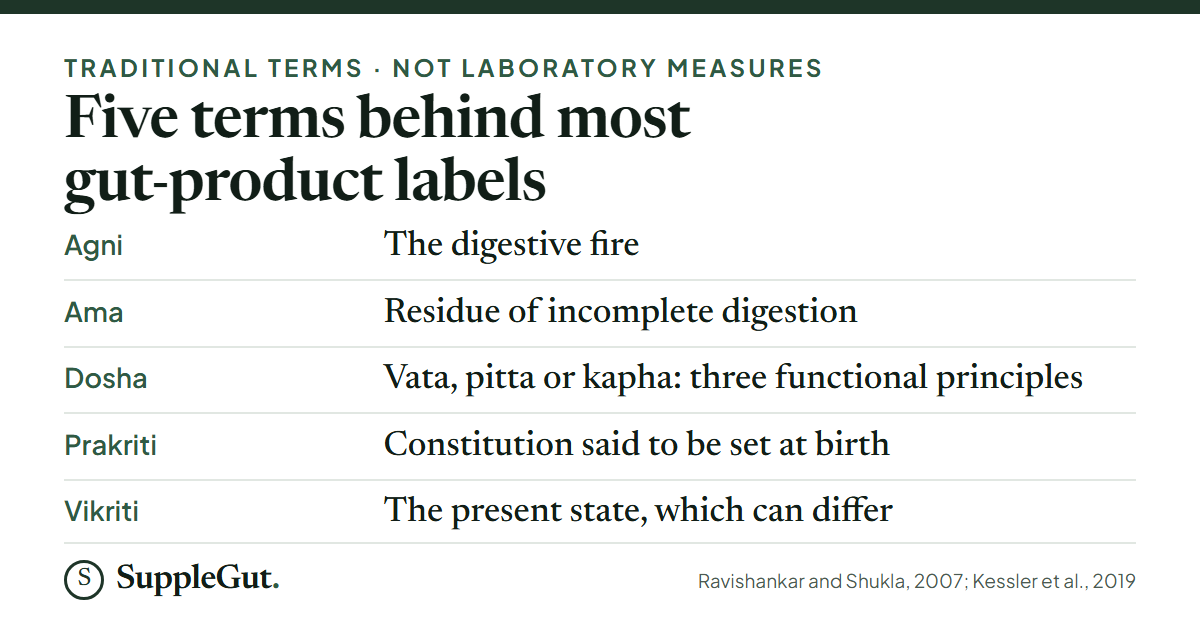
Words from Ayurveda, the traditional medicine of India, now sit on supplement labels in the United States: “for pitta,” “deepana and pachana,” “tridoshic,” “supports agni.” This guide defines the terms the way the tradition uses them, gives the nearest modern idea where one exists without treating the two as the same thing, and then sets out what a buyer can and cannot check about a label that uses them. The wider background is in What is Ayurveda?, and the full set of guides is in the Ayurveda section.
The terms, one by one
Every entry in the middle column is the tradition’s own account. The right-hand column is the closest idea in modern physiology or pharmacy, offered as a loose comparison and not as a translation. In a Berlin study of four Ayurvedic experts examining the same 30 patients, agreement on constitution (prakriti) and digestive fire (agni) was fair to poor, with kappa values between 0 and 0.4 (Kessler et al., 2019), so the concepts do not map cleanly even among practitioners.
| Term | In the tradition | Nearest modern idea (not an equivalent) |
|---|---|---|
| Dosha | One of three functional principles, vata, pitta and kapha, used to describe how the body works and how people differ. | None. Sometimes compared to regulatory systems, but no measurement corresponds. |
| Vata | The principle of movement, tied to air and space, including the movement of food and waste through the gut. | Loosely, nervous-system control and gut motility. |
| Pitta | The principle of transformation, tied to fire and water, including digestion and the heat of metabolism. | Loosely, digestive secretions and metabolism. |
| Kapha | The principle of structure and cohesion, tied to earth and water, including bulk and lubrication. | Loosely, tissue structure and mucus. |
| Agni | The digestive fire that acts on food, said to weaken with irregular meals. | Digestion and metabolism in general; enzymes, stomach acid and gut microbes are the usual comparisons. |
| Ama | A semi-processed residue of digestion that builds up when agni is weak and obstructs the channels. | Loosely, incompletely digested food or fermentation products. No laboratory marker is accepted as ama. |
| Prakriti | A person’s constitution, the mix of doshas said to be set at birth. | Loosely, a phenotype or body type. |
| Vikriti | The present state of the doshas, said to differ from prakriti when something is out of order. | Loosely, the current clinical picture. |
| Srotas | The channels through which doshas, food and waste are said to move. | Loosely, vessels, ducts and the gut lumen; the texts’ channels are not identical to any of them. |
| Rasa | Taste, one of six (sweet, sour, salty, bitter, pungent, astringent), each said to act on the doshas. The same word also names the first body tissue, a nutrient fluid. | Taste perception. No nutrient or compound is a rasa. |
| Virya | A substance’s potency, heating or cooling. | None. |
| Vipaka | The effect a substance is said to have after digestion, classed as sweet, sour or pungent. | Loosely, what a food becomes through metabolism after it is absorbed. |
| Churna | A fine powder of one or more dried herbs, a dosage form. | A powdered herbal supplement. |
| Arishta | A fermented herbal liquid made from a decoction, with a few percent of self-generated alcohol (3 to 10 percent in one review). | A fermented herbal tonic or tincture. |
| Ghrita | Clarified butter cooked with herbs, a fat-based dosage form. | A fat-based herbal extract. |
| Bhasma | An ash of a metal or mineral made by repeated heating, used in the rasa shastra branch. | A mineral or metal compound. |
| Rasa shastra | The branch of practice that combines herbs with metals, minerals and gems. | Metal-based pharmacy; lead, mercury and arsenic exposure is the concern. |
| Panchakarma | Five cleansing procedures; in Charaka’s list, therapeutic emesis, purgation, two kinds of medicated enema and nasal drug administration. | Purgation and enema are the gut-related steps. The word “detox” on a label is a modern term. |
| Dinacharya | The daily routine of waking, meals and sleep, with a seasonal counterpart. | Sleep and meal-timing advice. |
The words as a practitioner uses them
In the tradition a digestive complaint is read through agni and ama. A person with a weak agni is said to digest slowly, feel heavy after meals and form ama; a person with a sharp agni is said to feel hungry often and burn through food. Two verbs on labels come from this reading. Deepana means kindling agni, and pachana means digesting ama. A spice such as ginger or long pepper is classed as deepana. Neither word names a measured effect, and a label that uses them is describing the tradition’s classification of the ingredient.
The tastes (rasa), potency (virya) and post-digestive effect (vipaka) are the three properties a text lists for each food or herb. A pungent herb such as black pepper is classed as heating, while a paper on taste assessment notes that bitter-tasting drugs are described as cold in potency. The practitioner picks ingredients by those properties against the dosha thought to be raised.
How labels use these words
Three patterns recur on product pages.
- A product “for pitta,” “for vata” or “for kapha.” Banyan Botanicals sells a Pitta Digest tablet listing amla, guduchi, cumin, coriander, fennel, celery seed, licorice, cardamom and cinnamon; a Kapha Digest tablet that is trikatu (ginger, black pepper, long pepper) with gum acacia; and a Vata Digest tablet of amla, cumin, black pepper, celery seed, ginger, black cumin, long pepper, mineral salt, fenugreek and asafoetida. The dosha is a naming convention for a blend, and the ingredient list is what a buyer can read.
- “Tridoshic.” This means the tradition regards the ingredient as suitable for all three doshas, as it does triphala. It has no regulatory definition.
- “Deepana and pachana,” “supports agni,” “clears ama.” These describe the tradition’s purpose for the product. In the United States the law puts the burden of evaluating safety and labeling on the firm before it markets a supplement, and the FDA can act against adulterated or misbranded products after they reach the market.
The same blends appear under classical names. Hingvastak churna is a digestive powder led by asafoetida (the overview guide covers the main gut formulas), and amla, bibhitaki and haritaki make up triphala.
What a buyer can and cannot check
Can check. The ingredient list and the Latin names, so that “amla” reads Phyllanthus emblica or Emblica officinalis and not a trade name. The amount per serving on a Supplement Facts panel: Himalaya’s Organic Triphala caplet, for example, prints 438 mg of chebulic myrobalan powder plus 250 mg of triphala extract per caplet, and Organic India’s triphala powder prints 2.5 g of its blend per half teaspoon. Whether a brand publishes a heavy-metal test: Banyan Botanicals prints third-party testing for arsenic, cadmium, lead and mercury on its site, while Himalaya’s page says its products are tested for identity, strength and safety and names no laboratory or metal results.
Cannot check. Whether a dosha label fits the buyer, since there is no standard test for dosha or prakriti and experts disagree on it. Whether deepana, pachana or tridoshic has a defined meaning on that label. And whether the sold product matches what a practitioner would prepare, since classical formulas vary between texts and makers.
Some Ayurvedic preparations include metals, minerals or gems, a branch called rasa shastra. In a survey of 193 products bought online, 40.6% of rasa shastra products contained lead, mercury or arsenic against 17.1% of the others, and 20.7% of all products had them (Saper et al., JAMA, 2008). The FDA says Ayurvedic products typically are not labeled to contain heavy metals. The NCCIH advises people with a health condition, and people who are pregnant or nursing, to talk with a health care provider before using Ayurvedic products.
Where to go next
Ayurveda in the United States and Europe covers practitioners, regulation and the heavy-metal surveys. Does triphala work? and Ayurvedic herbs for digestion: what the trials show cover the evidence, and Are Ayurvedic supplements safe? covers the safety record.
Products researched for this topic
Common questions
What is agni?
Agni is the Ayurvedic term for the digestive fire that acts on food, which the texts say weakens with irregular meals. The nearest modern ideas are digestion and metabolism, with enzymes, stomach acid and gut microbes as the usual comparisons, though none has been shown to be the same thing.
What is ama?
Ama is the semi-processed residue of digestion that the tradition says builds up when agni is weak and obstructs the body’s channels. People sometimes compare it to incompletely digested food or fermentation products, but no laboratory marker is accepted as ama.
What do vata, pitta and kapha mean?
They are the three doshas. In the usual teaching vata is the principle of movement, pitta of transformation and digestion, and kapha of structure and cohesion. Prakriti is the mix a person is said to be born with, and vikriti is the present state.
What does “tridoshic” mean on a label?
It means the tradition regards the ingredient as suitable for all three doshas, as it does for triphala. The term has no regulatory definition, so the ingredient list and amounts are the checkable part of such a label.
What are deepana and pachana?
Deepana means kindling agni and pachana means digesting ama. They are the tradition’s classes for how an ingredient acts, such as ginger as a deepana spice, and neither word names a measured effect.
What is rasa shastra, and why does it come up with heavy metals?
Rasa shastra is the branch of Ayurvedic practice that combines herbs with metals, minerals and gems. In a 2008 survey of 193 products bought online, 40.6% of rasa shastra products had detectable lead, mercury or arsenic against 17.1% of the others.
Can I tell my dosha from a quiz on a product page?
The quizzes compare a person’s answers to the tradition’s descriptions. No standard laboratory test exists for dosha or prakriti, and four Ayurvedic experts examining the same 30 patients agreed only fairly to poorly on prakriti and agni, so a quiz result is the tradition’s category and not a measurement.
Sources
- Ravishankar B, Shukla VJ. “Indian Systems of Medicine: A Brief Profile.” African Journal of Traditional, Complementary and Alternative Medicines, 2007;4(3):319–337. Tridosha, agni, ama, dhatu (rasa as a body tissue). pmc.ncbi.nlm.nih.gov/articles/PMC2816487
- Pushpan R, Nishteswar K. “Rasa Nirdharana (assessment of taste) of Leonotis nepetifolia: a preliminary study in healthy volunteers.” Ancient Science of Life, 2014;33(3):186–191. The six rasas, virya, vipaka. pmc.ncbi.nlm.nih.gov/articles/PMC4264309
- Jadoun A, Dwivedi R. “Effect of selected Samana and Vicitra Pratyayarabdha Dravya with special reference to Vipaka.” Ayu, 2013;34(4):373–378. pmc.ncbi.nlm.nih.gov/articles/PMC3968699
- Chaudhary A, Singh N, Dalvi M, Wele A. “A progressive review of Sandhana kalpana (biomedical fermentation): an advanced innovative dosage form of Ayurveda.” Ayu, 2011. Asava and arishta, alcohol content. pmc.ncbi.nlm.nih.gov/articles/PMC3326893
- “A critical review and significance of lipid-based Ayurvedic dosage forms ghrita and taila: part I.” International Journal of Current Pharmaceutical Research. Sneha kalpana. journals.innovareacademics.in
- Charak Samhita Research, Training and Development Centre. “Panchakarma.” Charak Samhita New Edition. carakasamhitaonline.com/index.php/Panchakarma
- Rao MV, et al. “AYUSHCHARYA 2018: a national conference on Dinacharya and Ritucharya for public health promotion.” Journal of Ayurveda and Integrative Medicine, 2019. PMID 31522839. pubmed.ncbi.nlm.nih.gov/31522839
- Kessler CS, et al. “Reliability of Ayurvedic Diagnosis for Knee Osteoarthritis Patients: A Nested Diagnostic Study Within a Randomized Controlled Trial.” Journal of Alternative and Complementary Medicine, 2019. PMID 30653338. pubmed.ncbi.nlm.nih.gov/30653338
- Saper RB, et al. “Lead, mercury, and arsenic in US- and Indian-manufactured Ayurvedic medicines sold via the Internet.” JAMA, 2008;300(8):915–923. PMID 18728265. pubmed.ncbi.nlm.nih.gov/18728265
- FDA. Dietary supplements overview (DSHEA responsibilities of firms and FDA authority after marketing). fda.gov/food/dietary-supplements; and “FDA warns about heavy metal poisoning associated with certain unapproved Ayurvedic drug products.” fda.gov
- NCCIH. “Ayurvedic Medicine: In Depth.” nccih.nih.gov/health/ayurvedic-medicine-in-depth
- Brand pages: Banyan Botanicals Pitta Digest, Kapha Digest and Vata Digest tablets and quality testing page (banyanbotanicals.com); Himalaya Organic Triphala (himalayausa.com); Organic India Triphala powder Supplement Facts (vitacost.com).
Still deciding between products?
The guide gives the background. For a single answer, the quiz asks about your symptoms, your routine and what you have tried, then names one product.
Take the quiz →