Guide
Ayurvedic herbs for digestion: what the human trials show, herb by herb
Quick answer
Which Ayurvedic herbs have human trials for digestion? Of eleven herbs checked, eight have at least one placebo-controlled gut trial: ginger, turmeric, licorice, fennel, asafoetida, amla, psyllium and aloe. Psyllium has the most, with 16 constipation trials in 1,251 adults. Cumin has only a 57-person case series. Ashwagandha has placebo-controlled stress trials but none for the gut, and long pepper and its trikatu mix have none.
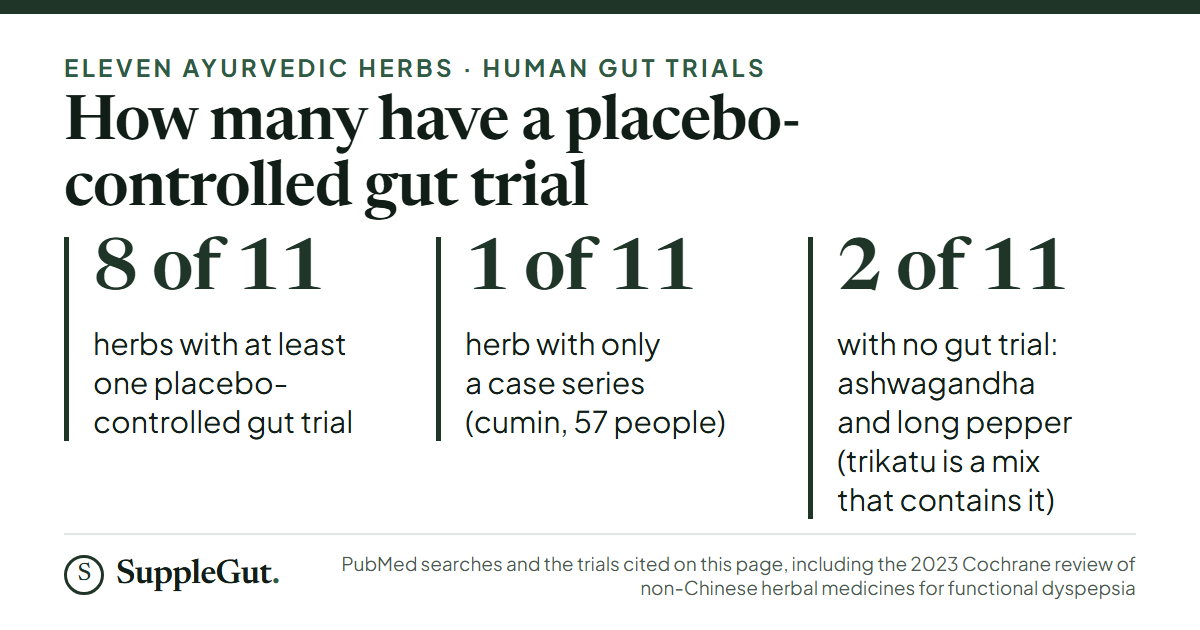
Ayurveda uses dozens of herbs for the gut, and a handful of them appear again and again on supplement labels. This page takes eleven of them one at a time and sets out what the human trials show: who was enrolled, the dose, the result, and whether there was a placebo. Each herb falls into one of three tiers: at least one placebo-controlled gut trial, only a pilot or case series with no control group, or no gut trial at all.
The trials at a glance
| Herb | Gut outcome tested | Design and headline number | Tier |
|---|---|---|---|
| Ginger | Nausea | 12 trials, 1,278 pregnant women; nausea improved (mean difference 1.20) | Placebo-controlled |
| Turmeric | Ulcerative colitis | 89 people: relapse 4.65% against 20.51%; 50 people: remission 53.8% against 0% | Placebo-controlled |
| Licorice | Dyspepsia | 75 mg of an extract twice a day for 30 days beat placebo on symptom scores | Placebo-controlled |
| Fennel | Infant colic; IBS with curcumin | 125 infants: 65% against 23.7%; 121 adults: score down 50% against 26% | Placebo-controlled |
| Cumin | IBS | 57 people on 20 drops a day of oil; no control group | Case series only |
| Asafoetida | Dyspepsia | 62 people, 250 mg a day for 14 days; no IBS trial found | Placebo-controlled |
| Amla | Reflux | 68 people, 2 g a day for 4 weeks; no dyspepsia trial found | Placebo-controlled |
| Psyllium | Constipation, IBS | 16 trials, 1,251 adults: 66% responding against 41% | Placebo-controlled, many |
| Aloe | IBS | 3 trials, 151 people; results mixed | Placebo-controlled |
| Ashwagandha | None for the gut | 12 stress trials, 1,002 people | No gut trial |
| Long pepper and the trikatu mix | None | Piperine pharmacokinetics only | No gut trial |
Ginger
Ginger has the most nausea data. A meta-analysis of 12 randomized trials in 1,278 pregnant women, mostly at 1 to 1.5 g a day, found nausea improved against placebo (mean difference 1.20, 95% CI 0.56 to 1.84), while the fall in vomiting did not reach significance (p = 0.06). In chemotherapy, 10 trials at 0.5 to 2.0 g a day gave an odds ratio of 0.71 for nausea and vomiting overall. For dyspepsia, an 11-person crossover found 1.2 g shortened gastric half-emptying from 16.1 to 12.3 minutes with symptoms unchanged, and in a 45-person IBS pilot 1 g and 2 g a day did not beat placebo (46.7% and 33.3% responding against 57.1%).
Turmeric
Turmeric has two kinds of trial. In irritable bowel syndrome, 207 volunteers screened by the Rome II criteria took one or two tablets of a standardized extract daily for eight weeks, and IBS prevalence fell by 53% and 60%; the pilot had no placebo group. In ulcerative colitis, 89 people in remission took 2 g a day of curcumin with their usual drug for six months, and 2 of 43 relapsed (4.65%) against 8 of 39 (20.51%) on placebo (p = 0.040). In 50 people with active disease despite mesalamine, 3 g a day for a month produced clinical remission in 14 of 26 (53.8%) against none on placebo. A 2018 meta-analysis of three trials found the remission odds ratio of 4.33 (95% CI 0.78 to 24.00) not significant on an intention-to-treat basis. The Cochrane review of non-Chinese herbal medicines for functional dyspepsia lists Curcuma longa with a moderate improvement in global symptoms (mean difference −3.33, 2 studies, 110 participants). The catalog’s curcumin entry is Thorne Meriva.
Licorice
Licorice has one kind of gut trial and one well-documented hazard. A licorice extract sold as GutGard, 75 mg twice a day for 30 days, lowered total dyspepsia symptom scores against placebo on days 15 and 30 (p ≤ 0.05). The Cochrane review lists one licorice study of 50 participants, with a standardized mean difference of −1.86 and moderate certainty. The hazard is glycyrrhizin: a meta-analysis of 18 studies of products with at least 100 mg of glycyrrhizic acid a day found systolic pressure up 5.45 mmHg (95% CI 3.51 to 7.39), diastolic up 3.19 mmHg and plasma potassium down. NCCIH states that products with glycyrrhizin removed might be safe for up to four months.
Fennel
Fennel has a trial in babies and one in adults. In 125 infants with colic aged 2 to 12 weeks, fennel seed oil emulsion ended colic by the Wessel criteria in 65% (40 of 62) against 23.7% (14 of 59) on placebo, a number needed to treat of 2. In 121 adults with mild to moderate IBS, two capsules twice a day of curcumin with fennel essential oil for 30 days cut the IBS severity score by 50.05% against 26.12% on placebo, and 25.9% were symptom-free against 6.8%. The adult trial tested the combination, so it cannot separate fennel from curcumin, and we found no trial of fennel alone in IBS.
Cumin
Cumin rests on one case series. Fifty-seven people with IBS stopped other treatments and took 20 drops a day of cumin essential oil; abdominal pain, bloating, incomplete evacuation, urgency and mucus fell, and stool form and frequency improved in the constipation-predominant group. With no control group, the study shows what happened to the people who took it, not what cumin caused.
Asafoetida
Asafoetida, or hing, has no IBS trial that we could find, but it has dyspepsia trials. In 62 people with functional dyspepsia symptoms, 250 mg a day of a self-emulsifying oleo-gum resin formulation for 14 days improved early satiety, bloating and heartburn against placebo; the formulation’s makers employ several of the authors. The Cochrane review lists one asafoetida study of 43 participants (standardized mean difference −1.51, low certainty).
Amla
Amla has a reflux trial and no dyspepsia trial that we could find. In 68 people with non-erosive reflux, two 500 mg tablets twice a day for four weeks reduced heartburn and regurgitation frequency and severity more than placebo (p < 0.001), though both groups improved. Amla is also one of the three fruits in triphala, whose own gut evidence is thinner.
Psyllium
Psyllium, ispaghula or isabgol in India, has the most trials. In chronic constipation, 16 randomized trials of fiber in 1,251 adults found 66% responding against 41% on control (relative risk 1.48), with psyllium among the types that worked and the effect clearest above 10 g a day over at least four weeks; flatulence was higher on fiber. In IBS, a 2008 meta-analysis of 12 fiber studies in 591 patients found the benefit limited to ispaghula (relative risk of persistent symptoms 0.78, 95% CI 0.63 to 0.96), and a 2026 meta-analysis of 30 trials in 1,904 people found psyllium specifically gave a risk ratio of 1.53 (95% CI 1.06 to 2.19). See how long psyllium takes.
Aloe
Aloe has three placebo-controlled IBS trials with mixed results. In 58 patients, 35% on aloe and 22% on placebo responded at one month (p = 0.763). In 110 patients randomized to a 60 mL dose twice a day, only 47 completed both arms of the crossover, and quality of life did not differ. In 68 patients on a standardized extract for four weeks, 55% responded against 31% (p = 0.09). A 2018 meta-analysis of the three, 151 patients, found a standardized mean difference of 0.41 (95% CI 0.07 to 0.75), while a 2026 meta-analysis gave a risk ratio of 1.25 (95% CI 0.76 to 2.06). The gel is the inner leaf; the latex, from the outer layer, causes abdominal pain, cramps and diarrhea, and in 2002 the FDA required it removed from over-the-counter laxatives.
Ashwagandha
Ashwagandha has stress trials and no gut trial that we could find; a PubMed search for it with IBS returned only a computer-modeling paper. A meta-analysis of 12 randomized trials in 1,002 adults found lower stress (standardized mean difference −1.75) and anxiety (−1.55) against placebo, with low-certainty evidence and high heterogeneity, and a dose-response effect on stress at 300 to 600 mg a day. Whether that carries to the gut is untested; the stress and gut guide covers the link. Its liver-injury reports are in the safety guide.
Long pepper and trikatu
Long pepper and the three-pungent mix trikatu (black pepper, long pepper and ginger) have no human gut trial that we could find. What exists is piperine pharmacokinetics: with 20 mg of piperine, serum levels of 2 g of curcumin in healthy volunteers rose from near undetectable, a 2,000% increase in bioavailability. A 1992 review suggested the tradition’s use of trikatu may reflect that bioavailability effect on co-administered medicines.
How the tiers read
Eight of the eleven have a placebo-controlled gut trial, but the trials differ in size and outcome: psyllium, ginger for nausea and turmeric in colitis rest on several trials or reviews, while licorice, asafoetida and amla rest on one or two. Cumin is a case series, and ashwagandha and long pepper (with the trikatu mix) have no gut trial. One Ayurvedic mix of curry leaf, pomegranate and turmeric did no better than placebo in 32 people with diarrhea-predominant IBS. Where the system comes from is in what Ayurveda is and key concepts for the gut; how these herbs are sold in the West is in Ayurveda in the West; the full section is at Ayurveda for the gut.
These are trials of specific preparations at specific doses, and a trial of one extract does not carry to every capsule or powder with the same herb on the label. Safety findings, from heavy metals to liver injury and drug interactions, are in Are Ayurvedic supplements safe?
The entries this page refers to
Common questions
Which Ayurvedic herbs have the strongest trial evidence for digestion?
Psyllium (isabgol) has the most: 16 trials of fiber in 1,251 adults with chronic constipation found 66% responding against 41% on control, and a 2026 meta-analysis found psyllium specifically gave a risk ratio of 1.53 in IBS. Ginger has several meta-analyses for nausea, and curcumin from turmeric has two placebo-controlled ulcerative colitis trials. See how long psyllium takes.
Do any Ayurvedic herbs help irritable bowel syndrome?
Psyllium has the clearest IBS data. Aloe is mixed, with a 2018 meta-analysis of three trials (151 patients) positive and a 2026 meta-analysis (risk ratio 1.25, 95% CI 0.76 to 2.06) not significant. Curcumin with fennel oil beat placebo in 121 adults, cumin has only a 57-person case series, and a curry leaf, pomegranate and turmeric preparation did no better than placebo in 32 people with diarrhea-predominant IBS.
What do the turmeric ulcerative colitis trials show?
In 89 people in remission, 2 g a day of curcumin with usual treatment gave relapse in 4.65% against 20.51% on placebo over six months. In 50 people with active disease despite mesalamine, 3 g a day for a month gave remission in 53.8% against none. A meta-analysis of three trials found the remission odds ratio of 4.33 not significant on an intention-to-treat basis (95% CI 0.78 to 24.00).
Is licorice for digestion different from licorice root?
Products with the glycyrrhizin removed are the ones NCCIH says might be safe for up to four months. A meta-analysis of 18 studies of products with at least 100 mg of glycyrrhizic acid a day found systolic pressure up 5.45 mmHg and plasma potassium down. The one extract trial for dyspepsia, GutGard at 75 mg twice a day for 30 days, lowered symptom scores against placebo.
Do ashwagandha and long pepper have gut trials?
We found none. Ashwagandha has 12 placebo-controlled stress trials in 1,002 adults, and long pepper and trikatu have piperine pharmacokinetics, where 20 mg of piperine raised curcumin bioavailability by 2,000% in healthy volunteers. Both are used by the tradition for digestion, but the trials measure other outcomes.
What is the difference between aloe gel and aloe latex?
The gel comes from the inner leaf and the latex from the outer layer. NCCIH says oral latex can cause abdominal pain, cramps and diarrhea, and that in 2002 the FDA required aloe latex removed from over-the-counter laxatives. The IBS trials above used gel or a standardized extract, not latex.
Sources
- Viljoen E, Visser J, Koen N, Musekiwa A. “A systematic review and meta-analysis of the effect and safety of ginger in the treatment of pregnancy-associated nausea and vomiting.” Nutrition Journal, 2014;13:20. PMID 24642205. pubmed.ncbi.nlm.nih.gov/24642205
- Chang WP, Peng YX. “Does the Oral Administration of Ginger Reduce Chemotherapy-Induced Nausea and Vomiting?: A Meta-analysis of 10 Randomized Controlled Trials.” Cancer Nursing, 2019;42(6):E14–E23. PMID 30299420. pubmed.ncbi.nlm.nih.gov/30299420
- Hu ML, Rayner CK, Wu KL, et al. “Effect of ginger on gastric motility and symptoms of functional dyspepsia.” World Journal of Gastroenterology, 2011;17(1):105–110. PMID 21218090. pubmed.ncbi.nlm.nih.gov/21218090
- van Tilburg MA, Palsson OS, Ringel Y, Whitehead WE. “Is ginger effective for the treatment of irritable bowel syndrome? A double blind randomized controlled pilot trial.” Complementary Therapies in Medicine, 2014;22(1):17–20. PMID 24559811. pubmed.ncbi.nlm.nih.gov/24559811
- Bundy R, Walker AF, Middleton RW, Booth J. “Turmeric extract may improve irritable bowel syndrome symptomology in otherwise healthy adults: a pilot study.” Journal of Alternative and Complementary Medicine, 2004;10(6):1015–1018. PMID 15673996. pubmed.ncbi.nlm.nih.gov/15673996
- Hanai H, Iida T, Takeuchi K, et al. “Curcumin maintenance therapy for ulcerative colitis: randomized, multicenter, double-blind, placebo-controlled trial.” Clinical Gastroenterology and Hepatology, 2006;4(12):1502–1506. PMID 17101300. pubmed.ncbi.nlm.nih.gov/17101300
- Lang A, Salomon N, Wu JC, et al. “Curcumin in Combination With Mesalamine Induces Remission in Patients With Mild-to-Moderate Ulcerative Colitis in a Randomized Controlled Trial.” Clinical Gastroenterology and Hepatology, 2015;13(8):1444–1449. PMID 25724700. pubmed.ncbi.nlm.nih.gov/25724700
- Grammatikopoulou MG, Gkiouras K, Theodoridis X, et al. “Oral Adjuvant Curcumin Therapy for Attaining Clinical Remission in Ulcerative Colitis: A Systematic Review and Meta-Analysis of Randomized Controlled Trials.” Nutrients, 2018;10(11):1737. PMID 30424514. pubmed.ncbi.nlm.nih.gov/30424514
- Báez G, Vargas C, Arancibia M, Papuzinski C, Franco JV. “Non-Chinese herbal medicines for functional dyspepsia.” Cochrane Database of Systematic Reviews, 2023;6:CD013323. PMID 37323050. pubmed.ncbi.nlm.nih.gov/37323050
- Raveendra KR, Jayachandra, Srinivasa V, et al. “An Extract of Glycyrrhiza glabra (GutGard) Alleviates Symptoms of Functional Dyspepsia: A Randomized, Double-Blind, Placebo-Controlled Study.” Evidence-Based Complementary and Alternative Medicine, 2012;2012:216970. PMID 21747893. pubmed.ncbi.nlm.nih.gov/21747893
- Penninkilampi R, Eslick EM, Eslick GD. “The association between consistent licorice ingestion, hypertension and hypokalaemia: a systematic review and meta-analysis.” Journal of Human Hypertension, 2017;31(11):699–707. PMID 28660884. pubmed.ncbi.nlm.nih.gov/28660884
- NCCIH. Licorice root: safety, glycyrrhizin and deglycyrrhizinated products. nccih.nih.gov/health/licorice-root
- Alexandrovich I, Rakovitskaya O, Kolmo E, Sidorova T, Shushunov S. “The effect of fennel (Foeniculum vulgare) seed oil emulsion in infantile colic: a randomized, placebo-controlled study.” Alternative Therapies in Health and Medicine, 2003;9(4):58–61. PMID 12868253. pubmed.ncbi.nlm.nih.gov/12868253
- Portincasa P, Bonfrate L, Scribano ML, et al. “Curcumin and Fennel Essential Oil Improve Symptoms and Quality of Life in Patients with Irritable Bowel Syndrome.” Journal of Gastrointestinal and Liver Diseases, 2016;25(2):151–157. PMID 27308645. pubmed.ncbi.nlm.nih.gov/27308645
- Agah S, Taleb AM, Moeini R, Gorji N, Nikbakht H. “Cumin extract for symptom control in patients with irritable bowel syndrome: a case series.” Middle East Journal of Digestive Diseases, 2013;5(4):217–222. PMID 24829694. pubmed.ncbi.nlm.nih.gov/24829694
- Das SS, Rm V, Aneesa PA, et al. “Ferula asafoetida oleo-gum resin alleviates dyspepsia symptoms through modulation of microbiome-gut-brain axis: A randomized, double-blind, placebo-controlled study.” Medicine (Baltimore), 2025;104(40):e44590. PMID 41054174. pubmed.ncbi.nlm.nih.gov/41054174
- Karkon Varnosfaderani S, Hashem-Dabaghian F, Amin G, et al. “Efficacy and safety of Amla (Phyllanthus emblica L.) in non-erosive reflux disease: a double-blind, randomized, placebo-controlled clinical trial.” Journal of Integrative Medicine, 2018;16(2):126–131. PMID 29526236. pubmed.ncbi.nlm.nih.gov/29526236
- van der Schoot A, Drysdale C, Whelan K, Dimidi E. “The Effect of Fiber Supplementation on Chronic Constipation in Adults: An Updated Systematic Review and Meta-Analysis of Randomized Controlled Trials.” American Journal of Clinical Nutrition, 2022;116(4):953–969. PMID 35816465. pubmed.ncbi.nlm.nih.gov/35816465
- Ford AC, Talley NJ, Spiegel BM, et al. “Effect of fibre, antispasmodics, and peppermint oil in the treatment of irritable bowel syndrome: systematic review and meta-analysis.” BMJ, 2008;337:a2313. PMID 19008265. pubmed.ncbi.nlm.nih.gov/19008265
- Staudacher HM, Rucco V, Mancell S, Dimidi E, Whelan K. “Fiber Supplementation in Irritable Bowel Syndrome: A Systematic Review and Meta-Analysis of Randomized Controlled Trials.” Gastroenterology, 2026. PMID 42600900. pubmed.ncbi.nlm.nih.gov/42600900
- Davis K, Philpott S, Kumar D, Mendall M. “Randomised double-blind placebo-controlled trial of aloe vera for irritable bowel syndrome.” International Journal of Clinical Practice, 2006;60(9):1080–1086. PMID 16749917. pubmed.ncbi.nlm.nih.gov/16749917
- Hutchings HA, Wareham K, Baxter JN, et al. “A Randomised, Cross-Over, Placebo-Controlled Study of Aloe vera in Patients with Irritable Bowel Syndrome: Effects on Patient Quality of Life.” ISRN Gastroenterology, 2011;2011:206103. PMID 21991499. pubmed.ncbi.nlm.nih.gov/21991499
- Størsrud S, Pontén I, Simrén M. “A Pilot Study of the Effect of Aloe barbadensis Mill. Extract (AVH200) in Patients with Irritable Bowel Syndrome: a Randomized, Double-Blind, Placebo-Controlled Study.” Journal of Gastrointestinal and Liver Diseases, 2015;24(3):275–280. PMID 26405698. pubmed.ncbi.nlm.nih.gov/26405698
- Hong SW, Chun J, Park S, et al. “Aloe vera Is Effective and Safe in Short-term Treatment of Irritable Bowel Syndrome: A Systematic Review and Meta-analysis.” Journal of Neurogastroenterology and Motility, 2018;24(4):528–535. PMID 30153721. pubmed.ncbi.nlm.nih.gov/30153721
- Meyer A, Auer J, Cascant-Ortolano L, et al. “Systematic Review and Meta-Analysis: Plant-Based Therapy for Irritable Bowel Syndrome.” Phytotherapy Research, 2026;40(10):5918–5950. PMID 42572206. pubmed.ncbi.nlm.nih.gov/42572206
- NCCIH. Aloe vera: gel, latex, the 2002 FDA ruling and oral safety. nccih.nih.gov/health/aloe-vera
- Akhgarjand C, Asoudeh F, Bagheri A, et al. “Does Ashwagandha supplementation have a beneficial effect on the management of anxiety and stress? A systematic review and meta-analysis of randomized controlled trials.” Phytotherapy Research, 2022;36(11):4115–4124. PMID 36017529. pubmed.ncbi.nlm.nih.gov/36017529
- Shoba G, Joy D, Joseph T, et al. “Influence of piperine on the pharmacokinetics of curcumin in animals and human volunteers.” Planta Medica, 1998;64(4):353–356. PMID 9619120. pubmed.ncbi.nlm.nih.gov/9619120
- Johri RK, Zutshi U. “An Ayurvedic formulation ‘Trikatu’ and its constituents.” Journal of Ethnopharmacology, 1992;37(2):85–91. PMID 1434692. pubmed.ncbi.nlm.nih.gov/1434692
- Lauche R, Kumar S, Hallmann J, et al. “Efficacy and safety of Ayurvedic herbs in diarrhoea-predominant irritable bowel syndrome: A randomised controlled crossover trial.” Complementary Therapies in Medicine, 2016;26:171–177. PMID 27261998. pubmed.ncbi.nlm.nih.gov/27261998
Want this narrowed to one product?
Reading is one thing, choosing is another. Answer the quiz and it weighs your own symptoms and routine and picks one product.
Take the quiz →