
Guide
Digestive enzymes vs probiotics: which one for bloating after meals?
Bloating after meals sends people to two different shelves. One holds digestive enzymes, which break food down in the hour after you eat it. The other holds probiotics, which are meant to change what lives in the gut over weeks. They are not competing answers to the same question; they answer different questions, and the way to choose is to ask which question is yours.
Quick answer
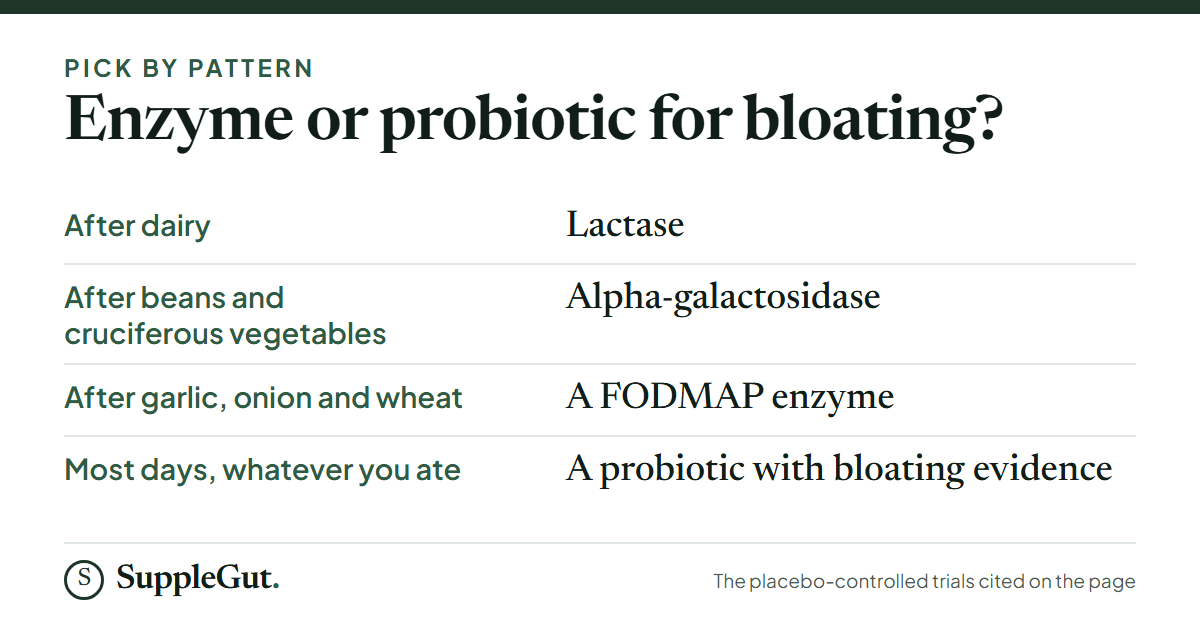
If the bloating follows particular foods, an enzyme matched to the food. Lactase for dairy, alpha-galactosidase for beans and cruciferous vegetables, a FODMAP enzyme for garlic, onion and wheat fructans. Taken with the meal, it works the same day or it does not work at all, and you will know.
If the bloating is there most days regardless of what you ate, a probiotic with bloating evidence. Bacillus coagulans is the only strain that reached significance for bloating in a 2022 analysis of IBS trials; B. infantis 35624 (Align) ranked second; the 24-strain DS-01 formula has its own 350-person trial. Give any of them four to six weeks.
How each one works, and why that decides it
An enzyme is a tool with one job. Lactase splits lactose; alpha-galactosidase splits the sugars in beans that human enzymes cannot; the enzymes in a FODMAP blend split fructans. When the sugar is split before it reaches the colon, the bacteria there have nothing to ferment, and fermentation is where the gas comes from. The enzyme has to be in the stomach at the same time as the food, which is why the label timing matters and why a capsule taken after the meal does little.
A probiotic is a population change. The idea is that adding a strain shifts what the resident bacteria do with whatever arrives, so that the same meal produces less gas, or that the gut wall becomes less sensitive to the stretch. That takes time, it is strain-specific, and it does not depend on which food you ate. So the first question is not “which is better” but “does my bloating have a food behind it?” If it does, the enzyme is the direct fix. If it does not, the enzyme has nothing to act on.
What the enzyme trials show
Lactase, for dairy. A placebo-controlled crossover trial gave three 4,500-unit lactase tablets before a lactose load and cut breath hydrogen — the direct measure of fermentation — by 55%, with fewer symptoms. Lactaid Fast Act Caplets supplies 9,000 units per caplet, more than the trial dose, at $0.20 a day when used.
Alpha-galactosidase, for beans and cruciferous vegetables. The 1994 “Does Beano prevent gas?” crossover trial fed 19 adults a meatless chili and found significantly less flatus with 240 units of the enzyme. A 2007 trial found 1,200 units, but not 300, cut both breath hydrogen and flatulence severity against placebo after a bean-heavy meal. A 2013 randomized, double-blind trial in children with gas-related symptoms found the enzyme reduced them against placebo. The dose matters: the effective figure in adults was the higher one.
FODMAP enzymes, for garlic, onion and wheat fructans. FODZYME FODMAP Enzyme Blend (Home Kit) broke down about 90% of a 3 g inulin dose within 30 minutes in laboratory work, which is real mechanistic support. In people, a 2026 study of 118 analyzed customers found 78% reported bloating and flatulence improving by more than 30% over four weeks — but those were self-selected buyers with no placebo and roughly 89% of sign-ups dropped out before analysis. Clinically studied; not clinically proven. It costs $1.27 per meal.
General multi-enzyme blends, for heavy meals. A randomized, double-blind, placebo-controlled trial gave a proprietary multi-enzyme complex to 40 people with functional dyspepsia for 60 days and found improvements in fullness, early satiety, bloating and belching that the placebo group did not show. It is one small trial of one blend. NOW Foods Super Enzymes is a different blend — pancreatin, ox bile and betaine HCl — with no trial of its own, and the betaine HCl makes it the wrong choice for anyone with heartburn or reflux.
What none of the enzyme trials show is an effect on bloating that has no food behind it. Every positive result above is an enzyme meeting the food it was made for. A broad-spectrum enzyme capsule taken for daily bloating with no trigger has no trial evidence, and the mechanism gives no reason to expect one.
What the probiotic trials show
The largest analysis is a 2022 network meta-analysis of 43 randomized trials in 5,531 people with IBS. Thirteen of those trials measured bloating. Only one organism reached statistical significance against placebo for it: Bacillus coagulans, with a large effect (standardized mean difference −1.42). B. infantis 35624, the strain in Align, ranked second; L. acidophilus third; L. plantarum last. Treatment length and dose did not change the bloating result, which fits the broader finding that probiotic dose-response is outcome-specific and absent for IBS-type symptoms.
Two product-level trials add to that. The FLORAVIE trial gave Align’s strain to 233 adults with IBS for 30 days and cut the IBS Symptom Severity Score from 303 to 208; bloating is one component of that score, not the whole of it. And a company-funded randomized trial gave Seed DS-01 Daily Synbiotic to 350 adults with chronic bloating for six weeks and found bloating, gas and discomfort scores improved against placebo. It is the one trial in this field that recruited people for bloating specifically, with the caveats that 131 of the 350 had dropped out by week six and nobody has repeated it.
| Approach | Best evidence for bloating | Time to judge | Where it fails |
|---|---|---|---|
| Lactase | Placebo-controlled crossover: breath hydrogen −55% after lactose | Same meal | Bloating not caused by dairy |
| Alpha-galactosidase | Two adult crossover trials (1994, 2007) and one pediatric RCT (2013); 1,200 units effective, 300 not | Same meal | Bloating not caused by beans, lentils or brassicas |
| FODMAP enzyme blend | Laboratory breakdown of inulin; a 118-customer study with no placebo | Same meal | Bloating not caused by fructans; no controlled trial yet |
| General multi-enzyme | One 40-person placebo-controlled trial of one blend in functional dyspepsia | Weeks | The blend you buy is probably not the one tested |
| Probiotic, B. coagulans | Only organism significant for bloating in the 2022 network meta-analysis | 4–6 weeks | Products vary; the studied strains are MTCC 5856 and Unique IS2 |
| Probiotic, B. infantis 35624 (Align) | Ranked second for bloating; FLORAVIE 233-person IBS trial | 4 weeks | Contains milk; bloating measured as part of IBS severity, not alone |
| Synbiotic, DS-01 (Seed) | 350-person company-funded trial recruited for bloating | 6 weeks | Not independently repeated; $2 a day |
How to decide, in order
- Find the food first. Two weeks of noting what you ate before the bad evenings usually answers it. Dairy, beans, garlic and onion, wheat and large fatty meals are the usual suspects.
- If there is a food, match the enzyme to it and take it with the first bite. Lactase for dairy; alpha-galactosidase at the higher dose for beans and brassicas; a FODMAP blend for garlic, onion and wheat. Judge it that evening.
- If there is no food pattern, choose a probiotic with a bloating result — B. coagulans, B. infantis 35624 or DS-01 — and give it four to six weeks before deciding. Check the strain designation on the label; the species name alone is not enough.
- If the bloating comes with constipation, neither is the first step. Fiber is; see constipation treatments with strong evidence.
- If it comes with heartburn, avoid enzyme blends containing betaine HCl, which adds acid.
Products in this catalog
Common questions
Should I take a digestive enzyme or a probiotic for bloating?
If the bloating follows particular foods — dairy, beans, garlic and onion, wheat — an enzyme matched to that food, taken with it, is the direct fix and works the same day. If it is there most days regardless of what you ate, an enzyme has nothing to act on, and a probiotic with bloating evidence (B. coagulans, B. infantis 35624, or the DS-01 formula) is the better bet, judged after four to six weeks.
Do digestive enzymes help with bloating?
Specific ones do, for specific foods. Lactase cut breath hydrogen by 55% after a lactose load in a placebo-controlled crossover trial. Alpha-galactosidase at 1,200 units reduced gas and flatulence after a bean-heavy meal against placebo in adults, and reduced gas symptoms in a randomized trial in children. A general multi-enzyme blend improved functional dyspepsia scores in a 40-person trial. A broad-spectrum enzyme capsule for bloating with no food trigger has no such evidence.
Do probiotics help with bloating?
Some strains, modestly. A 2022 network meta-analysis of 43 IBS trials in 5,531 patients found that among 13 trials measuring bloating, only Bacillus coagulans reached significance against placebo, with B. infantis 35624 ranking second. A separate company-funded trial of the 24-strain DS-01 formula in 350 adults with chronic bloating found improvement against placebo at six weeks.
Can I take digestive enzymes and probiotics together?
Yes; they do different jobs and there is no interaction between them. Take the enzyme with the meal it is for and the probiotic at whatever time you will remember. Start one before the other so you can tell which is helping.
How long do enzymes and probiotics take to work for bloating?
An enzyme works on the meal you take it with, so you know within a day. A probiotic is judged over four to six weeks, which is the length of the trials that found an effect.
Sources
- Ganiats TG et al. “Does Beano prevent gas? A double-blind crossover study of oral alpha-galactosidase to treat dietary oligosaccharide intolerance.” J Fam Pract, 1994;39(5):441–445. mdedge.com (PDF)
- Di Stefano M et al. “The effect of oral alpha-galactosidase on intestinal gas production and gas-related symptoms.” Dig Dis Sci, 2007;52(1):78–83. link.springer.com
- Di Nardo G et al. “Efficacy and tolerability of alpha-galactosidase in treating gas-related symptoms in children: a randomized, double-blind, placebo controlled trial.” BMC Gastroenterol, 2013;13:142. pmc.ncbi.nlm.nih.gov/PMC3849317
- Majeed M et al. “Evaluation of the safety and efficacy of a multienzyme complex in patients with functional dyspepsia: a randomized, double-blind, placebo-controlled study.” J Med Food, 2018;21(11):1120–1128. pmc.ncbi.nlm.nih.gov/PMC6249666
- Zhang T et al. “Efficacy of probiotics for irritable bowel syndrome: a systematic review and network meta-analysis.” Front Cell Infect Microbiol, 2022;12:859967. pmc.ncbi.nlm.nih.gov/PMC9010660
- Ouwehand AC. “A review of dose-responses of probiotics in human studies.” Benef Microbes, 2017;8(2):143–151. pubmed.ncbi.nlm.nih.gov/28008787
- Seed DS-01 randomized trial registration, NCT06009614; results summarized on our DS-01 guide. clinicaltrials.gov
- Lactase trial, FODZYME laboratory and customer data, FLORAVIE trial: see the research sections of the Lactaid, FODZYME and Align product pages, where each is sourced.
Not sure which product fits your situation?
This guide covers the mechanics. The quiz takes your specific symptoms, routine and preferences and matches you to one product from the catalog.
Take the quiz →