Guide
Does Banyan Botanicals Triphala work? A 1,000 mg fruit blend, one or two tablets, and what the trials used
Quick answer
Does Banyan Botanicals Triphala work? No trial tested this tablet, and we found no randomized trial of triphala alone for constipation. The one placebo-controlled pilot used 2,000 mg a day in 31 healthy adults and found no consistent change in gut bacteria; the label here gives 500 to 1,000 mg a day. Amazon shows 4.6 from 2,123 ratings, and 241 of the 295 reviewers who mention effectiveness are positive. Banyan states testing for arsenic, cadmium, lead and mercury but names no lab and posts no certificate.
Banyan Botanicals sells triphala as a 90 or 180 count tablet, and two tablets hold a 1,000 mg organic blend of amla, bibhitaki and haritaki fruit. Among the triphala tablets we read, it is the one whose page states metal testing and speaks in the vocabulary of Ayurveda, the traditional medicine of India.
What the Supplement Facts panel prints
The serving is two tablets, with 45 servings in the 90 count bottle and 90 in the 180 count. The panel reads “Organic Triphala Fruit Blend 1000 mg” and lists amla (Phyllanthus emblica), bibhitaki (Terminalia bellirica) and haritaki (Terminalia chebula), each marked certified organic and Fair for Life. The blend weight is printed and the three fruits are not dosed one by one. Banyan’s page says the formula is “equally composed of three dried fruits,” which would put each near a third of the 1,000 mg, though no per-fruit number appears on the label.
The only other ingredient is organic gum acacia. Each tablet is 500 mg of whole dried fruit powder, so the panel shows no extract, no extract ratio and no marker such as tannin or vitamin C. It names Latin binomials for all three fruits, which is the detail a buyer needs to match the product to the herb pages on this site, and it lists no mineral or metal preparation of the kind the tradition calls bhasma.
The tradition behind the formula, in Banyan’s words
“Triphala” means three fruits. Banyan calls it perhaps the most beloved formula in Ayurvedic medicine and says it is traditionally considered a rasayana, a class of rejuvenative preparations. It says the tablets gently stimulate agni, the digestive fire, which Ayurveda describes as the capacity to digest food and turn it into tissue, while supporting regular elimination.
The page then uses the dosha framework: it calls triphala tridoshic, says haritaki balances vata, amla balances pitta and bibhitaki balances kapha, and lists the formula’s taste (all five), action (neutral) and post-digestive effect (sweet). Those are the tradition’s own categories for describing a body and a herb. We found no trial that measured a dosha, and the statements are best read as Ayurveda’s vocabulary, not a measured effect. One three-star reviewer on Banyan’s page wrote that pitta symptoms increased after taking it, which shows readers testing the framework against their own experience.
The testing statement, and what it does and does not show
Banyan’s quality control page says its herbs and products are tested for arsenic, cadmium, lead and mercury by independent third party laboratories, and that they sit within the limits of the ANSI 173 dietary supplement standard and AHPA guidelines. It also describes microbiological testing and identification by HPTLC, a chromatography method. The page names no laboratory, links no certificate of analysis and prints no parts-per-million results for this product. The Amazon listing adds that every batch is third party tested in the USA.
So the label page makes a claim a buyer can quote back to the company; what it cannot do is let the buyer read a number. Himalaya and Planetary Herbals, the other two triphala tablets we read, make no metal statement on their pages. None of the three posts results.
What the triphala trials used, against one or two tablets
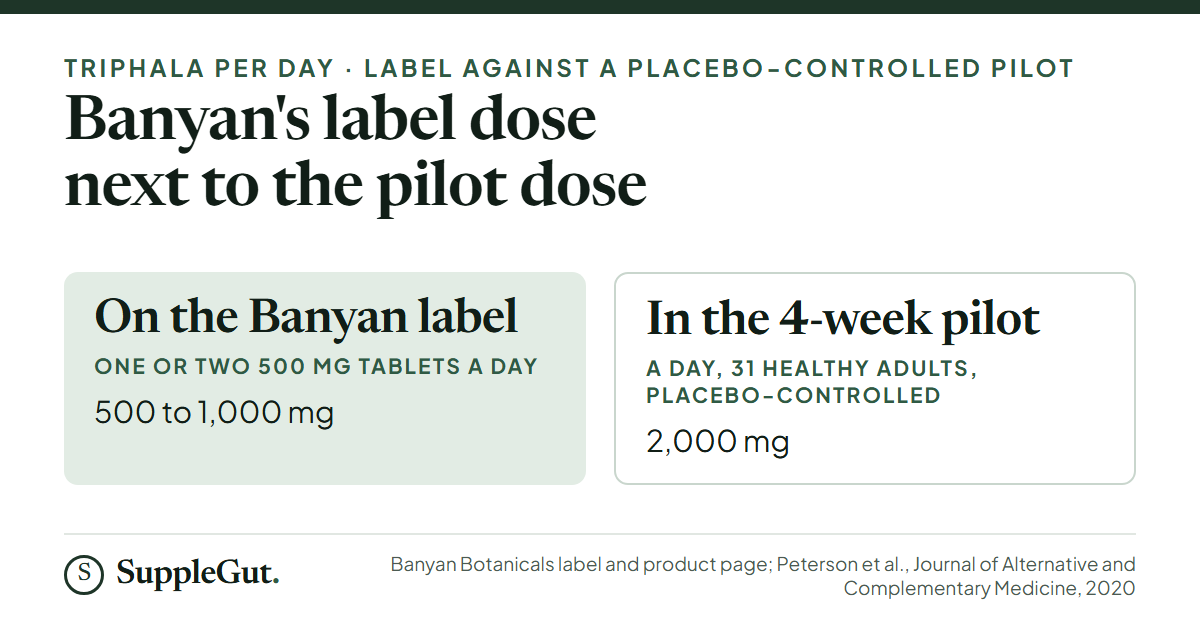
No trial of this tablet exists in PubMed or ClinicalTrials.gov as far as we could find. The nearest is a four-week double-blind, placebo-controlled pilot at UC Davis that gave 2,000 mg a day of triphala to healthy adults; 31 were randomized, and 9 on triphala, 9 on manjistha and 11 on placebo finished. Responses were “highly personalized” and no bacterial group changed in every person, with a trend toward more Akkermansia muciniphila in both herb groups (Peterson et al., 2020). The volunteers had no bowel complaint. Banyan’s label gives 500 to 1,000 mg a day, so the pilot dose is two to four times the label’s range.
The study most often cited for constipation followed 34 adults with functional constipation for 14 days, and weekly bowel movements rose from 10.19 to 18.29 (Munshi et al., 2011). It had no control group, and the product combined isabgol (psyllium) husk, senna extract and triphala extract, so it cannot be credited to triphala alone. A safety study of 20 healthy adults on 2,500 mg a day of a triphala water extract for four weeks found no serious adverse effects (Phetkate et al., 2020). A review of triphala in functional gut disorders concluded that it holds potential and called for clinical trials (Tarasiuk et al., 2018). Our fuller read of the evidence is in Does triphala work?
The trials above tested other preparations at other doses, in healthy adults or in a mixed formula. They set a reference for what triphala studies have measured, not a measurement of Banyan’s tablet.
One tablet or two
The label says to take one or two tablets at bedtime or on waking, on an empty stomach, and the page lets the dose follow how you respond. Two tablets are one Supplement Facts serving. Banyan says triphala is not intended to treat chronic constipation, and that loose stools or stomach discomfort can occur at higher doses. The healthy-adult trials we found ran four weeks.
Safety, metals and how this is regulated
The label asks anyone who is pregnant, nursing, taking medications or living with a medical condition to check with a health practitioner first, and says the tablet is not for chronic constipation. Stomach upset, gas and loose stools are the reported reactions; the review section below counts them.
Metals are the recurring safety question for imported Ayurvedic products. In a survey of 193 Ayurvedic medicines bought online, 20.7% (95% CI 15.2 to 27.1) had detectable lead, mercury or arsenic, with 21.7% of US-made and 19.5% of Indian-made products affected. Products built on metal and mineral preparations (rasa shastra) were far likelier to contain them, 40.6% against 17.1% for the rest, and 75% of the metal-containing products claimed good manufacturing practice (Saper et al., JAMA, 2008). The authors did not name products, and the finding describes a category, not this tablet. What a buyer can check here is the Latin names, the Supplement Facts panel, the organic certification printed on the bottle (QAI, with “Made in India” and a Banyan distribution address in New Mexico), and whether the company will supply a certificate on request; Banyan publishes none. The guide to Ayurvedic supplement safety covers the rest of the checklist.
In the United States this tablet is a dietary supplement under the 1994 law known as DSHEA, which means the FDA does not approve it before sale. No state licenses Ayurvedic practitioners. In India, Ayurveda is a state-recognized system with its own degree (BAMS) and a national ministry, AYUSH.
Banyan’s page and Amazon, side by side
Banyan’s product page runs the Judge.me review app and shows 4.88 from 223 reviews: 209 five-star, 7 four-star, 4 three-star and 3 one-star. That feed is hosted by the brand. Amazon, which is independent, shows 4.6 from 2,123 ratings, 79% of them five-star and 3% one-star. Among Amazon reviewers who mention effectiveness, 241 of 295 are positive.
Praise gathers around regular, comfortable bowel movements (27 of the 223 Banyan reviews use “regular” or “regularity”), easier digestion after meals (37 mention digestion) and a tablet that is gentle and easy to swallow with no capsule shell. Complaints are that nothing changed, which 54 of the 295 Amazon effectiveness mentions say, some gas or bloating (18 of 85 Amazon side-effect mentions are negative) and, for a few, a tablet that is large to swallow. We found no reviews that mention billing, subscriptions or refunds.
Prices and purchase terms
| Route | Price | Per day |
|---|---|---|
| Banyan site, 90 count | $22.99 | $0.26 at one tablet, $0.51 at two |
| Banyan site, 180 count | $35.99 | $0.20 at one tablet, $0.40 at two |
| Banyan subscription, 90 count (15% off) | $19.54 | $0.22 at one tablet, $0.43 at two |
| Amazon, 90 count | $21.99 | $0.24 at one tablet, $0.49 at two |
The subscription runs every 30, 45, 60 or 90 days with the discount on every delivery, and shipping on Banyan’s site is free over $60. The page prints a 90 day return policy, while Amazon lists the item as not returnable because it is ingestible, with damaged or defective items refundable.
Who Banyan’s tablet suits
- Readers who want a stated metal-testing policy on the page, even without a posted certificate.
- Readers who like a tradition-first label, with dosha and agni language and a rasayana framing.
- Readers who want to set their own dose at one tablet or two, rather than a fixed daily amount.
Himalaya prints 688 mg across a leaf powder and an extract in one caplet a day, and Planetary Herbals gives a 2 g blend twice a day. The full label, price and review record for this tablet sit on its product page.
The catalog entries behind this guide
Common questions
Does Banyan Triphala work for constipation?
No trial of this tablet turned up, and the one constipation study we found of a formula containing triphala also held psyllium husk and senna extract. On Amazon, 241 of the 295 reviewers who mention effectiveness are positive and 54 are negative. Banyan’s own page says the tablet is not intended to treat chronic constipation.
Is Banyan Triphala tested for heavy metals?
Banyan’s quality control page states that its herbs and products are tested for arsenic, cadmium, lead and mercury by independent third party laboratories and fall within ANSI 173 and AHPA guidelines. The page names no laboratory and shows no results, and we found no batch certificate posted. Amazon’s listing text says every batch is third party tested in the USA.
What does tridoshic mean on the Banyan label page?
Ayurveda describes three governing principles in the body, vata, pitta and kapha, called doshas. Banyan’s page calls triphala tridoshic and says haritaki balances vata, amla pitta and bibhitaki kapha. These are the tradition’s categories, and no trial we found measured them.
Should I take one tablet or two?
The label says one or two tablets at bedtime or on waking, and the Supplement Facts serving is two tablets. Banyan says your response guides the choice and that loose stools or stomach discomfort can occur at higher doses. The trials of triphala we found ran 14 days to 4 weeks.
How much does Banyan Triphala cost per day?
The 90 count is $22.99 on Banyan’s site and $21.99 on Amazon. That is about $0.26 a day at one tablet and $0.51 at two. The 180 count is $35.99, about $0.40 a day at two tablets, and a subscription takes 15 percent off each delivery.
Does the tablet contain any mineral or bhasma ingredient?
The Supplement Facts panel lists three fruits and gum acacia as the only other ingredient. It shows no bhasma, the calcined mineral and metal preparations used in some Ayurvedic products. The published metal surveys we cite looked at medicines of that wider category and do not name this product.
Sources
- Peterson et al. Four-week double-blind placebo-controlled pilot of triphala and manjistha on the gut microbiome in healthy adults (NCT03477825). Journal of Alternative and Complementary Medicine, 2020. PMID 32955913. pubmed.ncbi.nlm.nih.gov/32955913
- Munshi et al. Open-label study of a formula containing isabgol husk, senna extract and triphala extract in functional constipation. Journal of Ayurveda and Integrative Medicine, 2011. PMID 22022157. pubmed.ncbi.nlm.nih.gov/22022157
- Phetkate et al. Open-label phase I safety study of a triphala aqueous extract in healthy adults (Thai registry TCTR20180423002). Journal of Integrative Medicine, 2020. PMID 31680053. pubmed.ncbi.nlm.nih.gov/31680053
- Tarasiuk et al. Review of triphala in functional gastrointestinal disorders. Chinese Medicine, 2018. PMID 30034512. pubmed.ncbi.nlm.nih.gov/30034512
- Saper RB, Phillips RS, Sehgal A, et al. “Lead, mercury, and arsenic in US- and Indian-manufactured Ayurvedic medicines sold via the Internet.” JAMA, 2008;300(8):915–923. PMID 18728265. pubmed.ncbi.nlm.nih.gov/18728265
- FDA. “FDA warns about heavy metal poisoning associated with certain unapproved Ayurvedic drug products.” fda.gov
- FDA. Dietary supplements and the Dietary Supplement Health and Education Act of 1994. fda.gov/food/dietary-supplements; Ministry of Ayush, Government of India. ayush.gov.in
- Banyan Botanicals: product page for Triphala tablets (label, directions, dosha language, price, subscription, reviews). banyanbotanicals.com
- Banyan Botanicals: herbs quality control and testing page. banyanbotanicals.com
- Amazon: Banyan Botanicals Organic Triphala Tablets listing, ratings and review summary. amazon.com/dp/B000Q454D8
One answer for your symptoms
If this page raised more questions than it settled, the quiz asks the ones that matter for you and answers with one product.
Take the quiz →