
Guide
Does Bariatric Fusion’s GLP-ONE prebiotic fiber work? Two branded fibers, their trial doses and the label
Quick answer
Does Bariatric Fusion GLP-ONE Support Gut Health Booster work? No trial of this powder was found. Its ingredients have separate trials: Solnul resistant potato starch (4.7 g on the label) changed gut bacteria and stool form at 3.5 g and 7 g in healthy adults but not bloating or gas scores, and 6 g of partially hydrolyzed guar gum improved bloating in an IBS trial, against 3.4 g of Sunfiber on the label. The 90 mg postbiotic is below the 300 mg a trade report gives for its trial. No trial involved bariatric surgery or GLP-1 users, and the label gives no after-surgery guidance.
Bariatric Fusion’s GLP-ONE Support Gut Health Booster is an unflavored fiber powder: one 8 g scoop holds 6 g of dietary fiber from two branded ingredients, Solnul resistant potato starch and Sunfiber partially hydrolyzed guar gum, plus a heat-inactivated postbiotic. What sets it apart from the fiber on the next shelf is the audience. The brand markets it to people on GLP-1 medications and people recovering from bariatric surgery, and the label prints every amount, which makes it possible to set each one against the trial behind it.
What GLP-ONE Support Gut Health Booster is, and what it is not
The Supplement Facts panel lists a serving of one scoop (8 g), 20 servings per container, 20 calories and 7 g of carbohydrate. Dietary fiber is 6 g (21% of the daily value), split 3 g soluble and 3 g insoluble. Beneath it the panel names three ingredients with their amounts: 4.7 g Solnul resistant potato starch, 3.4 g Sunfiber partially hydrolyzed guar gum and 90 mg of a heat-inactivated postbiotic made from L. plantarum 276 and L. rhamnosus GG. There is no proprietary blend and no other ingredient, sweetener or flavor on the panel.
The numbers do not add up in a simple way, and the panel is the reason. The two fibers total 8.1 g against a 6 g fiber line on an 8 g scoop, so some of the potato starch is not counted as fiber on the label. We read that as the portion of resistant starch the panel does not count, but the brand does not say so. The postbiotic is not a probiotic: the two bacteria are heat-inactivated, so there are no live organisms and no CFU count. Both carry strain designations, which is more than many gut products print. The brand says the product is vegan, non-GMO and made in an NSF-certified facility with third-party testing; no laboratory or certificate is named. No allergen, gluten or cross-contact statement appears on the panel, and the ingredient maker’s own paper describes growing the bacteria on oat flour, which the label does not mention.
Several claims in the Amazon title and brand text, including “Low-FODMAP,” “Non-Bloating Formula” and “GLP-1 Activation Support,” are the brand’s own. We found no certification behind the FODMAP claim and no trial behind the others.
The trial of the product itself
There is none. A search of PubMed for the brand name returned only unrelated spinal fusion papers, and ClinicalTrials.gov lists no study of this powder or of “GLP-ONE.” The brand calls its ingredients “clinically studied” and says the fiber blend “helps inhibit the DPP-IV enzyme,” the enzyme that breaks down the gut hormone GLP-1. It gives no source for that statement, and we could find no human trial of this blend measuring GLP-1 activity, appetite or DPP-IV. What exists is separate research on each ingredient, which is what the next sections compare with the label.
The evidence for the ingredients
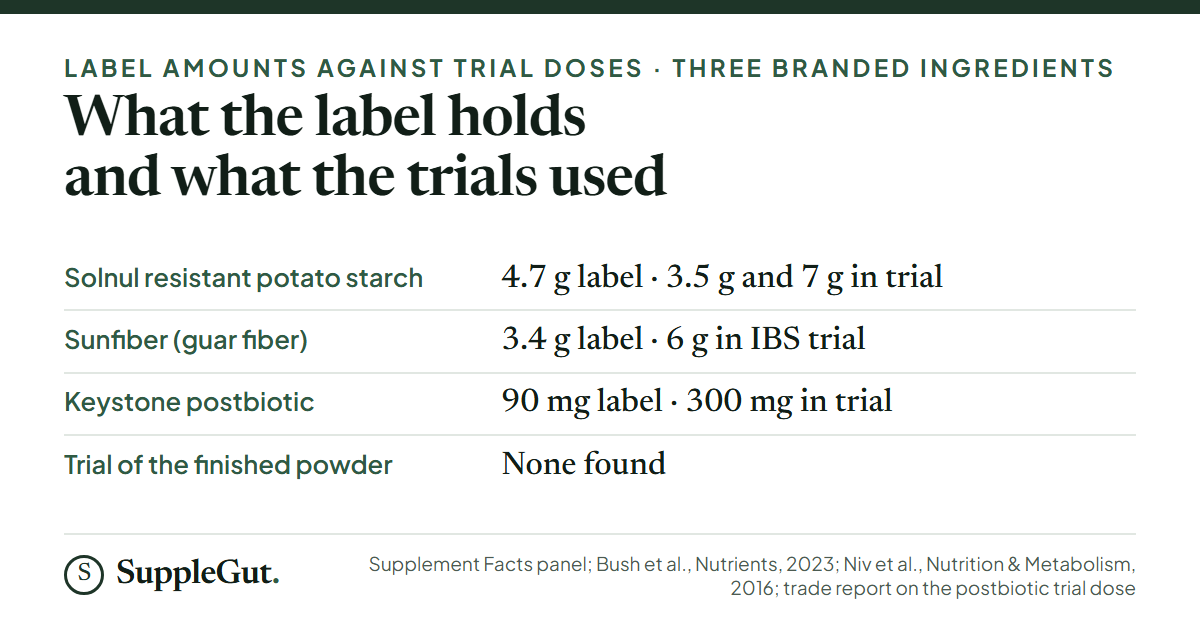
Solnul resistant potato starch (4.7 g on the label). The closest trial randomized healthy adults to placebo, 3.5 g or 7 g a day for four weeks. The 3.5 g group had greater increases in Bifidobacterium and Akkermansia than placebo, and diarrhea- and constipation-associated bowel movements were lower at that dose; the 7 g group responded similarly. The label’s 4.7 g sits between the two trial doses. The authors were employed by or consulted for the ingredient’s maker (Bush et al., Nutrients, 2023). A secondary analysis of the same trial looked at symptom scores for bloating, gas, abdominal pain, constipation, diarrhea and belching, and found that neither the starch nor placebo had significant effects on the mean scores (Bush and Alfa, BMC Nutrition, 2024). So the starch changed bacteria and stool form in healthy adults, and moved neither bloating nor gas.
Sunfiber partially hydrolyzed guar gum (3.4 g on the label). Sunfiber is a branded form of this fiber, and the trials below test the fiber class, not always the brand. The 12-week placebo-controlled IBS trial gave 6 g a day to people with irritable bowel syndrome (121 randomized, 108 analyzed). Bloating scores improved by 4.1 points against 1.2 on placebo (P = 0.03), and bloating plus gas by 4.3 against 1.1 (P = 0.035), with no effect on other IBS symptoms; the benefit lasted four weeks after stopping, and 49% of the placebo group dropped out against 22% on guar (Niv et al., Nutrition & Metabolism, 2016). The label’s 3.4 g is 57% of that trial dose. An open trial in 188 people with IBS compared 5 g of the same fiber with 30 g of wheat bran; both improved pain and bowel habits, and more people switched from bran to guar than the reverse (Parisi et al., Digestive Diseases and Sciences, 2002). In 52 long-term care residents with chronic constipation, 5 g with 200 ml of water did not change bowel frequency or stool form but was followed by significantly less laxative use in weeks three and four (Chan et al., Journal of Nutrition, Health & Aging, 2022). All of these enrolled people with gut conditions or older adults, not people after surgery or on GLP-1 drugs.
A meta-analysis of 22 fiber trials in IBS found that soluble fiber improved global symptoms and abdominal pain, and that there was no evidence for recommending insoluble fiber (Nagarajan et al., 2015). The label’s 6 g is half soluble and half insoluble.
The postbiotic (90 mg on the label). The published trial randomized 76 healthy adults, 38 per arm, for four weeks. Microbiome diversity did not change, but the postbiotic group had enrichment of Akkermansia, Bifidobacterium pseudocatenulatum and other taxa, a near-significant trend in serum butyrate (P = 0.053) and no adverse events. The outcomes were microbiome, stress hormone, inflammatory marker, mood and quality-of-life measures, not digestive symptoms, and the authors are from the company that makes the ingredient (Delebecque et al., Beneficial Microbes, 2026). The abstract does not state the dose; a trade report gives 300 mg a day, so the label’s 90 mg is 30% of that figure (trade report).
Put side by side, the label’s Solnul is inside the trial range, its Sunfiber is below the 6 g IBS dose and its postbiotic is below the trade-reported trial dose. None of the trials enrolled people who had bariatric surgery or take GLP-1 medications, and none tested the three together.
What the research says about fiber and GLP-1
A 2026 narrative review of dietary fiber and GLP-1 receptor agonist drugs notes that these drugs commonly cause nausea, vomiting and constipation, and that fibers may help bowel regularity. It also notes that tolerability “can be limited by bloating or gas,” particularly when intake rises too quickly, and calls for trials that pair the drugs with well-characterized fibers (Wang et al., Advances in Nutrition, 2026). That is the supported part of the pitch: fiber for regularity. The brand’s statements about natural GLP-1 release and appetite rest on how fermentable fibers behave in the gut in general, not on a trial of this powder.
How to take it
The directions on the brand’s graphic are to take one scoop with a beverage at meal or snack time daily, or as directed by your healthcare practitioner, and to blend it into a smoothie, yogurt or oatmeal. A 20-serving container lasts 20 days at one scoop. The Solnul trial ran four weeks and the guar IBS trial ran 12, so a fair test of fiber of this kind is a month or more at a steady amount. Reviewers say it blends more easily into hot liquids than cold ones.
Side effects, and fiber after bariatric surgery
The label’s only warnings are to consult a healthcare practitioner before use if pregnant, nursing, taking medication or having a medical condition, and to keep it out of reach of children. We did not find a fluid instruction beyond “with a beverage,” a warning about swallowing difficulty or narrowing of the esophagus or stomach, or any guidance on surgery type or timing, even though the brand’s page speaks directly to people “recovering from bariatric surgery.”
The medical literature is where the cautions sit. After bariatric surgery, bezoars (hard masses of undigested material) can form months to years later because of reduced stomach motility, loss of the pyloric valve and low acid, and the advice in that literature stresses sufficient drinking and chewing and avoiding large amounts of high-fiber foods (Ben-Porat et al., Surgery for Obesity and Related Diseases, 2016). A diet pill built on intact guar gum, which can swell 10 to 20 times, was linked to 26 reported obstructions, including 18 in the esophagus, and prior gastric stapling was among the listed conditions (Lewis, American Journal of Gastroenterology, 1992). Sunfiber is partially hydrolyzed, a different material, and we did not find reports of obstruction with it in bariatric patients; we also did not search for them exhaustively. Constipation after surgery varies by procedure: a pooled analysis of eight studies found it less likely after gastric bypass, more likely after adjustable gastric banding and not significantly different after sleeve gastrectomy (Zhu and Liu, Obesity Surgery, 2026). Program handouts we read advise adding fiber gradually, some weeks after surgery and with a bariatric dietitian’s agreement. Whether and when this powder fits is a question for the surgical team.
For everyone else, the common effect of fermentable fiber is gas, especially if the amount rises quickly. The brand’s “non-bloating” description is a claim; in the readable brand-site reviews, one person reported feeling nauseated after three attempts and none described relief from gas or bloating. A gas-pains testimonial in one of the brand’s advertisements was posted before this powder was listed for sale and does not name it.
What the reviews say
The review base is small. Amazon shows 4.0 from 94 ratings, with 66% five-star and 14% one-star; the review text is behind a sign-in. The brand’s own page, through a Stamped widget, shows 4.4 from 11 reviews, and the brand hosts that widget. Vitacost shows 8 reviews with no score or text. Trustpilot has one review for the brand overall.
The recurring praise on the brand page is that it produced normal bowel movements for someone who found other fibers ineffective, and that it mixes into smoothies and yogurt. The recurring complaints are that it does not dissolve fully, with one reviewer saying it “lays in the bottom” of a cold drink, a slight taste despite the unflavored label, and, in one case, nausea. Buyers have also asked on the product page when it will be back in stock and why a once-a-day product holds 20 servings, not 30.
The subscription and refund terms
The brand offers a 10% subscription discount through its Subscribe & Save program, with delivery every one to three months, and its published page says canceling is free, with no commitment. We found no minimum number of shipments. One reviewer who ordered three containers wrote that they had to ask for the next order to be put on hold. Returns are accepted for unopened product within 30 days of purchase, need an authorization by phone or email, and return shipping is paid by the customer. The product page also says “100% Satisfaction Guarantee”; the policy text is the one that sets the terms. Orders from retail partners go through the retailer. A single container can be bought one time on the brand site and at Vitacost.
Who this powder is for
- Someone who wants a once-a-day fiber with each amount printed on the panel, so the dose of each ingredient can be checked against the research.
- Someone adding fiber for regularity while taking a GLP-1 medication, after checking with the prescriber or dietitian.
- Someone who wants an unflavored powder to stir into a smoothie, yogurt or oatmeal.
- Someone after bariatric surgery whose surgical team has approved a fiber supplement and its starting amount.
If a single ingredient at a trial dose is the goal, Tomorrow’s Nutrition Sunfiber PHGG Powder is plain partially hydrolyzed guar gum, and Bob’s Red Mill Potato Starch is the raw potato starch route to resistant starch. Another branded blend with Solnul and Sunfiber is covered in the Supergut guide, and the probiotic or fiber guide and the constipation evidence guide set out where fiber fits among the options. The quiz starts from symptoms instead of products.
Cost
The brand site and Vitacost list one 20-serving container at $26.99, which is $1.35 a day at one scoop. The 10% subscription price is $24.29, or $1.21 a day. Brand shipping is free on orders over $100 and starts at $8.50 below that, which brings a single container to about $35.49 delivered, or $1.77 a day. The Amazon listing displayed no price and offered only “See All Buying Options.”
The products in this catalog
Common questions
Does Bariatric Fusion GLP-ONE Support Gut Health Booster work?
No trial of this exact powder was found. Solnul at 3.5 g and 7 g for four weeks changed gut bacteria and stool form in healthy adults, and 6 g of partially hydrolyzed guar gum improved bloating in 108 people with IBS over 12 weeks. The label has 4.7 g Solnul and 3.4 g of the guar fiber, and the claims about GLP-1 and appetite have no trial of this blend behind them.
Is it safe to take after gastric bypass or sleeve surgery?
The label says to take one scoop with a beverage and to consult a healthcare practitioner if you take medication or have a medical condition; it gives no after-surgery timing. Bezoars and blockages are documented after bariatric surgery, and program handouts advise adding fiber gradually, with fluids, once your bariatric team agrees. This product uses partially hydrolyzed guar, which we did not find studied for obstruction risk in bariatric patients.
Does it cause gas or bloating, or help with gas pains?
The brand calls it a non-bloating formula, but resistant starch and guar are fermentable fibers, and a 2026 review notes fibers can cause bloating or gas if intake rises too quickly. In the Solnul trial, bloating and gas scores did not change significantly, and in an IBS trial 6 g of the guar fiber lowered bloating and gas scores against placebo. We found no trial showing this powder reduces gas.
What is in the powder, and what are Solnul, Sunfiber and Keystone?
One 8 g scoop holds 6 g of dietary fiber, 3 g soluble and 3 g insoluble. The panel prints 4.7 g Solnul (resistant potato starch), 3.4 g Sunfiber (partially hydrolyzed guar gum) and 90 mg of Keystone Postbiotic, made from heat-inactivated L. plantarum 276 and L. rhamnosus GG. The bacteria are not alive and no CFU count is printed.
How much does it cost?
One 20-serving container is $26.99 on the brand site and at Vitacost, about $1.35 a day, or $24.29 (about $1.21 a day) on a 10% subscription. Brand shipping starts at $8.50 under $100, which brings one container to about $35.49, or $1.77 a day. The Amazon listing displayed no price.
How do you cancel the subscription or return it?
The brand says canceling a Subscribe & Save plan is free and can be done anytime. Returns are for unopened product within 30 days, with an authorization number from customer care and return shipping paid by the customer. One reviewer had to ask the company to hold the next shipment after ordering three containers.
How does it compare with plain Sunfiber or potato starch?
Plain Sunfiber powders hold only partially hydrolyzed guar gum, and raw potato starch is a single resistant starch. This powder combines 4.7 g of the starch and 3.4 g of the guar fiber with a postbiotic in one scoop, so it holds less guar fiber than the 6 g used in the IBS trial. See the Sunfiber product page for the single-ingredient option.
Sources
- Bush JR, Baisley J, Harding SV, et al. "Consumption of Solnul Resistant Potato Starch Produces a Prebiotic Effect in a Randomized, Placebo-Controlled Clinical Trial." Nutrients, 2023;15(7):1582. PubMed 37049425
- Bush JR, Alfa MJ. Secondary analysis of the Solnul resistant potato starch trial: bowel symptom scores. BMC Nutrition, 2024. PubMed 39605008
- Niv E, Halak A, Tiommny E, et al. "Randomized clinical study: Partially hydrolyzed guar gum (PHGG) versus placebo in the treatment of patients with irritable bowel syndrome." Nutrition & Metabolism, 2016;13:10. PubMed 26855665
- Parisi GC, et al. Partially hydrolyzed guar gum compared with wheat bran in irritable bowel syndrome. Digestive Diseases and Sciences, 2002. PubMed 12184518
- Chan TC, et al. Partially hydrolyzed guar gum in long-term care residents with chronic constipation. Journal of Nutrition, Health & Aging, 2022. PubMed 35297467
- Nagarajan N, et al. Fiber supplementation in irritable bowel syndrome: systematic review and meta-analysis. 2015. PubMed 26148247
- Delebecque CJ, et al. Randomized placebo-controlled trial of a heat-inactivated postbiotic in healthy adults. Beneficial Microbes, 2026. PubMed 42486470; trial dose per trade report: nutritioninsight.com
- Wang Y, et al. Dietary fiber and GLP-1 receptor agonists: narrative review. Advances in Nutrition, 2026. PubMed 42106160
- Ben-Porat T, et al. Phytobezoar after bariatric surgery. Surgery for Obesity and Related Diseases, 2016. PubMed 27989523
- Lewis JH. Guar gum diet pill obstructions: 26 reports to the FDA. American Journal of Gastroenterology, 1992. PubMed 1329494
- Zhu C, Liu W. Constipation after metabolic and bariatric surgery: meta-analysis. Obesity Surgery, 2026. PubMed 41483045
- Brand page: label, directions and price. bariatricfusion.com; brand refund policy and Subscribe & Save page
- Amazon listing: ratings and listing text. amazon.com; Vitacost listing: price and label. vitacost.com
Not sure which product fits your situation?
This guide covers the mechanics. The quiz takes your specific symptoms, routine and preferences and matches you to one product from the catalog.
Take the quiz →