
Guide
Does Benefiber work? What wheat dextrin does and does not do
Quick answer
Does Benefiber work? As a gentle way to add 6 g of fiber to a drink, yes: one ingredient, no taste, no thickening, and a review base in the tens of thousands. As a treatment for constipation, the evidence says no. Its fiber, wheat dextrin, does not form the water-holding gel that psyllium does, the meta-analysis of fiber trials found significant effects for psyllium and pectin and not for wheat dextrin, and one evidence review describes wheat dextrin as mildly constipating at ordinary doses.
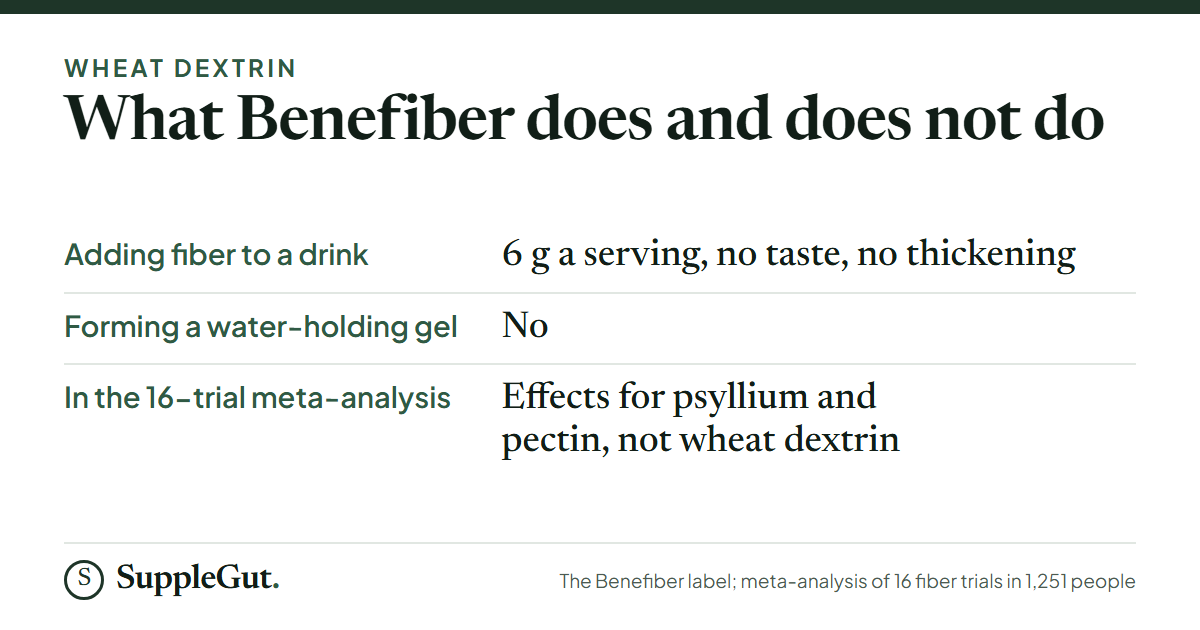
Benefiber is bought for two different reasons, and it only does one of them well. This page explains what wheat dextrin is, what the label dose delivers, what the trials do and do not show, what the reviews complain about, and which product to reach for instead if regularity is the goal.
What Benefiber is
The unflavored powder has one ingredient: wheat dextrin. The label footnote explains that the wheat has been processed to meet the FDA requirement for gluten-free foods, under 20 parts per million. There is no sugar, flavoring, color or sweetener in the original powder; the orange-flavored variant is a different product with sweeteners, lactose from milk and colors, so the unflavored tub is the one this page is about.
Wheat dextrin is a soluble fiber, but soluble is not one thing. Psyllium is soluble and viscous: it swells into a gel that holds water all the way through the colon. Wheat dextrin is soluble and non-viscous: it dissolves clear, does not thicken, and is readily fermented by gut bacteria. Benefiber’s selling points, that it dissolves in anything and does not change the texture, are the same fact as its limitation.
The label dose
One serving is four teaspoons, stirred into 4 to 8 ounces of any beverage or soft food, hot or cold, for up to 60 seconds until dissolved. That serving supplies 6 g of dietary fiber, about 21% of the daily value. The brand’s directions are one serving a day for digestive health, or two a day for the benefit of feeling fuller for longer, for adults and children of 12 and over. Nothing on the label warns about choking, medicine spacing or allergy, which are the three warnings every psyllium product carries, because wheat dextrin does not swell.
What the trials show
The evidence for fiber and constipation was pooled in a 2022 systematic review of 16 randomized trials in 1,251 adults with chronic constipation. Fiber as a category produced a treatment response in 66% of people against 41% on control. When the review looked at fiber types, the effect was significant for psyllium and pectin; the wheat dextrin subgroup was not, and most of the benefit came at doses above about 10 g a day kept up for four weeks or more (van der Schoot et al., American Journal of Clinical Nutrition, 2022).
The mechanistic review of fiber supplements says why. Non-viscous soluble fibers such as wheat dextrin and inulin are fermented in the colon, have no water-holding capacity and so provide no laxative benefit at physiologic doses; the same review states that wheat dextrin has a constipating effect at 10 to 15 g a day. Psyllium, by contrast, has been measured as 3.4 times more effective than wheat bran at increasing stool output (McRorie, Nutrition Today, 2015). The 2023 AGA/ACG guideline on chronic constipation gives fiber a conditional recommendation and names psyllium as the supplement fiber with the evidence.
Wheat dextrin’s own studies are elsewhere. Its documented effects are prebiotic and glycemic, at 30 to 45 g a day; the positive stool-output data comes from healthy volunteers taking 100 g a day, roughly sixteen label servings; and its cholesterol data comes from animals. There is no randomized trial of wheat dextrin in constipated patients, and none that tested it head to head against psyllium.
Psyllium is also an eligible source for the FDA-authorized cholesterol health claim at 7 g of soluble fiber a day. Wheat dextrin is not listed in that regulation, so a Benefiber tub cannot carry the claim a Metamucil tub does.
Does Benefiber cause gas or constipation?
Gas, sometimes. Wheat dextrin is a prebiotic, meaning gut bacteria ferment it, and fermentation makes gas; the recurring complaint in the reviews is new, unpleasant gas from what reviewers call a reformulation, although the label still lists wheat dextrin as the only ingredient. Constipation is the odder one: because the fiber holds no water, one evidence review describes it as mildly constipating at typical doses rather than laxative, which is the opposite of what most people buy it for. Neither effect is dangerous; both are worth knowing before the tub is opened.
What the reviews say
The Amazon listing carries roughly 13,100 ratings, and most of them are about the format: it dissolves, it has no taste, it goes into coffee and soup without changing them. The negatives cluster around gas and around people who bought it for regularity and found it did little. Both match the mechanism. No third-party testing certificate or certifying organization is named by the brand.
Who Benefiber suits
- Someone who wants to raise daily fiber intake and could not keep taking psyllium because of the texture.
- Someone who wants the shortest possible ingredient list and a gluten-free label.
- Someone after prebiotic fermentation rather than a laxative effect.
It does not suit hard, infrequent or incomplete stools, where the trial evidence belongs to psyllium, and it does not suit bloating and gas, which fermentable fiber can make worse before it makes anything better. The Metamucil vs Benefiber comparison sets the two tubs side by side; the psyllium buying guide covers the plain-husk alternative, which gives 7 g of fiber in a serving with one ingredient.
What to buy instead for regularity
Plain psyllium husk powder: the fiber with the trials, at more than twice the fiber per serving and no flavoring. For bloating rather than constipation, partially hydrolyzed guar gum is another non-viscous fiber, so it is not a laxative either, but it has a 12-week placebo-controlled trial in 108 people with IBS at 6 g a day that found less bloating and gas, and no benefit for pain or stool frequency.
The products in this catalog
Common questions
What is Benefiber?
A single-ingredient powder of wheat dextrin, a soluble, non-viscous fiber that dissolves clear, does not thicken and has no taste. The wheat is processed to meet the FDA gluten-free standard. One four-teaspoon serving supplies 6 g of fiber.
Does Benefiber work for constipation?
The evidence says not much. Wheat dextrin does not form a water-holding gel, so it lacks psyllium’s stool-bulking mechanism. A meta-analysis of 16 trials in 1,251 people found significant effects for psyllium and pectin, not wheat dextrin, and one evidence review describes wheat dextrin as mildly constipating at 10 to 15 g a day. There is no randomized trial of wheat dextrin in constipated patients.
How much Benefiber should you take, and how?
Four teaspoons, stirred into 4 to 8 ounces of any drink or soft food for up to 60 seconds, once a day for digestive health or twice a day for feeling fuller, for adults and children of 12 and over. Each serving is 6 g of fiber, about 21% of the daily value.
Does Benefiber cause gas?
It can. Wheat dextrin is a prebiotic that gut bacteria ferment, and fermentation makes gas. The recurring complaint in the reviews is new gas after what reviewers call a reformulation, although the label still lists wheat dextrin as the only ingredient.
Is Benefiber gluten-free?
Yes, under 20 parts per million. The label footnote says the wheat has been processed to meet the FDA requirement for gluten-free foods. The orange-flavored variant is a different product with sweeteners, lactose and colors.
Which is better, Benefiber or Metamucil?
For regularity or the cholesterol benefit, Metamucil, because its fiber is psyllium, the one supplement fiber with meta-analysis and guideline evidence for constipation and an FDA-authorized cholesterol claim. Benefiber is cheaper per day, simpler to take and dissolves in anything; it just does not do the job people usually buy fiber for.
Sources
- Benefiber. Benefiber Original prebiotic fiber powder: directions, serving size, fiber per serving and gluten-free statement. benefiber.com
- van der Schoot A, et al. "The Effect of Fiber Supplementation on Chronic Constipation in Adults: An Updated Systematic Review and Meta-Analysis of Randomized Controlled Trials." American Journal of Clinical Nutrition, 2022;116(4):953–969. pmc.ncbi.nlm.nih.gov/articles/PMC9535527
- McRorie JW. "Evidence-Based Approach to Fiber Supplements and Clinically Meaningful Health Benefits, Part 2." Nutrition Today, 2015;50(2):90–97. pmc.ncbi.nlm.nih.gov/articles/PMC4415970
- American Gastroenterological Association / American College of Gastroenterology. "Clinical Practice Guideline: Pharmacological Management of Chronic Idiopathic Constipation." Gastroenterology, 2023;164(7):1086–1106. pubmed.ncbi.nlm.nih.gov/37211380
- Review of wheat dextrin: stool output at 100 g a day in healthy volunteers, animal cholesterol data, no constipation trial. Journal of International Medical Research, 2009. journals.sagepub.com
- 21 CFR 101.81, the FDA health claim for soluble fiber and coronary heart disease: eligible sources. law.cornell.edu
- Benefiber Original, Amazon listing: rating pool and reviews. amazon.com
Not sure which product fits your situation?
This guide covers the mechanics. The quiz takes your specific symptoms, routine and preferences and matches you to one product from the catalog.
Take the quiz →