
Guide
Does Bioma work? What is in the capsule, what the trials say and the billing terms
Quick answer
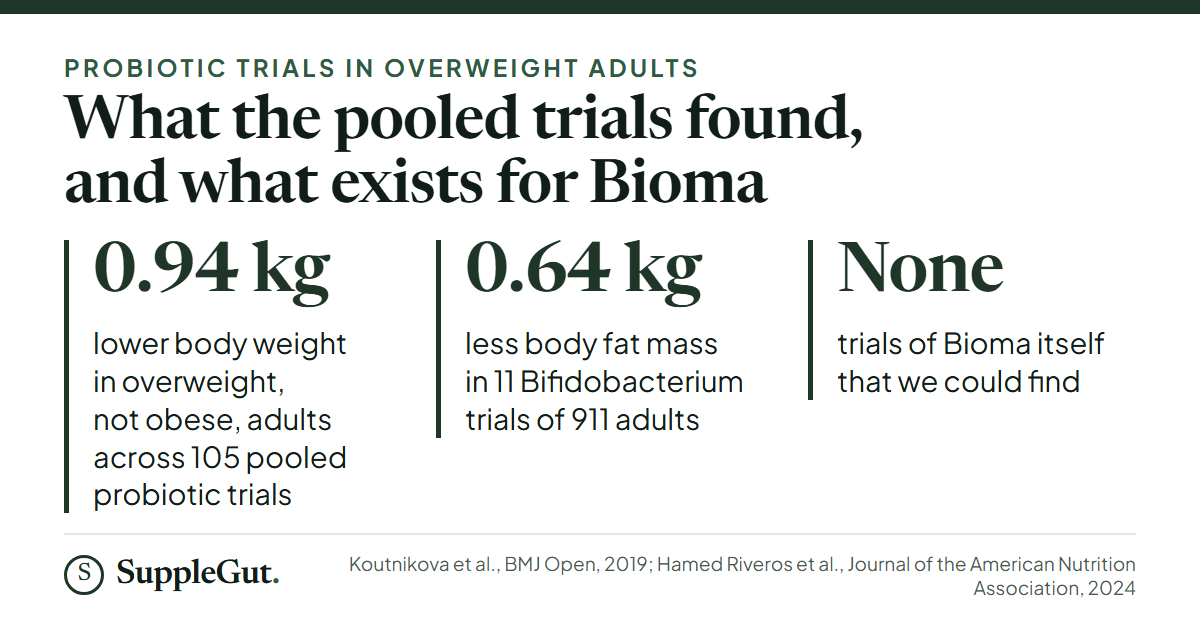
Does Bioma work? We could find no trial of Bioma itself; the brand’s own figures come from a one-week survey of 14 paid users that it says is not a scientific study. Probiotic trials in general show small effects on weight, mostly from named strains: a meta-analysis of 105 trials found 0.94 kg lower body weight in overweight, but not obese, adults. Bioma lists three Bifidobacterium species with no strain codes, and its 100 mg of xylooligosaccharide is far below the 1.4 to 8 g used in trials of that fiber. Amazon rates it 4.1 from 4,528 ratings, and most Trustpilot complaints concern subscription billing.
Bioma is a once-a-day delayed-release capsule that puts three Bifidobacterium species together with a prebiotic fiber (xylooligosaccharides) and tributyrin, a form of butyrate. The brand site markets it for gut balance, appetite and weight, through a quiz-and-checkout page, and the same bottle is sold at Walmart and Amazon. This page sets out what the label prints, what the trials of its ingredient classes found, the reviews by platform and what the brand’s published terms say about subscriptions and refunds.
What Bioma is, and what it is not
Per serving of two capsules, the label lists 100 mg of xylooligosaccharides (XOS), 90 mg of tributyrin (labeled CoreBiome on the retail version) and a Proprietary Probiotic Blend of 9 billion CFU at the time of manufacture: Bifidobacterium lactis, B. longum and B. breve. The three share one blend weight with no per-species amount and no strain codes. Other ingredients are microcrystalline cellulose, hypromellose, magnesium stearate and silicon dioxide. The brand’s FAQ says the delayed-release capsule gets bacteria to the gut where “96% of standard probiotic capsules” do not; the page gives no source for that figure.
Two label versions are in circulation. The blend weighs 90 mg on the brand’s FAQ label image and 29 mg on the Walmart and Amazon listings, with the same 9 billion CFU. The allergen statements contradict each other: one says the product is made in a facility that handles eggs, wheat, milk, tree nuts, peanuts, soybeans, shellfish and fish; the other says it is made without milk, eggs, fish, shellfish, tree nuts, peanuts, wheat, soybeans and sesame. We found no third-party testing statement on the pages we read. The terms name Karma Processing Incorporated (Delaware) as responsible for subscription services and refunds.
The trial of the product itself
There is none. We searched PubMed and ClinicalTrials.gov and found no study of Bioma. The brand’s page bases its figures on “a one-week study of 14 users aged 32–60,” who “were compensated to share their experiences,” and states “this is not a scientific study.” Its scientific-references page lists 43 references, none a trial of Bioma, and its weight-loss quote comes from a trial of Lactobacillus rhamnosus, an organism that is not in this product.
The evidence for the ingredients
Probiotics and weight. A systematic review of 27 randomized trials of probiotics or synbiotics in overweight or obesity found 23 reporting positive effects on weight, over about 12 weeks on average, with the strongest results from specific Lactobacillus and Bifidobacterium strains (Álvarez-Arraño and Martín-Peláez, Nutrients, 2021). A meta-analysis of Bifidobacterium alone (11 studies, 911 people, mixtures excluded) found 0.64 kg less body fat mass, 0.64 percentage points less body fat and a waist 1.39 cm smaller (Hamed Riveros et al., Journal of the American Nutrition Association, 2024). A meta-analysis of 105 trials in 6,826 people found body weight 0.94 kg lower in people who were overweight but not obese, described as “minor but consistent improvements” (Koutnikova et al., BMJ Open, 2019). Because effects differ by strain, and Bioma prints none, those results cannot be matched to it; the guide to how many CFU you need covers why.
Xylooligosaccharides. In a 21-day crossover trial in healthy adults, 8 g a day of XOS raised bifidobacteria counts (P = 0.008) but “did not alter the symptoms of bloating, abdominal pain or flatulence” (Childs et al., British Journal of Nutrition, 2014). The brand cites trials of 1.4 g and 2.8 g a day. At 100 mg this label is about one-eightieth of the 8 g dose and one-fourteenth of the 1.4 g dose.
Tributyrin. The published work on CoreBiome is a laboratory study: in an upper-gut simulation, 40.9% (capsule) and 48.7% (softgel) of the tributyrin was hydrolyzed to butyrate in the small intestine, 59.1% and 51.3% remained for the colon, and three weeks in a colon simulator raised butyrate and Bifidobacterium (Duysburgh et al., Frontiers in Nutrition, 2025). A crossover trial in 12 men measured blood butyrate after a meal, but used a different butyrate triglyceride at 650 to 2,000 mg (van Deuren et al., Frontiers in Nutrition, 2022). Neither tested 90 mg of tributyrin.
How to take Bioma
The label directs two capsules once a day with a full glass of water, before breakfast. Sixty capsules are 30 servings, and it is for adults 18 and over. The brand says bloating can occur in the first days for people new to probiotics. The weight trials in the systematic review averaged about 12 weeks, the closest guide to a fair test.
Side effects and who should not take it
The Walmart label photo reads: not for use under 18; consult a healthcare professional before use if you take any medication or have a medical condition; do not use if pregnant or nursing; do not use if the safety seal is damaged. The brand’s own pages are looser: its product page says pregnant or breastfeeding women should consult a professional, and its FAQ says probiotics are considered safe for breastfeeding mothers. Anyone with an allergy should check the bottle in hand, since the two allergen statements differ. Reviewers mostly describe no effect rather than harm.
What the reviews say
Amazon shows 4.1 from 4,528 ratings (66% five-star, 12% one-star) on a listing sold by a third-party seller, so those reviews cover the bottle and not the brand’s own billing. Walmart shows 4.3 from 194 ratings (142 five-star, 20 one-star). Trustpilot rates the brand site 4.1 from 11,339 reviews, 12.2% of them one or two stars, and the score is brand-wide and as much about ordering as about the capsule: 696 reviews mention the subscription, 552 cancelling and 342 refunds. The brand’s own page shows testimonials with no score. A BBB search found no business profile and one consumer report filed with BBB of a subscription cancelled several times with products still sent. The recurring praise is less bloating or a calmer stomach, fewer cravings and a smaller appetite, and easy ordering with quick support replies. The recurring complaints are no change in bloating or weight for the price, billing and cancellation, and the short return window.
The subscription and refund terms
Prices on the brand site, per bottle:
| Bottles | Subscription, first order | One time |
|---|---|---|
| 1 | $47.99 | $65.99 |
| 3 | $35.99 each | $47.42 each |
| 6 | $26.41 each | $36.16 each |
The terms say subscriptions renew automatically for the length of the last purchase, the discount applies to the first charge only, and later charges are at the company’s then current rates; the page does not state what the regular renewal price is. They say a subscription “can only be canceled after the second subscription charge is made,” or earlier by paying the difference between the plan price and the regular price (the help center calls this Pay & Cancel), while the pricing page says “Cancel anytime.” Returns are accepted within 14 days of delivery for unopened or faulty products; refunds on recurring shipments are issued for the initial purchase only, a $9 return label is deducted, and refunds take 10 to 30 business days. Disputes go to arbitration under Texas law, with class actions waived unless the customer opts out by email within 30 days.
Trustpilot one- and two-star reviewers report extra charges of $40 to $170 at cancellation, billing for more than they ordered and a phone call offering another product right after purchase. The terms say the return policy covers products from authorized resellers and that the company is not responsible for products bought through Amazon. Single bottles at Walmart and Amazon carry no subscription.
Who Bioma is for
- Gut comfort and a daily routine: bloating, gas or irregular bowel habits are what the reviews most often mention.
- Someone who wants a once-a-day capsule with three Bifidobacterium species and a prebiotic, and accepts that no strain codes are printed.
- Someone who will buy a single bottle at retail, or read the subscription terms before using the brand site.
If a named strain with a trial behind it is what you want, the Seed DS-01 guide covers a probiotic that prints its strains, and Life Extension Bifido GI Balance is a single B. longum strain by name. Which probiotic should I take starts from the symptom instead.
Cost
On the brand site a single bottle is $2.20 a day one time and $1.60 on the first subscription order; the three- and six-bottle one-time prices are $1.58 and $1.21 a day, and the subscriptions $1.20 and $0.88. Walmart and Amazon list a single bottle at $36.39, about $1.21 a day at two capsules.
The products in this catalog
Common questions
Does Bioma work?
Bioma’s page markets it for gut balance, appetite and weight. No trial of the finished product was found, and the brand’s own figures come from a one-week survey of 14 paid users that it says is not a scientific study. Reviewers split: Amazon shows 66% five-star and 12% one-star, with praise for less bloating and complaints of no change in bloating or weight.
What is in Bioma?
Per two capsules: 100 mg of xylooligosaccharides from corn cob, 90 mg of tributyrin (CoreBiome on the retail label) and a proprietary blend of Bifidobacterium lactis, longum and breve at 9 billion CFU at manufacture, with no strain codes. The capsule is hypromellose and described as delayed-release. The brand states it is vegan, non-GMO, stimulant-free and gluten-free, and no sweetener is listed.
Does Bioma boost GLP-1?
The brand’s page links the ingredients to appetite and GLP-1. The trials cited on this page measured body weight, fat mass, bifidobacteria counts and symptoms, not GLP-1 for this formula, and we found no trial of the finished product.
What are the side effects of Bioma?
The brand says bloating can occur in the first days for people new to probiotics. One version of the label says not to use it if pregnant or nursing, and all versions say to consult a professional if you take medication or have a medical condition. A few reviewers report no effect, and one Trustpilot reviewer reports constipation and a swollen foot that resolved after stopping; that is an individual report, not a finding.
How much does Bioma cost?
A one-month supply (60 capsules, 30 servings) is $65.99 one time or $47.99 on the first subscription order on the brand’s site. Walmart and Amazon list a single bottle at $36.39, which is about $1.21 a day.
Can I cancel a Bioma subscription?
The brand’s terms say a subscription can be cancelled only after the second charge, or earlier by paying the difference between the plan price and the regular price, and that refunds are not given on recurring shipments. Billing is the most common complaint on its Trustpilot profile (4.1 from 11,339 reviews, 12% at one or two stars), with reports of extra charges of $40 to $170 at cancellation. The Walmart and Amazon listings sell single bottles with no subscription.
Is Bioma safe to take with medication?
The label on the Walmart listing says to consult a healthcare professional before use if you take any medication or have a medical condition, and not to use it under 18. The brand’s own questions page says breastfeeding mothers should consult a professional, which differs from the Walmart label’s “do not use if pregnant or nursing.” See probiotic side effects for what the trials report.
Sources
- Álvarez-Arraño V, Martín-Peláez S. "Effects of Probiotics and Synbiotics on Weight Loss in Subjects with Overweight or Obesity: A Systematic Review." Nutrients, 2021;13(10):3627. doi.org/10.3390/nu13103627
- Hamed Riveros NF, García-Corredor L, Martínez-Solarte MA, et al. "Effect of Bifidobacterium Intake on Body Weight and Body Fat in Overweight and Obese Adult Subjects: A Systematic Review and Meta-Analysis." Journal of the American Nutrition Association, 2024;43(6):519–531. doi.org/10.1080/27697061.2024.2320192
- Koutnikova H, Genser B, Monteiro-Sepulveda M, et al. "Impact of bacterial probiotics on obesity, diabetes and non-alcoholic fatty liver disease related variables: a systematic review and meta-analysis of randomised controlled trials." BMJ Open, 2019;9(3):e017995. doi.org/10.1136/bmjopen-2017-017995
- Childs CE, Röytiö H, Alhoniemi E, et al. "Xylo-oligosaccharides alone or in synbiotic combination with Bifidobacterium animalis subsp. lactis induce bifidogenesis and modulate markers of immune function in healthy adults." British Journal of Nutrition, 2014;111(11):1945–1956. doi.org/10.1017/S0007114513004261
- Duysburgh C, Verstrepen L, Van Meulebroek L, et al. "Tributyrin (CoreBiome) enhances butyrate levels and modulates the gut microbiota, barrier function, and immune response in vitro." Frontiers in Nutrition, 2025;12:1712993. doi.org/10.3389/fnut.2025.1712993
- van Deuren T, Smolders L, Hartog A, et al. "Butyrate and hexanoate-enriched triglycerides increase postprandial systemic butyrate and hexanoate in men with overweight/obesity." Frontiers in Nutrition, 2022;9:1066950. doi.org/10.3389/fnut.2022.1066950
- Bioma brand pages: product and pricing, FAQ, scientific references and Terms of Service. bioma.health/weight-loss-pdp, terms-of-service
- Walmart and Amazon listings: label text, price and ratings. walmart.com, amazon.com/dp/B0F5J1XZHC
- Trustpilot: bioma.health reviews. trustpilot.com/review/bioma.health
Not sure which product fits your situation?
This guide covers the mechanics. The quiz takes your specific symptoms, routine and preferences and matches you to one product from the catalog.
Take the quiz →