
Guide
Does Bye Bye Bloat work? What is in the capsule and what the study found
Quick answer
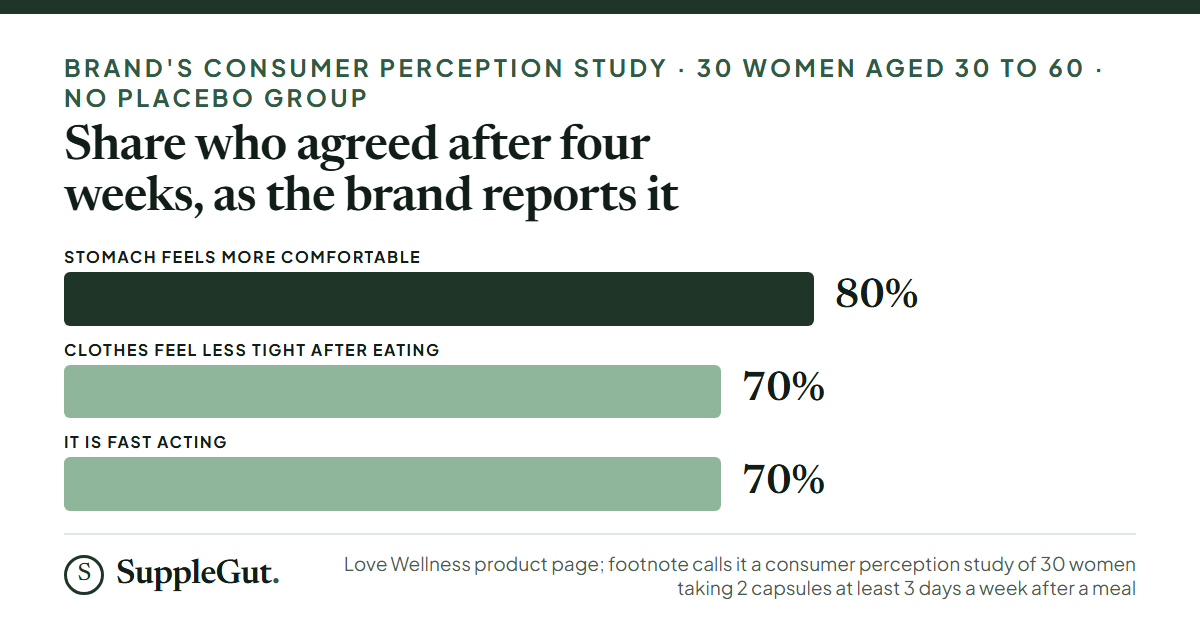
Does Bye Bye Bloat work? Evidence for this exact capsule is one registered four-week study of 40 women with no placebo group, plus a brand survey of 30 women in which 80% agreed their stomach felt more comfortable. No peer-reviewed trial of the formula was found. All eleven ingredients, five herbs and six enzyme complexes, sit in one 700 mg blend with no amounts or enzyme activity units, so no dose can be compared with a trial. About 63% of Amazon ratings are five stars, and Target, Walmart, Ulta and the brand site average 4.7.
Bye Bye Bloat is a capsule from Love Wellness that combines five herbs with six digestive enzymes, taken after a meal or at bedtime for bloating. What sets it apart from the enzyme capsules next to it is the herbs: dandelion and parsley give it a water-weight pitch on top of the enzyme pitch. This page sets out what the label discloses, what the brand’s study found and what it did not have, what the trials of the individual parts show, how the reviews split by platform, and what it costs.
What Bye Bye Bloat is, and what it is not
The Supplement Facts panel has one line: “Bye Bye Bloat Blend 700 mg”, the serving being two capsules (350 mg a capsule), with 30 servings in the 60-capsule bottle. The blend is organic fenugreek seed powder, organic dandelion root powder, organic fennel seed powder, organic ginger root powder, organic parsley leaf powder, then six enzyme complexes: amylase, protease, pepsin, lipase, bromelain (from pineapple) and papain (from papaya). No amount is printed for any herb or enzyme, and no enzyme activity units. U.S. rules list blend components in descending order by weight, so the five herbs together outweigh the six enzymes, which come last. Other ingredients are microcrystalline cellulose, the hypromellose capsule and magnesium stearate. There are no sweeteners.
It lists no lactase, no alpha-galactosidase and no gluten-specific enzyme, although the brand copy says the six enzymes “support digestion of gluten and dairy.” It is not vegan, and the brand says it is not a laxative. The label shows a “Third-Party Tested” icon without naming the tester.
The trial of the product itself
The brand registered a study on ClinicalTrials.gov (NCT06516744): single group, open label, no placebo or control arm, 40 women actually enrolled, four weeks, two capsules right after eating at least three times a week plus during hormonal bloating, with self-reported bloating questionnaires at baseline, first use, week two and week four. It enrolled women 18 and over with self-reported bloating and excluded those with diagnosed GI disorders, pregnancy, breastfeeding or trying to conceive. The sponsor is Love Wellness, and no results are posted.
The brand’s page quotes a clinical study in which 80% agreed their stomach feels more comfortable and 70% agreed their clothes feel less tight and that it is fast acting. The graphic’s own footnote calls it a third-party consumer perception study of 30 women aged 30 to 60. The site says 30 women and the registry says 40; it is not stated whether these are the same study. The page also promises “proof of results without placebo bias,” yet the registered design has no placebo group. PubMed returned no article on the formula.
The evidence for the ingredients
Enzymes. A double-blind crossover in 16 healthy adults gave 280 mg of acid-resistant lipase before a high-fat meal: stomach fullness was lower than on placebo (p < 0.05), while bloating and nausea showed no significant effect (Levine et al., Gut and Liver, 2015). In 120 adults with functional dyspepsia, two capsules a day, each with 200 mg of a fungal multi-enzyme blend, improved dyspepsia quality of life and pain against placebo over two months (Ullah et al., Biomedicine & Pharmacotherapy, 2023). That population, enzyme source and stated dose all differ from Bye Bye Bloat, which gives no enzyme amounts. A narrative review found multi-enzyme products “generally reported success” for post-meal symptoms in older trials but called for validated long-term trials (Graham et al., Journal of Digestive Diseases, 2018). The enzyme with a small gas trial, alpha-galactosidase, which cut gas after a bean meal in eight volunteers, is not in this product (Di Stefano et al., 2007).
Herbs. The only human dandelion trial we found had 17 volunteers for one day with no control group, using a fresh-leaf liquid extract: urination frequency rose in the five hours after the first dose and the output ratio after the second, with nothing after the third (Clare et al., Journal of Alternative and Complementary Medicine, 2009). The product has root powder, not leaf extract. Ginger at 1.2 g sped gastric half-emptying from 16.1 to 12.3 minutes in 11 people with functional dyspepsia without changing symptoms (Hu et al., World Journal of Gastroenterology, 2011); the whole 700 mg blend, shared across eleven ingredients, holds less than that. A fenugreek fiber product reduced heartburn in a two-week pilot, which is not a bloating trial (DiSilvestro et al., 2011). We found no adult trial of fennel seed powder or parsley leaf powder for bloating or water retention.
How to take Bye Bye Bloat
The brand page says to take one or two capsules after a meal or before bedtime, up to four capsules in one day. The brand’s questions page says to take two capsules daily at bedtime, or as needed such as after a big meal, and that it can take two to six weeks to see lasting results. It is sold as both a daily routine and an as-needed product. A bottle of 60 lasts 30 days at the two-capsule label serving and about 15 days at the four-capsule maximum.
Side effects and who should not take it
The bottle prints a California Proposition 65 warning without naming a chemical; Target’s listing does too, and Amazon’s review summary counts the warning as a topic in 65 reviews. The brand asks anyone pregnant, nursing, planning pregnancy or taking oral, external-cream or suppository medication to consult a healthcare provider, and says fenugreek may affect some people with nut allergies and dandelion some with a severe ragweed allergy. Independent herb monographs from Memorial Sloan Kettering add that dandelion may add to the effect of diuretic and diabetes drugs and that fenugreek may add to warfarin and diabetes drugs; those points are not printed on the label. Reviewers who report problems mention gas, queasiness and stomach pain.
What the reviews say
Amazon shows 4.1 from 9,956 ratings (63% five-star, 13% four, 10% three, 5% two, 9% one), the lowest score and the largest independent pool. Target shows 4.69 from 5,503 ratings (82% five-star), with sub-scores of effectiveness 3.48, quality 3.54 and value 3.3 out of 5 and 61% who would recommend; Target also says some reviews were originally posted on Love Wellness’s site and that its summary includes incentivized reviews. Walmart shows 4.7 from 9,601 ratings and Ulta 4.7 from 5,101. The brand site shows 4.7 from 5,560 reviews (94% recommend). Trustpilot has three reviews at 3.3 on an unclaimed profile.
The recurring praise is bloating that eases after a heavy meal or overnight, flexible as-needed use, and help with water weight and period-related bloating. The recurring complaints are no effect (the brand’s reply to one reviewer was that it can take two to six weeks), gas or queasiness, a strong vitamin-like taste or smell, and cost, with one reviewer at four capsules a day finishing a bottle in about three weeks.
The subscription and refund terms
The brand-site subscription is $16.24 on the first order (35% off) and 20% off after that, about $19.99, and the page says to cancel any time, with pause and skip. The refund policy accepts only unopened, unused product in original packaging within 30 days of delivery, with return shipping deducted and refunds in five business days; the policy text we read does not describe subscription cancellation. Trustpilot reviewers describe a subscription charged but not shipped and no refunds on opened product, and a Target reviewer reports an order canceled with money taken, which the brand answered by saying it cannot see Target orders. We found no larger billing pattern, and the signals are few.
Who Bye Bye Bloat is for
- Someone whose bloating follows heavy or large meals and who wants an as-needed capsule after eating.
- Someone interested in the water-weight and period-related bloating angle the dandelion and parsley represent, aware that the only dandelion trial was one day long.
- Someone not pregnant, nursing or on prescription medication, where the brand’s own caution applies.
If specific foods set it off, a single-target enzyme can be matched to the food: Beano for bean and vegetable sugars, and Fodzyme for FODMAP foods. Our digestive enzymes guide sets out what the trials of enzymes show, and the bloating and gas guide starts from the cause.
Cost
$24.99 for 60 capsules on the brand site; Amazon and Walmart list $24.48, Target $24.49 and Ulta $24.99. At the two-capsule label serving that is $0.83 a day, $0.42 at one capsule and $1.66 at the four-capsule maximum. The subscription after the first order (about $19.99) is $0.67 a day, and a Jumbo size at $59.99, which the brand calls a 90-day supply, is also $0.67 a day.
The products in this catalog
Common questions
Does Bye Bye Bloat work?
About 63% of Amazon ratings are five stars and 14% are one or two stars; Target and Walmart average 4.7. The brand registered a four-week, 40-woman study with no placebo group, and we found no peer-reviewed trial of the formula. The brand says results can take two to six weeks.
Is Bye Bye Bloat safe, and what are the side effects?
Reviewers who had problems mention gas, queasiness or stomach pain, and a few mention a strong taste. The label carries a California Proposition 65 warning without naming a chemical, and the brand says to check with a clinician if pregnant, nursing, planning pregnancy or taking oral medications. Fenugreek can cross-react with legume allergy and dandelion with ragweed allergy.
Is Bye Bye Bloat a diuretic?
It contains dandelion root and parsley leaf, which are traditionally used to increase urine output, and the brand says it supports normal water retention. The only human dandelion trial we found was one day in 17 people using a leaf extract, so the effect at this dose is unknown. The brand says the product is not a laxative.
How much does Bye Bye Bloat cost?
$24.99 for 60 capsules on the brand site and about $24.48 on Amazon and Walmart, which is $0.83 a day at the label serving of two capsules. The brand-site subscription is $16.24 for the first order, then 20% off. Under the brand’s policy only unopened, unused bottles can be returned.
How do you take Bye Bye Bloat?
The brand page says to take one or two capsules after a meal or before bedtime, and not more than four in a day. The brand’s questions page says two capsules daily at bedtime or as needed, for example after a big meal. The label serving is two capsules.
Bye Bye Bloat vs an alpha-galactosidase product such as Beano?
Bye Bye Bloat lists amylase, protease, pepsin, lipase, bromelain and papain but not alpha-galactosidase or lactase. Alpha-galactosidase has a small trial in which it cut gas after a bean meal. Which fits depends on the foods that set off the symptoms, and the Bye Bye Bloat label gives no enzyme amounts to compare.
Sources
- ClinicalTrials.gov NCT06516744: "A Single Group Study to Evaluate the Efficacy of Bye Bye Bloat Capsules in Relieving Bloating and Promoting Healthy Digestion" (sponsor Love Wellness). clinicaltrials.gov/study/NCT06516744
- Levine ME, Koch SY, Koch KL. "Lipase Supplementation before a High-Fat Meal Reduces Perceptions of Fullness in Healthy Subjects." Gut and Liver, 2015;9(4):464–469. doi.org/10.5009/gnl14005
- Ullah H, Di Minno A, Piccinocchi R, et al. "Efficacy of digestive enzyme supplementation in functional dyspepsia: A monocentric, randomized, double-blind, placebo-controlled, clinical trial." Biomedicine & Pharmacotherapy, 2023;169:115858. doi.org/10.1016/j.biopha.2023.115858
- Graham DY, Ketwaroo GA, Money ME, et al. "Enzyme therapy for functional bowel disease-like post-prandial distress." Journal of Digestive Diseases, 2018;19(11):650–656. doi.org/10.1111/1751-2980.12655
- Di Stefano M, Miceli E, Gotti S, et al. "The effect of oral alpha-galactosidase on intestinal gas production and gas-related symptoms." Digestive Diseases and Sciences, 2007;52(1):78–83. doi.org/10.1007/s10620-006-9296-9
- Clare BA, Conroy RS, Spelman K. "The diuretic effect in human subjects of an extract of Taraxacum officinale folium over a single day." Journal of Alternative and Complementary Medicine, 2009;15(8):929–934. doi.org/10.1089/acm.2008.0152
- Hu ML, Rayner CK, Wu KL, et al. "Effect of ginger on gastric motility and symptoms of functional dyspepsia." World Journal of Gastroenterology, 2011;17(1):105–110. doi.org/10.3748/wjg.v17.i1.105
- DiSilvestro RA, Verbruggen MA, Offutt EJ. "Anti-heartburn effects of a fenugreek fiber product." Phytotherapy Research, 2011;25(1):88–91. doi.org/10.1002/ptr.3229
- Love Wellness brand page: label, directions, perception-study claims, price and refund policy. lovewellness.com/products/bye-bye-bloat
- Memorial Sloan Kettering Cancer Center herb monographs on dandelion and fenugreek (dandelion, fenugreek); 21 CFR 101.36(c) on ordering the components of a proprietary blend. ecfr.gov
Not sure which product fits your situation?
This guide covers the mechanics. The quiz takes your specific symptoms, routine and preferences and matches you to one product from the catalog.
Take the quiz →