Taken with meals
Love Wellness Bye Bye Bloat
A capsule blend of six digestive enzymes and five herbs, taken after meals or at bedtime for bloating.
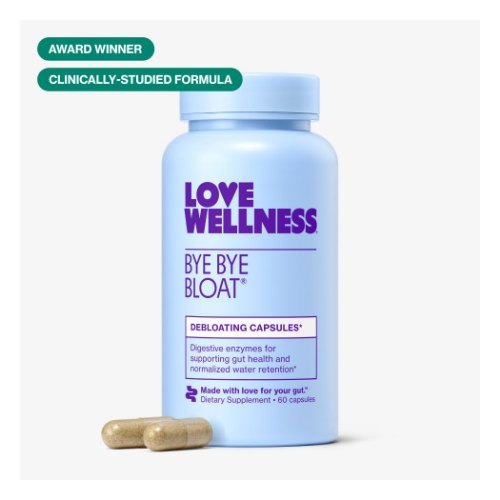
- Format
- Capsule
- Type
- Digestive enzyme and herbal
- Cost
- See the price on Amazon
- Customer rating
- 4.7 out of 5 from 8,906 ratings from Walmart
Not sure it suits your symptoms? The quiz matches one product to you in one to three minutes.
What customers consistently report
- Less bloating after meals and around periods
- A flatter, lighter stomach within a week or two
- A staple to take at night or pack for travel
Those are the themes that recur across the reviews. High review confidence — 4.7 from 8,906 ratings at Walmart.
The mechanism, as the brand describes it
Amylase, protease, pepsin, lipase, bromelain and papain are enzymes that break down starch, protein and fat, so the idea is that food is digested more fully and less of it reaches the large intestine to ferment into gas. Dandelion is a diuretic herb, meaning it is traditionally used to make you urinate more, and the brand credits parsley leaf with supporting normal water retention; that is the basis of its water-weight claim. Ginger may speed how fast the stomach empties, and fennel and fenugreek are traditional digestive herbs. The label gives no amounts, so it cannot be checked whether any ingredient is present at a studied level. No lactase or alpha-galactosidase, the enzymes that act on milk sugar and bean sugars, is listed.
What has actually been tested
The evidence here is for the ingredient classes, not this formula. The brand registered one open-label study of this product with no placebo group (40 women, four weeks, self-reported bloating), and its advertised 80% and 70% figures come from a consumer perception survey of 30 women. For the parts: a 16-person trial found a lipase capsule lowered fullness after a fatty meal without a significant bloating effect; the only human dandelion trial (17 people, one day, leaf extract) found more urination after the first two doses; ginger sped stomach emptying in 11 people but did not change symptoms. No adult bloating trial of fennel or parsley was found.
What the panel prints, and what it leaves out
All eleven ingredients sit inside one 700 mg blend, with no amount for any herb or enzyme and no enzyme activity units, so no dose can be compared with a trial. The five herbs are listed ahead of the six enzymes, and labeling rules list blend parts by weight, so the enzymes are the smallest share. The label says third-party tested without naming the tester, and prints a California Proposition 65 warning with no chemical named.
Herb entries for what is in it.




When it makes sense
The quiz pairs it with answers that mention bloating, symptoms that follow particular foods and general abdominal discomfort. It fits someone whose priority is day-to-day comfort or handling meals. Which product the quiz lands on also turns on what you have already tried, the format you prefer, and any exclusions that apply to you.
Where it falls short of the brief
The dietary claims the label makes are gluten-free, dairy-free and no added sweeteners. One group does not see Bye Bye Bloat in their results: people pregnant or breastfeeding or taking prescription medication. The product is not the problem; the person who should decide is. It is a capsule taken as often as the label directs, and the quiz asks whether that is a routine you will keep.
Side effects and what to be aware of
The brand advises people who are pregnant, nursing, planning pregnancy or taking oral medications to ask a clinician first, and notes fenugreek may affect people with a legume allergy and dandelion people with a ragweed allergy.
Questions people ask
Does Bye Bye Bloat work?
Target and Walmart average 4.7. The brand registered a four-week, 40-woman study with no placebo group, and no peer-reviewed trial of the formula was found. The brand says results can take two to six weeks.
Is Bye Bye Bloat safe, and what are the side effects?
The label carries a California Proposition 65 warning without naming a chemical, and the brand says to check with a clinician if pregnant, nursing, planning pregnancy or taking oral medications. Fenugreek can cross-react with a legume allergy and dandelion with a ragweed allergy.
Is Bye Bye Bloat a diuretic?
It contains dandelion root and parsley leaf, which are traditionally used to increase urine output, and the brand says it supports normal water retention. The only human dandelion trial was one day in 17 people using a leaf extract, so the effect at this dose is unknown. The brand says it is not a laxative.
How much does Bye Bye Bloat cost?
$24.99 for 60 capsules on the brand site, and about $24.48 at Walmart, which is $0.83 a day at the label serving of two capsules. The brand-site subscription is $16.24 for the first order, then 20% off. Opened bottles cannot be returned under the brand’s policy.
Bye Bye Bloat vs an alpha-galactosidase product such as Beano?
Bye Bye Bloat lists amylase, protease, pepsin, lipase, bromelain and papain but not alpha-galactosidase or lactase. Alpha-galactosidase has a small crossover trial in which it cut gas after a bean meal. Which fits depends on which foods set off the symptoms, and the Bye Bye Bloat label gives no enzyme amounts to compare.
A word before buying. Anyone pregnant or breastfeeding, or taking prescription medication should run Bye Bye Bloat past a doctor or pharmacist. What is written here is research, not medical advice.
Would the quiz pick this for you?
Tell the quiz your symptoms, what you have tried and any medicines you take; it ranks Bye Bye Bloat against the rest and shows its reasons.
Take the quiz →Free. Private. Nothing to sign up for.
Its peers in the catalog
These sit in the same role as Love Wellness Bye Bye Bloat — taken with meals — so they are the sensible things to weigh it against.
See all the products we have researched →
Further reading
The guides behind the category, written from the trials rather than the labels.