Guide
Do Casa de Sante FODMAP Digestive Enzymes work? Eighteen enzymes with units, and no enzyme for fructans
Quick answer
Do Casa de Sante FODMAP Digestive Enzymes work? No trial of this capsule was found. Its eighteen enzymes each print a unit, including alpha-galactosidase at 50 GalU and lactase at 500 ALU, but there is no fructan enzyme, and the brand itself says its enzymes do not break down fructans. The alpha-galactosidase amount is below the 300 to 1,200 GalU used in trials, and two IBS trials of that enzyme were null.
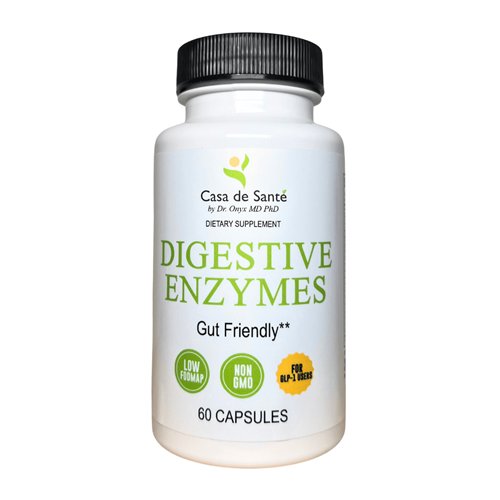
Casa de Sante FODMAP Digestive Enzymes is a vegetable capsule of eighteen enzymes, taken at the first bite of a meal and sold for gas, bloating and fullness on a low FODMAP diet. Every enzyme on its label has a printed activity unit and there is no proprietary blend, but the panel has no enzyme for fructans, the FODMAP group in wheat, garlic and onion. This page covers the label, the evidence, FODZYME, price and reviews.
What the capsule is, and what it is not
One capsule is the serving, and a bottle holds 60. The other ingredients are maltodextrin, medium chain triglycerides and the capsule (hypromellose and water). There are no probiotics or herbs. The panel lists eighteen enzymes, each with its own unit:
| Enzyme as printed | Per capsule |
|---|---|
| Protease 1; Protease 2 | 20,000 HUT; 4,000 HUT |
| Aspergillopepsin | 100 SAPU |
| Amylase; Glucoamylase | 5,000 DU; 50 AGU |
| Lipase | 1,250 FIP |
| Cellulase; Hemicellulase | 500 CU; 1,000 HCU |
| Invertase | 200 SU |
| Alpha Galactosidase | 50 GalU |
| Beta Glucanase; Pectinase | 65 BGU; 16.9 endo-PGU |
| Xylanase; Phytase | 250 XU; 10 FTU |
| Lactase | 500 ALU |
| Bromelain; Papain | 900,000 PU; 100,000 PU |
| Peptidase | 160 DPPIV |
The label does not define “PU”, and enzyme units are laboratory measures: suppliers do not always use the same assay behind the same abbreviation. The brand’s own blog pages list bromelain and papain at 500,000 PU each, where the bottle prints 900,000 and 100,000. Either the formula changed or the blog is out of date, and the bottle is the later source.
Which FODMAPs the enzymes address
Two panel lines match a FODMAP group: alpha-galactosidase at 50 GalU for galacto-oligosaccharides (the sugars in beans and lentils) and lactase at 500 ALU for lactose. There is no fructanase or inulinase, so nothing on the label targets fructans, and no enzyme for polyols such as sorbitol and mannitol. The brand says this itself: its product page states that enzymes “do not remove fructans from wheat, garlic, or onion,” and its comparison page says this capsule lists alpha-galactosidase and lactase but not a fructan-targeting enzyme.
The bottle carries a “Low FODMAP” badge, and the brand page says the finished product is FODMAP Friendly certified. Those are the brand’s claims. A certification of this kind says the capsule itself is low in FODMAPs per serving; it does not say the enzymes lower the FODMAPs in a meal.
The evidence
We found no trial of this capsule: a search of PubMed and ClinicalTrials.gov for the brand returned nothing, and the brand cites no study of the formula. The evidence sits with two of its enzymes and with blends in general.
Alpha-galactosidase. In 8 healthy volunteers eating a bean meal, 1,200 GalU lowered breath hydrogen and flatulence and 300 GalU lowered the symptom score. Two trials in people with irritable bowel syndrome were null: 125 patients over 12 weeks showed no routine benefit, and 20 patients given 1,200 GalU per meal did no better than on placebo. One capsule here supplies 50 GalU, a sixth of the lowest trial dose that helped; two capsules supply 100. Against the ElevenZyme (150 GalU), Let Loose (300), Digest Gold (450) and HoloZyme (650) labels, it prints the lowest alpha-galactosidase amount; the ElevenZyme guide sets out that comparison. No trial is pinned to the 500 ALU of lactase.
Multi-enzyme blends. A 120-adult trial of a fungal multi-enzyme blend at 400 mg a day found better dyspepsia scores than placebo over two months, and a 40-patient trial of another blend favored the enzymes, with authors tied to its maker. Both were in functional dyspepsia, not FODMAP intolerance, and this label gives no blend weight, so no dose comparison is possible. The only registered trial of a FODMAP-targeting enzyme product that we found is of FODZYME, and it does not test this formula. The digestive enzymes guide covers where single enzymes have trial support.
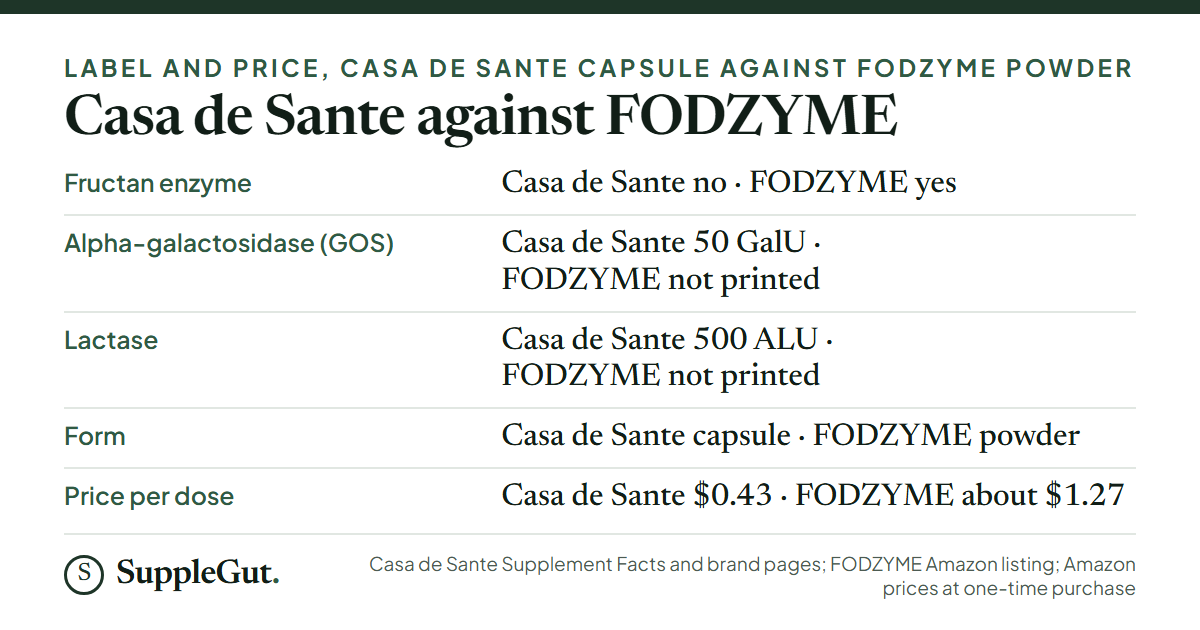
Casa de Sante against FODZYME
FODZYME is the product people most often compare it with, and the two differ in construction:
- Fructan enzyme: FODZYME lists a fructan hydrolase; Casa de Sante lists none.
- GOS and lactose: FODZYME lists alpha-galactosidase and lactase with no amounts printed; Casa de Sante prints 50 GalU and 500 ALU.
- Label detail: FODZYME prints a proprietary blend weight of 24 mg a serving and no individual units; Casa de Sante prints eighteen.
- Form: FODZYME is a powder sprinkled on food; Casa de Sante is a capsule swallowed at the first bite.
- Evidence: neither has results from a trial of its own formula. FODZYME has a registered randomized crossover trial with no results posted; Casa de Sante has none registered.
The brand’s own comparison page names FODZYME as the option when fructans are the main trigger. For the single-enzyme route, Beano is alpha-galactosidase alone at 300 GalU a tablet.
Directions on the label
The bottle says one capsule at the beginning of each meal or as directed by a healthcare professional, and not to exceed six capsules a day. The brand page says one or two capsules at the first bite of a meal that usually causes discomfort. No trial tests either, so a fair test is a few weeks at one meal type, noting symptoms after the meals that used to cause trouble.
The brand also markets the capsule to people taking GLP-1 medication and says enzymes do not change how the medication works. We found no trial of enzymes in GLP-1 users.
What the label says about side effects
The bottle says pregnant or nursing mothers, children under 18 and anyone with a known medical condition should consult a physician. The brand’s page also names blood thinners, diabetes medication, pancreatitis, active pancreatic disease and a history of gastrointestinal surgery as reasons to check with a clinician. Bromelain and papain are on the panel.
The panel reads “Contains Milk, Soy, and Wheat,” from the fermentation used to make the enzymes, and the bottle adds a shared-facility statement covering egg, peanuts, tree nuts, fish and shellfish. We found no gluten-free claim. The Amazon listing calls the capsules vegan, which sits alongside the milk statement on the panel.
Reading the customer reviews
- Brand site: 4.58 from 66 reviews, shown through a review app on the brand’s own page. We did not read the star split or the review text.
- Trustpilot: the profile for casadesante.com is unclaimed and has no reviews.
Price, subscriptions and returns
A 60-capsule bottle is $29.99 on the brand site, or $0.50 a capsule; the brand site offers subscriptions through an app, and we did not read the discount. At one capsule with each of three meals, that is about $1.50 a day on the brand site, and $3.00 at the six-capsule limit.
The brand’s refund policy runs 30 days, with the buyer paying return shipping and original shipping costs not refunded.
Where it fits
- Someone whose trigger meals involve beans, legumes or dairy, aware that the alpha-galactosidase amount is below the trial doses.
- Someone who wants a unit printed for each enzyme and a capsule rather than a powder.
- Someone whose main trigger is wheat, garlic or onion should read the fructan row above first; the FODZYME page covers the fructan option, and the quiz starts from symptoms.
The products in this catalog
Common questions
Do Casa de Sante FODMAP Digestive Enzymes work?
No trial of this formula was found. The label has alpha-galactosidase at 50 GalU and lactase at 500 ALU but no fructan enzyme, and the brand says its enzymes do not remove fructans from wheat, garlic or onion.
What enzymes are in it, and is there a fructan enzyme?
Eighteen: two proteases (20,000 and 4,000 HUT), aspergillopepsin 100 SAPU, amylase 5,000 DU, lipase 1,250 FIP, cellulase 500 CU, glucoamylase 50 AGU, invertase 200 SU, alpha-galactosidase 50 GalU, beta glucanase 65 BGU, pectinase 16.9 endo-PGU, xylanase 250 XU, phytase 10 FTU, hemicellulase 1,000 HCU, lactase 500 ALU, bromelain 900,000 PU, papain 100,000 PU and peptidase 160 DPPIV. There is no fructanase or inulinase.
Casa de Sante vs FODZYME: which covers more FODMAPs?
FODZYME lists a fructan hydrolase, lactase and alpha-galactosidase in a powder sprinkled on food, so it addresses fructans, GOS and lactose; Casa de Sante’s capsule has alpha-galactosidase and lactase but no fructan enzyme. Casa de Sante prints eighteen units; FODZYME prints no individual amounts and has a registered trial with no results posted. See the FODZYME page.
Is it really low FODMAP, and what does the certification mean?
The bottle has a “Low FODMAP” badge, and the brand says the finished product is FODMAP Friendly certified. Those are the brand’s claims. A certification of that kind means the capsule is low in FODMAPs per serving, not that it lowers the FODMAPs in a meal.
How much does it cost per dose and per day?
A 60-capsule bottle is $29.99 on the brand site ($0.50 a capsule). The bottle says one capsule at the beginning of each meal, up to six a day, so one capsule at each of three meals is about $1.50 a day on the brand site.
Is it gluten-free, and who should check with a doctor first?
The panel says “Contains Milk, Soy, and Wheat” from the fermentation process, and no gluten-free claim was found. The bottle says pregnant or nursing mothers, children under 18 and people with a known medical condition should consult a physician, and the brand’s site names blood thinners and diabetes medication.
Why do the bromelain and papain amounts differ from the brand’s blog?
The bottle prints bromelain at 900,000 PU and papain at 100,000 PU, while the brand’s blog pages list 500,000 PU of each. Either the formula changed or the blog is out of date, and the bottle is the later source. The label does not define PU.
Sources
- Casa de Sante brand pages: FODMAP Digestive Enzymes product page, and the Casa de Sante vs FODZYME comparison page (a brand source). casadesante.com/products/fodmap-digestive-enzymes; comparison page
- Casa de Sante brand pages: bottle Supplement Facts, directions and warnings; refund policy. casadesante.com/policies/refund-policy
- Amazon listing: Casa de Sante FODMAP Digestive Enzymes, listing text. amazon.com/dp/B0992MZJBR
- Di Stefano M, et al. Alpha-galactosidase and gas after a bean meal in 8 healthy volunteers. Digestive Diseases and Sciences, 2007. PMID 17151807
- Hillila M, et al. Alpha-galactosidase in 125 patients with irritable bowel syndrome. Scandinavian Journal of Gastroenterology, 2016. PMID 26133538
- Bohn L, et al. Alpha-galactosidase in 20 patients with irritable bowel syndrome. Neurogastroenterology and Motility, 2021. PMID 33619835
- Ullah H, et al. A multi-enzyme blend from fungal fermentation in 120 adults with functional dyspepsia: randomized, double-blind, placebo-controlled trial. Biomedicine and Pharmacotherapy, 2023. PMID 37976892
- Majeed M, et al. DigeZyme multi-enzyme supplement in 40 patients with functional dyspepsia. Journal of Medicinal Food, 2018. PMID 30156436
- ClinicalTrials.gov. Registered randomized crossover trial of FODZYME, NCT07591584 (no results posted). clinicaltrials.gov/study/NCT07591584
Which of these fits you?
Three minutes with the quiz turns this background into one named product, with the reasons shown.
Take the quiz →