
Guide
Does Cielo Horizon work? The label, the trials behind each ingredient and the reviews
Quick answer
Does Cielo Horizon work? No trial of Horizon exists. The probiotic trials that helped IBS used named strains, and this label lists six species with no strain codes and one 20 billion CFU total. Its 0.1 g of inulin compares with 3 to 20 g a day in the trials that raised bifidobacteria, and its seven enzymes are printed without units. Reviews average 4.3 from 69 on Amazon and 4.7 from 128 on the brand’s own page, which includes a gifted-product review.
Cielo Horizon is a 45-capsule bottle from Cielo Daily LLC, sold on its own site and on Amazon, that puts seven digestive enzymes, six probiotic species, inulin and three botanicals into one capsule taken once a day. The brand calls it a “Gut Foundation”. What makes it different from a single-purpose probiotic is the stack: four ideas in one capsule, each with human research at doses or identities the label does not show. This page checks each against its studies.
What Horizon is, and what the label prints
| Ingredient | Per capsule | What is disclosed |
|---|---|---|
| Enzyme blend: protease, amylase, lactase, cellulase, invertase, lipase, alpha-galactosidase | 300 mg | One figure; no activity units for any enzyme |
| Probiotic blend: six species | 100 mg, 20 billion CFU | One figure; no count per species |
| Inulin powder | 100 mg | Source plant not stated |
| Ginger root extract | 50 mg | Extract ratio not stated |
| Aloe vera leaf powder | 50 mg | Amount printed |
| Marshmallow root extract | 15 mg | Amount printed |
The two blends hold 400 of the 615 mg of actives. The other ingredients are the vegetable capsule, bamboo extract and a rice extract blend. The brand’s page text lists five ingredients and omits marshmallow root; the label and Amazon include it. The About page names its founders by first name only (Molly, Maddy and Nida) and a functional-medicine practitioner partner, Dr. Kenny Mittelstadt, whose license we did not check; we found no street address for Cielo Daily LLC.
There is no trial of Horizon
We found nothing on PubMed or ClinicalTrials.gov for Cielo Daily. The product page says “clinically studied doses” and “decades of clinical research” without naming a study, and the label names no trademarked strain or ingredient that has trials of its own.
Probiotics: six species, no strains
The label lists Bifidobacterium longum, B. lactis, Lactobacillus plantarum, L. rhamnosus, L. acidophilus and L. helveticus, with no strain designation for any. The 20 billion CFU is the blend’s total; split evenly it would be about 3.3 billion each, but the split is not stated, nor whether the count holds through expiry. The 2021 ACG guideline suggests against probiotics for global IBS symptoms (conditional, very low-quality evidence) and the 2020 AGA guideline found too little evidence to recommend them. A 2014 meta-analysis of 43 trials found probiotics lowered persisting IBS symptoms (RR 0.79, 95% CI 0.70 to 0.89) but said which species and strains help most “remains unclear” (Ford et al., 2014).
The trials that succeeded named their strains. A four-strain product cut an IBS composite score by 14 points against 3 on placebo in 86 patients over five months (p=0.0083; Kajander et al., 2008), and L. plantarum 299v lowered pain and bloating in 214 patients in four weeks (Ducrotté et al., 2012). Horizon names species without those strain codes, so those results are not shown to apply to it.
Inulin: 0.1 gram against the trial doses
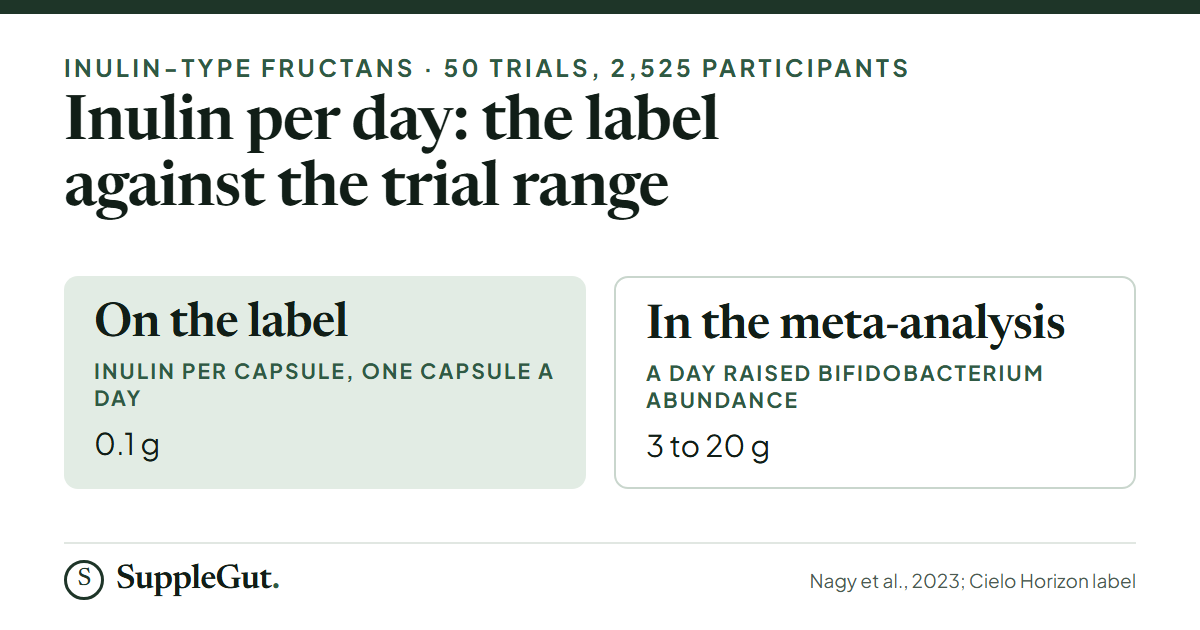
A meta-analysis of 50 trials in 2,525 participants found chicory inulin-type fructans at 3 to 20 g a day raised Bifidobacterium abundance (SMD 0.83, 95% CI 0.58 to 1.08; Nagy et al., 2023). Tolerance studies use 5 and 10 g (Bonnema et al., 2010). Horizon’s 0.1 g is 0.5% to 3.3% of the bifidogenic range. The 2014 review found synbiotics “appeared beneficial” (RR of non-response 0.78, 0.67 to 0.92) on sparse data.
Enzymes: seven named, none measured
The 300 mg enzyme blend prints no activity for any enzyme, so no dose can be compared. The enzyme research in IBS is prescription pancreatic enzymes in the 5% to 6% of IBS-D patients with measured insufficiency (Leeds et al.; Olmos et al., 2022). Alpha-galactosidase reduced gas after bean meals in a small trial at 300 to 1,200 GalU (Di Stefano et al., 2007); Horizon prints no units. We found no trial of a seven-enzyme supplement for bloating.
Ginger, aloe and marshmallow root
Ginger, 50 mg. In randomized crossover studies, 1.2 g of ginger quickened gastric emptying in 24 healthy volunteers and in 11 patients with functional dyspepsia, with no change in symptoms in either (Wu et al., 2008; Hu et al., 2011). Horizon’s 50 mg is 4% of that. A ginger plus artichoke extract (two capsules a day for 4 weeks, 126 patients) improved nausea, fullness, pain and bloating in functional dyspepsia (Giacosa et al., 2015); Horizon has no artichoke.
Aloe vera, 50 mg. A meta-analysis of 3 placebo-controlled trials in 151 IBS patients found improved symptom scores (SMD 0.41, 95% CI 0.07 to 0.75; Hong et al., 2018). One 58-patient trial found response of 35% against 22%, p=0.763 (Davis et al., 2006). Those tested aloe preparations measured in milliliters, not 50 mg of leaf powder. Marshmallow root, 15 mg: we found no human gastrointestinal trial.
How to take Horizon
One capsule daily with food, or as a healthcare provider recommends; no refrigeration. The label and brand say one capsule, and the bottle holds 45. The brand’s FAQ says to pick the meal that works best and stick with it. We found no stated length for a fair trial.
Side effects and who should not take it
The brand says Horizon is for adults 18 and over and is not recommended while pregnant or breastfeeding, and recommends checking with a provider before adding it, including for type 2 diabetes. The label image shows no warnings text and no allergen statement. The brand calls the formula vegan; gluten-free and dairy-free are not stated on the page we read. The Horizon reviews we read do not mention side effects for it alone; two bundle-page reviewers report gas, diarrhea, headaches and stomachaches from the three-product bundle.
What the reviews say
The brand’s own page shows 4.70 from 128 reviews in a widget it hosts, with an AI-written summary above them; one 5-star reviewer writes that the product was gifted for an Instagram post. Amazon shows 4.3 from 69 ratings (65% five-star, 13% four, 13% three, 4% two, 5% one). Of the 8 reviews on Amazon’s product page, 2 are flagged Vine Customer Review of Free Product, and of the 5 critical reviews we read, 3 are Vine. We found no Trustpilot profile and no Better Business Bureau listing, and we did not read Reddit.
Reviewers praise less bloating and better digestion, an easy-to-swallow capsule with no taste, and a change within days to weeks, including after gallbladder removal. They complain of no noticeable effect and, once, a package that arrived open.
Return policy and subscription
One-time purchase is the default on the brand page; a 10% subscription (every 1, 2 or 3 months) is opt-in. The brand offers a 60-day money-back guarantee: the request comes within 60 days of purchase, a physical return is required, $4.99 return shipping is deducted, opened product may be returned, and the limit is one return per product per household. The brand reserves the right to limit returns it suspects are misuse. The Amazon listing says 30 days instead. We found no cancellation instructions in the page text we read, and no independent billing or refund complaints, though with no Trustpilot profile that is an absence of data.
Who Horizon is for
- Someone who wants probiotics, a prebiotic, enzymes and botanicals in one daily capsule and accepts that strains, enzyme units and most doses are not printed.
- An adult who is not pregnant or breastfeeding and whose provider has no objection to ginger, aloe or the probiotic blend.
- Someone who prefers a once-a-day capsule to separate bottles.
The probiotic guide starts from named strains, and enzymes versus probiotics for bloating separates the two ideas. Catalog pages include Culturelle Digestive Daily, Align (compared in Align vs Culturelle) and the enzyme-only NOW Super Enzymes.
Cost
One bottle is $35.00 on the brand site and on Amazon, $0.78 a day at one capsule. A brand-site subscription is $31.50 ($0.70 a day); Amazon Subscribe & Save is $28.00 ($0.62). Horizon is also sold in a $99.95 three-product bundle, against $112.00 for the three bought singly.
The products in this catalog
Common questions
Does Cielo Horizon work?
No trial of Horizon was found. Probiotic trials that helped IBS used named strains, and this label lists six species with no strain codes; the ACG guideline suggests against probiotics for global IBS symptoms. Reviews average 4.3 from 69 on Amazon and 4.7 from 128 on the brand’s own page, and some reviewers report less bloating while others report no change. See the probiotic guide for strain-level evidence.
What strains are in Cielo Horizon?
None are named. The label lists six species, B. longum, B. lactis, L. plantarum, L. rhamnosus, L. acidophilus and L. helveticus, as a 100 mg blend totaling 20 billion CFU, with no count per species and no statement of whether the count holds through expiry.
Does 100 mg of inulin matter?
The inulin trials that raised Bifidobacterium used 3 to 20 g a day, and tolerance studies use 5 and 10 g. Horizon’s 100 mg is 0.1 g, which is 0.5% to 3.3% of that range.
Which digestive enzymes are in Cielo Horizon?
Protease, amylase, lactase, cellulase, invertase, lipase and alpha-galactosidase, as one 300 mg blend with no activity units for any of them, so the doses cannot be compared with those in studies. For how enzymes and probiotics differ, see enzymes versus probiotics for bloating.
Is Cielo Horizon safe, and can you take it while pregnant?
The brand says it is for adults 18 and over, not recommended while pregnant or breastfeeding, and that people with conditions such as type 2 diabetes should talk to a provider first. The label lists ginger, aloe vera leaf powder and marshmallow root extract and carries no allergen statement. The Horizon reviews we read do not mention side effects for it alone.
Are the Cielo Horizon reviews reliable?
The 4.70 from 128 sits in a widget on the brand’s own page, and one 5-star reviewer there says the product was gifted for an Instagram post. On Amazon, which shows 4.3 from 69 ratings, 2 of the 8 reviews on the product page are Vine free-product reviews. We found no Trustpilot profile.
How much does Cielo Horizon cost, and what is the return policy?
One 45-capsule bottle is $35.00 ($0.78 a day), or $31.50 with a brand-site subscription and $28.00 with Amazon Subscribe & Save. The brand offers a 60-day money-back guarantee with a physical return and $4.99 return shipping deducted, one return per product per household; the Amazon listing says 30 days instead.
Sources
- Ford AC, Quigley EM, Lacy BE, et al. "Efficacy of prebiotics, probiotics, and synbiotics in irritable bowel syndrome and chronic idiopathic constipation: systematic review and meta-analysis." American Journal of Gastroenterology, 2014;109(10):1547–1561. doi.org/10.1038/ajg.2014.202
- Lacy BE, Pimentel M, Brenner DM, et al. "ACG Clinical Guideline: Management of Irritable Bowel Syndrome." American Journal of Gastroenterology, 2021;116(1):17–44. doi.org/10.14309/ajg.0000000000001036; Su GL, Ko CW, Bercik P, et al. "AGA Clinical Practice Guidelines on the Role of Probiotics in the Management of Gastrointestinal Disorders." Gastroenterology, 2020;159(2):697–705. doi.org/10.1053/j.gastro.2020.05.059
- Kajander K, Myllyluoma E, Rajilić-Stojanović M, et al. "Clinical trial: multispecies probiotic supplementation alleviates the symptoms of irritable bowel syndrome and stabilizes intestinal microbiota." Alimentary Pharmacology & Therapeutics, 2008;27(1):48–57. doi.org/10.1111/j.1365-2036.2007.03542.x; Ducrotté P, Sawant P, Jayanthi V. "Clinical trial: Lactobacillus plantarum 299v (DSM 9843) improves symptoms of irritable bowel syndrome." World Journal of Gastroenterology, 2012;18(30):4012–4018. doi.org/10.3748/wjg.v18.i30.4012
- Nagy DU, Sándor-Bajusz KA, Bódy B, et al. "Effect of chicory-derived inulin-type fructans on abundance of Bifidobacterium and on bowel function: a systematic review with meta-analyses." Critical Reviews in Food Science and Nutrition, 2023;63(33):12018–12035. doi.org/10.1080/10408398.2022.2098246; Bonnema AL, Kolberg LW, Thomas W, Slavin JL. "Gastrointestinal tolerance of chicory inulin products." Journal of the American Dietetic Association, 2010;110(6):865–868. doi.org/10.1016/j.jada.2010.03.025
- Leeds JS, Hopper AD, Sidhu R, et al. "Some patients with irritable bowel syndrome may have exocrine pancreatic insufficiency." Clinical Gastroenterology and Hepatology, 2010;8(5):433–438. doi.org/10.1016/j.cgh.2009.09.032; Olmos JI, Piskorz MM, Litwin N, et al. "Exocrine Pancreatic Insufficiency is Undiagnosed in Some Patients with Diarrhea-Predominant Irritable Bowel Syndrome Using the Rome IV Criteria." Digestive Diseases and Sciences, 2022;67(12):5666–5675. doi.org/10.1007/s10620-022-07568-8
- Di Stefano M, Miceli E, Gotti S, et al. "The effect of oral alpha-galactosidase on intestinal gas production and gas-related symptoms." Digestive Diseases and Sciences, 2007;52(1):78–83. doi.org/10.1007/s10620-006-9296-9
- Wu KL, Rayner CK, Chuah SK, et al. "Effects of ginger on gastric emptying and motility in healthy humans." European Journal of Gastroenterology & Hepatology, 2008;20(5):436–440. doi.org/10.1097/MEG.0b013e3282f4b224; Hu ML, Rayner CK, Wu KL, et al. "Effect of ginger on gastric motility and symptoms of functional dyspepsia." World Journal of Gastroenterology, 2011;17(1):105–110. doi.org/10.3748/wjg.v17.i1.105
- Giacosa A, Guido D, Grassi M, et al. "The Effect of Ginger (Zingiber officinalis) and Artichoke (Cynara cardunculus) Extract Supplementation on Functional Dyspepsia: A Randomised, Double-Blind, and Placebo-Controlled Clinical Trial." Evidence-Based Complementary and Alternative Medicine, 2015;2015:915087. doi.org/10.1155/2015/915087
- Hong SW, Chun J, Park S, et al. "Aloe vera Is Effective and Safe in Short-term Treatment of Irritable Bowel Syndrome: A Systematic Review and Meta-analysis." Journal of Neurogastroenterology and Motility, 2018;24(4):528–535. doi.org/10.5056/jnm18077; Davis K, Philpott S, Kumar D, Mendall M. "Randomised double-blind placebo-controlled trial of aloe vera for irritable bowel syndrome." International Journal of Clinical Practice, 2006;60(9):1080–1086. doi.org/10.1111/j.1742-1241.2006.00980.x
- Brand pages: label, directions, claims, ingredients center, return policy and price (cielodaily.com/products/horizon, return policy); Amazon listing: price and ratings (amazon.com/dp/B0CW3PPQBR)
Not sure which product fits your situation?
This guide covers the mechanics. The quiz takes your specific symptoms, routine and preferences and matches you to one product from the catalog.
Take the quiz →