
Guide
Does Dr. Tobias Deep Immune work? One coded spore strain, three species, and a phage prebiotic
Quick answer
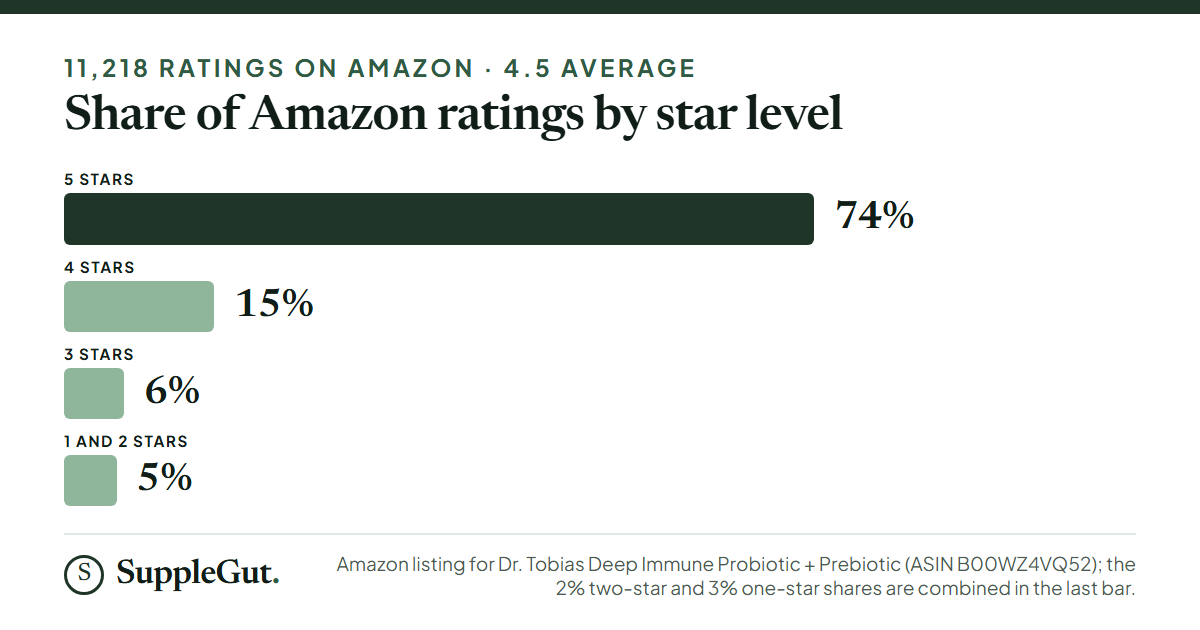
Does Dr. Tobias Deep Immune work? We could find no trial of Deep Immune itself. Its label lists four organisms sharing 4.4 billion CFU, only DE111 with a strain code, plus 15 mg of PreforPro, which is a bacteriophage mix and not a fiber. DE111 reached the small intestine in an 11-person ileostomy study, and PreforPro showed within-group gut changes alongside a different probiotic in 68 people, but the trial pairing DE111 with PreforPro has no published results. Amazon shows 4.5 from 11,218 ratings, with 74% five-star.
Deep Immune Probiotics & Prebiotics is the Dr. Tobias capsule that puts four bacteria and a mix of bacteriophages into one two-capsule serving. Three things set it apart from the probiotic shelf: one of its four organisms carries a strain code, two of them are spore-formers, and its “prebiotic” is not a fiber at all. This page sets out what the panel prints, what trials exist for the branded parts and at what dose, what the reviews say, and what it costs by route.
What Deep Immune is, and what it is not
The Supplement Facts panel lists two groups, each with a single weight. The probiotic group is 4.4 billion CFU of four organisms, 27 mg in all: DE111 (Bacillus subtilis), Bacillus coagulans, Lactobacillus acidophilus and Bifidobacterium lactis. The second group is PreforPro, 15 mg, listed as four components named LH01, LL5, T4D and LL12. A serving is two vegetable capsules, a bottle holds 60 capsules, and the other ingredients are the capsule (hydroxypropyl methylcellulose, pectin and water), maltodextrin and medium chain triglycerides.
Only DE111 carries a strain designation, and DE111 is a trademark of Deerland Probiotics & Enzymes that refers to one strain. B. coagulans, L. acidophilus and B. lactis are printed as species only, and probiotic effects are strain-specific. The 4.4 billion CFU is a total for four organisms, so the amount of DE111 alone is not printed. DE111 and B. coagulans form spores; the other two do not.
The PreforPro line is the one most readers misread. Its four components are bacteriophages, which are viruses that infect bacteria, not a fiber like inulin. The sponsor-linked trials describe it as a phage cocktail aimed at E. coli, which the maker calls a prebiotic because the idea is that thinning out some E. coli changes the gut in favor of the probiotic strains. The “prebiotic” in this capsule is therefore 15 mg of a phage preparation, and the label contains no fiber-type prebiotic. We cover phage ingredients in the Biome Protect guide, which uses a different phage blend.
The trial of the product itself
There is none. We searched PubMed and ClinicalTrials.gov under the product and brand names and found no study of the finished capsule, and the brand does not cite one. Its evidence sits in trials of the two branded ingredients, both made by Deerland (now part of ADM), and several of those were sponsor-linked or run at universities with its funding.
The evidence for PreforPro
In the first PreforPro study, healthy adults took the phage cocktail alone in a crossover design for 28 days. Fecal E. coli fell, alpha and beta diversity did not change, and circulating IL-4 dropped slightly (Febvre et al., Nutrients, 2019). That is a lab-marker result in healthy people, not a symptom result.
The closest trial to this product’s pairing is PHAGE-2, but it used a different probiotic. Sixty-eight healthy adults took B. lactis BL04, BL04 with PreforPro, or placebo for four weeks. The group taking BL04 with PreforPro had within-group improvements in gastrointestinal inflammation (p = 0.01) and a trending improvement in colon pain (p = 0.08); the probiotic-only group did not, and the abstract reports no between-group test for those outcomes (Grubb et al., Nutrients, 2020). A within-group change shows that a group moved; it does not show that the capsule moved it more than placebo would have.
The trial that pairs PreforPro with DE111 for bowel regularity and gut symptoms is registered as NCT05750433, run at Colorado State University in 120 participants. It is listed as completed, with no results posted and no publication found in PubMed. Until it reports, this product’s exact pairing has no published gut result.
The evidence for DE111
The best-known DE111 study asks whether the spores survive. In 11 people with an ileostomy, a randomized crossover trial found DE111 spores and vegetative cells in ileal effluent three hours after ingestion, with spore counts rising by six hours (Colom et al., Frontiers in Microbiology, 2021). That supports the brand’s survival argument for DE111 alone; it is not a symptom outcome, and Deerland employees were among its authors.
The symptom and immune trials of DE111 are small and mostly short. A four-week pilot in healthy adults found that anti-inflammatory immune-cell populations rose after laboratory stimulation, while perceived gut health, the microbiota and fecal inflammation markers were largely unaffected (Freedman et al., International Journal of Molecular Sciences, 2021). In 25 Division I baseball players taking 1 billion CFU a day for 12 weeks, TNF-alpha was lower with DE111 (p = 0.024), with no change in body composition, performance or gut permeability (Townsend et al., Sports, 2018). A four-week trial that included a DE111 arm found total cholesterol lower by 8 mg/dL versus baseline, which is not a gut outcome (Trotter et al., Beneficial Microbes, 2020). Another DE111 bowel-movement study, NCT04083521 in 50 participants, is completed with no results posted.
A 98-person pilot of a four-Bacillus cocktail that included DE111 gave 2.0 billion CFU a day in total for 45 days and reported fewer loose stools, with other symptoms and stool frequency unchanged (Rea et al., Beneficial Microbes, 2023). Its organisms differed from this formula and it had no PreforPro.
The DE111 trials above used 1 billion CFU or an unreported dose. This label gives 4.4 billion CFU for all four organisms combined, so DE111 is at most that figure and likely less. No published trial matches the label’s dose and combination.
What the evidence says about spore probiotics and bloating
For a different Bacillus subtilis strain (ATCC 122264), a randomized trial gave 5 billion CFU a day for eight weeks to 100 adults with functional bloating. It found no difference from placebo on the global gas score or on the bloating and flatulence dimensions. In women, belching and flatulence severity fell versus placebo (LeMoire et al., Beneficial Microbes, 2025). It is a different strain at a higher dose than this label’s whole total, so it does not say DE111 fails; it shows that a spore-forming Bacillus does not automatically beat placebo for bloating.
For IBS, a 2026 strain-by-strain meta-analysis of 32 placebo-controlled trials found benefit for named strains, and none of the organisms on this label were among those with a positive result there (Maslennikov et al., Journal of Clinical Medicine, 2026). The 2021 American College of Gastroenterology IBS guideline suggests against probiotics for overall IBS symptoms, and the 2020 American Gastroenterological Association guideline found too little evidence to recommend them outside trials. For how to read a CFU figure, see how many CFU you need.
The delayed-release claim
The brand page calls the capsules “delayed-release” and “targeted-release”, and the Amazon bullets say the design supports probiotic survival. The capsule shell on the panel is hydroxypropyl methylcellulose with pectin. We found no dissolution or release testing on the brand site, on Amazon or in PubMed, so the claim has no data behind it that we could read. The brand also says the product is shelf stable with no refrigeration.
How to take Deep Immune
The label says two capsules daily, preferably with a meal, or as directed by a healthcare professional. That is one serving a day, and a 60-capsule bottle lasts 30 days. The trials above ran from four weeks to 12 weeks, so a month on the bottle is a fair first test for the digestive effects reviewers describe.
Side effects and who should not take it
The bottle says not to exceed the recommended dose, and tells pregnant or nursing mothers, children under 18 and anyone with a known medical condition to consult a physician first. It carries no medication statement. Amazon’s safety box, which is on the listing rather than the bottle photo we read, says probiotics and prebiotics may temporarily cause bloating, gas, stomach pain, cramps, nausea, diarrhea or constipation, and advises people with severe dairy allergy or lactose intolerance to ask a medical professional first.
On allergens, the label has a facility statement only: it is made in a facility that may also process milk, soy, wheat, egg, peanuts, tree nuts, fish and crustacean shellfish. That covers the major allergens apart from sesame, which is not named. There is no “contains” statement and no free-from statement, and the source of the maltodextrin is not given.
What the reviews say
All three large pools are retailer-hosted. Amazon, where Dr. Tobias is the seller, shows 4.5 from 11,218 ratings: 74% five-star, 15% four, 6% three, 2% two and 3% one. iHerb shows 4.7 from 455 ratings (346 five-star, 72 four, 29 three, 3 two, 5 one). Walmart shows 4.5 from 2,298 ratings; that count looks high for a Walmart-only listing and may be syndicated from another retailer, which we could not verify. Trustpilot has no profile for the brand’s domain and the Better Business Bureau has no matching business, so there is no independent billing-complaint record to check. The brand site loads a third-party review widget whose score we could not read.
Amazon’s full reviews sit behind a sign-in, so what follows rests on its summary of review text and on iHerb’s written reviews. The recurring praise is less gas and bloating, more regular bowel movements, benefit within days to weeks, and a capsule that is easy to swallow. The recurring complaints are no effect, and nausea or discomfort when starting; Amazon’s summary counts 402 side-effect mentions among the 11,218 ratings. One iHerb reviewer wanted a larger pack, though 120- and 180-count sizes exist.
Price, subscription and refund terms
| Route | Price | Per day |
|---|---|---|
| Amazon, brand site or Walmart, 60 count | $25.99 | $0.87 |
| iHerb, 60 count | $27.32 | $0.91 |
| Amazon Subscribe & Save or brand-site subscription | $23.39 | $0.78 |
| Brand site, 120 count | $46.99 | $0.78 |
| Brand site, 180 count | $68.99 | $0.77 |
The brand site’s subscription takes 10% off and delivers every 30, 60 or 90 days. Its refund policy asks for an email to support and a return within 30 days of delivery for a full refund. Amazon sells the product as non-returnable for food-safety reasons.
The company behind it
Dr. Tobias is a Mimi’s Rock company. The brand’s About page says the founder started with fish oil, listed on Amazon, and partnered with Mimi’s Rock in 2018, and the page gives no founder name. The bottle reads “A Mimi’s Rock Company”, and its side text names a distributor in Ahrensburg, Germany. The NIH Dietary Supplement Label Database records one label with a Toronto distributor and a later one listing the German address. The bottle also carries seals reading “Tested Product, Certified Facility” and a GMP-facility mark, with no laboratory named and no certificate of analysis on the brand page or Amazon.
Who Deep Immune is for
- Someone who wants a spore-forming probiotic that needs no refrigeration, taken as two capsules once a day with a meal.
- A buyer who accepts that the combination has no trial of its own, and that the DE111 plus PreforPro gut trial has not reported.
- Someone who will run it for a month and judge it by bloating and regularity, the effects reviewers most often describe.
Where a single-strain product is the preference, see the Advanced Probiotic DE111 page and Just Thrive. Another capsule that pairs a spore probiotic with a phage blend is in the Biome Protect guide. The probiotic guide and the quiz start from symptoms rather than products.
Cost
At the label serving of two capsules a day, a $25.99 bottle costs $0.87 a day, or $0.78 a day on a subscription or the 120-count pack. Amazon prints a per-capsule figure of $0.43, which is half the daily cost.
The products in this catalog
Common questions
Does Dr. Tobias Deep Immune work?
No trial of this capsule was found. Its two branded ingredients have been studied: PreforPro, a bacteriophage mix, showed within-group gut improvements when added to a different probiotic in a 68-person trial, and DE111 reached the small intestine alive in an ileostomy study. The trial pairing DE111 with PreforPro for gut symptoms, in 120 people, has no published results. Amazon shows 4.5 from 11,218 ratings, and many reviewers describe less gas and bloating.
What is PreforPro, and is it a prebiotic?
PreforPro is a mixture of four bacteriophages, which are viruses that infect bacteria, aimed at E. coli. The panel lists them as LH01, LL5, T4D and LL12 at 15 mg a serving. Its maker calls it a prebiotic because it is meant to change the gut environment for probiotic bacteria, but it is not a fiber like inulin, and this label has no fiber-type prebiotic.
What probiotics are in Deep Immune, and how many CFU?
Four organisms share 4.4 billion CFU: DE111 (Bacillus subtilis), Bacillus coagulans, Lactobacillus acidophilus and Bifidobacterium lactis. Only DE111 carries a strain code, and the label gives no count for each organism. The DE111 trials we found used 1 billion CFU or an unreported dose. See how many CFU you need for reading a count.
What are the side effects of Dr. Tobias Deep Immune?
The bottle tells pregnant or nursing mothers, anyone under 18 and anyone with a known medical condition to consult a physician first. Amazon’s safety text lists bloating, gas, stomach pain, cramps, nausea, diarrhea and constipation as possible temporary effects, and some reviewers report nausea or discomfort when starting. The label gives a facility statement covering milk, soy, wheat, egg, peanuts, tree nuts, fish and shellfish, with no “contains” line.
Are the capsules really delayed release?
The brand page and Amazon bullets call them delayed-release or targeted-release, and the capsule shell contains pectin. We found no dissolution or release data on the brand site, on Amazon or in PubMed, so the claim has no test results behind it that we could read.
How much does Deep Immune cost?
A 60-capsule bottle is $25.99 on Amazon, the brand site and Walmart, which is $0.87 a day at two capsules a day, and $27.32 on iHerb. A subscription is $23.39 ($0.78 a day) on Amazon or the brand site, and the 120-count pack on the brand site is $46.99 ($0.78 a day). The brand site refunds within 30 days of delivery on request; Amazon sells it as non-returnable.
Who owns Dr. Tobias, and where is it made?
Dr. Tobias is a Mimi’s Rock company; the bottle reads “A Mimi’s Rock Company” and the brand’s About page says it partnered with Mimi’s Rock in 2018. The bottle’s side text names a distributor in Ahrensburg, Germany, and the label database lists a Toronto distributor on an earlier entry. The seals name no testing laboratory.
Sources
- Grubb DS, Wrigley SD, Freedman KE, et al. "PHAGE-2 Study: Supplemental Bacteriophages Extend Bifidobacterium animalis subsp. lactis BL04 Benefits on Gut Health and Microbiota in Healthy Adults." Nutrients, 2020;12(8). doi.org/10.3390/nu12082474
- Febvre HP, Rao S, Gindin M, et al. "PHAGE Study: Effects of Supplemental Bacteriophage Intake on Inflammation and Gut Microbiota in Healthy Adults." Nutrients, 2019;11(3):666. doi.org/10.3390/nu11030666
- Colom J, Freitas D, Simon A, et al. "Presence and Germination of the Probiotic Bacillus subtilis DE111 in the Human Small Intestinal Tract: A Randomized, Crossover, Double-Blind, and Placebo-Controlled Study." Frontiers in Microbiology, 2021;12:715863. doi.org/10.3389/fmicb.2021.715863
- Freedman KE, Hill JL, Wei Y, et al. "Examining the Gastrointestinal and Immunomodulatory Effects of the Novel Probiotic Bacillus subtilis DE111." International Journal of Molecular Sciences, 2021;22(5):2453. doi.org/10.3390/ijms22052453
- Townsend JR, Bender D, Vantrease WC, et al. "Effects of Probiotic (Bacillus subtilis DE111) Supplementation on Immune Function, Hormonal Status, and Physical Performance in Division I Baseball Players." Sports, 2018;6(3):70. doi.org/10.3390/sports6030070
- Trotter RE, Vazquez AR, Grubb DS, et al. "Bacillus subtilis DE111 intake may improve blood lipids and endothelial function in healthy adults." Beneficial Microbes, 2020;11(7):621–630. doi.org/10.3920/BM2020.0039
- Rea K, Colom J, Simon EA, et al. "Evaluation of Bacillus clausii CSI08, Bacillus megaterium MIT411 and a Bacillus cocktail on gastrointestinal health: a randomised, double-blind, placebo-controlled pilot study." Beneficial Microbes, 2023;14(2):165–182. doi.org/10.3920/BM2022.0117
- LeMoire A, Lin L, Girard SA, et al. "Effect of Bacillus subtilis ATCC 122264 on intestinal gas symptoms and quality of life in adults with functional bloating." Beneficial Microbes, 2025;16(3):281–292. doi.org/10.1163/18762891-bja00057
- Maslennikov R, Gosteeva E, Ananeva V, et al. "Strain-Specific Systematic Review with Meta-Analysis of Probiotics Efficacy in the Treatment of Irritable Bowel Syndrome." Journal of Clinical Medicine, 2026;15(3). doi.org/10.3390/jcm15031152
- ClinicalTrials.gov: NCT05750433 (PreforPro with B. subtilis DE111) clinicaltrials.gov; NCT04083521 (DE111 and the daily bowel movement profile) clinicaltrials.gov
- Brand page: label, directions, price, subscription and refund terms. drtobias.com/products/deep-immune-probiotics; Amazon listing: label photo, price, ratings and safety text amazon.com/dp/B00WZ4VQ52; NIH Dietary Supplement Label Database DSLD 319418
Not sure which product fits your situation?
This guide covers the mechanics. The quiz takes your specific symptoms, routine and preferences and matches you to one product from the catalog.
Take the quiz →