
Guide
Does GLP-1 SOS Gut Relief work? The magnesium dose, the ginger dose and the refund terms
Quick answer
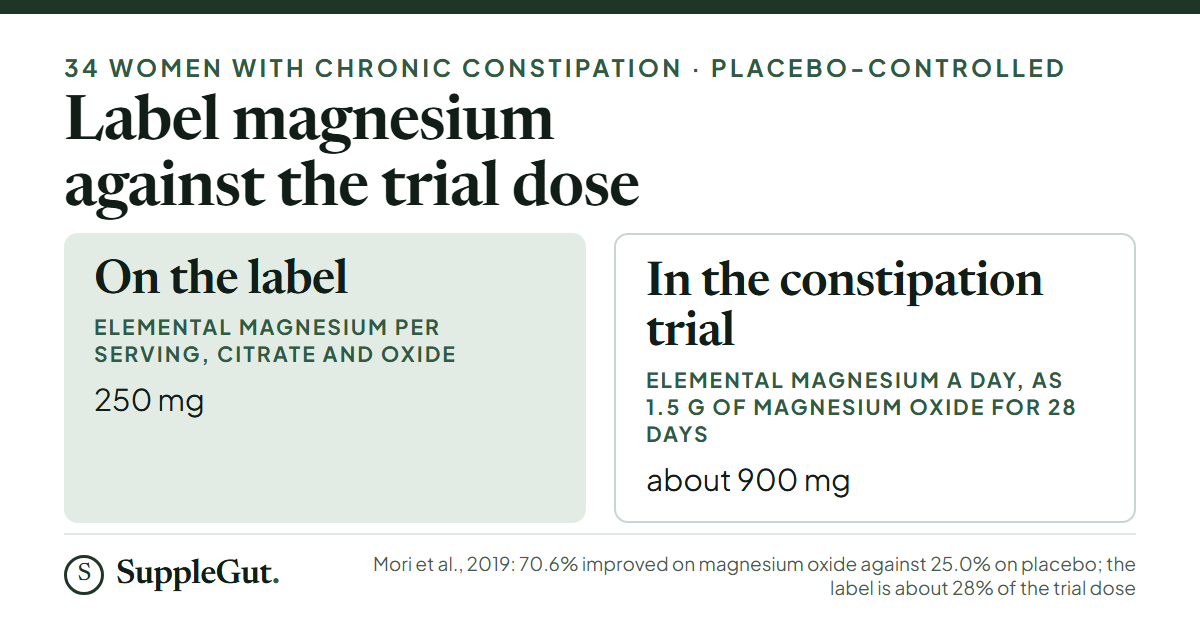
Does GLP-1 SOS Gut Relief work? No trial of this product, or of any ingredient in people on semaglutide or tirzepatide, was found. Magnesium oxide at about 900 mg of magnesium helped constipation in a 34-woman placebo-controlled trial; the label has 250 mg. Ginger helped nausea in other groups at higher gingerol doses than the label’s roughly 10 mg, and probiotic benefit in constipation trials has depended on named strains, which this label does not give. Amazon shows 3.9 from 623 ratings and Trustpilot 2.2 from 29.
GLP-1 SOS Daily Gut Relief is a two-capsule evening supplement sold for constipation, nausea and sulfur burps on semaglutide and tirzepatide. It combines 250 mg of magnesium, 200 mg of ginger extract, peppermint, ashwagandha, a 19-species probiotic blend and a set of vitamins. Its label prints most of its amounts, which lets each one be set beside the trial dose. No trial of the capsule or of any ingredient in people on these drugs exists, and the company behind it is not named.
What GLP-1 SOS Gut Relief is, and what the label leaves out
Two vegetarian capsules contain 250 mg magnesium (citrate and oxide, with the split not printed), 200 mg ginger root extract standardized to 5% gingerols (about 10 mg of gingerols), 50 mg peppermint leaf extract, 50 mg ashwagandha, 5 mg black pepper extract (95% piperine) and 10 mg of digestive enzymes (papain, bromelain, alpha-amylase). Also in each serving: 9 mg iron, 10 mg zinc, 500 mcg B12, 2,500 mcg biotin, 50 mcg vitamin D, 10 mg B6 and 400 mcg folate.
The probiotic is a 50 mg blend labeled “19 Strains, 100 Billion CFU/g”, which works out to about 5 billion CFU a serving by our arithmetic. The printed organisms are 19 named species, among them Lactobacillus, Bifidobacterium, Bacillus coagulans and Saccharomyces boulardii, with no strain designation on any, so the “19 strains” is a species count. An earlier label image, still in the product gallery, printed no organisms and no CFU. The current label says the facility also processes milk, soy, eggs, tree nuts, peanuts, wheat, sesame, fish and shellfish, while the Amazon bullets say the product is free from them.
Who is behind it
We could not establish the company. The site names only “GLP-1 SOS”, with no legal entity in the terms, privacy policy or footer, and prints two postal addresses: Miami, Florida in the footer and Albuquerque, New Mexico in the refund policy and terms. The label says “Manufactured & Shipped from Utah” and claims a cGMP, FDA-registered facility and third-party testing, with no manufacturer, laboratory or certificate named. Amazon’s bullets say “physician-formulated”; no physician is named. The Amazon seller is “GLP-1 SOS Supplements”.
The trial of the product, and why people reach for it
There is none. The brand’s figures (“55,000+ customers”, “73% reorder”, relief “within 48-72 hours”) carry no study or method. The gut effects of the drugs are documented: in a network meta-analysis of 33,354 adults, the risk of constipation against placebo was 2.10 for semaglutide and 3.36 for tirzepatide, and of nausea 2.95 and 2.90 (Ismaiel et al., 2025). An expert consensus puts constipation at 4 to 12% of participants in trials, up to 25 to 35% in people with obesity, and nausea at 15 to 50%, mostly in the first four to five weeks (Gorgojo-Martínez et al., 2022).
Magnesium: 250 mg against a 900 mg trial
The 2023 AGA-ACG guideline for chronic constipation gives strong recommendations to polyethylene glycol and four prescription drugs, and conditional ones to fiber, lactulose, senna, magnesium oxide and lubiprostone (Chang et al., 2023). The trial behind magnesium oxide is small: 34 Japanese women with mild to moderate constipation took 1.5 g of magnesium oxide a day, about 900 mg of elemental magnesium, for 28 days, and 70.6% improved overall against 25.0% on placebo (Mori et al., 2019). The label’s 250 mg is about 28% of that, and its oxide share is not printed. The NIH sets the upper limit for magnesium from supplements at 350 mg a day, above which diarrhea and cramping can occur; the label sits below it.
Ginger and the probiotic
Ginger sped stomach emptying in healthy volunteers at 1,200 mg of powder, six times the label’s 200 mg of extract, though the extract’s potency against powder is not stated (Wu et al., 2008), but did not change symptoms. In 103 adults on chemotherapy, 84 mg a day of gingerols and shogaols eased delayed nausea (Crichton et al., 2024); the label’s roughly 10 mg of gingerols is about 12% of that. A meta-analysis in pregnancy nausea found a benefit rated low quality (Viljoen et al., 2014). None of these studies involved a GLP-1 medicine, and these drugs work partly by slowing gastric emptying, which ginger has been shown to quicken; no study tests the two together.
For probiotics in chronic constipation, a meta-analysis of 30 trials found 57% responders against 44% on control (RR 1.28), significant for Bifidobacterium lactis but not for mixtures of probiotics (van der Schoot et al., 2022). The label lists B. lactis without a strain code.
The fiber claim
The brand page says fiber supplements “often get more bloated, not less” on a GLP-1 medicine. The expert consensus above advises water and fiber for constipation on these drugs, and the 2023 guideline makes a conditional recommendation for fiber. The brand’s “slow gastric motility by up to 70%” and “no cramping” claims have no source on the page.
How to take it
The label says 2 capsules with dinner, every day, with a full glass of water; the Amazon listing adds that a sensitive stomach can start with one capsule for three days.
Side effects and who should not take it
The label prints no warning beyond the FDA statement, and the page says to tell your healthcare provider about supplements. The refund policy says to stop and consult a doctor or pharmacist after a reaction. The ingredients to check with a clinician include iron, ashwagandha and piperine, which we did not research, and magnesium for anyone with kidney disease or on interacting medicines. The brand lists biotin at 2,500 mcg but prints no lab-test statement on this page. Consensus guidance tells anyone on a GLP-1 medicine with severe or lasting constipation or nausea to tell their prescriber.
What the reviews say
Three sources, three scores. The brand’s widget shows 4.53 from 1,570 reviews (84% five-star, 8% one-star), while the page text claims 4.8 from 55,000+. Amazon shows 3.9 from 623 ratings (60% five-star, 17% one-star), with the text behind a sign-in; Amazon’s own summary describes reviewers split between very helpful and not effective. Trustpilot shows 2.2 from 29 reviews, 80% of them one-star. The praise is regularity within days and less bloating. The recurring complaints are refunds denied or delayed, subscriptions that reviewers say they could not stop or did not intend to start, and slow support. The company replies to each negative review.
The subscription and refund terms
The product page loads with a subscription and a 3-bottle bundle selected, shipped every 3 months ($79.98), and says “Cancel anytime”. The page headline promises a “60-Day Money Back Guarantee” with “No return required. No questions asked.” The refund policy sets conditions: it covers the first bottle of the first order only, with a request made between day 30 and day 60 after delivery (earlier requests do not qualify), and with a subscription it must be cancelled before the second shipment. Shipping is not refunded, a multi-bottle first order is refunded the price divided by the number of bottles, and opened bottles, Amazon purchases and refunds for a reaction or medical reasons are excluded. Renewals are not refundable. Cancellation is online only, at least 48 hours before the next order; support does not cancel by email. The one-time price comes from the brand’s product listing; we could not switch the subscription off in the page widget.
Who GLP-1 SOS Gut Relief is for
- Someone who wants one evening capsule rather than a powder and accepts that its magnesium is a fraction of the trial dose.
- A buyer who will cancel the subscription within the stated window, or buys a single bottle once or on Amazon.
- A person comfortable that the company, strains and testing laboratory are not named.
For constipation, the options with guideline-level evidence are set out in constipation treatments with strong evidence, and psyllium vs magnesium compares the fiber and magnesium routes. The catalog has Natural Vitality CALM magnesium and Nature’s Way ginger as single-ingredient options.
Cost
One bottle (30 days) is $49.99 one time, about $1.67 a day, or $39.99 a month on subscription ($1.33 a day). The default 3-bottle subscription is $79.98 for 90 days ($0.89 a day), and the 5-bottle plan is $119.97 for 150 days ($0.80). A Meta ad says “Buy 2, Get 1 Free” at $18.33 a bottle ($54.99 for three), which differs from the page price. Amazon lists $48.99 ($1.63 a day) and $39.19 on Subscribe & Save.
The products in this catalog
Common questions
Does GLP-1 SOS Gut Relief work for constipation and nausea on Ozempic or Mounjaro?
No trial of this product, or of its ingredients in people on semaglutide or tirzepatide, was found. Magnesium oxide at about 900 mg of magnesium helped constipation in a small placebo-controlled trial, and the label has 250 mg. Ginger has helped nausea in other groups at higher doses than the label’s.
Is GLP-1 SOS safe, and what are the side effects?
The label prints no warnings, and the company says to tell a doctor about supplements you take. Magnesium from supplements can cause diarrhea, nausea and cramps above 350 mg a day, and the label has 250 mg. It also contains 9 mg iron, 500 mcg B12, 2,500 mcg biotin, ashwagandha and 5 mg piperine, which we did not research.
What is in GLP-1 SOS Gut Relief?
Two capsules contain 250 mg magnesium (citrate and oxide), 200 mg ginger extract (5% gingerols), 50 mg peppermint extract, 50 mg ashwagandha, a 50 mg blend of 19 named probiotic species (100 billion CFU per gram, about 5 billion CFU), 10 mg digestive enzymes and 5 mg black pepper extract, plus vitamins and minerals. No strain designations are printed.
How much does GLP-1 SOS cost?
One bottle (30 days) is $49.99 one time, about $1.67 a day, or $39.99 a month on subscription ($1.33 a day). The product page loads with a subscription and a 3-bottle bundle ($79.98, shipped every 3 months) selected. Amazon lists $48.99.
Who makes GLP-1 SOS, and what is the refund policy?
The site does not name a company and prints two addresses, in Miami and Albuquerque. The refund policy covers the first bottle only, with a request made between day 30 and day 60 after delivery, and a subscription must be cancelled before the second shipment. Renewals are not refundable, and cancellation is online only.
What do reviews say about GLP-1 SOS?
Scores differ by source: 4.53 from 1,570 reviews on the brand’s own widget, 3.9 from 623 ratings on Amazon, and 2.2 from 29 on Trustpilot, where 80% are one-star. Praise is for regularity and less bloating; complaints are about refunds, subscriptions that were hard to stop and slow support.
GLP-1 SOS vs Miralax or fiber?
Polyethylene glycol (Miralax’s ingredient) has a strong guideline recommendation for chronic constipation, while magnesium oxide and fiber have conditional ones; no study compares them in people on GLP-1 medicines. The brand says fiber can worsen GLP-1 constipation, but expert guidance for these drugs advises water and adequate fiber. See psyllium vs magnesium.
Sources
- Ismaiel A, Scarlata GGM, Boitos I, et al. "Gastrointestinal adverse events associated with GLP-1 RA in non-diabetic patients with overweight or obesity: a systematic review and network meta-analysis." International Journal of Obesity, 2025;49(10):1946–1957. doi.org/10.1038/s41366-025-01859-6
- Gorgojo-Martínez JJ, Mezquita-Raya P, Carretero-Gómez J, et al. "Clinical Recommendations to Manage Gastrointestinal Adverse Events in Patients Treated with Glp-1 Receptor Agonists: A Multidisciplinary Expert Consensus." Journal of Clinical Medicine, 2022;12(1):145. doi.org/10.3390/jcm12010145
- Chang L, Chey WD, Imdad A, et al. "American Gastroenterological Association-American College of Gastroenterology Clinical Practice Guideline: Pharmacological Management of Chronic Idiopathic Constipation." Gastroenterology, 2023;164(7):1086–1106. doi.org/10.1053/j.gastro.2023.03.214
- Mori S, Tomita T, Fujimura K, et al. "A Randomized Double-blind Placebo-controlled Trial on the Effect of Magnesium Oxide in Patients With Chronic Constipation." Journal of Neurogastroenterology and Motility, 2019;25(4):563–575. doi.org/10.5056/jnm18194
- Wu KL, Rayner CK, Chuah SK, et al. "Effects of ginger on gastric emptying and motility in healthy humans." European Journal of Gastroenterology & Hepatology, 2008;20(5):436–440. doi.org/10.1097/MEG.0b013e3282f4b224
- Crichton M, Marshall S, Isenring E, et al. "Effect of a Standardized Ginger Root Powder Regimen on Chemotherapy-Induced Nausea and Vomiting: A Multicenter, Double-Blind, Placebo-Controlled Randomized Trial." Journal of the Academy of Nutrition and Dietetics, 2024;124(3):313–330. doi.org/10.1016/j.jand.2023.09.003
- Viljoen E, Visser J, Koen N, Musekiwa A. "A systematic review and meta-analysis of the effect and safety of ginger in the treatment of pregnancy-associated nausea and vomiting." Nutrition Journal, 2014;13:20. doi.org/10.1186/1475-2891-13-20
- van der Schoot A, Helander C, Whelan K, Dimidi E. "Probiotics and synbiotics in chronic constipation in adults: A systematic review and meta-analysis of randomized controlled trials." Clinical Nutrition, 2022;41(12):2759–2777. doi.org/10.1016/j.clnu.2022.10.015
- NIH Office of Dietary Supplements, "Magnesium: Fact Sheet for Consumers" (ods.od.nih.gov); brand page: label, directions, refund and subscription policies and price (glp1sos.com); Amazon listing (B0GC739CTY); Trustpilot (trustpilot.com/review/glp1sos.com)
Not sure which product fits your situation?
This guide covers the mechanics. The quiz takes your specific symptoms, routine and preferences and matches you to one product from the catalog.
Take the quiz →