
Guide
Does Grow Young Probiotic work? Fourteen species with no strain codes, no trial of the capsule, and 1,863 brand-hosted reviews
Quick answer
Does Grow Young Probiotic + Prebiotic Fiber work? We found no trial of the capsule itself. A 43-trial review and a 27-review umbrella review of probiotics in IBS show modest benefit for bloating at low certainty, but those trials tested named strains and this label lists 14 species with no strain codes. Its whole 600 mg prebiotic blend is at most 0.6 g, against 4.5 g of glucomannan in the adult trials. The brand’s own review widget shows 4.94 from 1,863 reviews; we found no other rating.
Grow Young Fitness Daily Probiotic + Prebiotic Fiber is a once-a-day vegan capsule that lists 14 named organisms at 50 billion CFU, plus a 600 mg blend of burdock, garlic and konjac glucomannan. No trial of the capsule itself turned up, the label names species without strain codes, and its only star rating sits on the brand’s own page. This page covers the label, the trials behind each type of ingredient, the reviews, the price, the pre-selected subscription and the refund terms.
What Grow Young Daily Probiotic + Prebiotic Fiber is, and what it is not
Grow Young Fitness is a brand built around exercise programs for older adults, with workout DVDs and online workouts alongside its supplements. The probiotic page is titled “For Seniors” and sells one product in a purple, plant-based capsule that the brand calls the “magic purple capsule.” A serving is one capsule, a bottle holds 30, and the capsule shell is hydroxypropyl methylcellulose. Other ingredients are carrot concentrate, silica and magnesium stearate. The brand sells it on its own site; we found no Amazon listing for it.
The Supplement Facts panel has two lines, and each is a blend with a single total:
- Prebiotic Blend, 600 mg: burdock root extract (4:1), garlic bulb extract and konjac glucomannan (90%).
- Vegan Probiotic Blend, 125 mg (50 billion CFU): Lactobacillus acidophilus, L. plantarum, L. gasseri, L. paracasei, L. fermentum, L. casei, L. rhamnosus, L. salivarius, Streptococcus thermophilus, Bifidobacterium breve, B. longum, B. lactis, B. bifidum and a fourteenth printed as “Bifidobacterium infatis.”
The panel prints no strain designations, no CFU for any single organism, and no separate amounts for burdock, garlic or glucomannan. It does not say whether the 50 billion CFU is counted at manufacture or at the end of shelf life. No “Dietary Fiber” line appears, and no sweeteners are listed. It contains no senna, cascara, aloe latex or rhubarb, which are the laxative herbs found in some cleanse products.
The bottle photo carries the brand’s claims about relieving gas and bloating, detoxing digestive build up and promoting weight loss. The product’s store description says it “fixes” gas, bloating and reflux and relieves constipation and diarrhea, while the page copy is softer and says it supports digestive balance, regularity and everyday comfort. These are the brand’s statements. We found no trial of this capsule for any of them.
The free-from statement on the page reads “Dairy-Free. No Soy. No Gluten.” It does not name egg, tree nuts, fish, sesame or wheat, and the panel carries no facility statement, so the allergen picture is partial. The panel shows a GMP mark, which is a manufacturing standard rather than a test result, and the brand page we read does not state third-party testing. The page also carries the California Proposition 65 warning about lead.
Is there a trial of the capsule itself?
We found none. A PubMed search for the brand name together with probiotic, prebiotic, fiber and capsule returned no results, and the brand page cites no study. None of the ingredients is a trademarked or branded one: the probiotics carry no strain codes, and “Glucomannan 90%” and “Burdock Extract 4:1” are generic descriptors. So there is no trial of a branded ingredient to point to either. What exists is research on the classes of ingredient, covered next.
What the probiotic trials show, and why species-only labels matter
The largest evidence base for multi-organism probiotics is in irritable bowel syndrome (IBS) and constipation. A 2014 meta-analysis of 43 randomized trials in adults with IBS or chronic idiopathic constipation found that probiotics beat placebo for IBS symptoms persisting, with a relative risk of 0.79 (95% CI 0.70 to 0.89). Benefit appeared on global IBS, abdominal pain, bloating and flatulence scores. In chronic idiopathic constipation, probiotics raised stool frequency by 1.49 a week (95% CI 1.02 to 1.96), but that figure came from only two trials. The authors state that which individual species and strains are most beneficial remains unclear (Ford et al., American Journal of Gastroenterology, 2014).
A 2026 umbrella review of 27 systematic reviews of probiotics in IBS reached a more cautious reading: small or inconsistent effects on bloating and quality of life, with certainty of evidence predominantly low or very low (Ballena-Caicedo et al., Journal of Clinical Medicine, 2026).
Two points limit how far those findings reach this capsule:
- The trials enrolled people with a diagnosis. They studied IBS or chronic constipation, so the results do not map directly onto someone with occasional bloating and no diagnosis.
- The trials tested named strains. A strain is the unit that gets tested; a species is a group of many strains that can behave differently. This label lists 14 species and gives no strain, so a result from a trial of a particular strain cannot be matched to it, and the blend’s single 125 mg figure does not show how many CFU each organism contributes.
The trial summary above and the label are the whole of the probiotic evidence for this capsule. A product built on one named strain, such as Culturelle (Lactobacillus rhamnosus GG), can be compared with its own trials; this one lists species only. What a CFU figure does and does not predict is covered in the CFU guide.
The prebiotic blend and the glucomannan dose gap
Glucomannan is a viscous soluble fiber from the konjac plant. It holds water and is fermented by bacteria in the colon, which is how it is thought to soften stool. Of the three prebiotic ingredients, it is the only one with human constipation trials we could find, and those trials used far more than one capsule can hold:
- 8 healthy adults took 4.5 g a day for 21 days after a placebo period; defecation frequency rose about 27% and wet stool weight rose 30% (Chen et al., Nutrition, 2006).
- 7 constipated adults took 1.5 g three times a day (4.5 g a day) for 21 days; weekly bowel movements rose from 4.1 to 5.3 (Chen et al., Journal of the American College of Nutrition, 2008).
- Elite male Taekwondo athletes with functional constipation took konjac glucomannan for 8 weeks in a double-blind, placebo-controlled trial, and constipation symptom and quality-of-life scores, bowel movement frequency and a bowel function index improved (all p under 0.05). The abstract does not give the dose (Zhu et al., European Journal of Nutrition, 2025).
- Children with constipation gave mixed results. A crossover trial using 100 mg/kg up to 5 g a day had 45% treated successfully on glucomannan against 13% on placebo (46 recruited, 31 completed). A later trial of 80 children at 2.52 g a day for 4 weeks found success similar to placebo (relative risk 0.95, 95% CI 0.6 to 1.4), with more abdominal pain episodes on glucomannan at weeks 1 and 4 (Loening-Baucke et al., Pediatrics, 2004; Chmielewska et al., Clinical Nutrition, 2011).
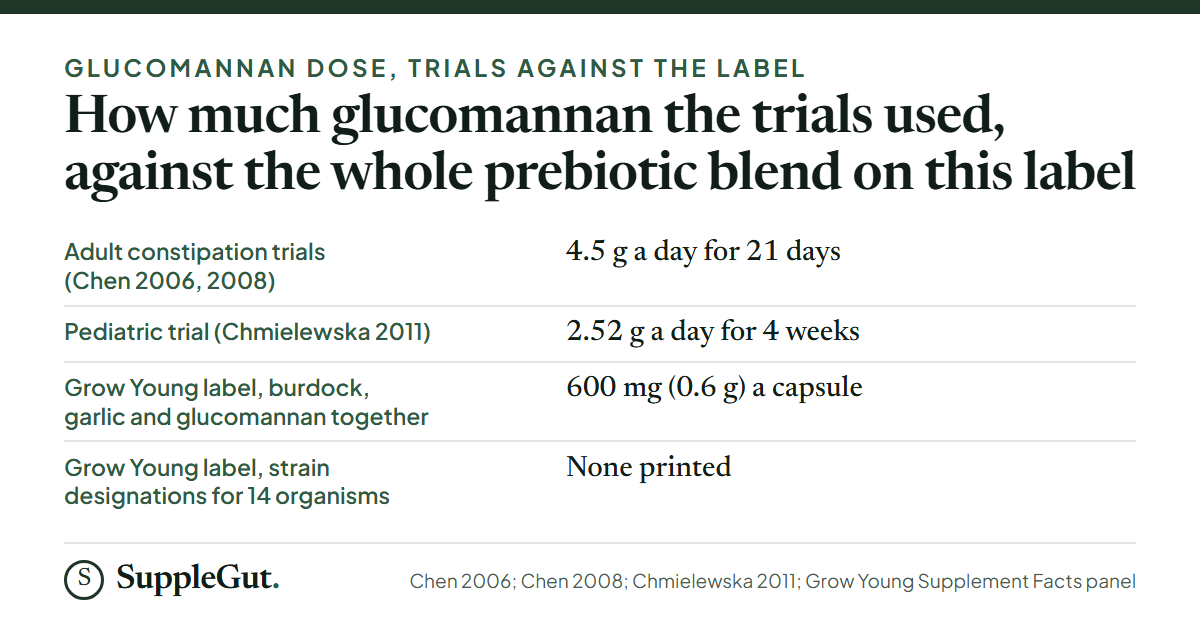
The dose gap. The whole prebiotic blend on this label, burdock and garlic included, is 600 mg, so it is at most 0.6 g. That makes the glucomannan in a capsule under one seventh of the 4.5 g used in the adult trials and under a quarter of the 2.52 g in the pediatric trial. The panel does not print how the 600 mg is split.
For burdock root extract and garlic extract, a PubMed check for human trials on digestion or a prebiotic effect found nothing relevant for burdock and no randomized human trials of garlic extract on gut bacteria. No human trial supporting either at this dose was found, and the amounts are not printed.
How to take it
The page directs one capsule a day with a full glass of water, taken at the same time each day. It gives no instruction about food. Some reviewers mention the brand advising 60 days of daily use before judging the result, which is longer than the 21-day glucomannan trials and the 4-to-8-week range of most trials in the probiotic reviews. Subscription deliveries ship every 30, 60 or 90 days, at the buyer’s choice.
Side effects and who should check first
We did not read the bottle’s own warnings, only the front photo and panel image. The site-wide footer says to consult a physician before using any supplement, especially if you are pregnant, breastfeeding, have a medical condition or take medication. Reviewers rarely mention side effects, and several describe the capsule as gentle on the stomach. A few reviewers report that gas or bloating continued with seeds, fruit or vegetable skins, or rough vegetables. Fiber and probiotics can cause gas and bloating when first started; the probiotic side effects guide covers the usual effects and when to stop.
What the reviews say
The only rating found is on the brand’s own product page, which runs the Stamped review app: 4.94 out of 5 from 1,863 reviews, across all variants. The page shows a “Verified Customer Reviews” badge from the same widget, and nearly all reviews carry the verified-buyer flag. We found no Amazon listing and no other retailer rating; a Trustpilot profile could not be read, so whether one exists is unconfirmed.
| Stars | Reviews |
|---|---|
| 5 | 1,765 |
| 4 | 89 |
| 3 | 6 |
| 2 | 2 |
| 1 | 1 |
Of the 1,863 reviews, 94.7% are five-star, and nine are three stars or lower. The widget does not say whether any reviews were incentivized, and the page does not say whether low-star reviews are filtered. Review dates by year are 25 in 2020, 67 in 2021, 144 in 2022, 373 in 2023, 663 in 2024, 463 in 2025 and 128 in 2026.
Three themes recur in the praise. About 309 reviews mention bloating or gas, with several describing it as resolved. About 340 mention regularity, including from one capsule a day. Others describe it as gentle and easy to swallow. The complaints fall into three groups: no effect, or an effect that faded (for example a reviewer who took it close to 3 years and said it stopped working in the last six months, and another who saw a good first week and then none); the price; and subscription or shipping quantity, such as a customer on a 3-pack every 3 months who received 10 bottles in a year and had asked for 12, and a reviewer who suggested buying two bottles up front because shipping can be slow.
Price, the pre-selected subscription and the refund terms
| Route | Price | Per day |
|---|---|---|
| 1 bottle (30 capsules), one-time | $60.00 | $2.00 |
| 1 bottle, Subscribe & Save (25% off) | $45.00 | $1.50 |
| 2-pack, one-time | $110.00 | $1.83 |
| 3-pack, one-time | $150.00 | $1.67 |
| 4-pack, one-time | $190.00 | $1.58 |
| 6-pack, one-time | $280.00 | $1.56 |
The $45.00 subscribed price is computed from the page’s 25% plan adjustment on the $60.00 price, not read at checkout. The page banner states free shipping on USA orders. The multi-bottle packs are shown against higher compare-at prices of $120, $180, $240 and $360.
On the product page, the Subscribe & Save option is pre-selected, and “One-time purchase” is the second choice. The only subscription wording on the page is “Cancel or change anytime,” with deliveries every 30, 60 or 90 days. About 70 of the 1,863 reviews mention a subscription or auto-ship, and almost all are positive; the exceptions are the quantity mix-up above and two customers who cancelled and later restarted. No review we read describes charges after cancelling, and those reviews all sit on the brand’s own widget.
The brand’s return policy offers a 60-day money-back guarantee: online returns within 60 days of purchase for a full refund, an exchange for an item of equal value, or store credit. Original shipping charges are non-refundable, and customers pay return shipping unless they buy the optional Checkout+ add-on. Returns after 60 days get store credit only. The policy also states: “At this time, we are unable to process returns for orders shipped to CALIFORNIA due to state-specific regulations.”
Who Grow Young Probiotic is for
- Someone who wants one capsule a day with a species list and accepts that no strain, per-organism count or ingredient split is printed.
- Someone drawn to a combined probiotic and fiber capsule rather than a separate fiber powder, who knows the fiber share of the label is at most 0.6 g.
- Someone comfortable with a brand-hosted review record as the main evidence of how buyers fared.
- A buyer who has checked the shipping state and the subscription box, since the subscription is pre-selected and returns on orders shipped to California are not processed under the brand’s policy.
For a single named-strain probiotic with a printed label, see Culturelle. Arrae Bloat Capsules has its label on its own catalog page for side-by-side reading, and the quiz starts from the symptom.
The products in this catalog
Common questions
Does Grow Young Daily Probiotic + Prebiotic Fiber work?
No trial of this capsule was found. A 43-trial review of multi-strain probiotics in IBS found modest benefit for bloating, but those trials used named strains and this label lists species only. The brand’s own review widget shows 4.94 from 1,863 reviews, and a small number of reviewers report no effect or that it stopped working.
What is in Grow Young Daily Probiotic + Prebiotic Fiber?
One capsule holds a 600 mg prebiotic blend (burdock root extract, garlic bulb extract and konjac glucomannan) and a 125 mg blend of 14 named organisms totaling 50 billion CFU, in a vegan capsule with carrot concentrate, silica and magnesium stearate. No strain designations or per-ingredient amounts are printed.
How much glucomannan is in Grow Young Probiotic?
The label does not print it separately. Burdock, garlic and glucomannan share one 600 mg figure, so glucomannan is under 0.6 g. Adult constipation trials of glucomannan used 1.5 to 4.5 g a day, and the pediatric trial used 2.52 g a day.
How much does Grow Young Probiotic cost per day?
A 30-capsule bottle is $60.00 one time, or $2.00 a day. The pre-selected Subscribe & Save option takes 25% off, about $1.50 a day. One-time multi-bottle packs run from $1.56 to $1.83 a day, and the page states free shipping on USA orders.
Grow Young Probiotic side effects: is it safe?
Reviewers rarely mention side effects, and several call the capsule gentle on the stomach. Fiber and probiotics can cause gas or bloating at first. The brand’s footer advises consulting a physician if you are pregnant, breastfeeding, have a medical condition or take medication, and the page carries a California Proposition 65 lead warning.
Can I get a refund on Grow Young Probiotic?
The brand offers a 60-day money-back guarantee for a refund, an exchange or store credit. Original shipping is non-refundable, and return shipping is at the customer’s cost unless Checkout+ is bought. Its policy states that returns on orders shipped to California cannot be processed, and returns after 60 days get store credit only.
Is the Grow Young subscription pre-selected, and can I cancel?
Yes. On the product page Subscribe & Save is the pre-checked option, and One-time purchase is the second choice. The page says “Cancel or change anytime” and offers deliveries every 30, 60 or 90 days. Of the reviews that mention a subscription, almost all are positive.
Sources
- Ford AC, et al. Prebiotics, probiotics and synbiotics in irritable bowel syndrome and chronic idiopathic constipation (43 randomized trials). American Journal of Gastroenterology, 2014. PubMed 25070051
- Ballena-Caicedo J, et al. Umbrella review of probiotics in irritable bowel syndrome (27 systematic reviews). Journal of Clinical Medicine, 2026. PubMed 41827145
- Chen HL, et al. Konjac glucomannan, 4.5 g a day for 21 days in healthy adults. Nutrition, 2006. PubMed 17027233
- Chen HL, et al. Konjac glucomannan in constipated adults. Journal of the American College of Nutrition, 2008. PubMed 18460488
- Zhu Y, et al. Konjac glucomannan in athletes with functional constipation, 8-week placebo-controlled trial. European Journal of Nutrition, 2025. PubMed 41117955
- Loening-Baucke V, et al. Glucomannan in children with constipation. Pediatrics, 2004. PubMed 14993586
- Chmielewska A, et al. Glucomannan in 80 children with constipation. Clinical Nutrition, 2011. PubMed 21320737
- Grow Young Shop: product page, Supplement Facts panel image, return policy and refund policy. growyoungshop.com
Not sure which product fits your situation?
This guide covers the mechanics. The quiz takes your specific symptoms, routine and preferences and matches you to one product from the catalog.
Take the quiz →