
Guide
Does HCL Guard work? Betaine HCl with pepsin, a dose ladder, and studies that measured pH rather than symptoms
Quick answer
Does HCL Guard work? We found no trial of HCL Guard and no randomized trial of betaine HCl for indigestion or protein digestion. The human data measured stomach pH in small groups: 1,500 mg lowered it for about an hour in 6 people whose acid a drug had suppressed, and 4,500 mg was needed after food in 9 people. One capsule holds 550 mg, and the brand’s usual 2 to 6 capsules a meal is 1,100 to 3,300 mg, or $0.40 to $1.20 at $0.20 a capsule.
HCL Guard is a gelatin capsule from Healthy Gut that pairs betaine HCl, a form of stomach acid, with pepsin, then adds ginger, licorice and intrinsic factor. The brand sets no fixed dose: it asks buyers to add one capsule per protein meal until they notice a response. This page sets out the label, what the betaine HCl studies measured, what the dose ladder implies for cost, and what the reviews show.
What HCL Guard is, and what it is not
The brand’s label image is headed Supplement Facts, with a serving of one capsule and 120 capsules in the bottle printed. Per capsule: 550 mg betaine hydrochloride, 30 mg pepsin (printed as 3000:1), 15 mg intrinsic factor, 100 mg organic ginger root extract (5% gingerols) and 50 mg deglycyrrhizinated licorice root extract (10% total flavonoids). That is 745 mg of actives. Every amount is printed; there is no proprietary blend. The only other ingredient is a gelatin capsule, so it is not vegetarian.
The label does not say where the pepsin and intrinsic factor come from, what activity the pepsin has beyond the 3000:1 ratio, or which laboratory, if any, tests the product. The brand page cites no study of HCL Guard.
What the main ingredients are
Betaine hydrochloride releases hydrochloric acid, the acid the stomach makes, when it dissolves, so a capsule can lower stomach pH for a short time; that is the effect the studies below measured. Pepsin is a protein-cutting enzyme that works only in strong acid, which is why it is paired with the acid. Intrinsic factor is a protein the stomach makes to carry vitamin B12. We found no human trial of oral pepsin or oral intrinsic factor at the amounts in this capsule.
What the studies of betaine HCl measured
We found no trial of HCL Guard, and no published randomized trial that tests betaine HCl, with or without pepsin, for indigestion, protein digestion or any symptom. What exists is drug-interaction pharmacology in healthy volunteers, reviews and a case report.
| Study | Who and how many | Betaine HCl dose | What was measured |
|---|---|---|---|
| Yago 2013 | 6 healthy volunteers given a drug (rabeprazole) that suppressed acid | 1,500 mg, once | Gastric pH fell from 5.2 to 0.6 and stayed below 3 for about 73 minutes |
| Fed-state study, 2019 | 9 volunteers, crossover, after food had raised stomach pH | 1,500, 3,000 and 4,500 mg | Only 4,500 mg brought pH back to baseline (about 17 minutes); without acid, pH returned in about 50 minutes |
| Atazanavir study, 2017 | Healthy volunteers, light meal, crossover | 1,500 mg | Restored 13% of the drug exposure peak that acid suppression had removed |
The first row describes six people whose acid had been switched off by a drug for four days, a temporary state, and it measured pH rather than digestion or symptoms. The second row is closer to a meal: once food had raised the pH, the 1,500 mg dose did not restore it, and 4,500 mg did. The third row is a drug-absorption result, as is a 2014 crossover in which 1,500 mg restored the absorption of a cancer drug that rabeprazole had cut. None tests a person with naturally low acid, and none measures whether protein is digested better.
Narrative reviews argue for mealtime acid replacement on theoretical and historical grounds, and a case report describes one person after esophageal surgery who reported fewer symptoms on a betaine HCl and pepsin capsule. Two registered trials, one of a different betaine HCl and pepsin product in functional dyspepsia (an estimated 64 people) and one of 648 mg capsules in autoimmune gastritis (an estimated 100), have posted no results. Our digestive enzymes guide and acid reflux guide found the same gap.
Ginger and licorice in the capsule
Each capsule carries 100 mg of ginger extract. In a crossover of 11 people with functional dyspepsia, 1.2 g of ginger sped gastric emptying (half-emptying time 12.3 against 16.1 minutes) without changing symptoms. The label amount is about a twelfth of that dose. A 30-day placebo-controlled trial of one licorice extract at 75 mg twice a day in functional dyspepsia reported lower symptom scores at days 15 and 30; the label’s 50 mg of deglycyrrhizinated licorice is not stated to be that extract, a distinction the chewable DGL entry also covers.
How to take HCL Guard, and what the ladder implies
The brand calls its method an HCL Challenge. As printed on the product page: take one capsule with a protein meal of at least 7 g of protein; if nothing is felt, add one capsule per meal until a response appears; then stay at that dose; if there is warmth or burning, or loose stools, reduce by one capsule. It says most customers land at 2 to 6 capsules per meal and recommends three to six months of use.
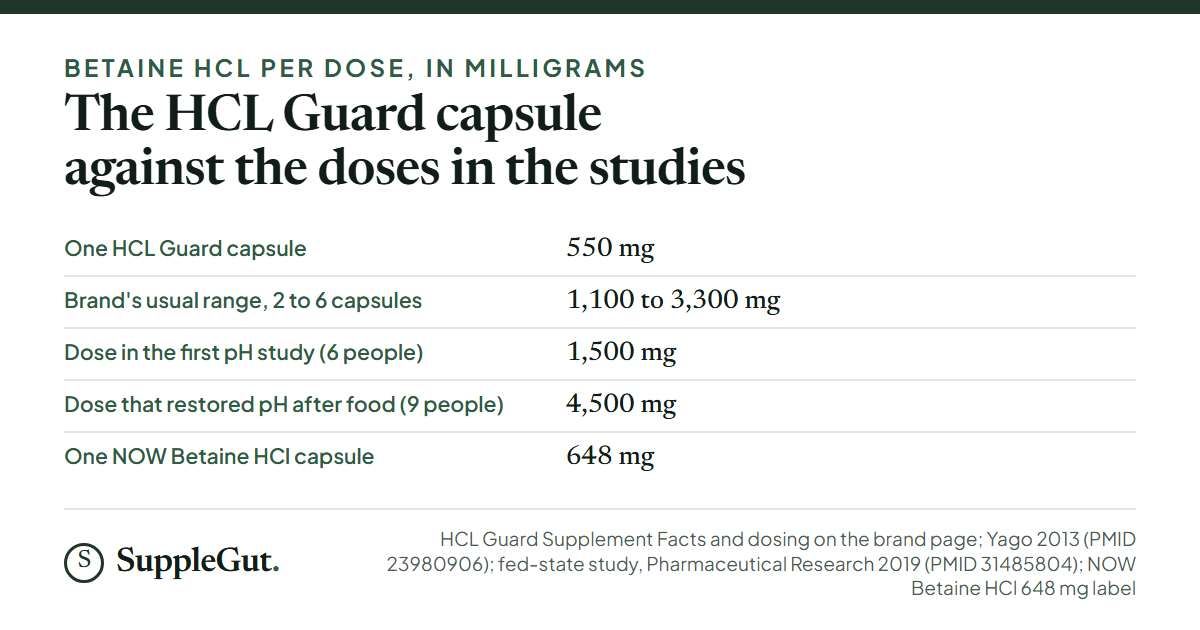
Because the dose is counted in capsules, it can be set against the studies. One capsule is 550 mg. Two to six capsules is 1,100 to 3,300 mg. Three capsules (1,650 mg) pass the 1,500 mg dose of the first pH study; reaching the 4,500 mg fed-state dose takes nine. The brand’s typical range therefore sits above the first study dose and below the fed-state one. A three-meal day at that range is 6 to 18 capsules, and a 300-capsule bottle lasts about 17 days at 18 a day, while the brand’s four-week subscription ships 120 capsules, about 4 a day.
Side effects and who should not take it
The brand page says not to use HCL Guard with active ulcers, gastritis or prescription steroid medication, and that if one capsule causes discomfort the product might not be right for the buyer. The footer advises consulting a healthcare professional when pregnant, breastfeeding or considering it for a child. The page does not mention NSAIDs, and the label image carries no warning text.
The page treats warmth or burning as a dose signal rather than a reason to stop. It lists heartburn and indigestion among the benefits in its own buyer survey, which has no respondent count or comparison group, and lists gastritis and ulcers as reasons not to use the product.
HCL Guard against NOW Betaine HCl
The other betaine HCl capsule here is NOW Betaine HCl 648 mg with pepsin. NOW’s capsule has 648 mg of betaine HCl against HCL Guard’s 550 mg, and HCL Guard adds intrinsic factor, ginger and licorice extract. Neither product has a trial of its own formula. Company material (founder page, refund terms) is in the HoloZyme guide.
What the reviews say
- Amazon: 4.2 from 118 ratings, on a listing a few months old. The review text and star split were not readable when we looked.
- Trustpilot: 4.5 from 23 reviews for the whole company; one names HCL Guard.
- The store’s own review feed (a vendor the brand chose): a store-wide score and one review of HCL Guard.
- The brand page: no star count for the product. It cites scores beside logos for Google, Amazon and others that we did not read at the source; its Amazon figure differs from the one we read.
The testimonials on the brand page are chosen by the brand; one says it took about 11 days at two capsules a meal before it helped. With no independent review text available to us, we cannot say whether burning or heartburn is a common complaint.
Price, subscriptions and the guarantee
| Route | Price | Per capsule |
|---|---|---|
| Brand site, 300 capsules, one time | $59.99 plus shipping and handling | $0.20 |
| Brand site, 300 capsules, subscription every 4 weeks | $53.99 | $0.18 |
| Brand site, 120 capsules, one time | $46.00 | $0.38 |
| Amazon, 300 capsules, one time | $59.99 | $0.20 |
| Amazon, 300 capsules, Subscribe & Save | $50.99 | $0.17 |
At $0.20 a capsule, one capsule a meal is $0.20. At the brand’s 2 to 6 capsules, one protein meal a day costs $0.40 to $1.20 and three meals a day cost $1.20 to $3.60. The brand site lists a 60-day guarantee that excludes shipping and processing; Amazon lists the product as non-returnable except for damaged or defective items. When read, the brand page showed an out-of-stock label beside the buy button while its store feed listed every size as available, so availability is unsettled.
Who HCL Guard is for
- Someone who wants every amount printed and no blend, including the acid dose per capsule.
- Someone who has discussed betaine HCl with a doctor or pharmacist and is comfortable with a dose counted in capsules that changes from meal to meal.
- Someone who accepts a gelatin capsule and a bottle that empties faster at higher doses.
For bloating that does not follow a protein meal, the enzymes against probiotics guide compares approaches, and the quiz starts from symptoms.
The products in this catalog
Common questions
Does HCL Guard work?
We found no trial of HCL Guard, and no randomized trial showing that betaine HCl relieves indigestion or improves protein digestion. In 6 volunteers made low in acid by a drug, 1,500 mg lowered stomach pH for about an hour. After a meal, 4,500 mg was needed to bring pH back to baseline in 9 people.
How many HCL Guard capsules should you take?
The label serving is 1 capsule. The brand’s method starts at 1 capsule with a protein meal of at least 7 g, adds 1 per meal until a response, then steps down if there is warmth or burning. It says most customers settle at 2 to 6 capsules, which is 1,100 to 3,300 mg of betaine HCl.
What are the side effects of HCL Guard, and who should avoid it?
The brand says not to use it with active ulcers, gastritis or prescription steroid medication, and treats warmth or burning as a reason to lower the dose. NSAIDs are not mentioned on its page or label. Its footer advises consulting a healthcare professional if pregnant, breastfeeding or considering it for a child.
How much does HCL Guard cost?
The 300-capsule bottle is $59.99 one time on the brand site and on Amazon, about $0.20 a capsule, or $50.99 on Amazon Subscribe & Save. At the brand’s 2 to 6 capsules, one meal a day costs $0.40 to $1.20 and three meals a day cost $1.20 to $3.60.
HCL Guard vs NOW Betaine HCl: what is the difference?
HCL Guard has 550 mg of betaine HCl and 30 mg of pepsin per capsule, plus ginger, licorice extract and intrinsic factor, in a gelatin capsule. NOW’s capsule has 648 mg of betaine HCl with pepsin. Neither has a trial of its own formula.
What are the HCL Guard reviews like?
Amazon shows 4.2 from 118 ratings on a listing a few months old, and its review text was not readable. Trustpilot shows 4.5 from 23 reviews for the whole company. The testimonials on the brand page are chosen by the brand.
Sources
- Yago MR, et al. Gastric reacidification with betaine HCl in healthy volunteers with rabeprazole-induced hypochlorhydria (n = 6). Molecular Pharmaceutics, 2013. PMID 23980906
- Yago MR, et al. Betaine HCl and dasatinib absorption under rabeprazole pretreatment: randomized crossover. AAPS Journal, 2014. PMID 25274610
- Betaine HCl and atazanavir absorption under fed conditions: randomized crossover in healthy volunteers. Pharmaceutical Research, 2017. PMID 28028768
- Food, gastric pH and acid supplementation at 1,500, 3,000 and 4,500 mg (n = 9). Pharmaceutical Research, 2019. PMID 31485804; registration NCT02758015
- “Meal-Time Supplementation with Betaine HCl for Functional Hypochlorhydria: What Is the Evidence?” Integrative Medicine, 2020. PMID 32549862
- Creating a framework for treating autoimmune gastritis: the case for replacing lost acid. Nutrients, 2024. PMID 38474790
- Betaine HCl with pepsin in an esophageal cancer patient: case report. Journal of Medicinal Food, 2024. PMID 38695854
- Registered trials without results: NCT06320379 (functional dyspepsia) and NCT06881511 (autoimmune gastritis).
- Hu ML, et al. Ginger and gastric motility in functional dyspepsia (n = 11). World Journal of Gastroenterology, 2011. PMID 21218090
- Raveendra KR, et al. A licorice extract in functional dyspepsia: placebo-controlled trial. Evidence-Based Complementary and Alternative Medicine, 2012. PMID 21747893
- Brand page: label, directions, dose ladder, warnings, price and guarantee. healthygut.com/products/hcl-guard; Amazon listing for rating and price: amazon.com/dp/B0H4XXM3GQ; Trustpilot profile for Healthy Gut.
Not sure which product fits your situation?
This guide covers the mechanics. The quiz takes your specific symptoms, routine and preferences and matches you to one product from the catalog.
Take the quiz →