Guide
Does Health Concerns Quiet Digestion work? A modified Bao He Wan, thirteen herbs and one blend weight
Quick answer
Does Health Concerns Quiet Digestion work? No trial of Quiet Digestion or of Bao He Wan in people turned up; the formula’s lab evidence is in mice. The label shares four of the classical pill’s eight herbs, adds nine others and prints one 1,435 mg total for all thirteen. Amazon shows 4.5 from 54 ratings and the brand’s own widget 4.83 from 12; the 45 servings printed on the bottle last 15 days at the suggested dose.
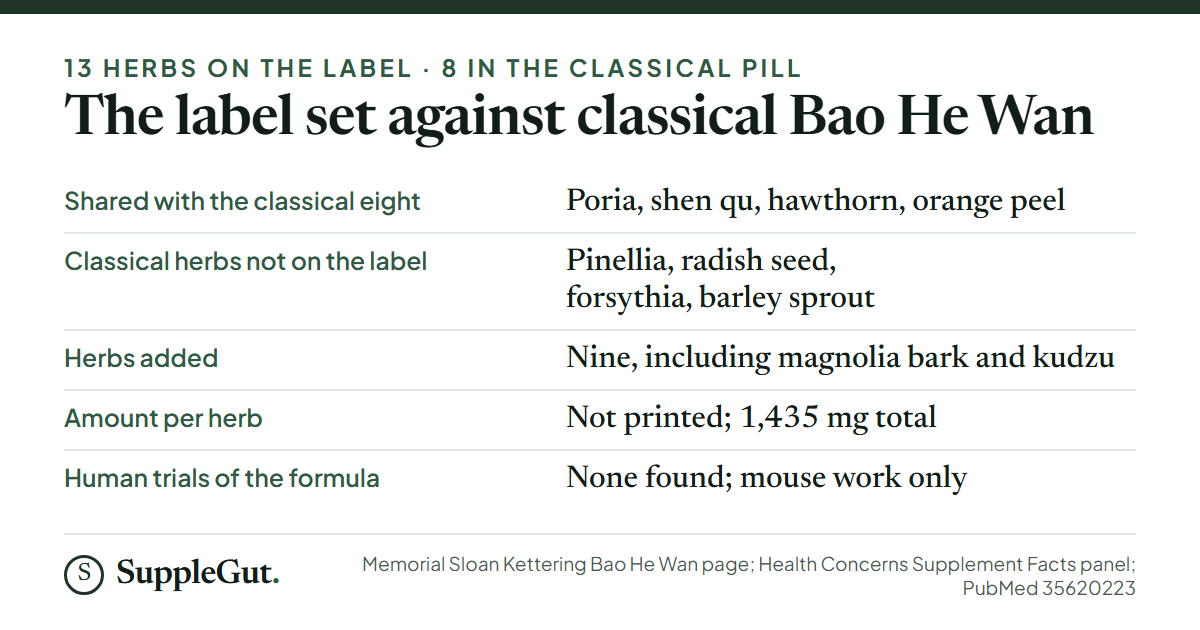
Quiet Digestion is Health Concerns’ capsule built on Bao He Wan, a pill the Chinese tradition uses for the full, heavy feeling that follows too much food. The bottle calls it “Modified Bao He Wan,” and the label shows how much was modified: thirteen herbs, four of them shared with the classical eight, all printed under one blend weight of 1,435 mg.
Thirteen herbs under a 1,435 mg total
The Supplement Facts panel gives a serving of two capsules, 45 servings per container, 65 mg of calcium as coral calcium and a Proprietary Herbal Blend of 1,435 mg with no Daily Value. A capsule weighs 750 mg, so two hold 1,500 mg: the blend plus the calcium. Other ingredients are hypromellose, a plant-cellulose shell, and rice bran. The herbs are named in label order and the panel gives no amount for any one of them.
| Label order | Name on the label | Pinyin on the bottle | Marked as |
|---|---|---|---|
| 1 | Poria sclerotium | Fu Ling | Extract |
| 2 | Job’s Tears seed (coix) | Yi Yi Ren | Extract |
| 3 | Barley seed, labeled shen qu (massa fermentata) | Shen Qu | Extract |
| 4 | Magnolia bark | Hou Po | Extract |
| 5 | Fragrant Angelica root | Bai Zhi | Extract |
| 6 | Kudzu root | Ge Gen | Extract |
| 7 | Cang-Zhu Atractylodes rhizome | Cang Zhu | Extract |
| 8 | Costus root (aucklandia) | Mu Xiang | Extract |
| 9 | Peppermint leaf | Bo He | Plain herb |
| 10 | Chinese Hawthorn leaf & flower | Latin printed: Crataegus pinnatifida | Extract |
| 11 | Trichosanthes root | Tian Hua Fen | Plain herb |
| 12 | Wild Chrysanthemum flower | Ju Hua | Extract |
| 13 | Orange peel | Zhi Shi | Plain herb |
Ten herbs are marked as extracts and three as plain herb. The bottle’s pinyin line prints a Latin name for hawthorn only; for the other twelve a buyer has the common name and the Chinese name. The panel lists no sweetener and no mineral beyond the coral calcium.
Four of the eight classical herbs
Bao He Wan, usually translated Preserve Harmony Pill, comes from a text called the Tanxi Xinfa, according to Memorial Sloan Kettering’s herb page. That page lists its eight herbs as hawthorn fruit (shan zha), shen qu, radish seed (lai fu zi), tangerine peel (chen pi), prepared pinellia (ban xia), poria (fu ling), forsythia fruit (lian qiao) and barley sprout (mai ya).
Set against that list, the capsule carries poria, shen qu, hawthorn and an orange peel, which makes four of eight. It does not list pinellia, radish seed, forsythia or barley sprout, and it adds nine herbs the classical pill lacks: Job’s tears, magnolia bark, fragrant angelica, kudzu, cang zhu, costus root, peppermint, trichosanthes root and chrysanthemum.
Two entries differ from their classical counterparts in ways the label leaves open. The hawthorn is leaf and flower, where the classical pill uses the fruit. The orange peel is followed by the pinyin zhi shi, and in the tradition zhi shi is the immature fruit of bitter orange while the peel is chen pi, so which of the two sits in the capsule is not stated.
What the tradition says the pill is for
The brand page describes the formula in the tradition’s terms: it “disperses food stagnation, resolves dampness, and regulates the spleen and stomach,” and it is “particularly effective” when symptoms come on suddenly or after dietary indiscretion. In the tradition, food stagnation is food said to sit unmoved in the stomach and intestines, with fullness, sour belching and no wish to eat. Dampness is a heavy, sticky influence that the texts tie to a weak spleen, and the spleen and stomach are the organ systems the tradition assigns to digestion, not the anatomical organs. These are the tradition’s categories, and no study cited here sorted people by them. The key concepts guide defines the rest, and the TCM section lists the series.
Health Concerns positions the capsule as an as-needed formula for gas, bloating, nausea or travel upset (“in acute conditions take every two hours”), and also for daily support of sluggish digestion.
The evidence: mice, and a gap where human trials would sit
PubMed holds no trial of Quiet Digestion and none of Bao He Wan in people. Our searches on Bao He Wan, Baohe pill and Baohewan with dyspepsia terms returned mouse studies and papers about a place named Baohe. Memorial Sloan Kettering’s page says clinical trials are needed to settle whether the pill helps digestive complaints.
The mouse work used the classical pill, not this capsule. In a study of 45 male mice fed only a high-fat, high-protein diet, a decoction of Baohe pills at 6.67 g/kg a day for 6 days raised the counts of culturable bacteria, Bifidobacterium among them, and the activities of amylase, protease, sucrase and lactase compared with untreated diet mice (PMID 35620223). The authors also wrote that the pills could not improve the thin, wet stool well. A second mouse study, of 15 animals, looked at lactase-producing bacteria (PMID 36093186). Neither gives a dose that translates into capsules.
The nearest human evidence is for other formulas in another condition. The 2006 Cochrane review of herbal medicines for irritable bowel syndrome pooled 75 randomized trials with 7,957 people and found only three high-quality double-blind, placebo-controlled trials; a standard Chinese formula, individualized Chinese herbal medicine and one named formula beat placebo on global symptoms, with no serious adverse events reported (PMID 16437473). In the Australian trial, 116 people with IBS took five capsules three times a day for 16 weeks of a standard formula (43 people), an individualized formula (38) or placebo (35), and bowel symptom scores improved more than placebo (patient rating P = .03, gastroenterologist rating P = .001); it tested a 20-herb IBS formula, and an erratum to the paper has since been published (PMID 9820260). The formula-by-formula record is gathered in TCM formulas for digestion: what the trials show.
Neither source tested food stagnation, fullness after a heavy meal or Bao He Wan. They show that some Chinese formulas have beaten placebo in IBS and that most trials in the field are low quality. They say nothing about this capsule.
Barley, shen qu and the missing gluten line
The label lists “Barley seed (shen qu).” Shen qu is the tradition’s fermented cake (see our herb page), and Memorial Sloan Kettering says classical Bao He Wan contains wheat and barley sprouts and advises against it with a gluten allergy. Health Concerns prints no contains line, no facility statement and no gluten or wheat statement on the bottle or product page, and does not say whether its barley seed ingredient holds wheat. Amazon’s listing shows “Gluten Free” in its allergen and diet fields; those are entries in Amazon’s listing, not wording read from the bottle. Rice bran is the only other grain on the panel.
Safety: aristolochic acid, adulteration and metals
The bottle’s notice reads that, as with any dietary supplement, it should not be taken without first consulting a health care practitioner, especially in pregnancy, while nursing or under medical supervision for any reason. That is the one precaution the label prints; no ingredient-specific warning appears, and the brand page lists no contraindication for this product.
Aristolochic acid is the most thoroughly documented case of a Chinese herbal product harming people. A Brussels team reported nine women under 50 with rapidly progressive kidney fibrosis after a slimming regimen that had added two Chinese herbs (Vanherweghem et al., Lancet, 1993). A manufacturing error had substituted Aristolochia fangchi for Stephania tetrandra, and among 39 patients who agreed to preventive surgery, 18 (46%) had urothelial carcinoma (Nortier et al., NEJM, 2000). The FDA’s Import Alert 54-10 allows detention of products containing Aristolochia species and certain Asarum, Cocculus and Thottea species, and names qing mu xiang, guang fang ji, fang chi, xi xin and mu tong among the forms. None of Quiet Digestion’s herbs is one of those by name. Its mu xiang is costus root (Aucklandia), a different plant from the qing mu xiang on the alert, and no fang ji, xi xin or mu tong appears. Health Concerns states no aristolochic acid testing.
Surveys of finished products describe what was sampled and cannot be applied to a particular bottle. The California health department tested 260 Asian patent medicines from retail herbal stores and found at least 83 (32%) with undeclared pharmaceuticals or heavy metals (Ko, NEJM, 1998, figures via Relias Media). A Harvard Medical School analysis of 334 raw Chinese herb samples covering 126 species found at least one metal in every sample, and under the likely scenario of use only 3 samples (1%) held metals at levels that could add to a person’s exposure (Harris et al., 2011). Health Concerns publishes no heavy-metal, third-party or GMP statement on the product page or the Amazon listing, and its About Us page speaks of the “highest quality herbs possible” without a named test or certifier. The coral calcium is a marine mineral, and the brand gives neither its source nor a test for it. We found no FDA warning letter or recall for the brand in web searches. Are Chinese herbal supplements safe? goes through the surveys in more detail.
In the United States the capsule is a dietary supplement under the Dietary Supplement Health and Education Act of 1994: the maker is responsible for the product’s safety and claims, and the FDA acts after a product reaches the market. Health Concerns sells through a practitioner portal as well as to the public on its own store and on Amazon. Acupuncture is licensed in most states, with Chinese herb practice under that license in some of them (NCCIH). What a buyer can check on this bottle: a Supplement Facts panel (present, with a total only), Latin names (printed for one herb of thirteen) and a third-party certificate (none found).
Forty-five servings, fifteen days
The panel counts 45 servings of two capsules. The directions are two capsules three times a day between meals, which is six capsules a day, so a 90-capsule bottle lasts 15 days. The brand page also gives a lighter option, one to two capsules before or after meals to help food absorb.
A 90-capsule bottle is $35.90 on the brand site and on Amazon: $2.39 a day at six capsules, or $0.40 a capsule. The 270-capsule bottle is $84.90, which covers 45 days at that dose, $1.89 a day. At the one-to-two-capsule range the brand suggests, each use costs $0.40 to $0.80. Shipping is free over $100 on the brand site. The refund policy accepts claims within 30 days for unopened, unexpired product, with a 15% restocking fee that may apply and credits that expire after six months. We found no brand subscription price.
Reviewer reports
Amazon shows 4.5 from 54 ratings on a listing sold by Health Concerns itself. The brand’s own Judge.me widget shows 4.83 from 12 reviews (11 five-star, one three-star), a feed the brand hosts. Of eight Amazon reviews visible on the product page, seven are five-star.
Praise centers on three things: an upset stomach settling after rich or spicy food, with one Amazon reviewer writing of feeling back to normal in 20 to 30 minutes; years of as-needed use, often after an acupuncturist suggested it; and a capsule that is easy to swallow and travels well. Two reviewers say they gave it to a dog. We found no recurring complaint, and the one three-star review describes no problem. The Six Gentlemen listing on the same label template drew reviews about 45 servings against 15 days (see the Six Gentlemen guide); no Quiet Digestion reviewer raised it. We found no billing complaints.
Who Quiet Digestion is for, and what sits beside it
- Someone looking for a Bao He Wan style formula in capsules, on the understanding that it is a modified version of thirteen herbs under one weight.
- Someone who follows the tradition’s food-stagnation idea and wants an as-needed product for heavy meals and travel, the use the brand describes.
- Someone choosing within the brand: its Six Gentlemen page pairs the two, and Six Gentlemen is the formula aimed at weak digestion with fatigue (guide). Stomach Chi is another Chinese capsule, built on a different herb list.
The product page is Health Concerns Quiet Digestion.
Products this guide draws on
Common questions
Does Quiet Digestion work for bloating and indigestion?
We could find no trial of the capsule or of Bao He Wan in people; the only formula-level work is in mice. Reviewers on Amazon and the brand’s page mostly describe an upset stomach settling after rich food, and the Amazon rating is 4.5 from 54. The brand’s own claims use the tradition’s terms, food stagnation and dampness, which no study measured.
Is Quiet Digestion the same as Bao He Wan?
It is a modified version. Four of the classical pill’s eight herbs appear on the label (poria, shen qu, hawthorn and an orange peel), pinellia, radish seed, forsythia and barley sprout do not, and nine other herbs are added. The hawthorn is leaf and flower rather than fruit.
Does Quiet Digestion contain gluten?
The label prints no gluten, wheat or allergen statement. It lists barley seed labeled shen qu, and Memorial Sloan Kettering says classical Bao He Wan contains wheat and barley sprouts. Amazon shows the product as gluten free in its own attribute fields; the brand does not state it.
Why does the bottle say 45 servings if it lasts 15 days?
The panel counts a serving as two capsules, and the suggested use is one serving three times a day between meals. Six capsules a day empties a 90-capsule bottle in 15 days. Taken one to two capsules at a time as needed, which the brand also describes, the bottle lasts longer.
Who is told to check with a practitioner first?
The bottle says not to take it without first consulting a health care practitioner, especially if pregnant, nursing or under medical supervision. No ingredient-specific warning is printed. Are Chinese herbal supplements safe? covers the wider record.
Does Health Concerns test for heavy metals?
We found no heavy-metal, third-party or GMP statement on the product page, the About Us page or the Amazon listing. Published surveys of Chinese patent medicines and raw herbs found metals and undeclared drugs in some samples, but they describe the samples tested, not this capsule.
What does a day of Quiet Digestion cost?
At the suggested six capsules a day, $35.90 for 90 capsules is $2.39 a day, and the 270-capsule bottle at $84.90 is $1.89 a day. Taken as needed at one to two capsules a use, it is $0.40 to $0.80 a use.
Sources
- Health Concerns: Quiet Digestion product page (Supplement Facts, suggested use, tradition wording), About Us page and refund policy. healthconcerns.com
- Amazon listing for Health Concerns Quiet Digestion, 90 capsules (price, rating, allergen and diet fields). amazon.com/dp/B09G51Z75Q
- Memorial Sloan Kettering Cancer Center: Bao He Wan herb page (source text, eight herbs, wheat and barley sprouts, need for trials). mskcc.org
- Guo K, et al. “Study on Baohe Pills Regulating Intestinal Microecology and Treating Diarrhea of High-Fat and High-Protein Diet Mice.” Biomed Res Int, 2022. PMID 35620223. pubmed.ncbi.nlm.nih.gov/35620223
- Zhou K, et al. “Baohe pill decoction for diarrhea induced by high-fat and high-protein diet is associated with the structure of lactase-producing bacterial community.” Front Cell Infect Microbiol, 2022;12:1004845. PMID 36093186. pubmed.ncbi.nlm.nih.gov/36093186
- Liu JP, et al. “Herbal medicines for treatment of irritable bowel syndrome.” Cochrane Database of Systematic Reviews, 2006. PMID 16437473. pubmed.ncbi.nlm.nih.gov/16437473
- Bensoussan A, et al. “Treatment of irritable bowel syndrome with Chinese herbal medicine: a randomized controlled trial.” JAMA, 1998;280(18):1585–1589. PMID 9820260. pubmed.ncbi.nlm.nih.gov/9820260
- Vanherweghem JL, et al., Lancet, 1993;341:387–391 (PMID 8094166); Nortier JL, et al., NEJM, 2000;342:1686–1692 (PMID 10841870). pubmed.ncbi.nlm.nih.gov/8094166; pubmed.ncbi.nlm.nih.gov/10841870
- FDA Import Alert 54-10 (aristolochic acid). accessdata.fda.gov. Ko RJ, “Adulterants in Asian patent medicines,” NEJM, 1998;339:847 (PMID 9750079), figures from Relias Media. Harris ES, et al., Sci Total Environ, 2011;409:4297–4305 (PMID 21824641). pubmed.ncbi.nlm.nih.gov/21824641
- NCCIH: “Traditional Chinese Medicine: What You Need To Know” (state licensing of acupuncture); FDA backgrounder on dietary supplement manufacturers’ responsibilities under DSHEA. nccih.nih.gov; fda.gov
Still deciding between products?
The guide gives the background. For a single answer, the quiz asks about your symptoms, your routine and what you have tried, then names one product.
Take the quiz →