Guide
Does Snap Dynasty Stomach Chi work? An unnamed eleven-herb blend set against the rikkunshito trials
Quick answer
Does Snap Dynasty Stomach Chi work? No trial of Stomach Chi turned up. Seven of its eleven herbs are seven of rikkunshito’s eight, and rikkunshito gave 33.6% responders against 23.8% on placebo in 247 people (P = 0.09) at 7.5 g a day of extract; the label’s standard dose is 3.0 g a day of a blend whose form is not stated. Amazon shows 4.5 from 162 ratings and the brand’s own widget 4.75 from 56.
Stomach Chi is the eleven-herb capsule from Snap Dynasty Herb Company, formerly the Oriental Herb Company (OHCO), which says it has been acquired by QualiHerb, the supplier of its formulas. The brand names no classical formula for it. Three things set the label apart: its herb list overlaps seven of the eight herbs in the Japanese formula rikkunshito, the brand states several kinds of testing without naming a lab, and the product page calls the blend “safe for all ages” with “no contraindications.”
Eleven herbs and a 1.0 g blend
The panel counts a serving as two capsules and 60 servings per container for the 120-capsule bottle. One line holds the herbs: Stomach Chi Blend, 1.0 g per serving, with no Daily Value, and the eleven herbs listed in this order with plant parts and no amounts. Other ingredients are non-GMO cornstarch and gelatin. The label reads “Made in USA from globally sourced ingredients.”
| Label order | Name on the label | Part |
|---|---|---|
| 1 | Pinellia | Root |
| 2 | Poria | Fruiting body |
| 3 | Asian ginseng | Root |
| 4 | Atractylodes | Root |
| 5 | Ginger | Root |
| 6 | Magnolia (magnolia bark) | Bark |
| 7 | Saussurea (aucklandia) | Root |
| 8 | Chinese cardamom (amomum) | Seed |
| 9 | Tangerine (citrus peel) | Aged peel |
| 10 | Perilla | Leaf |
| 11 | Licorice | Root |
The panel prints English names and parts only: no pinyin, no Latin, no choice between bai zhu and cang zhu for atractylodes, and no statement of whether the herbs are raw powder or extract. The brand’s quality page describes “cooking, decoction/extraction and fluid-bed granulation.” The first ginseng is “Asian ginseng” on the label and “Oriental ginseng” on the product page.
Seven-eighths of rikkunshito, plus magnolia bark and perilla
Rikkunshito is the Japanese form of Liu Jun Zi Tang. A review of its composition gives eight herbs: atractylodes, ginseng, pinellia, poria, jujube, citrus peel, licorice and ginger (Inokuchi et al., 2021). Stomach Chi has seven of them and lacks jujube. It also carries saussurea and cardamom, the two herbs that turn Liu Jun Zi Tang into the Xiang Sha version, and then magnolia bark and perilla leaf on top.
By our reading of the list, pinellia, poria, ginger, magnolia bark and perilla together are the five herbs of Ban Xia Hou Po Tang, a second classical formula. The brand does not say so; it calls the product “a contemporary interpretation of classic formulas rooted in Traditional Chinese Medicine,” and its people page says its original formulas were “meticulously tested for efficacy among a large sample size,” with no study cited.
Three grams a day against seven and a half
The trials below are of related formulas in functional dyspepsia, not of this blend.
- Rikkunshito, 247 people. At 2.5 g of extract three times a day (7.5 g a day) for 8 weeks, global-assessment responders were 33.6% against 23.8% on placebo (P = 0.09, so the primary endpoint was not significant), and epigastric pain improved (P = 0.04) (PMID 24766295).
- Rikkunshito, the DREAM study, 128 randomized. Over 8 weeks the overall treatment effect favored rikkunshito (P = .019), with bloating and postprandial fullness improved (PMID 29498457).
- Rikkunshito in Belgium, 23 completers. A crossover of 4 weeks per period found no change in gastric motility and a high placebo response (PMID 31608532). A meta-analysis of 52 trials with 5,475 people put the efficacy risk ratio at 1.21 (1.17 to 1.25) against Western medicine, with quality limited (PMID 32767596).
- Xiang Sha Liu Jun Zi granules, 202 analyzed. Over 4 weeks fullness, early satiety and epigastric pain scores beat placebo (P = 0.000, 0.000, 0.039) with no adverse events reported, but the granule recipe was astragalus, codonopsis, atractylodes, poria, fructus aurantii, amomum, chuanxiong, corydalis, medicated leaven and licorice (PMID 28852318).
- Modified Liu Jun Zi granules, 160 people. Symptom scores were better than placebo (P < 0.01) over 4 weeks; that recipe included magnolia bark, mu xiang, sha ren and pinellia (PMID 23453018). A meta-analysis of 23 studies with 2,101 people gave an effectiveness risk ratio of 1.27 (1.21 to 1.33), with low-quality studies (PMID 38933675).
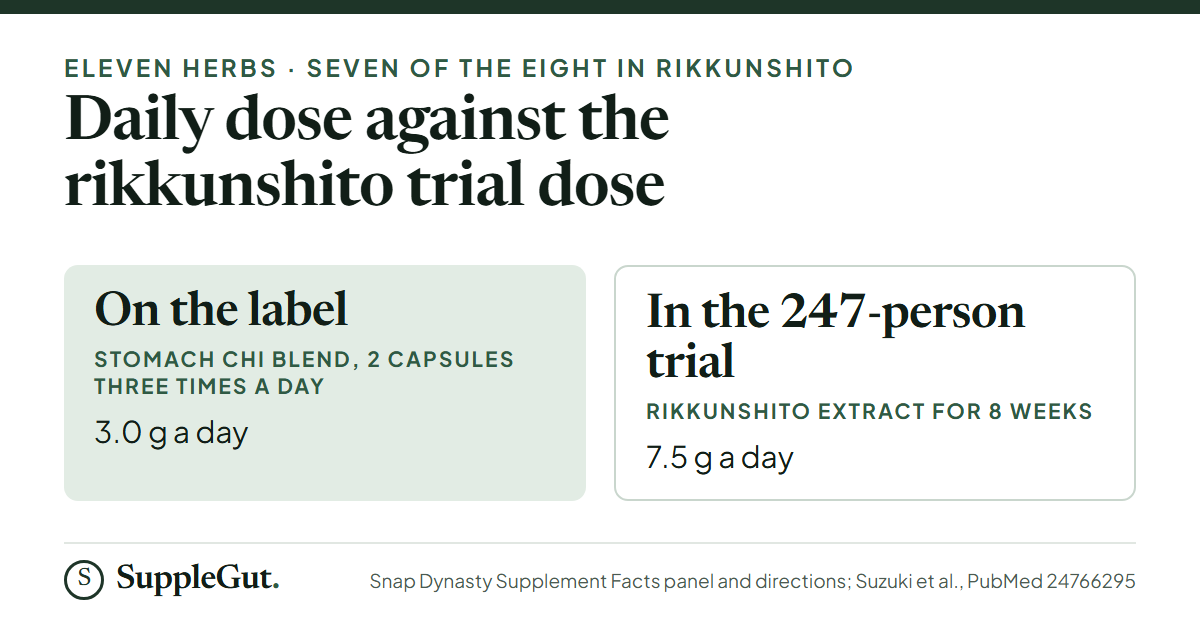
The dose gap is the notable figure. One serving of Stomach Chi is 1.0 g of blend, so the standard three servings a day come to 3.0 g, against 7.5 g a day of extract in the 247-person trial. Extract and raw-herb weights are not equivalent, and the label does not say which form it holds, so the two numbers cannot be turned into a ratio. The brand’s daily maximum of 24 capsules for adults would be 12 g of blend by our arithmetic.
Single herbs have small trials. In 11 people with functional dyspepsia, 1.2 g of ginger sped gastric half-emptying from 16.1 to 12.3 minutes (P ≤ 0.05) while symptoms did not change (PMID 21218090). A Glycyrrhiza glabra extract, GutGard, at 75 mg twice a day for 30 days lowered dyspepsia symptom scores against placebo (P ≤ .05) (PMID 21747893), and it is a different preparation from the whole root here. Our PubMed searches found no dyspepsia trial of ginseng alone or magnolia bark alone. The wider record of formula trials sits in TCM formulas for digestion: what the trials show.
The brand’s vocabulary: stomach chi
Snap Dynasty writes that the blend “strengthens spleen and stomach chi, allowing your digestive system to process nourishment.” In the tradition, chi (qi) is the activity that moves and transforms in the body, and the spleen and stomach are the organ systems said to receive food and turn it into nourishment, not the anatomical organs. The page ties the product to bloating after eating, a heavy, weighed-down feeling after meals and a sense that digestion does not feel settled, and it does not use the pattern names food stagnation or spleen qi deficiency. The tradition’s categories are descriptions, not measurements. The key concepts guide defines them, and the TCM section lists the series.
“Safe for all ages” and the herbs on the panel
The product page states that Stomach Chi “is safe for all ages and has no contraindications”; it is the brand’s claim, and the label prints no warning beyond keeping the bottle from children. The directions give adults two capsules three times a day and children 12 and under one capsule three times a day, and say that in some circumstances the age-appropriate dose can be taken as often as every 30 minutes, to a daily maximum of 24 capsules for adults and 8 for children under 12. The brand’s FAQ lists four other formulas as contraindicated in pregnancy and does not list this one, and the site footer advises consulting a healthcare professional before starting any new herbal supplement.
Two herbs on the panel have documented interactions. In a randomized, double-blind trial, 20 healthy volunteers who took American ginseng for 2 weeks had a lower peak INR on warfarin than those on placebo (difference −0.19, 95% CI −0.36 to −0.07, P = 0.0012) (Yuan et al., 2004). That trial used American ginseng, while the label says Asian ginseng, and NCCIH adds that ginseng might lower blood sugar (NCCIH). For licorice, a meta-analysis of 18 studies with 337 people, in products giving 100 mg or more of glycyrrhizic acid a day, found systolic pressure up 5.45 mmHg and plasma potassium down 0.33 mmol/L (Penninkilampi et al., 2017). Neither the ginseng nor the licorice amount is printed, and these findings describe the herbs, not what a serving here does.
Testing statements and what a buyer can check
Snap Dynasty states on the product page, “We batch-test for pesticides, microbes, and heavy metals.” Its quality page says raw materials and finished products are tested for identity by TLC and HPLC, that further testing “may include” microbial examination, plasticizer inspection, heavy metal, residual pesticide, aflatoxin, aristolochic acid and sulfur dioxide testing, and that the facility is “GMP-certified by an independent certification body.” Each bottle carries a batch number, manufacture date and expiry date. No lab or certifier is named, and we found no results or certificate on the pages we read.
The published context is a set of surveys, each describing what it sampled. California’s health department found at least 83 of 260 Asian patent medicines (32%) holding undeclared pharmaceuticals or heavy metals (Ko, NEJM, 1998). In 334 raw herb samples from China, all held at least one metal, and 3 (1%) were at levels that could add to exposure under the likely scenario of use (Harris et al., 2011). On aristolochic acid, the FDA’s Import Alert 54-10 covers Aristolochia, Asarum, Cocculus orbiculatus and Thottea species and names qing mu xiang, guang fang ji, fang chi, xi xin and mu tong forms. No herb on this label is one of those by name, and “saussurea (root)” is the costus root rather than qing mu xiang. The brand also says it does “not use endangered, restricted or questionable ingredients.” Are Chinese herbal supplements safe? covers the wider record.
In the United States the capsule is a dietary supplement under the Dietary Supplement Health and Education Act of 1994, so the maker answers for safety and claims and the FDA acts after sale; we found no FDA warning letter or recall for the brand in web searches. The brand sells through its own site, retail stores and practitioners. Most states license acupuncture, with Chinese herb practice under that license in some (NCCIH). The capsule is bovine gelatin, so it is not vegan, and the powder is stated to be; the brand claims gluten-free, no wheat-derived herb is on the list, and one reviewer reports avoiding it for a corn sensitivity.
Capsules, powder and price
The 120-capsule bottle is $29.99 on the brand site and $29.98 on Amazon, where it is sold by a seller named VerSure whose relationship to the brand is not stated. At the standard six capsules a day it lasts 20 days, which is $1.50 a day. The 60-capsule bottle is $17.99 for 10 days, $1.80 a day. At the 24-capsule daily maximum a 120-capsule bottle lasts 5 days, $6.00 a day. The powder is $36.99 for 100 g and $21.99 for 50 g. The brand offers a subscription program with a discount whose percentage we did not find, and 20% off a first order. Its refund policy covers purchases made on its own site within 30 days of the order, and not purchases through stores or other online sellers, Amazon included.
Reviewer reports
Amazon shows 4.5 from 162 ratings. The brand’s Judge.me widget shows 4.75 from 56 reviews (51 five-star, 2 four-star, 3 one-star), spanning several years and including some written under the OHCO name. iHerb showed 4.4 from 33 when we read it, listed as out of stock.
Praise centers on fast relief of an upset stomach (one reviewer: “within 20 min. all symptoms… gone”), years of use with a bottle kept for travel or big meals, and, in some reviews, relief of heartburn or reflux, which the brand page does not claim. The three one-star reviews say it did not work for them. Other complaints are the corn starch, relief that lasted two to four hours for one four-star reviewer, and one report of ordering and customer-service problems. We found no subscription-billing complaint.
Who Stomach Chi is for, and what sits beside it
- Someone who wants one capsule built on the Liu Jun Zi herbs and is comfortable with eleven herbs under one weight and no named formula.
- Someone drawn to the brand’s own wording, bloating and a heavy feeling after meals, and willing to take it as needed or three times a day.
- Someone comparing capsules: Six Gentlemen uses eight herbs without pinellia or poria, and Quiet Digestion follows Bao He Wan.
The product page is Snap Dynasty Stomach Chi.
Products this guide draws on
Common questions
Does Stomach Chi work for heartburn or acid reflux?
The brand page makes no heartburn or reflux claim; its wording is bloating, indigestion and a heavy feeling after meals. Some reviewers on the brand site and Amazon write that it eased heartburn, and we could find no trial of the blend for it. The label lists licorice root and does not mention deglycyrrhizinated licorice, the form sold for reflux.
Is Stomach Chi gluten free?
The brand claims gluten-free on the product page, and no wheat-derived herb such as shen qu or barley sprout is on the panel. The capsule is bovine gelatin with non-GMO cornstarch, and no contains line is printed for other allergens.
How many Stomach Chi capsules should I take?
The brand directs adults to take two capsules three times a day and children 12 and under one capsule three times a day. It adds that the age-appropriate dose can be taken as often as every 30 minutes in some circumstances, to a daily maximum of 24 capsules for adults and 8 for children under 12.
Is Stomach Chi the same as rikkunshito or Six Gentlemen?
It overlaps both without matching either. It has seven of rikkunshito’s eight herbs, all but jujube, and adds saussurea, cardamom, magnolia bark and perilla. Health Concerns Six Gentlemen is an eight-herb blend without pinellia or poria; see the Six Gentlemen guide.
Does Stomach Chi interact with medicines?
The brand says it has no contraindications, and the panel contains ginseng and licorice. Trial data show American ginseng lowering the effect of warfarin in 20 healthy volunteers, and licorice with 100 mg or more of glycyrrhizic acid raising blood pressure in a meta-analysis of 337 people. The label prints no amount for either herb.
Who tests Stomach Chi?
Snap Dynasty states that it batch-tests for heavy metals, pesticides and microbes and that its facility is GMP-certified by an independent body. It names no lab or certifier and publishes no results that we could find.
What does a day of Stomach Chi cost?
At the standard six capsules a day, the 120-capsule bottle at $29.99 lasts 20 days, or $1.50 a day. The 60-capsule bottle at $17.99 is $1.80 a day. At the 24-capsule daily maximum it is $6.00 a day.
Sources
- Snap Dynasty: Stomach Chi product page, safety and quality page, FAQ, return policy and people page (Supplement Facts, directions, testing statements, refund terms). snapdynasty.com; safety and quality
- Amazon listing for Snap Dynasty Stomach Chi, 120 capsules (price, rating). amazon.com/dp/B00028M8QO; iHerb listing. iherb.com
- Suzuki H, et al. “Randomized clinical trial: rikkunshito in the treatment of functional dyspepsia: a multicenter, double-blind, randomized, placebo-controlled study.” Neurogastroenterol Motil, 2014;26(7):950–961. PMID 24766295. pubmed.ncbi.nlm.nih.gov/24766295
- Tominaga K, et al., DREAM study, Neurogastroenterol Motil, 2018;30(7):e13319 (PMID 29498457); Masuy I, et al., Neurogastroenterol Motil, 2020;32(2):e13739 (PMID 31608532); Ko SJ, et al., J Gastroenterol Hepatol, 2021;36(1):64–74 (PMID 32767596). 29498457; 31608532; 32767596
- Inokuchi K, et al. “Rikkunshito as a therapeutic agent for functional dyspepsia and its prokinetic and non-prokinetic effects.” Front Pharmacol, 2021;12:640576. pmc.ncbi.nlm.nih.gov/articles/PMC8217963
- Lv L, et al., World J Gastroenterol, 2017;23(30):5589–5601 (PMID 28852318); Zhang S, et al., BMC Complement Altern Med, 2013;13:54 (PMID 23453018); Wang L, et al., Front Pharmacol, 2024;15:1356899 (PMID 38933675). 28852318; 23453018; 38933675
- Hu ML, et al. “Effect of ginger on gastric motility and symptoms of functional dyspepsia.” World J Gastroenterol, 2011;17(1):105–110. PMID 21218090. Raveendra KR, et al. “An extract of Glycyrrhiza glabra (GutGard) alleviates symptoms of functional dyspepsia.” Evid Based Complement Alternat Med, 2012;2012:216970. PMID 21747893. 21218090; 21747893
- Yuan CS, et al. “American ginseng reduces warfarin’s effect in healthy patients: a randomized, controlled trial.” Ann Intern Med, 2004;141(1):23–27. PMID 15238367. pubmed.ncbi.nlm.nih.gov/15238367. Penninkilampi R, et al., J Hum Hypertens, 2017;31:699–707. PMID 28660884. pubmed.ncbi.nlm.nih.gov/28660884. NCCIH, Asian ginseng. nccih.nih.gov
- Ko RJ, NEJM, 1998;339:847 (PMID 9750079; figures via Relias Media); Harris ES, et al., Sci Total Environ, 2011;409:4297–4305 (PMID 21824641). 9750079; 21824641
- FDA Import Alert 54-10 (aristolochic acid). accessdata.fda.gov. NCCIH, “Traditional Chinese Medicine: What You Need To Know.” nccih.nih.gov
Which of these fits you?
Three minutes with the quiz turns this background into one named product, with the reasons shown.
Take the quiz →