Guide
Does Health Concerns Six Gentlemen work? A Xiang Sha Liu Jun Zi Tang without pinellia or poria, and the dyspepsia trials
Quick answer
Does Health Concerns Six Gentlemen work? No trial of this capsule turned up. Related formulas have been tested in functional dyspepsia: rikkunshito, the Japanese version, gave 33.6% responders against 23.8% on placebo in 247 people (P = 0.09) and beat placebo in a 128-person trial, and Chinese granule trials of 202 and 160 people favored the granules. This capsule omits pinellia and poria and prints one 1,349 mg weight for eight herbs. Amazon shows 4.4 from 41 ratings.
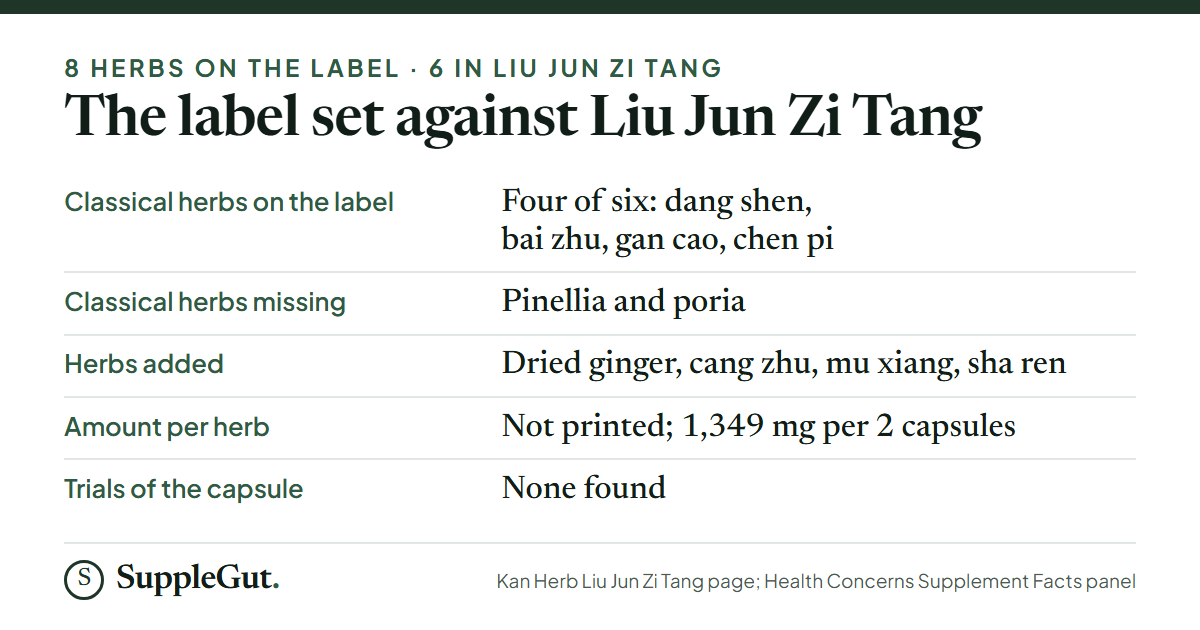
Six Gentlemen is the Health Concerns capsule printed with the name Xiang Sha Liu Jun Zi Tang, a classical formula whose relatives have more placebo-controlled digestive trials behind them than most Chinese herbal formulas. The label and the trials share a name and some herbs but not a recipe or a dose, and this guide sets the three side by side.
Eight herbs, one 1,349 mg weight
The panel gives a serving of two capsules, 45 servings per container and a Proprietary Herbal Blend of 1,349 mg with no Daily Value; a capsule is 675 mg. Other ingredients are hypromellose and rice bran. The eight herbs appear in label order with no amounts, and the bottle prints their pinyin names without Latin names.
| Label order | Name on the label | Pinyin on the bottle | Marked as |
|---|---|---|---|
| 1 | Codonopsis root | Dang Shen | Extract |
| 2 | Bai-Zhu Atractylodes rhizome | Bai Zhu | Plain herb |
| 3 | Ginger rhizome | Gan Jiang | Plain herb |
| 4 | Licorice root | Gan Cao | Extract |
| 5 | Tangerine peel (citrus peel) | Chen Pi | Extract |
| 6 | Cang-Zhu Atractylodes rhizome | Cang Zhu | Extract |
| 7 | Costus root (aucklandia) | Mu Xiang | Extract |
| 8 | Cardamom fruit | Sha Ren | Extract |
Six are marked as extracts; bai zhu and ginger are listed without that word. Gan jiang is the pinyin for dried ginger, and sha ren is the name the tradition gives to the amomum fruit.
Six classical herbs, four on this label
Kan Herb lists Liu Jun Zi Tang, the Six Gentlemen Decoction, as dang shen, bai zhu, ginger-cured pinellia (jiang ban xia), chen pi, poria (fu ling) and honey-fried gan cao. The Health Concerns label carries four of those six: dang shen, bai zhu, gan cao and chen pi. It does not list pinellia or poria, and it adds dried ginger, cang zhu, mu xiang and sha ren.
Two of the additions follow the name. Xiang Sha in Xiang Sha Liu Jun Zi Tang is conventionally read as mu xiang and sha ren, so if that version is the six herbs plus those two, six of its eight are on the label. The brand page headed its ingredient section “Modified Xiang Sha Liu Jun Zi Wan” and says the formula “builds upon the classic Four Gentlemen formula, with additional herbs.” Pinellia and poria are the two the capsule leaves out.
The dyspepsia trials, trial by trial
Functional dyspepsia means fullness after meals, early satiety or upper abdominal pain with no structural cause found, and it is the condition the trials below enrolled. The two Chinese trials also required a spleen-deficiency and qi-stagnation pattern, a diagnosis made by the tradition’s criteria. None of the trials tested this capsule.
| Trial | Formula and dose | People and length | Result |
|---|---|---|---|
| Suzuki et al. (PMID 24766295) | Rikkunshito extract, 2.5 g three times a day | 247 people, 8 weeks, placebo-controlled | Global-assessment responders 33.6% vs 23.8% on placebo (P = 0.09, primary endpoint not significant); epigastric pain improved (P = 0.04) |
| Tominaga et al., DREAM (PMID 29498457) | Rikkunshito | 128 randomized, 8 weeks | Overall treatment effect P = .019; postprandial fullness and bloating improved (P = .001 and P = .002 at 8 weeks) |
| Masuy et al. (PMID 31608532) | Rikkunshito, crossover | 23 completers in Belgium, 4 weeks each | Gastric motility unchanged; a similarly high placebo response |
| Lv et al. (PMID 28852318) | Xiangsha Liujunzi granules, 130 mL three times a day | 202 analyzed (135 granules, 67 placebo), 4 weeks | Fullness, early satiety and epigastric pain scores better than placebo at week 4 (P = 0.000, 0.000, 0.039); no adverse events reported |
| Zhang et al. (PMID 23453018) | Modified Liu Jun Zi granules, 150 mL twice a day | 160 people, 4 weeks plus 4 of follow-up | Total and single symptom scores better than placebo (P < 0.01); gastric emptying improved (P < 0.05) |
Two meta-analyses pool these formula families. For rikkunshito, 52 trials with 5,475 people gave a total clinical efficacy risk ratio of 1.21 (95% CI 1.17 to 1.25) against Western medicine, and the authors called for higher-quality trials (PMID 32767596). For Xiangsha liujunzi decoction, 23 studies with 2,101 people gave an effectiveness risk ratio of 1.27 (1.21 to 1.33) against control groups, with no difference in safety events (RR 0.67, 0.16 to 2.76), and the authors rate the included studies low quality (PMID 38933675).
The headline trials do not share a recipe with the capsule. Rikkunshito has eight herbs, atractylodes, ginseng, pinellia, poria, jujube, citrus peel, licorice and ginger (Inokuchi et al., 2021), and the capsule shares four of them. The Lv granules held astragalus, codonopsis, white atractylodes, poria, fructus aurantii, amomum, chuanxiong, corydalis, medicated leaven and licorice, of which four are on this label. The Zhang recipe was dang shen, bai zhu, fu ling, gan cao, hou po, mu xiang, sha ren, yuan hu and ban xia, five of whose nine are on the label. Doses differ as well: the trials gave 7.5 g a day of extract or 300 to 390 mL a day of dissolved granules, where two capsules three times a day deliver 1,349 mg of blend three times, about 4.0 g in all by our arithmetic.
Rikkunshito missed its primary endpoint in the largest trial and beat placebo in a smaller one, and the Belgian crossover found no change in gastric motility. The pooled risk ratios are larger than any single trial, and every trial used a different herb list from this capsule.
Beyond dyspepsia, Chinese formulas have been tested mostly in irritable bowel syndrome. The 2006 Cochrane review found 75 trials with 7,957 people and only three high-quality double-blind, placebo-controlled ones (PMID 16437473), and the 116-person Australian trial of a 20-herb formula reported bowel symptom scores better than placebo, P = .03 by patient rating and P = .001 by gastroenterologist rating (PMID 9820260). More formulas are gathered in TCM formulas for digestion: what the trials show.
Spleen qi and fatigue: the brand’s vocabulary
The brand page says the formula “tonifies Qi and harmonizes the spleen and stomach” and calls it “a foundational formula” for fatigue, bloating and digestive discomfort “due to a weak spleen and stomach.” It names the patterns spleen qi deficiency, cold-damp and phlegm-dampness, and adds that long-term use is typically needed. In the tradition, qi is the activity that moves, warms and transforms in the body; the spleen is the organ system said to turn food and fluid into qi; and deficiency means an under-supply of that activity, with tiredness and poor appetite. Dampness and phlegm are the heavy, sticky and thickened influences the texts tie to a weak spleen. These are the tradition’s own terms, and no instrument measures them. The key concepts guide defines each, and the TCM section lists the series.
The page prints one contraindication: “Excess conditions and diseases caused by external factors.” In the tradition, excess means accumulation or blockage, and diseases from external factors are those said to enter from outside, the way a common cold is described. It names no medicine and no medical condition.
Safety: licorice, metals and the testing statements
The bottle’s notice advises consulting a health care practitioner before use, especially when pregnant, nursing or under medical supervision for any reason. That is the one precaution the label prints; there is no licorice-specific wording, although licorice is on the panel.
Whole licorice root carries glycyrrhizin, which can raise blood pressure and lower potassium. A meta-analysis of 18 studies with 337 people, in products giving at least 100 mg of glycyrrhizic acid a day, found systolic pressure up 5.45 mmHg (95% CI 3.51 to 7.39) and plasma potassium down 0.33 mmol/L (Penninkilampi et al., 2017). The label gives no licorice amount, so the glycyrrhizic acid in a serving cannot be worked out.
On aristolochic acid, the FDA’s Import Alert 54-10 lists Aristolochia, Asarum, Cocculus orbiculatus and Thottea species and names qing mu xiang (Aristolochia debilis), guang fang ji, fang chi, xi xin and mu tong forms. The label’s mu xiang is printed as costus root, the Aucklandia plant and not qing mu xiang, and none of the other seven herbs is on the alert. Latin names are not printed on this bottle, so that reading rests on the English names and the pinyin. The brand publishes no aristolochic acid test result.
Published metal surveys describe the products sampled and do not extend to every bottle. Of 292 Ayurvedic, Chinese and Tibetan preparations bought in the Netherlands, 186 (64%) contained mercury, arsenic or lead, fewer than 20% of their labels suggested it, and 59 (20%) were likely to exceed safety limits at the labeled dose (Martena et al., 2010). Health Concerns states no GMP, third-party or heavy-metal testing on its product page, About Us page or Amazon listing; one reviewer writes of “Good information about the ingredients, but not a source or manufacturer process.” Are Chinese herbal supplements safe? covers the wider record.
The capsule is a dietary supplement under the Dietary Supplement Health and Education Act of 1994, which leaves safety and claims with the maker and the FDA acting after sale. Health Concerns says it was the first company to manufacture Chinese herbal products in the United States for practitioners, and it also sells to the public. Most states license acupuncture, and in some of them Chinese herb practice falls under that license (NCCIH). A buyer can check the Supplement Facts panel (present, with one total) and the English names (printed); a third-party certificate and Latin names are not on this bottle.
Two capsules three times a day: the arithmetic of the bottle
The bottle’s suggested use is two capsules, three times a day, between meals, or as a practitioner advises. That is six capsules, so the 45 servings the panel counts are two-capsule servings and a 90-capsule bottle lasts 15 days. The brand page says long-term use is typically needed, and two bottles cover 30 days.
The bottle is $29.90 on the brand site and $29.99 on Amazon: $1.99 a day at six capsules ($2.00 on Amazon), or $0.33 a capsule, and $59.80 for 30 days at the brand price by our arithmetic. Shipping on the brand site is free over $100. We found no subscription price.
Reviewer reports
Amazon shows 4.4 from 41 ratings on a listing sold by Health Concerns itself, though only about eight reviews are readable on the page. The brand’s Judge.me widget shows 4.69 from 13 reviews (9 five-star, 4 four-star). Ten of those 13 were posted within about two weeks of each other, and several of the ten come from buyers who had just received the bottle and say it is too early to judge; the other three were posted at separate times.
Praise centers on less bloating and gas, gentle capsules that do not upset the stomach, and a strong, fresh herbal aroma. Complaints cluster on the serving count: one four-star reviewer writes “only 15 days of servings, not 45,” and an Amazon reviewer asks whether it is a 45-day or a 15-day supply. A few mention the price, and one four-star reviewer is never sure the capsules are working. One Amazon one-star review reads “Wrong item entirely” with no further text. We found no billing complaints.
Who Six Gentlemen is for, and what sits beside it
- Someone who wants a Liu Jun Zi style capsule and is comfortable with eight herbs under one weight and a recipe that departs from the classical six.
- Someone following the tradition’s spleen qi idea and willing to take it daily, which is how the brand describes the formula.
- Someone comparing capsules: Quiet Digestion is the brand’s as-needed formula for heavy meals and travel upset, and Stomach Chi is an eleven-herb blend that keeps pinellia and poria.
The product page is Health Concerns Six Gentlemen.
The entries this page refers to
Common questions
Does Six Gentlemen work for bloating?
We could find no trial of this capsule. Trials of related formulas in functional dyspepsia reported better symptom scores than placebo in some cases and no change in gastric motility in another, using different herb lists and doses. Reviewers on Amazon and the brand’s page often write of less bloating and gas, and the Amazon rating is 4.4 from 41.
Is Six Gentlemen the same as Liu Jun Zi Tang?
It shares four of the six classical herbs: dang shen, bai zhu, gan cao and chen pi. Pinellia and poria are not on the label, and dried ginger, cang zhu, mu xiang and sha ren are added. The brand page calls it a modified Xiang Sha Liu Jun Zi formula.
How is Six Gentlemen different from rikkunshito?
Rikkunshito is the Japanese form of Liu Jun Zi Tang, with eight herbs including ginseng, pinellia, poria and jujube, and it was the subject of the 247-person and 128-person trials. The capsule shares four of those herbs (atractylodes, citrus peel, licorice and ginger) and gives about 4.0 g of blend a day against 7.5 g of extract in the larger trial.
Does Six Gentlemen contain licorice, and does that matter?
Yes, licorice root extract is the fourth herb listed, and the label prints no amount for it. Whole licorice root carries glycyrrhizin, which in a meta-analysis of 18 studies raised systolic pressure by 5.45 mmHg and lowered potassium by 0.33 mmol/L at 100 mg or more of glycyrrhizic acid a day. Nothing printed lets a buyer work out how much a serving holds.
Why does the bottle say 45 servings if it lasts 15 days?
The panel counts a serving as two capsules, and the suggested use is two capsules three times a day, which empties a 90-capsule bottle in 15 days. Reviewers on both the brand page and Amazon have raised the wording.
What does Six Gentlemen cost per day?
The bottle is $29.90 on the brand site and $29.99 on Amazon. At six capsules a day that is $1.99 a day, and about $59.80 for 30 days at the brand price.
Sources
- Health Concerns: Six Gentlemen product page (Supplement Facts, suggested use, brand wording, contraindication line) and About Us page. healthconcerns.com
- Amazon listing for Health Concerns Six Gentlemen, 90 capsules (price, rating, reviews). amazon.com/dp/B09H3MNFLR
- Kan Herb Company: Six Gentlemen (Liu Jun Zi Tang) page, for the six-herb list. kanherb.com
- Suzuki H, et al. “Randomized clinical trial: rikkunshito in the treatment of functional dyspepsia: a multicenter, double-blind, randomized, placebo-controlled study.” Neurogastroenterol Motil, 2014;26(7):950–961. PMID 24766295. pubmed.ncbi.nlm.nih.gov/24766295
- Tominaga K, et al. “Rikkunshito simultaneously improves dyspepsia correlated with anxiety in patients with functional dyspepsia: a randomized clinical trial (the DREAM study).” Neurogastroenterol Motil, 2018;30(7):e13319. PMID 29498457. pubmed.ncbi.nlm.nih.gov/29498457. Masuy I, et al., Neurogastroenterol Motil, 2020;32(2):e13739. PMID 31608532. pubmed.ncbi.nlm.nih.gov/31608532
- Ko SJ, et al. “Effects of the herbal medicine Rikkunshito, for functional dyspepsia: a systematic review and meta-analysis.” J Gastroenterol Hepatol, 2021;36(1):64–74. PMID 32767596. pubmed.ncbi.nlm.nih.gov/32767596. Inokuchi K, et al., Front Pharmacol, 2021;12:640576 (rikkunshito composition). pmc.ncbi.nlm.nih.gov/articles/PMC8217963
- Lv L, et al. “Efficacy and safety of Xiangsha Liujunzi granules for functional dyspepsia: a multi-center randomized double-blind placebo-controlled clinical study.” World J Gastroenterol, 2017;23(30):5589–5601. PMID 28852318. pubmed.ncbi.nlm.nih.gov/28852318
- Zhang S, et al. “Efficacy of modified LiuJunZi decoction on functional dyspepsia of spleen-deficiency and qi-stagnation syndrome: a randomized controlled trial.” BMC Complement Altern Med, 2013;13:54. PMID 23453018. pubmed.ncbi.nlm.nih.gov/23453018. Wang L, et al., Front Pharmacol, 2024;15:1356899. PMID 38933675. pubmed.ncbi.nlm.nih.gov/38933675
- Liu JP, et al., Cochrane review of herbal medicines for irritable bowel syndrome, 2006 (PMID 16437473); Bensoussan A, et al., JAMA, 1998;280(18):1585–1589 (PMID 9820260). pubmed.ncbi.nlm.nih.gov/16437473; pubmed.ncbi.nlm.nih.gov/9820260
- Penninkilampi R, et al. “The association between consistent licorice ingestion, hypertension and hypokalaemia: a systematic review and meta-analysis.” J Hum Hypertens, 2017;31:699–707. PMID 28660884. pubmed.ncbi.nlm.nih.gov/28660884. Martena MJ, et al., Food Addit Contam Part A, 2010;27:190–205. PMID 19890755. pubmed.ncbi.nlm.nih.gov/19890755. FDA Import Alert 54-10. accessdata.fda.gov. NCCIH, “Traditional Chinese Medicine: What You Need To Know.” nccih.nih.gov
From the general to your case
The trials above are the general case. The quiz applies them to yours: symptoms, medicines, routine, and what you have already tried.
Take the quiz →