
Guide
Does Innocuous Vitamins GLP-1 Synbiotic work? Eighteen strains, two different CFU totals, and trials that measured fat, not GLP-1
Quick answer
Does Innocuous Vitamins GLP-1 Synbiotic work? No trial of this capsule was found, and none measured GLP-1 after taking it. Trials of single strains on the label found small changes in visceral fat or fat mass, such as 0.8 kg less fat mass with no weight change for L. sakei CJLS03, and a 2018 meta-analysis of 15 probiotic trials found an average loss of 0.6 kg. The panel's counts add up to 81 billion CFU against the brand's 66 billion. The price is $0.67 a day, and Amazon shows 4.2 from 28 ratings.
Innocuous Vitamins GLP-1 Synbiotic is one capsule a day holding 18 bacterial strains and 100 mg of manuka honey powder, sold under the line “boosts GLP-1 & weight loss naturally.” What sets it apart is a label that prints a CFU figure for every organism, 13 of them with strain codes; what it leaves open is that those figures add up to 81 billion while the brand’s own pages say 66 billion.
What the GLP-1 Synbiotic is, and what it is not
The Supplement Facts panel lists a 200 mg Probiotic Blend and 100 mg of manuka honey powder per capsule, with hypromellose and magnesium stearate as the other ingredients. The blend names 18 organisms, each with its own count. Three carry the largest figure, 10 billion CFU: Akkermansia muciniphila WB-STR-001, Bifidobacterium animalis ssp. lactis 420 and Lactobacillus gasseri SBT2055. Seven print 5 billion and eight print 2 billion. Thirteen of the 18 have a strain designation; five do not: B. breve, L. casei, L. helveticus, L. paracasei and Streptococcus thermophilus.
The brand names the honey as the prebiotic; we found no study of a 100 mg honey dose. The label makes no allergen or free-from statement, and the brand does not claim the capsule is vegan, since it contains honey.
The product is not a GLP-1 drug. The brand states this itself: it “does not contain GLP-1 or synthetic GLP-1 and is not a GLP-1 agonist drug.” The bottle’s claim concerns the body’s own gut hormone response, which the trials below did not measure.
Eighteen strains, two CFU totals
The brand page, the Amazon listing and the graphics say 66 billion CFU and “18 clinical strains.” The per-organism figures printed on the panel add up to 81 billion. The first 15 organisms in the panel’s order sum to 66 billion; the last three, L. plantarum KY1032, L. sakei CJLS03 and S. thermophilus, add 5 billion each, 15 billion in all. The brand does not explain the difference. The label does not say whether the counts hold at expiry. For how CFU counts work, see the CFU guide.
Who makes it, and what testing is stated
The About page is signed by an unnamed founder who writes that he spent three months working with AI to pick the strains; the manufacturer is not named. The brand says it can provide test reports on request; we found no laboratory named, no certificate posted and no NSF, USP or Informed Choice mark.
The trial of the capsule itself
There is none. A PubMed search for the brand name and the product name returned no trial. The brand’s page says its listed results come from trials on specific strains and that the combination’s results “will vary.” We found no trial that measured GLP-1 after taking this product. The evidence sits strain by strain.
What the trials of the individual strains found
| Strain on the label | Trial | Dose in the trial, against the label | Result |
|---|---|---|---|
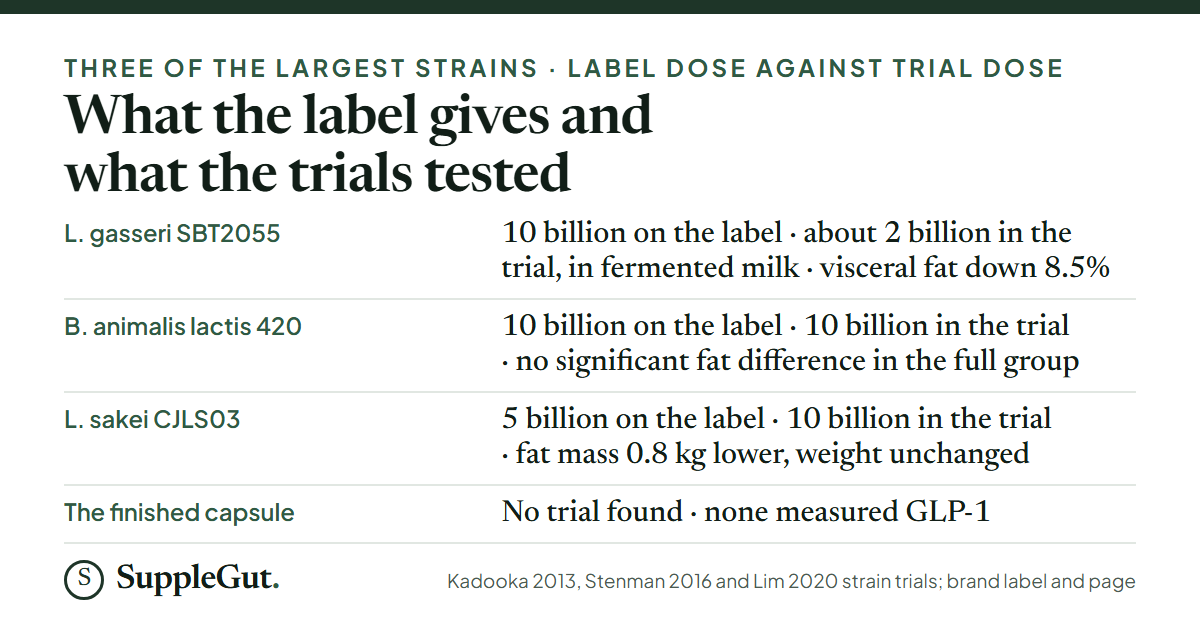
| L. gasseri SBT2055 (10 billion) | 210 adults with large visceral fat areas; 12 weeks; fermented milk | About 2 billion CFU a day in milk | Visceral fat area down 8.5% on CT against no significant change on placebo; faded after stopping |
| L. sakei CJLS03 (5 billion) | 114 adults, BMI 25 or more; 12 weeks | 10 billion a day, as two 5 billion doses | Fat mass 0.8 kg lower than placebo; waist 0.8 cm smaller; body weight and BMI did not change |
| L. curvatus HY7601 with L. plantarum KY1032 (5 billion each) | 72 adults with overweight; 12 weeks | 10 billion a day together, the label total | Lower body weight, visceral fat mass and waist than placebo |
| L. gasseri BNR17 (2 billion) | 90 adults, BMI 25 to 35; 12 weeks | 1 or 10 billion a day; the label is one fifth of the higher | Visceral fat area 21.6 cm2 smaller than placebo at 10 billion |
| B. animalis lactis 420 (10 billion) | 225 adults, BMI 28 to 34.9; 6 months | 10 billion a day, the same as the label | No significant body fat difference in the full group of 209; post-hoc, 4.0% less fat mass in the 134 who followed the protocol |
The outcomes are body fat, waist and weight; none is GLP-1. The gaps are modest: the CJLS03 result is a 0.8 kg difference in fat mass with no change in weight, the same 1.76 pounds the brand lists as “weight loss” for that strain. The doses and forms also differ. SBT2055 was tested in fermented milk, and the label puts about five times as many CFU in a capsule; BNR17’s effective dose was five times the label figure. The B420 trial used the label dose and found no difference in its main analysis. Four label strains with the Lab4 name were studied in 52 people with IBS, and that trial measured IBS symptoms, not weight.
Akkermansia, and the GLP-1 claim
The 10 billion CFU of Akkermansia muciniphila is a strain, WB-STR-001, with no published trial: a PubMed search for the code returned nothing. The human trials of the species used other preparations. In a 40-person pilot at 10 billion bacteria a day for three months, the pasteurized form improved insulin sensitivity by 28.6% against placebo, and a weight loss of 2.27 kg was not statistically significant. A trial of pasteurized cells in 142 adults with metabolic syndrome, at 30 billion a day, missed its main endpoint; post-meal GLP-1 was higher than placebo only in exploratory subgroups. This bottle says “live” Akkermansia, so pasteurized results do not transfer directly. See the Double Wood Akkermansia guide and Akka guide.
Probiotics as a class lower weight by a small amount. A 2018 meta-analysis pooled 15 randomized trials in 957 people with overweight or obesity and found an average loss of 0.6 kg (confidence interval 0.01 to 1.19 kg), with small effect sizes and no significant change in fat mass.
How to take it
The brand’s directions are one capsule a day before the largest meal, with an optional second capsule before a large second meal. Its page asks readers to pair the product with exercise, fewer calories and less starch, so any weight change in a reviewer’s account may come from those steps. The brand recommends refrigeration.
Side effects and who should not take it
The label advises consulting a healthcare provider before use if you are pregnant, nursing, taking any medication or have a medical condition. It lists no specific side effects. The brand says changes such as easier bowel movements and less gas appear in the first two weeks. The label gives no dairy statement, and several listed species are often grown on dairy media. The probiotic side effects guide covers the usual first-week effects.
What the reviews say
Amazon shows 4.2 from 28 ratings (45% five-star, none at one star). Every one of the seven reviews we could read carries Amazon’s label for Vine reviews, which are written by reviewers who received the product free. The brand’s own site uses a built-in review widget showing 4.7 from 12 reviews (11 five-star, one one-star), hosted by the brand. Trustpilot has no profile for the company.
Praise: small capsules with no aftertaste, a metal bottle, and no bloating. Complaints: no change in weight or appetite, a GLP-1 link one reviewer found unclear, the price compared with other probiotics, and in one case a bottle with no seal.
Price, subscription and refund terms
| Route | Price for 60 capsules | Per day at one capsule |
|---|---|---|
| Brand site, one time | $40.00 | $0.67 |
| Brand site, subscription (5% off, monthly until canceled) | $38.00 | $0.63 |
| Amazon, one time | $40.00 | $0.67 |
At the optional two capsules a day the cost is about $1.33. The brand’s page offers free shipping and a full refund within 120 days, on the conditions that the buyer has taken the product for at least 60 days (or twice a day for 30 days), is not happy with the results and says why. The refund page calls these “free 120 day returns.” We did not read the subscription’s cancellation terms beyond “until canceled,” and found no billing complaints, though no independent review site covers the company.
Who the GLP-1 Synbiotic is for
- Someone who wants a multi-strain capsule with a CFU figure for each organism and accepts that the formula as a whole is untested.
- A person who is not pregnant or nursing and has checked with a healthcare provider if on medication.
If bloating or irregularity is the main concern rather than weight, Seed DS-01 is a synbiotic with a trial of the finished product, at about $2 a day. Pendulum Akkermansia and Double Wood Akkermansia are single-organism Akkermansia capsules. The probiotic guide and quiz start from symptoms.
The products in this catalog
Common questions
Does Innocuous Vitamins GLP-1 Synbiotic work for weight loss?
No trial of this capsule was found. The brand points to trials of single strains in other products: L. sakei CJLS03 gave 0.8 kg less fat mass than placebo with no change in body weight, and L. gasseri SBT2055 in fermented milk cut visceral fat area by about 8.5%. A 2018 meta-analysis of 15 probiotic trials found an average loss of 0.6 kg.
Does it actually raise GLP-1?
The bottle says it “boosts GLP-1,” and the brand also states the capsule contains no GLP-1 and is not a GLP-1 drug. We found no trial measuring GLP-1 after this product. The nearest human data are exploratory subgroups of an Akkermansia trial using a different strain and pasteurized cells.
What strains are in it, and why do the CFU totals differ?
The panel prints 18 organisms with a count each, including Akkermansia muciniphila WB-STR-001, B. animalis lactis 420 and L. gasseri SBT2055 at 10 billion CFU each. Five have no strain code: B. breve, L. casei, L. helveticus, L. paracasei and S. thermophilus. The printed counts add up to 81 billion, while the brand’s pages say 66 billion, and the brand does not explain the gap.
How much does it cost?
A 60-capsule bottle is $40 on the brand site and on Amazon, which is $0.67 a day at one capsule. The brand’s monthly subscription is $38, about $0.63 a day. A second optional capsule doubles the daily cost.
What is the refund policy?
The brand offers a full refund within 120 days, on the conditions that the buyer has taken it for at least 60 days (or twice a day for 30 days), is not happy with the results and says why. We did not read the subscription cancellation terms beyond “until canceled.” Amazon orders follow Amazon’s return terms.
What are the side effects, and what do the reviews say?
The label lists none and advises asking a healthcare provider first if pregnant, nursing, on medication or with a medical condition. Reviewers report small capsules, no aftertaste and no bloating, and some report no change in weight or appetite; one received a bottle with no seal. Every Amazon review we could read was a Vine review of a free product, so the 4.2 from 28 ratings rests on few independent accounts.
Who makes it, and has it been tested by an outside lab?
The manufacturer is not named, and the About page is signed by an unnamed founder. The brand says it can provide test reports on request. We found no laboratory named, no posted certificate and no NSF, USP or Informed Choice mark. See the CFU guide for what a count at expiry would tell a buyer.
Sources
- Kadooka Y, et al. Lactobacillus gasseri SBT2055 in fermented milk and abdominal adiposity in 210 adults. British Journal of Nutrition, 2013. PMID 23614897. pubmed.ncbi.nlm.nih.gov/23614897
- Lim S, et al. Lactobacillus sakei CJLS03 and body fat in 114 adults. Endocrinology and Metabolism, 2020. PMID 32615727. pubmed.ncbi.nlm.nih.gov/32615727
- Mo SJ, et al. Lactobacillus curvatus HY7601 with Lactobacillus plantarum KY1032 in 72 adults with overweight. Nutrients, 2022. PMID 35745214. pubmed.ncbi.nlm.nih.gov/35745214
- Kim J, et al. Lactobacillus gasseri BNR17 and visceral fat in 90 adults. Journal of Medicinal Food, 2018. PMID 29688793. pubmed.ncbi.nlm.nih.gov/29688793
- Stenman LK, et al. Bifidobacterium animalis ssp. lactis 420 with or without polydextrose in 225 adults. EBioMedicine, 2016. PMID 27810310. pubmed.ncbi.nlm.nih.gov/27810310; Hibberd AA, et al. Beneficial Microbes, 2019. PMID 30525950. pubmed.ncbi.nlm.nih.gov/30525950
- Williams EA, et al. Lab4 probiotic consortium in 52 people with IBS. Alimentary Pharmacology & Therapeutics, 2009. PMID 18785988. pubmed.ncbi.nlm.nih.gov/18785988
- Depommier C, Everard A, Druart C, et al. "Supplementation with Akkermansia muciniphila in overweight and obese human volunteers: a proof-of-concept exploratory study." Nature Medicine, 2019;25(7):1096–1103. PMID 31263284. pubmed.ncbi.nlm.nih.gov/31263284
- Suenaert P, et al. Pasteurized Akkermansia muciniphila MucT in 142 adults with metabolic syndrome. Gut Microbes, 2026. PMID 42343233. pubmed.ncbi.nlm.nih.gov/42343233
- Borgeraas H, et al. Probiotic supplementation and body weight: systematic review and meta-analysis of 15 randomized trials. Obesity Reviews, 2018. PMID 29047207. pubmed.ncbi.nlm.nih.gov/29047207
- Brand page: label, directions, claims, price and refund terms. innocuousvitamins.com; About page innocuousvitamins.com/about; Amazon listing amazon.com/dp/B0FZHQYSVK
Not sure which product fits your situation?
This guide covers the mechanics. The quiz takes your specific symptoms, routine and preferences and matches you to one product from the catalog.
Take the quiz →