
Guide
Does JSHealth Detox + Debloat work? Fennel, turmeric and milk thistle at the label dose, and what the reviews say
Quick answer
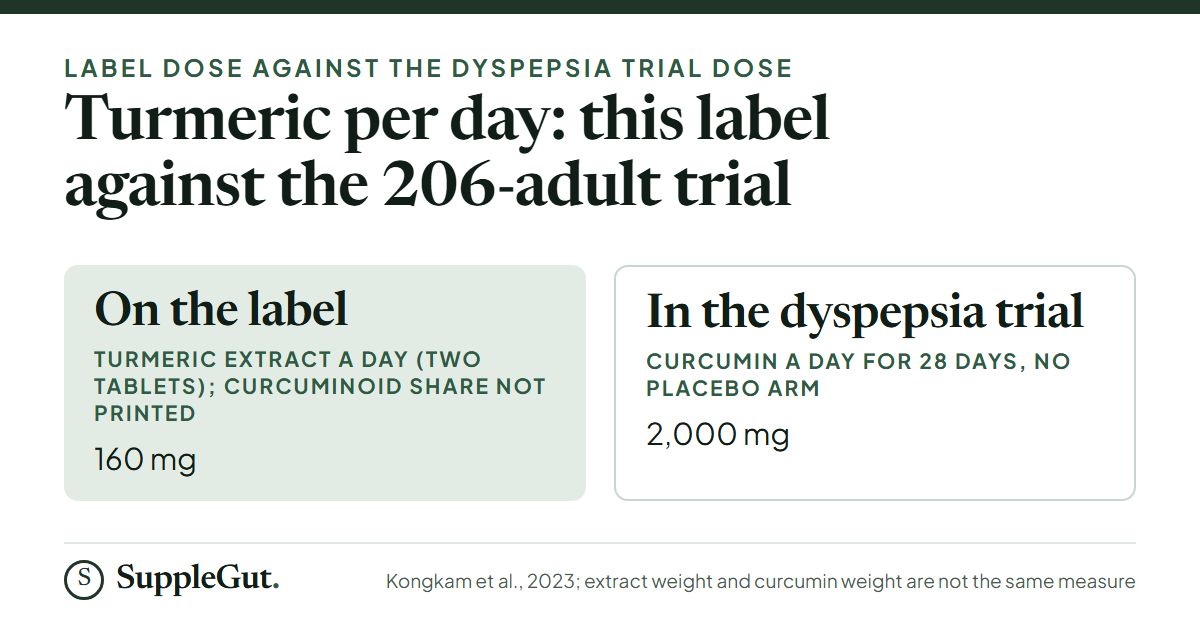
Does JSHealth Detox + Debloat work? We could find no trial of the tablet. We found no adult trial of fennel for bloating, no trial of milk thistle for bloating or dyspepsia, and two Thai trials of turmeric in functional dyspepsia, one using 2,000 mg of curcumin a day against 160 mg of turmeric extract a day on this label. Fennel fruit is listed in Europe for bloating and flatulence on the basis of traditional use, not trials. The brand cites only a self-reported customer survey of the tablet taken with its probiotic, and reviewers range from less bloating within days to no change.
JSHealth Vitamins Detox + Debloat Formula is a red-brown tablet from the Australian brand founded by nutritionist Jessica Sepel, sold in the US from a US warehouse and on Amazon. It is built on three extracts, fennel seed, turmeric and milk thistle, with amino acids, dandelion root and schisandra, and it is sold for bloating and liver support. It has no proprietary blend, so every amount is printed. What is easy to miss is that the amounts are per tablet and the directions are two tablets a day. This page sets out what the label prints, what the three herbs have in trials, and what the reviews and terms say.
What the label prints
The panel serving is one tablet, and the directions are one tablet twice a day, so each daily amount is double:
| Ingredient | Per tablet | Per day (2 tablets) |
|---|---|---|
| Organic fennel seed extract | 150 mg | 300 mg |
| Turmeric extract | 80 mg | 160 mg |
| Milk thistle extract | 60 mg | 120 mg |
| L-taurine, L-glutamine, inositol | 150, 100, 100 mg | 300, 200, 200 mg |
| L-glycine, dandelion root, schisandra berry | 50, 25, 20 mg | 100, 50, 40 mg |
| Choline, calcium, phosphorus, molybdenum | 40 mg, 55 mg, 45 mg, 50 mcg | double |
Extract ratios and standardization (curcuminoids, silymarin, a fennel marker) are not printed, so the figures are extract weights only. The Amazon listing gives raw-herb equivalents per tablet: fennel from 1.5 g of seed, turmeric from 800 mg of rhizome and milk thistle from 4.2 g of fruit. That listing also names a 35 mg broccoli extract that the US brand-site label does not; the brand’s own footnote says it is an international product and label text may vary slightly. The brand states a no-gluten, vegan formula, heavy-metal testing of every batch, Clean Label Project certification and an NSF-certified facility; we found no certificate or lab name.
The trial of the tablet itself
We found none. The only study the brand mentions is a self-reported customer survey of Detox + Debloat taken with its probiotic: “more regular bowel movements reported by the majority of users” and improved gut health reported by 63% after eight weeks. We found no sample size, protocol or publication. The claims on the page are worded as traditional use, relieving occasional abdominal bloating and supporting liver detoxification, with results “may be seen after 4 weeks”.
The evidence for the herbs
Fennel. We found no adult randomized trial of fennel for bloating, flatulence or dyspepsia. The European Medicines Agency’s herbal committee lists sweet fennel fruit for mild spasmodic gastrointestinal complaints including bloating and flatulence on the basis of traditional use, not trial data (EMA assessment report). The trial evidence is in infant colic, which does not apply to adults.
Turmeric. Two Thai trials in functional dyspepsia are the closest. In 132 adults, turmeric, omeprazole or placebo for four weeks: the pain score fell by 16.98 on turmeric against 10.53 on placebo (P<0.001) and 14.69 on omeprazole, with no significant difference from omeprazole; the abstract gives no dose (Yongwatana et al., 2022). In 206 adults, curcumin 2,000 mg a day (two 250 mg capsules four times a day), omeprazole, or both for 28 days with no placebo arm, the pain scores fell by 5.46, 6.22 and 4.83 respectively, with no significant differences (Kongkam et al., 2023). The label supplies 160 mg a day of turmeric extract with its curcuminoid share unstated. Extract weight and curcumin weight are not the same measure, so the gap cannot be read as a ratio.
Milk thistle. We found no trial for bloating or dyspepsia; the brand positions it for the liver. The NIH’s NCCIH says trials of milk thistle in liver disease have been conflicting or too limited for conclusions (NCCIH). The taurine, glutamine, glycine, inositol and choline were not researched for bloating here, and the brand does not claim them for it.
How to take it
The label says one tablet twice daily with water after food, no more than two tablets a day, so a 60-tablet bottle is 30 days. The brand notes a strong herbal scent from the bottle, and Amazon says a tablet may be split. Asked how long to take it, the brand’s FAQ says to be guided by a physician. The turmeric trials ran 28 days and four weeks, matching the brand’s four-week mark.
Side effects and who should not take it
The caution reads: pregnant or nursing mothers, children under 18 and people with a known medical condition should consult a physician, and anyone taking medication, including the oral contraceptive pill, should speak to a health professional. Reviewers report stomach ache, nausea and headaches, and several say the tablets are large; the brand replied to one that they can be crushed.
The NIH LiverTox entry rates turmeric “A”, a well-documented cause of clinically apparent liver injury, probably very rare (1 in 10,000 to 1 in 100,000), mostly linked to high-bioavailability or piperine products but also to ground turmeric, typically within one to three months (LiverTox). This product has no piperine and an 80 mg extract per tablet, and its label has no liver-injury warning. Milk thistle is rated “E”, unlikely to cause liver injury.
What the reviews say
The brand’s own widget shows 4.79 from 5,940 reviews (85% five-star, 11% four, 3% three, 1% two, 1% one). 95% are flagged verified buyers, but 1,912 (32%) are flagged by the review platform as rewarded with loyalty points or a coupon, and 4,629 (78%) are dated before 23 October 2024, when the US product record was created; the earliest is from January 2019, which suggests the widget pools reviews from the brand’s other storefronts, though the brand has not confirmed it. Amazon shows 4.3 from 2,339 ratings (72%, 9%, 8%, 3%, 8%), with the text behind a sign-in. Trustpilot shows 4.2 from 2,451 reviews for the whole brand, on a claimed profile with a paid plan, where the brand asks customers to review and replies to every negative one.
The recurring praise is less bloating, often described as quick (3,018 of the widget reviews mention bloating), comfort after meals and around a period, and customer service. The recurring complaints are no difference, stomach pain or headaches, tablet size, and, on Trustpilot, review moderation and subscription cancellation.
The subscription and refund terms
The brand’s returns policy accepts damaged, incorrect, missing or defective items reported within 7 working days. Change-of-mind returns and opened or used products are not accepted, and the store keeps final decision, so there is no refund for a product that did not work. Amazon marks the listing non-returnable.
Subscriptions run through Skio at 15% off monthly, 20% off every 3 months and 25% off every 6 months, and can be skipped or cancelled in an account the buyer creates. The product page headline reads “20% off” and “an average of 30%”, while the plan data and the subscription page say 15% for monthly. A recent Trustpilot reviewer calls cancelling almost impossible; the brand replied that it is self-managed in the account. Three of the nine most recent one-star Trustpilot reviews are about undelivered orders. A single bottle can be bought once.
Who it is for
- Someone who wants a twice-a-day tablet with a printed amount for every ingredient.
- Someone drawn to fennel, turmeric and milk thistle as traditional-use herbs and who has no medication or condition the caution covers.
- Someone who will give it the four weeks the brand suggests.
Other bloating products are set out the same way: HUM Flatter Me, an 18-enzyme capsule with a pizza-meal trial; Love Wellness Bye Bye Bloat, an enzyme and herb blend; and Iberogast, a six-herb liquid for fullness and queasiness. The bloating guide starts from the cause instead of the product.
Cost
A 60-tablet bottle is $39.99 on the brand site, or $1.33 a day, plus $4.99 shipping under $70 ($44.98 delivered, $1.50 a day). Two months is $69.99 ($1.17 a day). Subscriptions are $33.99 monthly ($1.13), $95.98 for three months ($1.07) and $179.96 for six months ($1.00). Amazon lists $38.99 ($1.30 a day) or $35.09 on Subscribe & Save ($1.17).
The products in this catalog
Common questions
Does JSHealth Detox + Debloat work?
No trial of the tablet was found. Fennel has traditional-use status in Europe for bloating, turmeric helped dyspepsia in two Thai trials at about 2,000 mg of curcumin a day (this label has 160 mg of extract a day), and we found no bloating trial of milk thistle. Amazon shows 4.3 from 2,339 ratings, with some reviewers reporting less bloating within days and others no change.
Is JSHealth Detox + Debloat safe, and what are the side effects?
The label asks pregnant or nursing mothers, people under 18 and people with medical conditions to see a physician, and anyone on medication, including the oral contraceptive pill, to speak to a health professional. Reviewers mention stomach aches, nausea, headaches and large tablets. Turmeric supplements have been linked to rare liver injury (an NIH LiverTox rating of A), mostly with high-absorption products.
How do I take JSHealth Detox + Debloat, and for how long?
The label says one tablet twice daily with water after food, with a maximum of two tablets a day, so each printed amount doubles. Asked how long to take it, the brand’s FAQ says to be guided by a physician, and its page says results may be seen after four weeks. Amazon notes a tablet may be split to make it easier to swallow.
How much does JSHealth Detox + Debloat cost?
A 60-tablet bottle is $39.99 on the brand site ($1.33 a day), plus $4.99 shipping under $70, and two months is $69.99. Subscriptions are 15% off monthly ($33.99), 20% off every three months and 25% off every six months. Amazon lists $38.99 and $35.09 on Subscribe & Save.
Should I buy Detox + Debloat on Amazon or the brand site?
The prices are close ($38.99 on Amazon against $39.99 on the site). Amazon’s ingredient text lists a broccoli extract that the brand’s US label does not, and Amazon marks the item non-returnable, while the brand site accepts returns only of damaged, wrong or missing items within 7 working days. Neither accepts change-of-mind returns.
What is the JSHealth refund policy, and how do I cancel a subscription?
The brand refunds damaged, incorrect, missing or defective items reported within 7 working days, and there is no refund for a product that did not work. Subscriptions can be paused, skipped or cancelled in a customer account on its site. A recent Trustpilot reviewer calls cancelling almost impossible, and the brand replied that it can be self-managed in the account.
Sources
- Yongwatana K, Harinwan K, Chirapongsathorn S, et al. “Curcuma longa Linn versus omeprazole in treatment of functional dyspepsia: A randomized, double-blind, placebo-controlled trial.” Journal of Gastroenterology and Hepatology, 2022;37(2):335–341. doi.org/10.1111/jgh.15705
- Kongkam P, Khongkha W, Lopimpisuth C, et al. “Curcumin and proton pump inhibitors for functional dyspepsia: a randomised, double blind controlled trial.” BMJ Evidence-Based Medicine, 2023;28(6):399–406. doi.org/10.1136/bmjebm-2022-112231
- NIH LiverTox: Turmeric (NBK548561) and Milk Thistle (NBK548817)
- NIH National Center for Complementary and Integrative Health, “Milk Thistle” (nccih.nih.gov)
- European Medicines Agency HMPC, assessment report on Foeniculum vulgare Miller (ema.europa.eu)
- Brand pages: label, directions, caution, claims and price (product page), returns (shipping and returns) and subscriptions (subscription page)
- Amazon listing: ingredient text, price and ratings (amazon.com/dp/B07J9KNS9G); Trustpilot, jshealthvitamins.com: brand-wide reviews (trustpilot.com)
Not sure which product fits your situation?
This guide covers the mechanics. The quiz takes your specific symptoms, routine and preferences and matches you to one product from the catalog.
Take the quiz →