
Guide
Does HUM Flatter Me work? The pizza trial, the 18 enzymes and what the reviews say
Quick answer
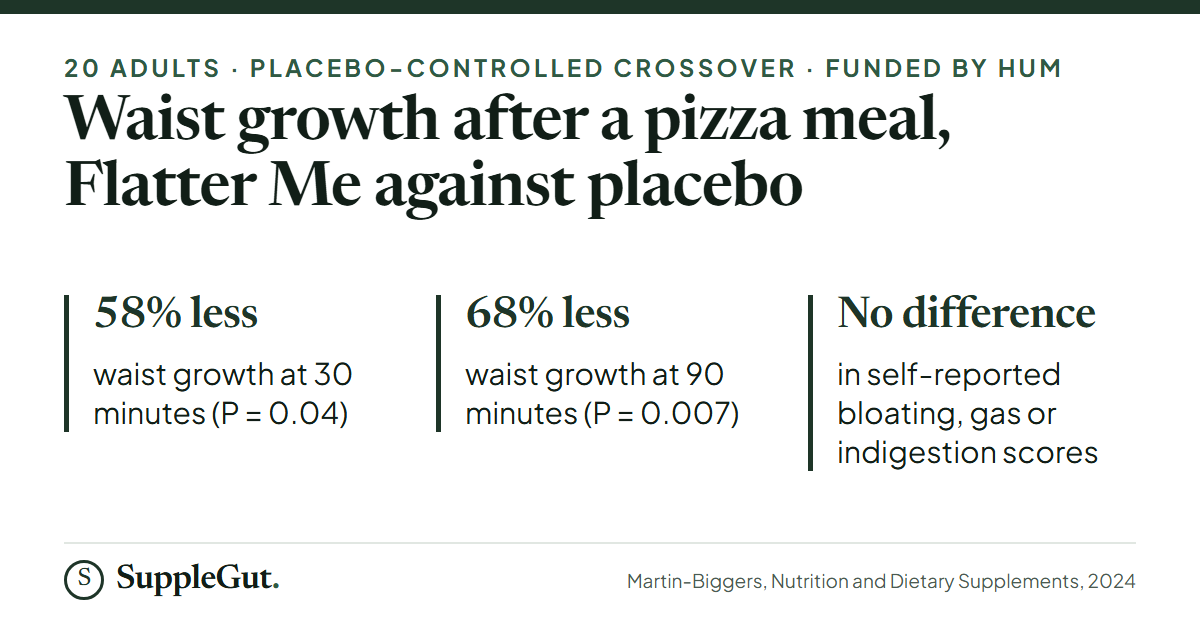
Does HUM Flatter Me work? One placebo-controlled crossover trial of this formula exists. In 20 healthy adults who bloat after meals, waist circumference grew 58% less at 30 minutes (P = 0.04) and 68% less at 90 minutes (P = 0.007) after a cheese-pizza meal taken with the capsule than with placebo. HUM funded it, its author was a HUM employee, it was a pilot with no power calculation, and the self-reported bloating, gas and indigestion scores did not differ significantly. The 18 enzymes are sold as one 249 mg blend with no activity units, so their strength cannot be compared with any other trial.
HUM Flatter Me is a vegan capsule of 18 digestive enzymes plus ginger, fennel and peppermint leaf powder, taken with the first bites of a meal. What sets it apart from the enzyme bottles beside it is that the finished capsule has a published trial of its own. That trial was paid for by the brand, ran for one meal, and found a difference in waist measurement but not in how people rated their bloating.
What Flatter Me is, and what it is not
Each capsule lists a Proprietary Enzyme Blend of 249 mg: seven protein-splitting enzymes (bromelain, papain, three numbered proteases, peptidase, neutral bacterial protease), lipase for fat, five for carbohydrates (amylase, glucoamylase, alpha-galactosidase, invertase, diastase), four for fiber (hemicellulase, cellulase, beta-glucanase, phytase) and lactase for milk sugar. A separate Herbal Blend of 45 mg holds ginger root, fennel seed and peppermint leaf powder, so none of the three exceeds 45 mg. Other ingredients are the vegetable capsule and rice hulls. There are no bacteria in it. The enzyme blend prints no activity units, so the strength of any one enzyme cannot be compared with another product or a trial, and the peppermint is leaf powder rather than enteric-coated oil.
Two formulas sell under the name. The 60-capsule bottle on the brand site shows 249 mg; Amazon sells that and a separate “Extra Strength” with a 374 mg enzyme blend. We could not determine which one Target, Ulta and Walmart ship. The label states it contains no milk, eggs, fish, shellfish, tree nuts, peanuts, wheat, soy or sesame, and the brand cites Clean Label Project and Non-GMO Project certifications; no USP or NSF mark is stated.
The trial of the product itself
In the trial, 25 adults aged 18 to 45 with daily bloating or distension after meals and no gut diagnosis took the capsule or a maltodextrin placebo, fasted, immediately before a test meal of two slices of cheese pizza, with at least a week between visits; 20 completed both. The primary result was a smaller rise in waist circumference: the waist grew 1.50 cm on placebo at 30 minutes, and 58% less with the capsule (P = 0.04); at 90 minutes it grew 2.12 cm on placebo and 68% less with the capsule (P = 0.007), and 80% of participants had less distension with the product. The paper prints two sets of product-arm figures (0.93 and 0.94 cm in the abstract and results text, 0.63 and 0.67 cm in the discussion); the 58% and 68% match the discussion figures, which put the gap at about 0.87 cm at 30 minutes and 1.45 cm at 90 minutes (Martin-Biggers, Nutrition and Dietary Supplements, 2024).
The self-reported scores told a different story. On a four-point scale there were no significant differences in bloating, distension, gas or indigestion, though trends favored the capsule (65% reported less stomach discomfort, 55% less gas). No adverse events were reported. The limits are stated or visible in the paper: HUM funded the study and the author was a HUM employee at the time, it was a pilot with no power calculation, the participants were healthy adults recruited through an app network, the dose was one meal, the number of capsules was not stated, and the effect of the enzymes cannot be separated from the herbs. The brand’s headlines read “Reduce bloat by up to 2 inches” and “Debloat in 30 Minutes”; its footnote on Target and Walmart gives the average as 1/2 inch, from a HUM-sponsored study of 19 participants.
The evidence for the ingredients
Enzyme blends. A 2023 trial of 120 adults with functional dyspepsia gave 2 capsules a day of a 200 mg fungal multi-enzyme blend or placebo for two months and found better dyspepsia, pain and sleep scores with no side effects (Ullah et al., Biomedicine & Pharmacotherapy, 2023). That is a different blend in a different condition. A 2016 review notes that animal-derived enzymes are standard care in pancreatic insufficiency and lactase in lactose intolerance, and that combinations for other conditions “might constitute an intriguing therapeutic option in the future” (Ianiro et al., Current Drug Metabolism, 2016).
Ginger. In 11 people with functional dyspepsia, 1.2 g of ginger sped stomach emptying (median half-emptying 12.3 against 16.1 minutes) but symptoms did not differ (Hu et al., World Journal of Gastroenterology, 2011). A systematic review found a divided daily dose of 1,500 mg or less beneficial for nausea, with too few studies for other gut conditions (Nikkhah Bodagh et al., Food Science & Nutrition, 2019). All three herbs in Flatter Me together total 45 mg.
Peppermint and fennel. A meta-analysis of 12 trials in 835 adults with IBS found peppermint oil improved overall symptoms (risk ratio 2.39) and abdominal pain (1.78), with side effects no more common than on placebo (9.3% against 6.1%) (Alammar et al., BMC Complementary and Alternative Medicine, 2019). Flatter Me carries peppermint leaf powder in a 45 mg blend, a different preparation, and the guide to IBgard covers the oil. We could find no verified randomized trial of fennel seed powder for bloating.
How to take Flatter Me
The brand’s directions are one capsule with the first few bites of a meal, and it notes that many people take it with two meals a day. One Amazon field reads two capsules a day with food, another one capsule with a meal. A 60-capsule bottle lasts 60 days at one a day and 30 at two. Because the trial measured a single dose over 90 minutes, there is no trial length to point to for daily use; one Amazon reviewer reported no difference after more than two weeks.
Side effects and who should not take it
The label panel we read prints no warnings, and the brand’s help center advises consulting a doctor before any supplement while pregnant or nursing; the Extra Strength listing adds a keep-out-of-reach-of-children line. The 20-person trial reported no adverse events. In the reviews, some Amazon buyers report constipation, nausea or heartburn.
What the reviews say
Amazon shows 4.1 from 8,951 ratings on the 60-capsule bottle (60% five-star, 10% one-star) and 4.2 from 1,037 on Extra Strength. Target shows 4.3 from 3,252. Walmart shows 4.3 from 3,158 ratings on the 30-count bottle, many of the reviews tagged as collected as part of a promotion. Ulta shows 4.5 from 2,515, possibly including syndicated brand reviews, and the brand site 4.5 from 2,880 in a widget on its own page. Trustpilot rates the whole brand 1.8 from 73 reviews, brand-wide rather than specific to this capsule. The recurring praise is less bloating after meals, more regular digestion and the variety of enzymes. The recurring complaints are no effect, constipation or stomach upset in some users, and price.
The subscription and refund terms
The brand site sells the bottle at $27 one time or on subscription at $18.90 for the first order (30% off) and $21.60 after (20% off), shipping monthly with “pause or cancel any time.” The help center says to cancel by email, chat or phone at least 24 hours before the next shipment. Returns are accepted within 30 days of delivery: unopened products are refunded excluding shipping, and opened products receive store credit. Trustpilot reviewers, mostly in 2024 and 2025, report being charged to cancel an older VIP plan, a shipment after a delivery-date change and store credit in place of a refund; another reviewer on the same page defends the terms as clearly written. Purchases from Amazon, Target, Ulta and Walmart fall under those retailers’ return terms, and the retail reviews we read carried no billing-complaint pattern.
Who Flatter Me is for
- Bloating or distension after meals in a person with no gut diagnosis: the group the one trial enrolled.
- A broad multi-enzyme capsule rather than a single enzyme matched to one food.
- Someone who will take a capsule with the first bites of a meal, at one or two meals a day.
If one food reliably causes the trouble, the enzyme made for that food (lactase for dairy, alpha-galactosidase for beans) has its own trials, set out in do digestive enzymes work. The bloating and gas guide starts from the cause instead.
Cost
At the brand’s $27 for 60 capsules, Flatter Me costs $0.45 a day at one capsule and $0.90 at two. The subscription works out at $0.32 a capsule on the first order and $0.36 after. Amazon’s $17.55 for 60 is about $0.29 a capsule, Ulta’s $26.99 for 60 is $0.45, and Walmart’s $15.97 for 30 is $0.53.
The products in this catalog
Common questions
Does HUM Flatter Me work for bloating?
One placebo-controlled crossover trial of the formula, funded by HUM and written by a HUM employee, found less waist expansion after a pizza meal (58% less at 30 minutes, P = 0.04) in 20 healthy adults. Self-reported bloating, gas and indigestion scores did not differ significantly. It was a single meal and a pilot study.
What is in HUM Flatter Me?
Each capsule holds a 249 mg proprietary blend of 18 enzymes (proteases, lipase, amylases, alpha-galactosidase, cellulases, lactase and others) and a 45 mg herbal blend of ginger root, fennel seed and peppermint leaf powder, with no amounts printed for any single ingredient. Other ingredients are the vegetable capsule and rice hulls. It contains no milk, eggs, fish, shellfish, tree nuts, peanuts, wheat, soy or sesame.
How do you take HUM Flatter Me?
The brand directs one capsule with the first few bites of a meal, and says many people take it with two meals a day. A 60-capsule bottle lasts 60 days at one capsule a day and 30 days at two. The trial gave a single dose with one test meal, so it says nothing about daily use over weeks.
What are the side effects of HUM Flatter Me?
The label panel prints no warnings, and HUM advises consulting a doctor before any supplement while pregnant or nursing. The 20-person trial reported no adverse events. Some Amazon reviewers report constipation, nausea or heartburn, and others report no effect.
How much does HUM Flatter Me cost?
HUM lists $27 for 60 capsules, or $18.90 on a first subscription order and $21.60 on later ones. Amazon lists $17.55 for 60, Ulta $26.99 and Walmart $15.97 for a 30-count bottle. At one capsule a day the brand price is $0.45 a day, and $0.90 at two.
Flatter Me vs a probiotic: what is the difference?
Flatter Me is a multi-enzyme capsule with a small herbal blend that acts on the food in a meal, not on gut bacteria. A probiotic supplies live bacteria meant to act over weeks, and HUM’s own questions page says people often take both. The enzyme-or-probiotic question is worked through in digestive enzymes vs probiotics for bloating.
Can I cancel a HUM subscription?
HUM’s terms say to cancel by email, chat or phone at least 24 hours before the next shipment, with a 30-day return window in which opened products receive store credit. On Trustpilot, which rates the whole brand 1.8 from 73 reviews, recurring complaints are subscription renewals, a cancellation charge on an older plan and store credit instead of a refund. The capsules are also sold one at a time by Target, Ulta, Walmart and Amazon.
Sources
- Martin-Biggers J. "A Multi-Digestive Enzyme and Herbal Dietary Supplement Reduces Bloating in a Single Use in Healthy Adults: A Randomized, Placebo-Controlled, Cross Over Study." Nutrition and Dietary Supplements, 2024;16:51–57. ClinicalTrials.gov NCT05520411. doi.org/10.2147/NDS.S453377
- Ullah H, Di Minno A, Piccinocchi R, et al. "Efficacy of digestive enzyme supplementation in functional dyspepsia: A monocentric, randomized, double-blind, placebo-controlled, clinical trial." Biomedicine & Pharmacotherapy, 2023;169:115858. PMID 37976892
- Ianiro G, Pecere S, Giorgio V, et al. "Digestive Enzyme Supplementation in Gastrointestinal Diseases." Current Drug Metabolism, 2016;17(2):187–193. PMID 26806042
- Hu ML, Rayner CK, Wu KL, et al. "Effect of ginger on gastric motility and symptoms of functional dyspepsia." World Journal of Gastroenterology, 2011;17(1):105–110. PMID 21218090
- Nikkhah Bodagh M, Maleki I, Hekmatdoost A. "Ginger in gastrointestinal disorders: A systematic review of clinical trials." Food Science & Nutrition, 2019;7(1):96–108. PMID 30680163
- Alammar N, Wang L, Saberi B, et al. "The impact of peppermint oil on the irritable bowel syndrome: a meta-analysis of the pooled clinical data." BMC Complementary and Alternative Medicine, 2019;19(1):21. doi.org/10.1186/s12906-018-2409-0
- Brand page: label, directions and price. humnutrition.com/product/23/flatter-me
- HUM help center: subscription cancellation and return policy. cancellation, returns
- Amazon listings: label text, price and ratings. amazon.com/dp/B015OVVI4Q, amazon.com/dp/B0CGBVW491
- Trustpilot: humnutrition.com reviews. trustpilot.com/review/humnutrition.com
Not sure which product fits your situation?
This guide covers the mechanics. The quiz takes your specific symptoms, routine and preferences and matches you to one product from the catalog.
Take the quiz →