
Guide
Does MAV Nutrition Prebiotics and Probiotics work? Sixteen species, no strains, and two formulas under one name
Quick answer
Does MAV Nutrition Prebiotics and Probiotics work? We could find no trial of this product. The label lists 16 species with no strain codes and no per-organism counts, 50 billion CFU stated at manufacture, and 1,000 mg of XOS and inulin where the human trials used 1.4 to 8 g of XOS and 12 g of inulin. Amazon’s listing text and other retailers describe a different 20 billion CFU, two-organism formula, so its 4.6 from 6,998 ratings may span both. The brand’s own 1,001 reviews are all flagged incentivized and date from 2018 to 2022.
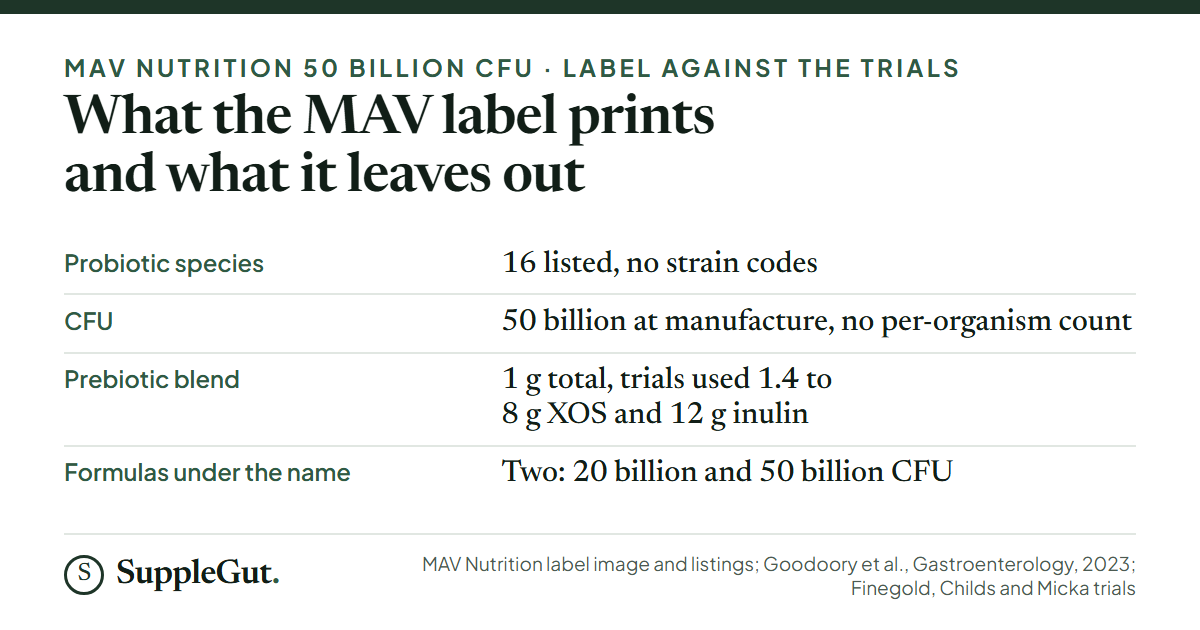
MAV Nutrition Prebiotics and Probiotics is a two-capsule-a-day product sold mainly on Amazon, with a label that prints 16 bacterial species, a 50 billion CFU total and a 1,000 mg prebiotic blend of xylooligosaccharide (XOS) and chicory inulin. It is one of the more heavily rated probiotics on Amazon, and the same brand sells a different formula under a similar name elsewhere. This page sets out what the label prints and leaves out, which formula the ratings may describe, what the trials of the ingredient classes found at what doses, what the two review pools are, and what each route to buying it costs.
What MAV Nutrition Prebiotics and Probiotics is, and what it is not
The Supplement Facts panel on the 50 billion CFU version, per serving of two delayed-release vegetarian capsules, lists a prebiotic fiber blend of 1,000 mg (xylooligosaccharide and inulin from chicory root, with no split between them) and a probiotic blend of 280 mg providing 50 billion CFU. A 60-capsule bottle is 30 servings. The other ingredients are hypromellose, which is the capsule, and NuFlow rice hulls, a flow agent. No sweeteners or flavors are listed.
The probiotic blend names sixteen organisms: Bifidobacterium lactis, Lactobacillus reuteri, L. plantarum, L. rhamnosus, B. longum, B. breve, B. bifidum, L. acidophilus, L. gasseri, L. paracasei, B. infantis, L. helveticus, L. casei, L. salivarius, L. fermentum and Bacillus subtilis. Fifteen are the usual Lactobacillus and Bifidobacterium species and one is a spore-forming Bacillus. None carries a strain designation, and no per-organism count is printed. Dividing the blend weight by the total gives about 5.6 mg of material per billion CFU, which is all the arithmetic the panel allows. The 50 billion figure is stated “at the time of manufacturing”, so it is a count at manufacture and not at expiry.
It is not a product with a trial behind it, and it is not a single-strain capsule whose strain can be looked up. It is a multi-species blend sold as a synbiotic, meaning live bacteria plus a prebiotic fiber for them to ferment. The label also carries icons for “Doctor Formulated”, “3rd-Party Tested”, GMP, gluten free and vegan; the pages we read name no physician and no testing laboratory.
Two formulas under one name
The listing text and the label image do not describe the same capsule. The Amazon listing’s ingredient and directions fields read as a 20 billion CFU, two-organism product (L. acidophilus and B. bifidum, 100 mg) with 400 mg of XOS per capsule, taken one capsule a day. The Amazon gallery image of the panel and the brand’s own page describe the 50 billion CFU, 16-organism product with 1,000 mg of prebiotics, taken as two capsules. Target and Vitacost list MAV’s 60-capsule prebiotic and probiotic with the 20 billion panel, and a third-party rating site’s page for the brand does the same.
The brand’s own product page for the 50 billion version was created in June 2026, while the Amazon listing has been selling since 2018. We could not find when the formula changed. The 6,998 Amazon ratings, and the retailer scores below, may therefore describe both capsules, and the panel on the bottle in hand is the one to read.
The trial of the product itself
There is none. We searched PubMed under the brand name and the product name and ClinicalTrials.gov under “MAV Nutrition”, and the NIH Dietary Supplement Label Database holds 11 MAV labels but none for this product. The brand cites no study; its copy says “16 evidence-based” strains without naming them. The evidence below belongs to the ingredient classes, and in each case the label does not let a reader match its dose or organism to the trial.
The evidence for combination probiotics
The closest trial in kind is a placebo-controlled study of 49 adults with IBS (25 on the probiotic, 24 on placebo) who took a twice-daily mixture of B. longum, B. bifidum, B. lactis, L. acidophilus, L. rhamnosus and Streptococcus thermophilus for four weeks. Substantial relief was reported by 68.0% against 37.5% on placebo, and pain, discomfort and bloating improved in the probiotic group and not the placebo group (Yoon et al., Journal of Gastroenterology and Hepatology, 2014). Five of those species are also on this label, but the trial used named strains, and this label names none. A second multispecies trial in 81 IBS patients over four weeks found adequate relief in 74.4% against 61.9% on placebo, a difference that was not statistically significant (p = 0.230), with no difference in total symptom score (PMID 26388670).
The wider picture is less favorable to any one blend. A meta-analysis pooled 82 randomized trials in 10,332 patients with IBS, found only 24 at low risk of bias, and rated the certainty of benefit for abdominal bloating or distension as very low for combination probiotics and for Bacillus strains, which are the two groups this label falls into. Adverse events were not higher than on placebo (Goodoory et al., Gastroenterology, 2023). An earlier review of 53 probiotic trials in 5,545 patients said particular combinations or specific species and strains appeared to help, without a definitive answer on which (Ford et al., Alimentary Pharmacology & Therapeutics, 2018). Results belong to strains and doses, and a species list with no strain codes gives no way to say which of them applies. For how to read a CFU figure, see how many CFU you need.
The evidence for the prebiotic blend
XOS and inulin each have human trials, at doses well above the label’s. In 32 healthy adults, 1.4 g or 2.8 g of XOS a day for eight weeks raised bifidobacteria in both groups, more at 2.8 g, with no significant gut side effects (Finegold et al., Food & Function, 2014). At 8 g a day for 21 days in healthy adults, bowel movements per day rose, while bloating, abdominal pain and flatulence did not change (Childs et al., British Journal of Nutrition, 2014). For chicory inulin, 12 g a day for four weeks in 44 adults with constipation raised median stool frequency from 3.0 to 4.0 a week against placebo (Micka et al., International Journal of Food Sciences and Nutrition, 2017).
Against those, the label’s entire prebiotic blend is 1,000 mg, so XOS plus inulin together come to at most 1 g a day, below the lowest XOS dose tested and about one-eighth of the 8 g and one-twelfth of the 12 g. Because the split is not printed, the amount of either fiber is not known. One synbiotic of a similar design, with Lactobacillus and Bifidobacterium species, XOS and fiber, improved bowel perception in 30 Korean adults with functional constipation over four weeks, though that was a different formula and the authors were from its maker (Kim et al., Journal of Medicinal Food, 2021).
How to take it
The brand’s page and the label image say to take two capsules daily, preferably with a meal. Amazon’s directions field says one capsule, which belongs to the 20 billion formula. The capsule is delayed-release, a design that is meant to carry the bacteria past stomach acid; we found no survival or release testing published for this product. The trials above ran three to eight weeks, so a month at the label serving is a reasonable first test.
Side effects and who should not take it
The safety text on the Amazon listing advises consulting a healthcare provider before use, especially if pregnant, nursing, intending to become pregnant, taking medication or having a medical condition, and says to take only as directed, keep out of reach of children and not use the product if the seal is broken. The image we read shows only the panel, so we could not confirm the same text is printed on the 50 billion bottle. Target’s text for the 20 billion product adds “adult use only”. Inulin and XOS are fermented in the colon and can produce gas in some people, and 1,000 mg is a small amount of either. Amazon’s review summary says customers report no side effects or discomfort, and lists “side effects” as a topic in 278 reviews without showing which way they lean.
The panel prints no allergen statement beyond gluten-free and vegan icons, and the NuFlow rice-hull flow agent is the only non-capsule excipient. For the general picture on gas and bloating when starting a probiotic, see probiotic side effects.
What the reviews say
There are two pools, and neither is straightforward. Amazon shows 4.6 from 6,998 ratings: 77% five-star, 13% four, 6% three, 1% two and 3% one. Amazon’s own summary of the review text, generated by Amazon, says customers find it effective, mention digestion and particularly bloating, and call the capsules easy to take and flavorless. The review text itself is behind a sign-in and we did not read it. Because the listing carries text for two formulas, that count may span both capsules.
The brand’s own site shows 4.8 from 840 reviews in the page markup, and its review feed holds 1,001 reviews with a 4.77 average. All 1,001 are flagged as incentivized by the review platform, and they are dated from 2018 to 2022, before the 50 billion product page existed. About 121 are for other MAV products such as weight-loss pills, krill oil and collagen, and several say the reviewer got the bottle free through a rebate or coupon. Praise there is less bloating, regularity and easy swallowing; the small set of low scores mentions no change, capsules that are hard to swallow, and a free-bottle coupon that did not work. Target shows 4.91 from 64 ratings and Vitacost 4.56 from 48, both for the 20 billion formula. We found no Trustpilot reviews and no Better Business Bureau profile, which is an absence of data and not evidence either way.
Price, refunds and subscription terms
On Amazon the 60-capsule bottle is $21.99, which is $0.73 a day at the two-capsule serving; Subscribe & Save is $19.79, or $0.66 a day. Amazon’s listed “$0.37 per count” is per capsule, not per day. The 30-capsule size is $14.95, or $1.00 a day. The brand’s own page lists $26.39 for 60 capsules, $0.88 a day, with free shipping over $40, and showed it sold out when we read it; it has no subscription option. Subscribe & Save through Amazon is the only subscription we found, and we did not read its terms beyond the price.
The brand’s refund policy allows returns within 30 days for a refund or exchange, with shipping and handling not refunded and outbound shipping possibly deducted from free-shipping orders. The Amazon listing is marked non-returnable for food-safety reasons. We found no money-back guarantee wording on the brand site. In the brand-site reviews, three mention subscribing or canceling and none reports a billing problem.
Who makes it
The label says “Manufactured for MAV Nutrition, LLC” with an address on 2nd Avenue South in St. Petersburg, Florida. The brand’s About page says “100% third-party tested” and “USA GMP-certified facilities” as claims, and it names no founder, physician or formulator. The plant is not named, and we found no testing laboratory and no certificate of analysis; the brand’s testing pages we tried returned not found. MAV sells across many categories, including fish oil, gummies, children’s products and weight management.
Who this product suits
- Someone who wants a multi-species probiotic with a prebiotic included and is content to judge it by how they feel over a month, since the label gives no strain to look up.
- Someone buying on Amazon who will check the panel on the bottle that arrives, given the two formulas.
- Someone comparing cost per day across probiotics: $0.73 a day here against $0.75 for Culturelle Digestive Daily, which prints a single named strain at 10 billion CFU, and $2.00 for Seed DS-01, which prints 24 named strains and has a trial of the finished formula.
Another species-only capsule with the same kind of label is covered in the Biome V3 guide. For choosing between product types, see which probiotic to take, or start from symptoms with the quiz.
The products in this catalog
Common questions
Does MAV Nutrition Prebiotics and Probiotics work?
No trial of this product was found. Its probiotic blend lists 16 species with no strain codes and a 50 billion CFU total measured at manufacture. Trials of multispecies Lactobacillus and Bifidobacterium mixtures in IBS found relief in a small study, but a 2023 meta-analysis of 82 trials rated the certainty of benefit for bloating as very low. On Amazon 77% of 6,998 ratings are five-star.
Why do some MAV listings say 20 billion CFU and others 50 billion?
MAV sells at least two formulas under similar names. Target and Vitacost list a 20 billion CFU capsule with two organisms (L. acidophilus and B. bifidum) and 400 mg of XOS, one capsule a day, while the brand site and the Amazon label image show 50 billion CFU from 16 species, two capsules a day. Amazon’s ingredient text still reads like the older formula, so the panel on the bottle is the one to check.
What strains are in MAV Nutrition Prebiotics and Probiotics?
The label names 16 organisms at species level only: 15 Lactobacillus and Bifidobacterium species and Bacillus subtilis. No strain code and no per-organism CFU is printed, so a trial of a named strain cannot be matched to it. The 50 billion CFU is a single blend figure stated at the time of manufacturing.
Is MAV Prebiotics and Probiotics safe, and does it have side effects?
The Amazon safety text advises talking to a healthcare provider first if you are pregnant, nursing, taking medication or have a medical condition. Amazon’s summary says customers report no side effects or discomfort, though “side effects” is a topic in 278 reviews whose direction we could not read. Prebiotic fibers such as inulin and XOS can cause gas in some people, and the label’s 1,000 mg is a small amount.
How much does MAV Prebiotics and Probiotics cost?
The 60-capsule bottle is $21.99 on Amazon, and at two capsules a day that is $0.73 a day, or $0.66 with Subscribe & Save at $19.79. Amazon’s “$0.37 per count” is per capsule. The brand’s own site lists $26.39 ($0.88 a day), with a 30-day return policy that does not refund shipping, and showed it sold out when we read it.
How does MAV compare with Vitalitown, Culturelle and Seed?
MAV prints 16 species at 50 billion CFU and 1,000 mg of XOS and inulin, two capsules a day at $0.73. Vitalitown prints 36 names at 120 billion CFU, 150 mg of an unnamed prebiotic blend and 20 mg of 13 digestive enzymes, one capsule at $0.55 a day, and neither prints strain codes. Culturelle prints one named strain at 10 billion CFU for $0.75 a day. No trial compares any of them.
Who makes MAV Nutrition?
The label says it is manufactured for MAV Nutrition, LLC, at an address in St. Petersburg, Florida. The brand’s About page names no founder, physician or formulator and does not name the plant, and its claims of third-party testing and GMP-certified facilities come with no laboratory or certificate that we could find.
Sources
- Yoon JS, Sohn W, Lee OY, et al. Effect of multispecies probiotics on irritable bowel syndrome: a randomized, double-blind, placebo-controlled trial (49 patients). Journal of Gastroenterology and Hepatology, 2014. PMID 23829297
- Randomized trial of a multispecies probiotic in 81 patients with irritable bowel syndrome. PMID 26388670
- Goodoory VC, Khasawneh M, Black CJ, Quigley EMM, Moayyedi P, Ford AC. Efficacy of probiotics in irritable bowel syndrome: systematic review and meta-analysis (82 randomized trials, 10,332 patients). Gastroenterology, 2023. PMID 37541528
- Ford AC, Harris LA, Lacy BE, Quigley EMM, Moayyedi P. Systematic review with meta-analysis: the efficacy of prebiotics, probiotics, synbiotics and antibiotics in irritable bowel syndrome. Alimentary Pharmacology & Therapeutics, 2018. PMID 30294792
- Finegold SM, Li Z, Summanen PH, et al. Xylooligosaccharide increases bifidobacteria but not lactobacilli in human gut microbiota (1.4 g and 2.8 g a day). Food & Function, 2014. PMID 24513849
- Childs CE, Röytiö H, Alhoniemi E, et al. Xylo-oligosaccharides alone or in synbiotic combination with Bifidobacterium animalis subsp. lactis induce bifidogenesis and modulate markers of immune function in healthy adults (8 g a day). British Journal of Nutrition, 2014. PMID 24661576
- Micka A, Siepelmeyer A, Holz A, Theis S, Schön C. Effect of consumption of chicory inulin on bowel function in healthy subjects with constipation (12 g a day). International Journal of Food Sciences and Nutrition, 2017. PMID 27492975
- Kim MC, et al. XOS plus probiotics (ID-HWS1000) in adults with functional constipation. Journal of Medicinal Food, 2021. PMID 34406877
- MAV Nutrition on Amazon: Supplement Facts image, listing text, safety text, ratings and price. amazon.com/dp/B07HJD4QQJ
- MAV Nutrition brand pages: product page, refund policy and About page. mavnutrition.com; the 20 billion formula at Target and Vitacost
Not sure which product fits your situation?
This guide covers the mechanics. The quiz takes your specific symptoms, routine and preferences and matches you to one product from the catalog.
Take the quiz →