
Guide
Does Micro Ingredients Inulin work? A 2.6 g scoop, trials at 12 g, and a bag that does not name its plant
Quick answer
Does Micro Ingredients Organic Inulin FOS work? No trial of this product exists. Each scoop holds 2.6 g of inulin, about a fifth of the 12 g used in the constipation trials (4.0 against 3.0 stools a week), and a pooled analysis found pain and bloating did not improve. Bifidobacteria rose at 2.5 g of FOS in a small study, with more bloating than placebo. Amazon shows 4.6 from 5,359 ratings, and the label does not name the plant the inulin comes from.
Micro Ingredients Organic Inulin FOS Fiber Powder is an unflavored powder with one ingredient: 2.6 g of organic inulin in a level scoop, mixed into a drink once a day. What sets it apart from the fiber on the next shelf is the size of the bag and the gaps on it. A 998 g pouch holds 384 scoops, and the label never says which plant the inulin comes from. This page sets out what the panel prints, how 2.6 g compares with the doses in the trials, what the bag leaves unsaid, what the reviews show and what the two return policies say.
What Micro Ingredients Inulin is, and what it is not
The Supplement Facts panel gives a serving of one scoop (about 2.6 g), 384 servings per container, no calories and 2.6 g of dietary fiber (9% of the daily value) with no sugars listed. The single active is organic inulin powder, 2.6 g, and the other-ingredients line reads “None.” That makes the whole scoop inulin on paper, with no blend to decode and no flow agent. The bag also prints “free of soy, dairy, gluten and tree nuts,” the USDA Organic seal and a vegan claim in the listing titles. It says nothing about egg, fish, shellfish, sesame or peanuts, and we found no facility statement.
Two naming points matter. First, the titles on Amazon and the brand site say “Inulin FOS,” but the bag and the panel say only inulin. FOS (fructooligosaccharides) are the shorter-chain relatives of inulin, and the panel lists one ingredient, not two. Second, the label names no plant. The Amazon page says the inulin is harvested from Jerusalem artichoke and shows the tubers, and chicory and agave are the other usual sources of inulin, but neither the bag back nor the brand’s product page says which one this is. So “Jerusalem artichoke” is a claim on a retail page and not a statement on the label.
It is not a probiotic, since there are no bacteria in it, and it is not a gel-forming fiber like psyllium. Inulin is a chain of fructose units that the small intestine does not digest. It reaches the colon, where bacteria, especially bifidobacteria, ferment it into short-chain fatty acids and gas. It is a fructan, a fermentable carbohydrate group, which matters in the side effects section below.
The trial of the product itself
There is none. A PubMed search for Micro Ingredients inulin returned no records, and ClinicalTrials.gov returned no studies. The inulin is unbranded on the label, so there is no trademarked ingredient with its own papers either. All of the evidence below is for inulin and related fibers as a class.
The evidence for inulin, against a 2.6 g label dose
The constipation trials used far more than a scoop. Two placebo-controlled crossover trials in adults with constipation each gave 12 g of chicory inulin a day for four weeks, which is about 4.6 scoops. In the first, 44 adults took 4 g three times a day, and median stool frequency was 4.0 a week against 3.0 on a maltodextrin placebo (p = 0.038), with softer stools; the inulin was supplied by its maker (Micka et al., International Journal of Food Sciences and Nutrition, 2017). In the second, 39 adults with functional constipation had larger gains than on placebo in stool frequency, abdominal symptoms and quality of life, with a rise in bifidobacteria. The authors report a carry-over problem between the crossover periods and re-analyzed the first period alone, which supported the effect (Puhlmann et al., BMC Gastroenterology, 2025). The label dose is about 22% of the 12 g used in both.
The pooled picture is narrower than the trials alone suggest. A meta-analysis of five randomized trials in 252 people with chronic constipation found inulin raised stool frequency (a difference of 0.69 a week, 95% confidence interval 0.04 to 1.34) and softened stools, but its authors write that pain and bloating “do not improve” with inulin (Collado Yurrita et al., Nutrición Hospitalaria, 2014). A systematic review of 50 studies in 2,525 people found chicory inulin-type fructans at 3 to 20 g a day raised bifidobacteria (standardized mean difference 0.83), but not in people with gastrointestinal disorders; 2.6 g sits just below that range (Nagy et al., Critical Reviews in Food Science and Nutrition, 2023).
Because the Amazon page names Jerusalem artichoke, it is useful to know how thin the evidence for that source is. The only trial we found of Jerusalem artichoke inulin gave 5 g a day to 66 healthy adults, in fruit and vegetable shots rather than powder. Fecal bifidobacteria were higher than on placebo (10.0 and 9.8 log units against 9.3, P < 0.0001), with a slight but significant increase in flatulence (Ramnani et al., British Journal of Nutrition, 2010). That dose is about twice the label dose.
The closest match in dose is the 2.5 g arm of a short-chain FOS dose study in healthy adults. Bifidobacteria rose (from 9.15 to 9.39 log units, P = 0.02), and bloating was significantly more intense than on placebo at 2.5 g and 5 g, though not at 7.5 or 10 g. It was 8 people per group for 7 days, and the fiber was FOS, not inulin (Bouhnik et al., Nutrition Journal, 2006). The same trial and the IBS trials are set out in the GoBiotix Fiber Boost guide, so they are not repeated here. In short, no trial tested 2.6 g of inulin.
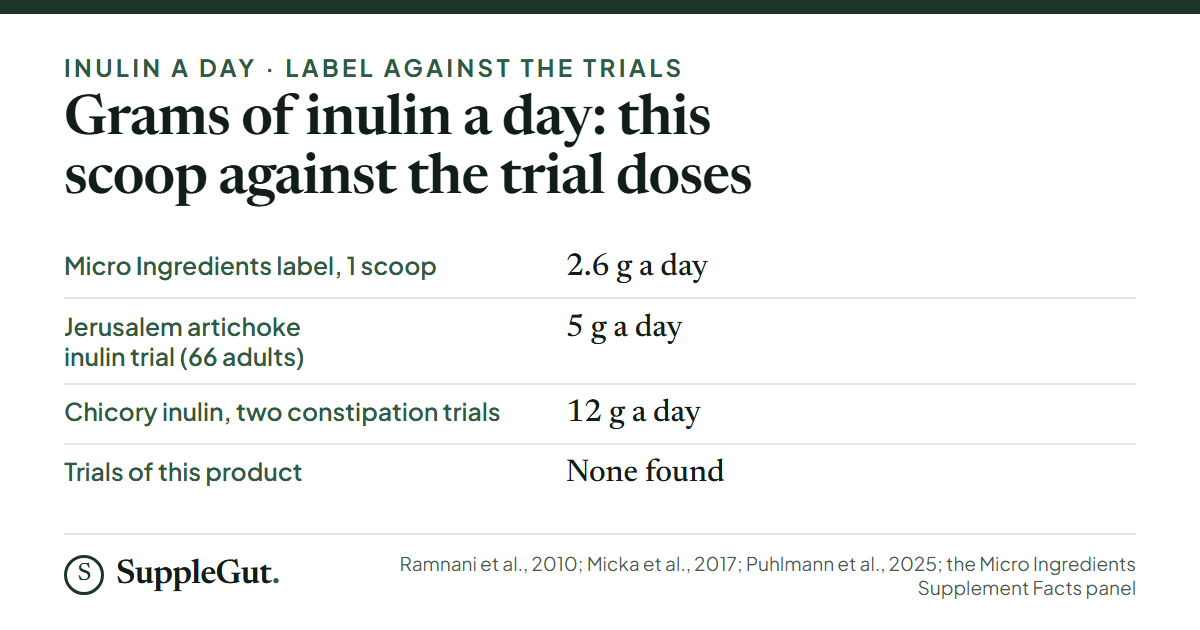
Set against the trials, one scoop prints 2.6 g, which is below the 5 g of the Jerusalem artichoke trial and about a fifth of the 12 g in the constipation trials. Whether a smaller dose does less, or the same at lower cost, is not something these trials answer.
How to take it
The bag says: as a dietary supplement, take 1 scoop daily, and for best results consult your physician. The brand page says to mix a full scoop into a drink, and Amazon says to take it with or between meals in a shake or smoothie. The scoop is inside the pouch. The bag back also prints a kefir recipe that uses a tablespoon of the powder, which is a recipe and not a serving direction.
The label has changed over time. A 2020 version of the label, held in the National Institutes of Health supplement label database, said to take one scoop three times daily, which is 7.8 g a day, with a different carbohydrate figure (2.2 g) and a different free-from list. The current bag says one scoop a day, and the printed fiber is 2.6 g per scoop, so the figure per scoop rose between versions while the scoop stayed the same size. Which version a given reviewer bought is not known. The trials ran four weeks per period, so a month is the shortest fair test.
Side effects and who should check first
The recurring effect in both the trials and the reviews is gas and bloating. Amazon’s review summary says some customers feel better in the gut while others get bloated, and the topic count for digestive effects is labeled mixed. The bag has no start-slowly, gas or FODMAP statement. Inulin is a fructan, and fructans worsened symptoms in some children with IBS in a trial, so people who know they react to fructans, such as those in onions and garlic, may react here. The label tells anyone who is pregnant, lactating or taking any medication to consult a physician.
The bag carries a California Proposition 65 warning for lead. That is a legal notice required under California law, and the bag says the warning does not mean the product is unsafe; it is not a measurement. The brand’s FAQ says its products are third-party tested for heavy metals and microorganisms, but we found no certificate of analysis, no laboratory name and no test values on the brand page or Amazon, and the bag has no NSF or USP mark.
Who sells Micro Ingredients Inulin, and what do the reviews say?
The Amazon listing reads “Ships from Amazon, Sold by Bayland Health,” with Micro Ingredients as the manufacturer. The bag names Micro Ingredients of Montclair, California, as distributor. Amazon shows 4.6 out of 5 from 5,359 ratings (80% five-star, 5% one-star), with one listing covering the 1.1 lb and 2.2 lb sizes. The brand’s own product page shows 4.8 from 446 reviews, in a review widget the brand hosts.
The recurring praise is a neutral, slightly sweet taste, easy mixing, a large bag that lasts months and more regular bowel movements. The recurring complaints are in three groups. The first is the source: several brand-page reviewers say the bag lists no plant, one says the Amazon page named Jerusalem artichoke and the bag did not, and one who avoids chicory root returned it. The second is dissolving: Amazon labels solubility mixed and clumping negative, and its summary says the powder dissolves well in cool drinks and less well in hot liquids. The third is digestive effects, covered above.
Trustpilot is a separate matter. Its profile for Micro Ingredients covers every product the brand sells, is unclaimed, and shows 1.7 from 97 reviews. The visible reviews are about customer service with no phone number, late orders and subscription cancellation, and none that we found is about inulin. The Better Business Bureau has no listing for the brand. We could not read Reddit.
Returns and subscriptions
The brand’s policy allows returns within 30 days if the item is in the same condition as received and in its original packaging, with a receipt; perishable goods cannot be returned, and purchases made through another retailer go back through that retailer. Amazon lists the item as non-returnable for food safety reasons. The brand page also offers a three-month subscription at 10% off, with a notice that it is a recurring purchase; we found no separate subscription terms page. The page header says free shipping over $59, while another block on the same page says over $500, so the threshold is unclear.
Who this powder is for
- Someone who wants a single-ingredient inulin in a large bag and will mix it into cool drinks.
- Someone comfortable that the label does not name the plant, and who does not need to avoid chicory.
- Someone who can raise the dose gradually, since the trials that found benefit used up to 12 g and the tolerability data come from higher doses.
Where the plant source or a published test report matters, a label that names its source fits better. NOW Foods inulin is the closest comparison: single-ingredient organic inulin with a serving of 2.8 g. GoBiotix Fiber Boost is FOS at 5 g a scoop. For a gel-forming fiber instead of a fermentable one, see NOW Foods psyllium husk and the psyllium guide. The probiotic or fiber guide and the quiz start from symptoms instead of a product.
Cost
The 2.2 lb (998 g) bag is $29.95 on Amazon ($25.46 with Subscribe & Save) and $33.28 on the brand site. That is $0.078 a day at one scoop, and $0.030 a gram of powder on Amazon, or about $0.15 per 5 g of inulin. Reaching the 12 g of the constipation trials would take about 4.6 scoops, roughly $0.36 a day.
NOW Foods inulin, read on Amazon, is $9.90 for 8 oz ($0.044 a gram) and $26.95 for 1 lb ($0.059 a gram). Per gram, Micro Ingredients is about 31% lower than NOW’s 8 oz and about 50% lower than its 1 lb. Servings are close, 2.6 g against 2.8 g. GoBiotix, at 5 g of FOS per scoop and $30.99 for 35 servings, comes to $0.164 a gram, and its label dose is about twice this one.
The products in this catalog
Common questions
Does Micro Ingredients Organic Inulin work?
No trial of this product was found. Trials of inulin at 12 g a day raised stool frequency in constipated adults (4.0 against 3.0 a week in one 44-adult trial), but a pooled analysis found pain and bloating did not improve, and this label gives 2.6 g a scoop. On Amazon 80% of 5,359 ratings are five-star.
Is Micro Ingredients Inulin from chicory or Jerusalem artichoke?
The label does not say. The Supplement Facts panel reads “Organic Inulin Powder,” and the Amazon page says it is harvested from Jerusalem artichoke, but the bag and the brand’s product page name no plant. Several brand-page reviewers raise this, including one who avoids chicory root. The only Jerusalem artichoke inulin trial we found gave 5 g a day to 66 healthy adults.
Is Micro Ingredients Inulin safe, and what are the side effects?
The label advises consulting a physician if pregnant, lactating or taking any medication. Inulin is fermented quickly in the colon, so gas and bloating are the usual side effects in trials, and Amazon’s summary says some customers feel better while others get bloated. Inulin is a fructan, which can worsen symptoms in some people with IBS. The bag carries a California Proposition 65 warning for lead, a legal notice and not a test result.
How much does Micro Ingredients Inulin cost?
The 2.2 lb (998 g) bag is $29.95 on Amazon and $33.28 on the brand site, with 384 scoops of 2.6 g, which is $0.078 a day or $0.030 a gram on Amazon. NOW’s inulin on Amazon is $0.044 a gram for 8 oz ($9.90) and $0.059 a gram for 1 lb ($26.95), so Micro Ingredients is about 31% and 50% lower per gram.
Micro Ingredients Inulin vs NOW Inulin: what is different?
Both are single-ingredient organic inulin with servings of about 2.6 to 2.8 g. The catalog describes NOW’s as chicory inulin, while the Micro Ingredients label names no plant (its Amazon page says Jerusalem artichoke), and Micro Ingredients costs less per gram. No trial compares the two. See the NOW Foods inulin page.
Who sells Micro Ingredients Inulin, and what is the return policy?
Amazon sells the bag through Bayland Health (4.6 stars from 5,359 ratings), and the brand sells it on its own site. The brand’s Trustpilot profile is unclaimed and shows 1.7 from 97 reviews across all its products, mostly about customer service and late orders, and the Better Business Bureau lists no profile. The brand allows returns within 30 days if unused and in original packaging, and Amazon lists the item as non-returnable.
How much inulin per day, and is 2.6 g enough?
The label says one scoop a day, 2.6 g. Trial doses run mostly from 3 to 20 g a day, and the two constipation trials used 12 g. We found no trial at 2.6 g, so whether it produces the same effect on stools or bifidobacteria is not established. A 2020 version of the label said three scoops a day, or 7.8 g.
Sources
- Micka A, Siepelmeyer A, Holz A, Theis S, Schön C. Effect of consumption of chicory inulin on bowel function in healthy subjects with constipation: a randomized, double-blind, placebo-controlled trial (NCT02548247). International Journal of Food Sciences and Nutrition, 2017. PMID 27492975. pubmed.ncbi.nlm.nih.gov/27492975
- Puhlmann ML, et al. Chicory inulin 12 g a day in adults with functional constipation, randomized double-blind placebo-controlled crossover trial (NCT05447481). BMC Gastroenterology, 2025. PMID 41233756. pubmed.ncbi.nlm.nih.gov/41233756
- Collado Yurrita L, et al. Effectiveness of inulin intake on indicators of chronic constipation: a meta-analysis of controlled randomized clinical trials. Nutrición Hospitalaria, 2014. PMID 25208775. pubmed.ncbi.nlm.nih.gov/25208775
- Nagy DU, et al. Chicory inulin-type fructans and Bifidobacterium: systematic review of 50 studies. Critical Reviews in Food Science and Nutrition, 2023. PMID 35833477. pubmed.ncbi.nlm.nih.gov/35833477
- Ramnani P, et al. Jerusalem artichoke inulin, 5 g a day, in 66 healthy adults. British Journal of Nutrition, 2010. PMID 20187995. pubmed.ncbi.nlm.nih.gov/20187995
- Bouhnik Y, Raskine L, Simoneau G, et al. Dose-response study of short-chain fructo-oligosaccharides on fecal bifidobacteria in 40 healthy adults. Nutrition Journal, 2006. PMID 16569219. pubmed.ncbi.nlm.nih.gov/16569219
- NIH Dietary Supplement Label Database: Micro Ingredients Organic Inulin Powder, label 231698 (2020 version), and NOW Foods inulin, label 335219. dsld.od.nih.gov
- Micro Ingredients: product page, FAQ and return policy. microingredients.com
- Amazon listing: label images, price, ratings and review summary. amazon.com
- Trustpilot profile for microingredients.com (brand-wide). trustpilot.com
Not sure which product fits your situation?
This guide covers the mechanics. The quiz takes your specific symptoms, routine and preferences and matches you to one product from the catalog.
Take the quiz →