
Guide
Does GoBiotix Fiber Boost work? Five grams of FOS, and what the dose trials found about bloating
Quick answer
Does GoBiotix Prebiotic Fiber Boost work? No trial of the jar exists. Each scoop holds 5 g of short-chain FOS, and at 5 g a day trials show a rise in fecal bifidobacteria and, in a 17-trial meta-analysis, more bowel movements. The one dose-response study found bloating higher than placebo at 2.5 and 5 g, and a 79-patient IBS trial at 5 g did not beat placebo on its main outcome. Ratings run 4.4 from 12,741 on Amazon and 4.7 from 4,576 on the brand’s own page.
GoBiotix Prebiotic Fiber Boost is an unflavored powder with one active ingredient: 5 g of short-chain fructooligosaccharides (FOS) in a level scoop, mixed into a drink once a day. What sets it apart from the fiber on the next shelf is the plainness of the label, since there is no blend to decode, and the claim the brand leads with in its ads, which is bloating. This page sets out what is in the scoop, what the trials of 5 g of this fiber found, where the claims on the jar have no source, what the reviews say and what the two prices and two refund promises are.
What Fiber Boost is, and what it is not
The Supplement Facts panel lists a serving of 5.4 g (one level scoop), 35 servings per tub, 10 calories, 5 g of total carbohydrate, 5 g of dietary fiber (18% of the daily value) and no sugars. The single active is fructooligosaccharides, sold as FOSSENCE P95, at 5 g, with silicon dioxide as the only other ingredient. It is an anti-caking agent. So 5 g of the 5.4 g scoop is the active, and the remaining 0.4 g is silicon dioxide and anything else the scoop holds. There are no sweeteners, flavors or colors, and no bacteria: the brand says plainly that the powder “does not add bacteria”, so it is a prebiotic, not a probiotic.
FOS are short chains of three to five sugar units that the small intestine does not digest. They reach the colon intact, where gut bacteria, chiefly bifidobacteria, ferment them into short-chain fatty acids and gas. That fermentation is how a prebiotic is meant to work, and it is also why gas and bloating are its usual side effects. FOS are a fructan, which is a fermentable carbohydrate group, and that matters for the claims discussed below. The brand describes FOSSENCE as derived from fermented cane sugar; the papers on the ingredient come from its maker, Tata Chemicals. The listing on Amazon calls the ingredient NUTRAFLORA in its description, a different brand of the same type of fiber, while its ingredient field and the label photo say FOSSENCE P95, so the description appears to be older copy.
The label shows dietary supplement labeling and a “3rd Party Tested” icon, but the pages we read name no laboratory and show no certificate of analysis. There is no “contains” statement and no facility statement on the label. The brand site says “no dairy, soy or gluten”, which covers milk, soy and wheat only through the word gluten; egg, tree nuts, fish and sesame are not mentioned. The brand lists it as vegan, sugar-free and keto-friendly.
The trial of the product itself
There is none. A PubMed search for GoBiotix returned no records, and ClinicalTrials.gov returned no studies. The brand’s ads say “clinically studied ingredient”, which is a brand claim about the ingredient and not about the jar. Its product page says a human study using daily FOS doses including 5 g found more beneficial gut bacteria; that is a study of short-chain FOS in general, not of FOSSENCE, and it is set out in the next section.
Two papers do exist on the branded ingredient itself, and both were written by employees of its maker. One was a randomized, double-blind, cross-over trial in 25 healthy adults: 10 g of FOSSENCE on its own did not raise glucose or insulin above the response to water, and adding 15 g to a carbohydrate meal did not change the glucose response (Shah et al., Heliyon, 2021). The other put 0.5% FOSSENCE into a colon simulator inoculated with stool from one donor; short-chain fatty acids rose (61.9 mM against 33.7 mM in the blank) and bifidobacteria and lactobacilli increased (Tiwari et al., FEMS Microbiology Letters, 2021). Neither measured bloating, stool frequency or bacteria in people. They show how the ingredient behaves in a blood-sugar test and a laboratory model.
The evidence for 5 g of FOS
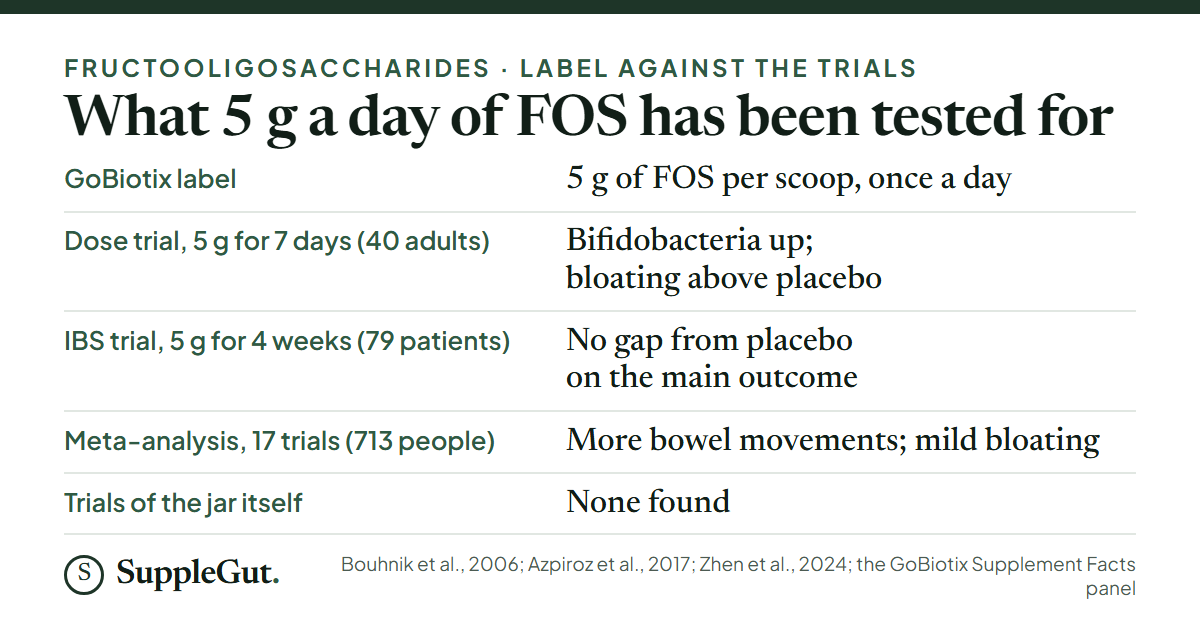
The trials that can be matched to the label dose are trials of short-chain FOS as a class. The most direct is a dose-response study in 40 healthy adults, 8 per group, given 2.5, 5, 7.5 or 10 g a day or placebo for seven days. Fecal bifidobacteria rose at every dose; at 5 g the count went from 10.21 to 10.67 log units (P = 0.03). The same paper reports that “bloating was significantly more intense” on FOS at 2.5 and 5 g a day than on placebo, and not at 7.5 or 10 g; flatulence, rumbling and abdominal pain did not differ from placebo, and the authors concluded that 2.5 to 10 g was well tolerated (Bouhnik et al., Nutrition Journal, 2006). The label dose is exactly 5 g, so this is the closest match, with the limits that the volunteers were healthy and the groups were tiny. An earlier study by the same group tested 0 to 20 g a day in 40 healthy adults: bifidobacteria were significantly higher at 10 and 20 g than on placebo or 2.5 g, the authors called 10 g a day the optimal well-tolerated dose, and excess flatus became more frequent at 20 g (Bouhnik et al., Journal of Nutrition, 1999). A 2022 meta-analysis of eight studies found bifidobacteria rose with FOS, with a larger rise above 5 g (+1.12) than at 5 g or less (+0.52), and no difference in digestive adverse symptoms against comparators (Dou et al., Nutrients, 2022). On those figures 5 g sits in the lower-dose group.
For constipation, a 2024 meta-analysis of 17 randomized trials in 713 participants found that FOS raised bowel movement frequency and softened stool, with less effort and pain, and no serious adverse events. It also recorded mild bloating as an adverse event (odds ratio 10.36, 95% confidence interval 3.32 to 33.23), and the authors say dose and duration need more trials (Zhen et al., Foods, 2024). A separate meta-analysis of 47 publications on beta-fructans, by authors with ties to a FOS producer, found that short-chain types raised stool frequency by 0.36 a day while long-chain types had no effect (de Vries et al., Nutrients, 2019).
For irritable bowel syndrome the results are less favorable to the label dose. A randomized, placebo-controlled trial gave 5 g a day for four weeks to 79 IBS patients with rectal hypersensitivity. The main outcome, the rectal discomfort threshold, and the IBS and quality-of-life scores improved about equally on FOS and on placebo. FOS did lower anxiety scores and raise fecal bifidobacteria against placebo, and the effect on rectal sensitivity was larger in constipation-predominant IBS (P = .051). The authors have ties to a FOS producer (Azpiroz et al., Neurogastroenterology & Motility, 2017). At four times the label dose, 20 g a day for 12 weeks in 96 IBS patients, symptoms worsened at the start and ended no different from placebo (58% improved against 65%) (Olesen and Gudmand-Hoyer, American Journal of Clinical Nutrition, 2000).
Putting the trials together: at 5 g a day, FOS raises fecal bifidobacteria and adds a modest amount of stool frequency in pooled data, and it carried more bloating than placebo in the one study that tested that dose against placebo for symptoms. None of this is a trial of Fiber Boost.
The claims on the jar that have no source
The jar image and the brand’s pages carry “low-FODMAP” wording. FOS is a fructan, and fructans are one of the fermentable groups the low-FODMAP approach limits. In a cross-over trial in 23 children with IBS, fructans at up to 19 g for 72 hours caused more abdominal pain, bloating and flatulence than placebo, and 52% of the children were classed as fructan sensitive (Chumpitazi et al., Clinical Gastroenterology and Hepatology, 2018). That was a different dose and population, and we did not find a certification or a test behind the label’s wording.
The Amazon listing and the ad-page jar also say “GLP-1 support”, and one badge says “GLP-1 approved”. We found no trial of this product in people using GLP-1 medicines and no body that approves supplements for that use, so the badge is a brand claim with no source we could read. The ads also say “relief bloating instantly” and “in minutes”; the trials above measured bloating over days to weeks, and the dose-response study found it higher than placebo at 5 g. The jar also says “No Psyllium (No Bloat)”. No head-to-head trial of FOS and psyllium was found, so any difference between them rests on what kind of fiber each is, not on a measured result.
How to take Fiber Boost
The directions are to mix one scoop (5.4 g) into 8 to 10 oz of water, juice or another drink once a day, with or without food, morning or evening. The brand’s FAQ says some people have mild gas in the first three to five days and suggests half a scoop for the first week for anyone who is sensitive. The powder is unflavored and the brand says it dissolves in hot and cold drinks. A fair test is longer than a week: the dose-response study ran seven days, the IBS trial at the same dose ran four weeks, and the constipation trials in the meta-analysis ran longer.
Side effects and who should not take it
No warning is printed on the label photos we read, and the Amazon listing shows no safety information field. There is no pregnancy, breastfeeding, medication or medical-condition statement. The brand’s FAQ calls the product safe for daily use. Gas and bloating are the documented effects of FOS: the 2024 meta-analysis recorded mild bloating, and the dose-response study measured it above placebo at 5 g. About 10% of the Amazon review mentions of digestive effects were negative (194 of 1,872). People with IBS are the group in whom fructans have worsened symptoms in trials, so the trial evidence above is the reason to start with half a scoop; the label does not address them.
What the reviews say
The scores come from different kinds of source. Amazon shows 4.4 from 12,741 ratings on a listing sold by GoBiotix, with 73% five-star, 13% four, 6% three, 3% two and 5% one-star. The brand’s own page shows 4.7 from 4,576 reviews, 83% of them five-star, through a widget that says some of the reviews come from related products. Walmart shows 4.7 from 4,221 reviews on a three-pack listing, a figure we read only from a search snippet because the page itself did not open. Trustpilot, which is independent, shows a TrustScore of 4.3 from 681 reviews, but the profile covers every GoBiotix product, not this one, and the score does not match its own split (84% five-star, 7% four, 3% three, 2% two, 4% one, which averages near 4.65). We found no Better Business Bureau profile. Reddit could not be read.
Amazon’s own summary of the review text counts 2,951 mentions of effectiveness, 2,837 of them positive, and 1,872 of digestive effects, 1,678 positive. The recurring praise is a powder with no taste or grit that dissolves in coffee or water, more regular bowel movements, and less bloating for many reviewers. The recurring complaint is that it did nothing after a week or so, with 144 of 616 mentions of value negative. A minority report digestive side effects, which matches the brand’s own warning about the first days. The Trustpilot complaints are mostly about the store: cancelling a subscription, discount codes and taxes at checkout, shipping, and expired product.
Price, subscription and refund terms
The same 35-serving jar is priced two ways on the brand’s own site. The standard product page is $30.99 one time ($0.89 a day), or $24.79 on a 20% Subscribe & Save plan ($0.71 a day) delivered every 30, 60 or 90 days; two and three tubs are $30.00 each and six are $30.16 each. A separate ad landing page for what is labeled the same jar is $49.99 one time ($1.43 a day), or $37.49 on subscription ($1.07 a day). Amazon lists the tub at $28.97 ($0.83 a day). A 20-serving travel pack is $31.99, or $1.60 a serving.
The written refund policy accepts returns of unopened and unused product within 30 days of delivery, with refunds paid five to seven business days after receipt, and the shipping policy says the brand covers return shipping if it is requested within 30 days of the order. The ad landing page instead promises a “60-Day Money Back Guarantee” for anyone who does not feel a difference. The two statements differ, and we could not tell from the public pages which governs a purchase through the ad page. The cart also offers optional shipping protection from $0.98; the shipping policy says the brand does not cover stolen parcels unless it is selected. Subscriptions can be cancelled at any time through the links in the order confirmation email or by emailing the brand, and no minimum number of shipments is stated. In the sample of 20 one- and two-star Trustpilot reviews we read, three concerned cancelling a subscription, five concerned discount codes or taxes at checkout, and one concerned expired product with a partial refund. A single tub can be bought one time on the brand site or on Amazon.
Who Fiber Boost is for
- Someone who wants a single-ingredient prebiotic with a printed dose and no blend to interpret.
- Someone who wants an unflavored powder that mixes into coffee, water or a smoothie without changing it.
- Someone who will start with half a scoop and give it a few weeks, knowing that bloating is the effect the trials flag at this dose.
If the main complaint is bloating that is already present, or an IBS diagnosis, the fermentable nature of FOS is the thing to weigh against the options. NOW Foods Inulin is a longer-chain fructan that works the same way. California Gold Nutrition Sunfiber PHGG is partially hydrolyzed guar gum, and NOW Foods Psyllium Husk Powder is the gel-forming option; the psyllium guide compares the products. The LOAM guide covers a six-fiber blend, the probiotic or fiber guide and the bloating and gas guide start from the symptom, and the quiz does the same.
The products in this catalog
Common questions
Does GoBiotix Prebiotic Fiber Boost work?
No trial of the jar was found. A scoop is 5 g of short-chain fructooligosaccharide (FOS). At 5 g a day, trials show more fecal bifidobacteria in healthy adults, and a meta-analysis of 17 trials found more bowel movements, but the one dose-response study found bloating higher than placebo at 5 g. Amazon shows 4.4 stars from 12,741 ratings, which reflects customer opinion and not a trial.
What are the side effects of GoBiotix Fiber Boost, and is it low-FODMAP?
The label lists FOS and silicon dioxide and prints no warnings. The brand says mild gas for the first three to five days is common and suggests half a scoop for the first week. FOS is a fructan, and fructans worsened symptoms in some children with IBS in a trial. The “low-FODMAP” wording on the jar has no certifier or test that we could find.
Is GoBiotix Fiber Boost approved for GLP-1 users?
We found no body that approves supplements for GLP-1 use and no trial of this product in people taking GLP-1 medicines. “GLP-1 support” and “GLP-1 approved” appear on the jar images as brand claims. The evidence we found is for FOS in general, mostly in healthy adults and people with constipation or IBS.
How much does GoBiotix Fiber Boost cost?
One 35-serving tub is $30.99 on the standard brand page ($0.89 a day), $24.79 on the 20% Subscribe & Save plan and $28.97 on Amazon. A separate ad landing page for the same labeled jar shows $49.99 one time, or $37.49 on subscription, so the page you are on sets the price.
GoBiotix Fiber Boost vs psyllium or inulin?
No head-to-head trial was found. Fiber Boost is 5 g of FOS, a fermentable prebiotic; the jar’s “No Psyllium (No Bloat)” is a brand claim. See the psyllium guide for the gel-forming option, and the inulin and Sunfiber pages below for other single-fiber powders.
How do I cancel a GoBiotix subscription or get a refund?
Cancel through the links in the order confirmation email or by emailing the brand; no minimum number of shipments is stated. The written refund policy takes back unopened, unused product within 30 days of delivery, while the ad landing page promises a 60-day money-back guarantee. A few Trustpilot reviews describe trouble cancelling, and Trustpilot shows 4.3 from 681 reviews across the whole store.
Sources
- Bouhnik Y, Raskine L, Simoneau G, et al. Dose-response study of short-chain fructo-oligosaccharides on fecal bifidobacteria in 40 healthy adults. Nutrition Journal, 2006 (PMID 16569219). pubmed.ncbi.nlm.nih.gov/16569219
- Bouhnik Y, Vahedi K, Achour L, et al. Short-chain fructo-oligosaccharide administration at 0 to 20 g a day and fecal bifidobacteria in healthy adults. Journal of Nutrition, 1999 (PMID 9915885). pubmed.ncbi.nlm.nih.gov/9915885
- Azpiroz F, Dapoigny M, Pace F, et al. Short-chain fructo-oligosaccharide, 5 g a day for 4 weeks, in 79 patients with irritable bowel syndrome and rectal hypersensitivity. Neurogastroenterology & Motility, 2017 (PMID 27477485). pubmed.ncbi.nlm.nih.gov/27477485
- Zhen H, et al. Fructo-oligosaccharides for functional constipation: meta-analysis of 17 randomized trials. Foods, 2024 (PMID 39766936). pubmed.ncbi.nlm.nih.gov/39766936
- de Vries J, et al. Beta-fructans and bowel function: meta-analysis of 47 publications. Nutrients, 2019 (PMID 30621208). pubmed.ncbi.nlm.nih.gov/30621208
- Dou Y, et al. Fructo-oligosaccharides and gut microbiota: meta-analysis of eight studies. Nutrients, 2022 (PMID 36014803). pubmed.ncbi.nlm.nih.gov/36014803
- Shah P, et al. FOSSENCE and the glycemic response in 25 healthy adults (NCT03755232). Heliyon, 2021 (PMID 33997376). pubmed.ncbi.nlm.nih.gov/33997376
- Tiwari DP, et al. FOSSENCE in a colon simulator (SHIME). FEMS Microbiology Letters, 2021 (PMID 34849765). pubmed.ncbi.nlm.nih.gov/34849765
- Olesen M, Gudmand-Hoyer E. Fructo-oligosaccharide, 20 g a day for 12 weeks, in irritable bowel syndrome. American Journal of Clinical Nutrition, 2000 (PMID 11101487). pubmed.ncbi.nlm.nih.gov/11101487
- Chumpitazi BP, et al. Fructans in children with irritable bowel syndrome. Clinical Gastroenterology and Hepatology, 2018 (PMID 28970147). pubmed.ncbi.nlm.nih.gov/28970147
- Brand pages: label, directions, price, refund, subscription and shipping policies. gobiotix.com
- Amazon listing: ratings and price. amazon.com
- Trustpilot profile for gobiotix.com. trustpilot.com
Not sure which product fits your situation?
This guide covers the mechanics. The quiz takes your specific symptoms, routine and preferences and matches you to one product from the catalog.
Take the quiz →