
Guide
Does Microbiome Plus+ work? One named L. reuteri strain studied mostly for cholesterol, plus a small fiber tablet
Quick answer
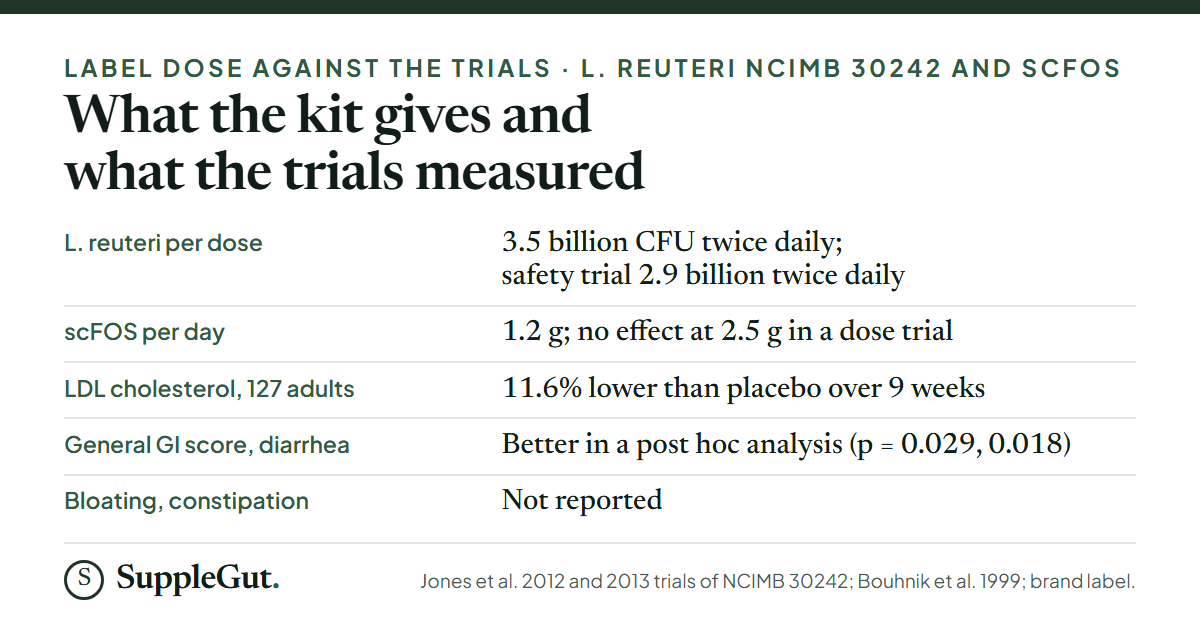
Does Microbiome Plus+ work? We found no trial of the kit. Its capsule strain, L. reuteri NCIMB 30242, lowered LDL cholesterol 11.6% against placebo in a 127-person, nine-week trial, and a post hoc look at that trial found better general gut scores and fewer diarrhea symptoms (p = 0.029 and 0.018); constipation and bloating were not reported. The fiber tablet gives 1.2 g of scFOS a day, below the 2.5 g that had no effect in a dose trial.
Microbiome Plus+ Gastrointestinal Combo is a two-container kit: a delayed-release capsule holding one named strain of Lactobacillus reuteri, NCIMB 30242, and a 600 mg tablet of short-chain fructooligosaccharides (scFOS), a fermentable fiber. Both are taken twice a day with meals. What sets it apart from the shelf next to it is that the bacteria are identified to the strain; what limits what can be said about it is that the strain’s evidence sits mostly in cholesterol rather than the gut.
What Microbiome Plus+ is, and what it is not
The kit holds two Supplement Facts panels with one active each and no proprietary blend. The capsule carries Lactobacillus reuteri NCIMB 30242 at 3.5 billion CFU, in a hypromellose and gellan gum shell with microcrystalline cellulose, magnesium stearate and silica. The tablet carries 600 mg of scFOS, with microcrystalline cellulose, dicalcium phosphate, stearic acid, croscarmellose sodium, magnesium stearate, silicon dioxide, shellac and povidone. Each container holds 56 units. Taken as directed, the day’s total is 7 billion CFU of the strain and 1.2 g of scFOS.
The label prints a CFU figure but not the count at expiry, and one block of the brand’s product page prints “AFU” where the label and the page’s FAQ print CFU. The capsule is sold as delayed release and shelf stable, and the brand says it releases in the colon; the page posts no survival data. The brand says the product is “third-party tested for quality” and names no laboratory, and we found no NSF, USP or Informed Choice mark. The same strain is sold by NOW Foods under a clinical-strain heart-health label, so it is not exclusive to this brand.
The trial of the kit itself
We found none. PubMed searches for the brand name and for NCIMB 30242 together with scFOS returned no trial of the capsule-plus-tablet kit. The brand’s line about clinical trials in seven scientific papers refers to the strain alone. Those papers come from one research group at McGill University and report a small number of cohorts rather than seven independent trials: a 127-person capsule trial, a 131-person safety trial, two post hoc analyses of the 127-person trial, a 114-person yogurt trial, a yogurt safety trial and a pilot of 14 adults.
What the trials of the strain measured
The main trial randomized 127 adults with high cholesterol to the capsules or placebo for nine weeks. LDL cholesterol fell 11.64% against placebo (p < 0.001), total cholesterol fell 9.14% and apoB-100 fell 8.41%; triglycerides and HDL did not change. The abstract does not state the capsule dose. The brand’s headline claims rest on this paper.
The only gut data come from a post hoc analysis of that same trial, using the Rome III questionnaire. Compared with placebo, general gastrointestinal health status improved (p = 0.029) and diarrhea symptoms improved (p = 0.018). Constipation and bloating were not reported as improved. The participants were adults with high cholesterol, not people with a gut complaint, and the analysis was post hoc.
The mechanism explains the emphasis. NCIMB 30242 makes bile salt hydrolase, an enzyme that frees bile acids, and in the trials that is linked to lower cholesterol absorption; a 14-person pilot looked at plasma bile acid profiles. A 2023 meta-analysis of six randomized trials of four L. reuteri strains (512 participants) found total cholesterol down 0.26 mmol/L overall and no change in LDL, HDL, triglycerides, blood pressure or fasting glucose across all strains pooled; its strain subgroup found NCIMB 30242 reduced total and LDL cholesterol, and total cholesterol fell more at doses above 5 billion CFU. The kit’s 7 billion CFU a day is above that figure.
Class-level reviews of gut outcomes are less encouraging for combinations. A 2022 review of 30 probiotic trials in chronic constipation found 57% responding on probiotics against 44% on control, with a significant effect for Bifidobacterium lactis but not for mixtures, and four synbiotic trials showed no change in stool output or symptom scores. A 2023 review of 82 trials in 10,332 adults with IBS rated the certainty of benefit from combination probiotics as very low. Neither tested NCIMB 30242 on its own.
The fiber tablet and its dose
Each tablet is 600 mg, so the day’s fiber is 1.2 g. The brand calls it food for the probiotic. The dose-response trial is a 1999 study in 40 healthy adults over seven days: fecal bifidobacteria rose at 10 g and 20 g a day and did not rise at 2.5 g, and the authors called 10 g the optimal, well-tolerated dose. The kit gives less than half of the dose that had no effect. A 2024 meta-analysis of 17 trials (713 participants) of fructooligosaccharides in functional constipation found more bowel movements a week and softer stool, with mild bloating recorded as an adverse event; those trials used higher doses, so it is class evidence only. The brand’s own FAQ says the combo may be more suitable for people who have no issue with FODMAPs than the capsule alone.
How to take it
The label says one capsule twice daily with meals or as directed by a physician, and the panel header reads “take with meals twice daily”; the page gives no separate line for the tablet. A kit is 56 of each, so 28 days. It is not a once-a-day product, and the capsule and safety trials ran nine weeks.
Side effects and who should not take it
The label advises anyone who is pregnant, nursing, under 18 or has a medical condition to consult a physician first, and not to take it with an allergy to a listed ingredient. The brand’s Amazon listing for the single-strain capsule adds prescription medication to that list. In the 131-person, nine-week safety trial at 2.9 billion CFU twice daily, blood chemistry, hematology and adverse events were similar to placebo; the kit’s 3.5 billion twice daily is above the dose in that trial. The tablet is a fermentable fiber, and the FOS trials record gas and bloating.
The allergen statement says the L. reuteri capsule is free from the major allergens, including milk, eggs, wheat, soy, tree nuts, fish and sesame. It names the capsule, not the tablet, and no facility or cross-contact statement was found.
What the reviews say
There are three pools, and none is a rating of the kit alone. The brand’s Loox widget reads 4.8 from 298 reviews, but it pools the kit with the brand’s single-strain capsule, and 35 of the 40 reviews visible on the page are headed by the single-strain capsule. Trustpilot reads 4.0 from 51 for the whole brand. Amazon reads 4.4 from 714 ratings for the single-strain capsule only, which has no fiber tablet.
The recurring praise is lower LDL and total cholesterol on blood tests, less gas and bloating within a few weeks, and a capsule and tablet that are easy to swallow. The recurring complaints are delivery, which is the most common one on Trustpilot, the price, and a kit that arrives as “two separate containers” when a buyer expected one.
Price, subscription and refund terms
On the brand site the one-time price is $61.49 for 28 days, or $2.20 a day, with no discount on three-packs or six-packs. The standard subscription is 15% off, $52.27 a pack (about $1.87 a day), monthly or every two or three months, and the page says it can be skipped or canceled at any time. The capsule alone is $48.99 on the brand site and $49.99 on Amazon. The page’s “$0.55/capsule” figure counts the 56 tablets as capsules. Shipping is free above $75.
The brand’s return policy offers a 100% money-back guarantee for one year from purchase. The buyer has to phone customer service first and return the product to the brand’s Vancouver address; whether return shipping is paid is not stated. Amazon purchases follow Amazon’s rules. On Trustpilot, one reviewer disputed a charge with a card issuer after an undelivered order.
Who Microbiome Plus+ is for
- Someone who wants one named strain with published human trials, with the understanding that the main trial measured cholesterol.
- Someone who wants a probiotic and a prebiotic fiber in one routine and will take two units twice a day with meals.
- Someone comfortable with a fermentable fiber, which the brand’s own FAQ separates from the capsule-only product.
For other L. reuteri strains, BioGaia Gastrus uses two different strains in a once-daily chewable. Ritual Synbiotic+ is a capsule that combines bacteria with prebiotics, and NOW Foods Inulin is a prebiotic fiber sold loose. The CFU guide covers how to read the count, and the quiz narrows the choice.
The products in this catalog
Common questions
Does Microbiome Plus+ work for gut symptoms?
No trial of the kit was found. The strain in the capsule, L. reuteri NCIMB 30242, was studied mostly for cholesterol; a post hoc analysis of its 127-person trial found better general gut scores and fewer diarrhea symptoms (p = 0.029 and 0.018) in adults with high cholesterol, and constipation and bloating were not reported. Reviews of combination probiotics in IBS and constipation rate the evidence as low.
Is Microbiome Plus+ a cholesterol supplement or a gut supplement?
The brand markets it for both, and the strain’s trials measured cholesterol. In 127 adults with high cholesterol, LDL fell 11.6% against placebo over nine weeks. The strain makes bile salt hydrolase, an enzyme that frees bile acids, which is why most of its evidence is about blood lipids and not the gut.
What are the side effects of Microbiome Plus+?
A 131-person, nine-week safety trial at 2.9 billion CFU twice daily found adverse events similar to placebo; the kit gives 3.5 billion twice daily. The scFOS tablet is a fermentable fiber, and trials of fructooligosaccharides record mild gas and bloating. The label advises a physician first if you are pregnant, nursing, under 18 or have a medical condition. See the probiotic side effects guide.
How much does Microbiome Plus+ cost?
The kit is $61.49 for 28 days on the brand site, about $2.20 a day for two capsules and two tablets, and $52.27 a pack on the standard subscription. The capsule alone is $48.99 on the brand site and $49.99 on Amazon. The page’s “$0.55/capsule” counts the tablets as capsules.
Can you cancel Microbiome Plus+ and get a refund?
The brand says subscriptions can be skipped or canceled at any time, online or by phone, and offers a one-year money-back guarantee. The buyer has to phone customer service first and return the product to its Vancouver address. Trustpilot (4.0 from 51) lists delivery as the most common complaint, and Amazon purchases follow Amazon’s rules.
Is 600 mg of scFOS enough?
The kit gives 1.2 g a day. In a seven-day trial in 40 healthy adults, fecal bifidobacteria rose at 10 g and 20 g a day and did not rise at 2.5 g. The tablet is under half of the dose that had no effect, though no trial tested the kit’s fiber alongside the strain.
Is one strain better than a multi-strain probiotic?
No trial compares them. The kit uses one named strain at 3.5 billion CFU twice daily; a 2022 review of constipation trials found a stool-frequency gain for B. lactis alone but not for mixtures. A result for one strain does not carry to another, which is covered in the probiotic guide.
Sources
- Jones ML, et al. Randomized, double-blind, placebo-controlled trial of L. reuteri NCIMB 30242 capsules in 127 hypercholesterolemic adults. European Journal of Clinical Nutrition, 2012. PubMed 22990854
- Jones ML, et al. Safety and tolerance trial of L. reuteri NCIMB 30242 capsules, 131 participants, 2.9 billion CFU twice daily. Regulatory Toxicology and Pharmacology, 2012. PubMed 22561556
- Jones ML, et al. Post hoc Rome III analysis of the 127-person trial: general gastrointestinal health status and diarrhea symptoms. Expert Opinion on Biological Therapy, 2013. PubMed 24074303
- Other papers on the strain: Jones ML, et al. yogurt formulation trial, 114 participants, British Journal of Nutrition, 2012, PubMed 22067612; Martoni CJ, et al. pilot of 14 adults on bile acid profiles, Gut Microbes, 2015, PubMed 25612224
- Liu J, et al. Systematic review and meta-analysis of L. reuteri and cardiovascular risk factors, 6 randomized trials, 512 participants. Nutrition Research, 2023. PubMed 37419064
- van der Schoot A, et al. Probiotics and synbiotics in chronic constipation, 30 and 4 randomized trials. Clinical Nutrition, 2022. PubMed 36372047
- Goodoory VC, et al. Probiotics in irritable bowel syndrome, 82 randomized trials, 10,332 adults. Gastroenterology, 2023. PubMed 37541528
- Bouhnik Y, et al. Dose-response of short-chain fructooligosaccharides on fecal bifidobacteria in 40 healthy adults. Journal of Nutrition, 1999. PubMed 9915885
- Fructooligosaccharides in functional constipation, meta-analysis of 17 randomized trials, 713 participants. Foods, 2024. PubMed 39766936
- Brand pages: product page, label image, allergen statement and return and shipping policies at microbiomeplus.com; review pools on the brand’s Loox widget, Trustpilot and the Amazon listing for the single-strain capsule.
Not sure which product fits your situation?
This guide covers the mechanics. The quiz takes your specific symptoms, routine and preferences and matches you to one product from the catalog.
Take the quiz →