
Guide
Does Natural Colon work? Twenty-three plants in one blend, an aloe of unstated form, and a two-day claim
Quick answer
Does Natural Colon work? No trial of Natural Colon or of any ingredient at its dose was found. Its 690 mg blend holds 23 plants with no amount printed for any of them, so the psyllium is at most 0.69 g against trials that needed more than 10 g a day, and the Bacillus coagulans is 300 million CFU with no strain. The label says no senna and no cascara but does not say whether the aloe is gel or latex. The directions are one capsule a day, with two a day for up to three days, while the advertising says results in 2 days.
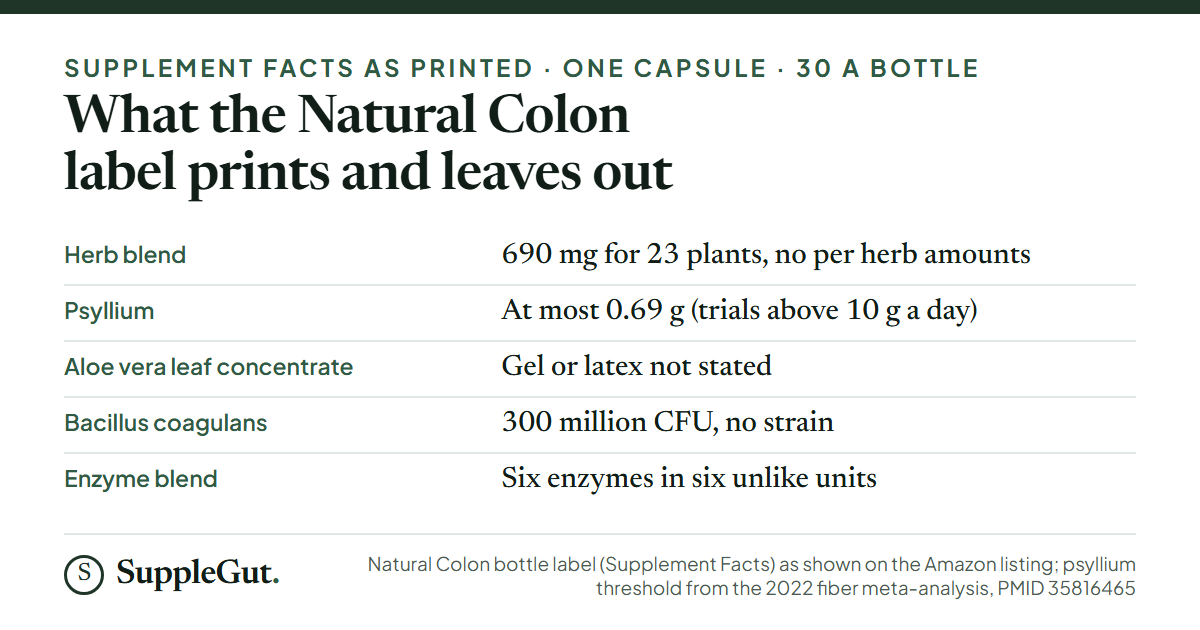
Natural Colon is a once-a-day capsule sold as a colon cleanse, and the label is built around one number: a 690 mg blend that holds 23 named plants and an amount for none of them. What sets it apart from a fiber or a senna cleanse is the combination in a single capsule: aloe, psyllium, peppermint, ginger and a long list of greens, plus a six-enzyme blend and a spore probiotic. This page sets out what the label prints and leaves out, what the trials of the ingredients show, how the directions compare with the “2-day” wording, the reviews on each platform, and the price and refund terms.
What Natural Colon is, and what it is not
The serving is one capsule, with 30 in the bottle. The Supplement Facts panel has three parts. The first is a Proprietary Greek Colon Cleansing Blend of 690 mg that lists, in this order of print, aloe vera leaf concentrate, milk thistle seed extract, peppermint leaf extract, ginger root extract, psyllium husk, chlorophyll, acai juice powder and then organic alfalfa grass, amla, burdock, carrot, chlorella, a second ginger extract, goji, kale, kelp, moringa, nopal, oat grass, pomegranate, purple corn, spirulina and algae. That is 23 named items sharing 690 mg, and no amount is printed for any of them. Divided evenly it would be 30 mg each, though a blend is rarely split evenly. Retail pages describe the same blend as 16 organic ingredients, 18 organic botanicals or 12 organic herbs, so the count depends on the page.
The second part is a Digestive Dual-Action Plant Enzyme Blend printed as six enzymes in six different units: amylase 600 SKB, protease 5,000 HUT, acid protease 6 SAP, glucoamylase 4 AG, lipase 350 LU and cellulase 315 CU, with a total of 6,275 “activity units.” The six units measure different reactions, so the total is a sum of unlike things and the panel gives no daily value for it. The third is a probiotic blend of Bacillus coagulans at 300 million CFU, with no strain designation. Only the bottle label names the organism; the brand’s own pages say “plant probiotics” and give the number alone. Other ingredients are cellulose, magnesium stearate and silica.
It carries a Supplement Facts panel, so it is sold as a dietary supplement, not as a drug. The bottle front reads “Promotes regular bowel movements and cleanses the colon,” with the FDA disclaimer. We found no third-party testing mark and no testing laboratory named on the label or the brand pages.
The bottle is sold as Natural Colon by Greek Island Labs on two brand sites that carry the name Greek Wellness, and on Amazon under the Greek Island Labs store. It is the same product in all three places: the Amazon manufacturer part number, 1680, is the SKU on the brand’s own store, the ingredient text matches word for word, and the bottle shows the same Scottsdale, Arizona address.
No senna, no cascara, and an aloe of unstated form
The bottle front says “No Senna, No Cascara Sagrada,” and the Amazon text adds no bentonite. Those are the only laxative-herb statements on the label. What the label does not say is which kind of aloe is inside. The panel reads “aloe vera leaf concentrate,” and we found no page that says whether that is inner-leaf gel or material containing the leaf latex, and no page that gives an aloin or anthraquinone limit or calls the aloe decolorized or latex-free. The latex is the part of the leaf that contains hydroxyanthracene compounds with a laxative effect; a 2026 review describes safety concerns for those compounds and treats inner-leaf gel products separately. The brand’s home page describes the inner gel of the aloe leaf in general terms and says nothing about this capsule’s material. So the label rules out two stimulant herbs by name and leaves the aloe question open.
One reviewer on the brand’s own review list says senna was part of the formula until several years ago and that the product is less effective without it. We could not confirm an earlier formula. The contrast with a product that does state its stimulant herbs is on the Inno Cleanse guide, where senna, cascara, cape aloe and frangula sit in one named blend on a 14-day course.
The trial of the product itself
There is none that we could find. PubMed returns no result for Natural Colon with Greek Island Labs, and ClinicalTrials.gov returns none for the company. The brand’s About page says it conducts “extensive clinical studies” on its ingredients and its products, and cites no study. The Amazon description refers to the Royal Society of Medicine for the idea that more than 54 health problems can be linked to a toxic colon, with no reference given, and the brand says people “should be having 2 bowel movements a day.” We found no trial that tests colon cleansing as an outcome in a search for reviews of the topic.
The evidence for the ingredients
None of the evidence below is at the dose in the capsule, because the capsule prints no dose for any herb.
Psyllium. The main fiber evidence for constipation is a meta-analysis of 16 randomized trials in 1,251 adults: 66% responded to fiber against 41% on control (relative risk 1.48), with significant effects for psyllium and pectin, and a higher response “only with higher fiber doses,” meaning above 10 g a day (American Journal of Clinical Nutrition, 2022). Psyllium is one of the 23 items in a 690 mg blend, so it is at most 0.69 g, under 7% of the trial threshold. A tub of plain psyllium, such as NOW Foods Psyllium Husk Powder, is the form those trials used.
Aloe vera. A meta-analysis of three randomized trials in 151 people with irritable bowel syndrome found a symptom score improvement (standardized mean difference 0.41, 95% CI 0.07 to 0.75) and more responders on aloe (relative risk 1.69), with no adverse events reported (Journal of Neurogastroenterology and Motility). A later randomized trial in 160 IBS patients compared an Aloe barbadensis extract with inulin for four weeks and found both groups improved with no difference between them (P = 0.62; 39% responders on aloe against 45% on inulin) (Neurogastroenterology and Motility, 2021). Those were IBS trials of specific extracts, not constipation trials of this capsule. An aloe product that states its form is the Lily of the Desert inner-fillet aloe juice.
Bacillus coagulans. Strain-named trials used far more than 300 million CFU. B. coagulans LBSC (DSM 17654) at 6 billion CFU a day, in 40 adults with IBS over 80 days, improved several symptom scores against placebo (Medicine, 2021). B. coagulans Unique IS2 at 2 billion spores, added to lactulose in 150 adults with functional constipation for four weeks, did not change stool frequency significantly against lactulose alone (PMID 34599466). The capsule’s 300 million CFU is one-twentieth of the first dose, and no strain is named, so neither result transfers. The general question of dose is on how many CFU you need.
The rest. We found no randomized trial of the enzyme blend, ginger, peppermint, milk thistle, chlorella, spirulina or moringa for constipation or bloating at amounts like these. How enzyme products are judged in general is covered in do digestive enzymes work.
How to take it, and the “2-day” claim
The directions on the brand’s product page are one capsule a day, preferably in the morning with food. For rapid relief it allows two a day for a maximum of three days, then back to one a day. The brand FAQ says to take one capsule daily to see results “in as little as 2 days” and that long-term daily use leads to increased benefit over time. The Amazon images say it is formulated to work in two days, and the brand’s ad headline is “2-day Colon Cleanse.” So the two days describe how fast results are claimed, while the directions describe a daily capsule with no stated end. For a fiber-type product, a fair test is longer than two days; the psyllium timeline is on how long psyllium takes.
Side effects and who should not take it
We found no pregnancy, nursing, medication, age or medical-condition warning on the Amazon label photos, the bottle front or the brand pages. The only caution is the brand’s suggested-use line not to take it without consulting a doctor if allergic to any ingredient. The Amazon description claims the product works without cramping, bloating or diarrhea. Reviewers describe it differently in places: one reports slight cramping on the second day, and another says it works, “sometimes too well.” Any product that moves the bowel can loosen stools, and anyone with a bowel condition, on medication or pregnant can check with a doctor or pharmacist first. No contains statement is printed, although alfalfa, kelp and milk thistle are listed ingredients. The label states free of dairy, gluten and soy, and the brand page says no animal products.
What the reviews say
Amazon shows 4.3 from 46 ratings: 73% five-star, 10% four, 3% three, 4% two and 10% one. These are independent of the brand. The text of the top reviews describes a bowel movement within a day or two, often taken at night, and several years of repeat use. The complaints are price (one reviewer counts over $1 a pill), cramping, and in one case bottles that arrived with a best-by date one to two weeks away.
naturalcolon.com shows 4.72 “based on 309 reviews” on its home page. That section is a theme block with typed totals, not a review app: the average, the count and the star bars are entered in the page itself, with 25 undated review cards listed under them. Some reviewer names repeat across cards, two cards describe use that is not daily, and one card carries a criticism under a five-star rating. A testimonial on the product page refers to the company’s joint product. The sister site greekwellness.com shows 4.9 from 95 reviews for the same product through a review app, so the two brand sites give different counts for one bottle.
The Better Business Bureau lists Greek Island Labs LLC with an A+ rating, not accredited, no complaints in three years and no customer reviews. We found no Trustpilot profile under the brand or either site’s name. We did not read Reddit.
The price, subscription and refund terms
A 30-capsule bottle is $24.99 on Amazon, which is $0.83 a day at one capsule, or $22.49 with the Amazon subscribe discount ($0.75). On the brand site it is $29.99 ($1.00 a day) plus $3.97 shipping for a single bottle, $23.99 on its Subscribe & Save 20% plan delivered every 30 to 120 days ($0.80), $89.97 for four bottles ($0.75) and $119.96 for six ($0.67). The page prints per-bottle figures of $17.99 and $15.99 for those two bundles, which are lower than the totals divided by the bottles named in the bundle titles. The brand FAQ also calls its monthly subscription “coming soon” while the product page sells a subscribe option.
The brand’s return policy offers a 30-day money-back guarantee on the unused portion, less the cost of shipping, and says no refund can be made without verbal confirmation from a customer care representative by phone, followed by a return authorization number sent by email. The Amazon listing follows Amazon’s standard returns. We found no billing or subscription complaint in the Amazon reviews we read or in the BBB record.
Who Natural Colon is for
- Someone who wants a plant-based capsule taken once a day and accepts that the amount of each herb is not printed.
- Someone comfortable with an aloe of unstated form, since the label excludes senna and cascara by name and says nothing more about laxative compounds.
- Someone who will judge it over weeks, using the directions rather than the two-day claim.
If the aim is a stool-bulking fiber with a trial record, the constipation treatments with strong evidence guide lists the options and doses, and the quiz matches symptoms to products.
The products in this catalog
Common questions
Does Natural Colon work, and is it a 2 day cleanse?
We found no trial of the product, and the amounts of its herbs are not printed. The brand’s directions are one capsule a day with food, with up to two a day for three days if needed, and its FAQ claims results “in as little as 2 days.” On Amazon, 73% of 46 ratings are five star, and reviewers describe a bowel movement within a day or two.
Does Natural Colon contain senna or aloe latex?
The bottle says “No Senna, No Cascara Sagrada.” It lists aloe vera leaf concentrate and does not say whether that is inner leaf gel or latex, and no aloin limit is given. One reviewer on the brand’s own page says the formula once contained senna. The contrast with a labeled stimulant blend is on the Inno Cleanse guide.
Is Natural Colon safe, and what are the side effects?
We found no pregnancy, nursing, medication or age warning on the label or the brand pages. The brand says not to take it without a doctor if allergic to an ingredient. One Amazon reviewer reports slight cramping on day two, and another says it works “sometimes too well,” so anyone pregnant, on medication or with a bowel condition can check with a doctor or pharmacist first.
What are the Natural Colon reviews, and where do they come from?
Amazon shows 4.3 from 46 ratings. The home page of naturalcolon.com shows 4.72 from 309 reviews in a theme block with typed totals, not a review app, while greekwellness.com shows 4.9 from 95 reviews through a review app for the same bottle. The BBB lists an A+ rating with no complaints and no reviews, and we found no Trustpilot profile.
How much does Natural Colon cost?
A 30 capsule bottle is $24.99 on Amazon ($0.83 a day) and $29.99 on the brand site ($1.00 a day, plus $3.97 shipping for one bottle). The brand’s subscription is $23.99 a bottle ($0.80 a day), and its four and six bottle bundles work out to $0.75 and $0.67 a day by the totals shown.
How do I get a refund for Natural Colon?
The brand’s policy offers a 30 day money back guarantee on the unused portion, less shipping, and requires verbal confirmation from a customer care representative by phone before a return authorization number is emailed. The Amazon listing follows Amazon’s standard returns.
Are Greek Wellness and Greek Island Labs the same Natural Colon?
Yes. The Amazon listing is sold by Greek Island Labs, its manufacturer part number 1680 matches the SKU in the brand’s own store, and the ingredient text and Scottsdale address match the bottle on the Greek Wellness sites. Amazon lists it at $24.99 against $29.99 on the brand site.
Sources
- Meta-analysis of fiber supplementation in chronic constipation (16 randomized trials, 1,251 adults; psyllium and pectin; response only above 10 g a day). American Journal of Clinical Nutrition, 2022. PMID 35816465. pubmed.ncbi.nlm.nih.gov/35816465
- Meta-analysis of aloe vera in irritable bowel syndrome (three randomized trials, 151 patients). Journal of Neurogastroenterology and Motility. PMID 30153721. pubmed.ncbi.nlm.nih.gov/30153721
- Randomized trial of an Aloe barbadensis extract against inulin in 160 patients with IBS. Neurogastroenterology and Motility, 2021. PMID 32314514. pubmed.ncbi.nlm.nih.gov/32314514
- Review of aloe vera, including hydroxyanthracene compounds in the leaf latex. Food Research International, 2026. PMID 42680334. pubmed.ncbi.nlm.nih.gov/42680334
- Trial of Bacillus coagulans LBSC (DSM 17654), 6 billion CFU a day, in 40 adults with IBS. Medicine, 2021. PMID 33545934. pubmed.ncbi.nlm.nih.gov/33545934
- Trial of Bacillus coagulans Unique IS2 with lactulose in 150 adults with functional constipation. PMID 34599466. pubmed.ncbi.nlm.nih.gov/34599466
- Amazon listing: bottle label (Supplement Facts), price, ratings and top reviews. amazon.com/dp/B00BR01X8U
- Brand pages: label text, directions, price, subscription and review section. naturalcolon.com; FAQ naturalcolon.com/pages/faq; return policy naturalcolon.com/pages/return-policy; sister site greekwellness.com
- Better Business Bureau profile, Greek Island Labs LLC. bbb.org
Not sure which product fits your situation?
This guide covers the mechanics. The quiz takes your specific symptoms, routine and preferences and matches you to one product from the catalog.
Take the quiz →