Guide
Does PiPi Tea hibiscus tea work? One ingredient, trials on blood pressure but none on the gut, and four different ratings
Quick answer
Does PiPi Tea hibiscus tea work? No study of this tea turned up, and no human trial of hibiscus for bloating, constipation or any other gut symptom. The hibiscus trials measure blood pressure: in a 65-person placebo-controlled trial, three cups a day for six weeks lowered systolic pressure 7.2 mm Hg against 1.3 on placebo. The brand’s minimum is one cup a day. Amazon shows 4.3 from 586 ratings, Trustpilot 4.2 from 1,686, and the brand’s own review app 3.37 across its newest 1,000.
PiPi Tea Hibiscus Tea Bags is a caffeine-free tea with one ingredient, organic hibiscus flower, sold as 30 pyramid bags of 2 g each. The brand’s own pages sell it mainly for blood pressure, and the gut language on them is limited to a few lines about digestion and bloating. This page sets out the panel, what the ads and the brand’s pages each say, what the hibiscus trials measured, the ratings on four sites, the price per cup, the subscription and refund wording, and who runs the company.
One ingredient, 30 bags and a panel headed Hibiscus Facts
The brand’s graphic is headed “Hibiscus Facts,” not Supplement Facts or Nutrition Facts. It gives a serving size of 1 tablespoon (2 g), 30 servings per container, and a single line: organic hibiscus flower, 2,000 mg. A footnote reads “Daily value not established.” The descriptor under the line names anthocyanins, organic acids, polyphenols and vitamin C as occurring naturally in the petals, and gives no amount for any of them. Other Ingredients reads “100% pure organic hibiscus flower petals,” followed by a free-from line covering soy, dairy, gluten, GMO, caffeine and artificial additives. It does not address egg, tree nuts, fish, sesame or shared equipment. The brand says the flowers come from USDA Organic certified family farms in northern Nigeria, and Amazon’s title gives the net weight as 60 g, which matches 30 bags of 2 g.
There is no senna, cascara, aloe latex, rhubarb root, frangula or buckthorn, no sweetener, no fiber and no probiotic. The brand calls the tea “third party tested” and says it is tested for heavy metals and pesticides, but the pages we read name no laboratory and link no certificate.
The panel’s serving size is a tablespoon, which is a loose-leaf direction, while the product is sold as pyramid bags. We could not weigh a bag ourselves. Amazon’s 60 g for 30 bags is consistent with 2 g each. The first product image on the brand’s page is a rendered pouch graphic with badges, including “Viral On TikTok” and USDA Organic, rather than a photograph of a real pouch.
What the ads say, and what the brand’s own pages sell it for
Instagram and Facebook ads that lead to shop.pipitea.com were collected under gut-health, bloating and IBS search terms, and we did not read the ad copy. The brand’s pages tell a different story. The funnel page and the store page sell the tea for blood pressure, heart health, energy, sleep and sugar cravings. The gut wording is limited to “improved digestive comfort” and “reduced bloating” in a results timeline, “improved digestion and reduced bloating” in the one-month row of the store page, a persona review that says “less bloated,” and a store-page line about bloating after every meal. Neither page mentions constipation or IBS. One reviewer on the brand’s review app says the ad that drew them in stressed kidney care, which the literature shipped with the tea did not mention.
The funnel also says the tea is “backed by 100+ clinical studies” and has the “highest antioxidant content of any herbal tea tested,” with no citation for either on the pages we read. Typed survey figures on the store page (81% replaced sugary drinks, 57% had positive feedback from their doctor) are footnoted as a voluntary, self-reported customer survey run by PiPi Tea in 2025.
What the hibiscus research covers: no gut trials, and several for blood pressure
We searched PubMed and ClinicalTrials.gov for the product name and found no study of this tea. For the gut, a PubMed search combining Hibiscus sabdariffa with constipation, bloating, irritable bowel, dyspepsia, laxative, gastrointestinal symptoms or bowel returned 12 records, and none was a human trial of hibiscus for a gut symptom. A second search on hibiscus or roselle with gut microbiota, stomach or stool returned 40; the first 17 titles were read and none was a gut-symptom trial. ClinicalTrials.gov lists one hibiscus study that matches constipation, bloating, IBS or dyspepsia terms, a pilot in pregnancy that is not about the gut. So whether hibiscus changes digestion or bowel habit in people has not been tested in anything we found, and the accounts of easier digestion come from reviewers.
Blood pressure is where the trials are. The closest trial to a daily cup was a randomized, double-blind, placebo-controlled study of 65 pre- or mildly hypertensive adults aged 30 to 70 who were not taking pressure-lowering drugs. They drank three 240 mL servings of brewed hibiscus tea a day, or a placebo drink, for six weeks. Systolic pressure fell 7.2 mm Hg on hibiscus against 1.3 on placebo (P = 0.030). Diastolic pressure fell 3.1 against 0.5, which did not differ from placebo (P = 0.160) (McKay et al., Journal of Nutrition, 2010). Pooled reviews of larger sets of trials report systolic drops of about 5 to 8 mm Hg:
- 5 trials, 390 people: systolic down 7.58 mm Hg and diastolic down 3.53 (Serban et al., Journal of Hypertension, 2015).
- 7 trials, 362 people: systolic down 4.71, diastolic down 4.08, fasting glucose down 3.67 mg/dl, and no significant change in triglycerides, total cholesterol or HDL (Najafpour Boushehri et al., Phytotherapy Research, 2020).
- 13 trials, 1,205 people with mild-to-moderate hypertension: systolic down 6.67 and diastolic down 4.35 against placebo, with no significant difference from antihypertensive drugs (Abdelmonem et al., Journal of Cardiovascular Pharmacology, 2022).
- 17 trials: systolic down 7.10 against placebo, with wide variation between trials (I2 = 95%) (Ellis et al., Nutrition Reviews, 2022).
- An umbrella review of 26 trials in 1,797 people found a dose-dependent drop in blood pressure (Norouzzadeh et al., Complementary Therapies in Medicine, 2025).
These trials used hibiscus tea or extracts in general, not this product. The dose gap is the practical point. The trial amount was three cups a day, and the brand’s minimum is one cup a day, with up to three cups on the panel. The brand’s own text on when results appear refers to “3 cups daily, the dose used in clinical studies.” The brand does not say whether a 2 g bag matches the amount of hibiscus in the trial drinks. Against the “100+” studies on the funnel, the reviews above count between 5 and 26 randomized trials.
Brewing a cup, and the steeping times that disagree
The direction is one bag in hot water. The panel reads “Steep in hot water (5-7 min)” and “Enjoy up to 3 cups per day.” The funnel’s How to Prepare section says 1 to 2 minutes, while its FAQ says 5 to 7 minutes. The panel also says “Use 1 tablespoon,” the loose-leaf wording noted above. Whether to take it with food is not stated. The panel calls it naturally caffeine-free and safe to drink any time of day. Hibiscus brews as a tart, red infusion with no added flavor.
Side effects and the blood-pressure medicine caution
The panel prints “Keep out of reach of children” and no pregnancy or medication line. The funnel’s FAQ is where the caution sits: for anyone on blood pressure medication or with a specific health condition, it advises checking with a healthcare provider first, because hibiscus can strengthen the effect of certain medications. The funnel footer repeats the advice to consult a physician before changing medication, especially blood pressure medication. The McKay participants were not taking pressure-lowering drugs, so that trial says nothing about combining the two.
The brand also states the tea is safe in pregnancy and for people taking medicines that interact with caffeine, and cites no source for it. The umbrella review above noted a minor, clinically insignificant rise in the liver enzyme AST in pooled trials, without more adverse events, and called for monitoring at therapeutic doses.
In reviews, stomach upset is the recurring complaint. Amazon’s review summary notes that some customers report nausea and counts nine mentions of side effects, eight of them negative. On the brand’s review app, 29 of the newest 1,000 reviews mention stomach pain, nausea, diarrhea, cramps or a reaction, some after a single bag and some after two cups a day. The same 1,000 reviews include 25 that mention constipation or regularity, 5 that mention digestion and 2 that mention bloating, and several of the regularity comments are five-star.
What the ratings say, site by site
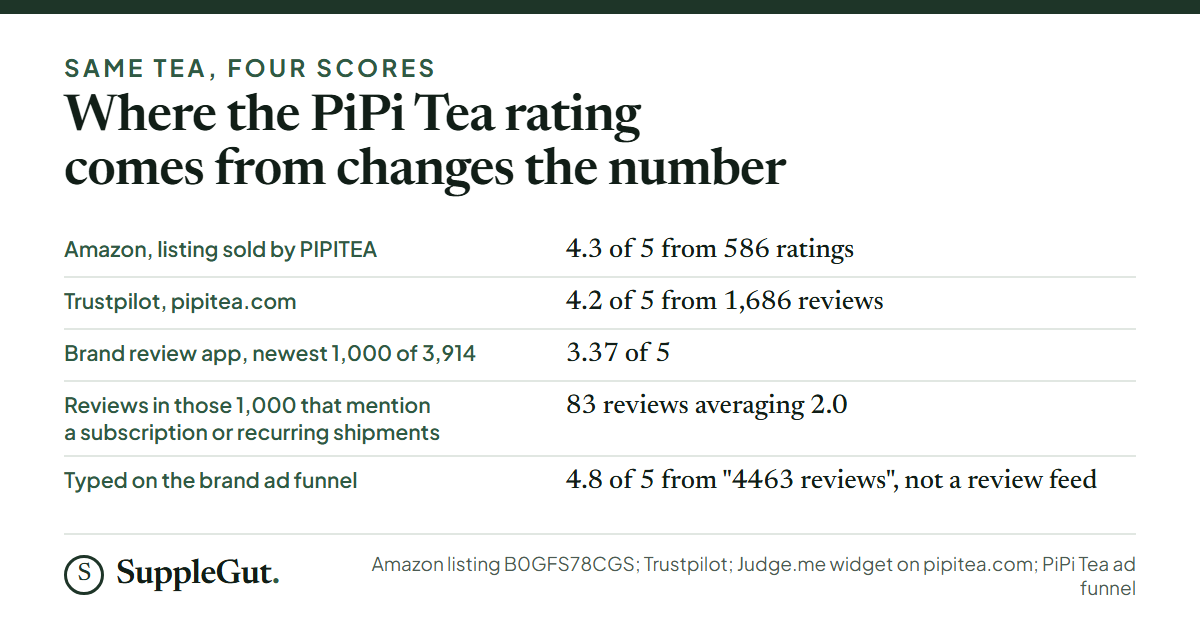
The same tea carries four different scores, depending on where the rating sits.
| Where | Rating | Count | Whose feed |
|---|---|---|---|
| Amazon, listing sold by PIPITEA | 4.3 of 5 | 586 ratings | Amazon, on the brand’s storefront |
| Trustpilot | 4.2 of 5 | 1,686 reviews | Independent site; the brand has claimed its profile |
| Judge.me on pipitea.com | 3.37 across the newest 1,000 | 3,914 reviews in total | The brand’s own review app |
| Brand ad funnel | 4.8 of 5 | “4463 reviews” | Typed text, not a review feed |
On Amazon the split is 72% five-star, 10% four, 7% three, 2% two and 9% one. Trustpilot shows 68% five-star and 17% one-star. In the newest 1,000 reviews on the brand’s app, 439 are five-star, 105 four, 117 three, 66 two and 273 one. Those 1,000 reviews are all marked as verified buyers.
Praise centers on taste and color: 392 of the 1,000 app reviews mention taste, flavor or delicious, and on Amazon 173 reviews mention taste, 137 of them positively. Others praise a caffeine-free cup that helps them wind down in the evening, and 34 of the 1,000 mention blood pressure. The complaints center on billing. Among the 1,000, 83 mention a subscription, automatic shipping or recurring shipments, and those 83 average 2.0 stars, with 48 giving one star. The words cancel (92 reviews), refund (43), non-delivery (18) and “deceptive” or similar (15) recur. On Amazon, value for money draws 24 mentions, 11 positive and 13 negative.
The brand’s review app returns only the newest 1,000 reviews, which cover about seven weeks, so the star split for the other roughly 2,900 could not be read. The count of 586 on Amazon is shared across the pack-size variants of the listing.
Price per cup, the three-for-two offer, renewals and the refund wording
| Route | Price | Cups | Per cup |
|---|---|---|---|
| pipitea.com, one pack | $34.95 | 30 | $1.17 |
| Amazon, one pack | $34.95 | 30 | $1.17 |
| Amazon, 2 packs | $49.95 | 60 if both packs hold 30 bags | about $0.83 |
| Amazon Subscribe & Save, 10% off | about $31.46 | 30 | about $1.05 |
| Ad funnel, three packs for the price of two | $59.97 as reported by reviewers | 90 | about $0.67 |
The funnel page shows no price in its text. Reviewers report $59.97 for three packs, $65 on a renewal, a $79.98 charge and a $25 charge to unsubscribe. The store page’s product record carries no subscription plan, so any subscription is set up in the funnel or at checkout. Banners advertise “up to 48% off” on the store page and “up to 70% off” with a $250 DoorDash gift card on the funnel.
The refund policy and the marketing lines read differently:
- Refund policy: a 90-day “Buyer Protection Period” for eligible order-related concerns, which it says does not guarantee a refund or specific resolution for every request. Customer-remorse returns need unopened, sealed product and may require the customer to pay return shipping. Opened or used tea is generally not eligible.
- Subscriptions: shipments every 30, 60 or 90 days, cancellable at any time before the next scheduled billing date. Cancelling does not cancel an order already processed or shipped. The terms say subscription fees are non-refundable except as the terms provide.
- Marketing lines: the panel banner says “90-Day Money Back Guarantee,” the funnel says to email within 90 days and “we’ll make it right,” and the store page says “we’ll refund you in full. No hassle. No questions asked.”
- Amazon: the listing is non-returnable for food-safety reasons, and damaged or defective items can be refunded through Your Orders.
Who runs it, and other sellers using the name
The terms of service say the site is operated by WYCENTAUER TEA LLC and print a contact address in Shenzhen, China (4th Floor, Building G, Ba Fang Zhi Gu, No. 10 Huanguan South Road). The funnel says orders ship “from our Texas warehouse,” and the store page says “from our Ohio warehouse.” The pouch graphic reads “EST 2009,” while the public registration record for pipitea.com shows the domain was registered in 2025. The brand’s store also lists a ceremonial matcha and a honey-scented oolong, each $34.95, and a $0.00 hibiscus “Creator Sample” listing.
On Amazon, the listing sold by PIPITEA ships from Amazon, and it is the source of the 4.3 from 586 used above. A search for the tea name shows at least seven other 30-bag hibiscus listings titled “Pipi” or “PiPi” from other sellers. One, under the brand name “PIPI TEA,” shows 399 ratings at $27.97, and others show between 40 and 67 ratings. The manufacturer line on the 2-pack variant of the main listing names a different company, SiMao District Shumaisi HuiTong Tea Company. Only the “Sold by PIPITEA” line identifies the brand’s own listing. We found no PiPi Tea listing at Walmart, Target or iHerb.
Who this tea is for
- Someone who wants a caffeine-free, one-ingredient tea with a printed amount of 2 g of hibiscus a bag and no sweetener or laxative herb.
- Someone drinking it for blood pressure, where the trials are, at the three-cup amount those trials used, who has told their clinician if they take blood pressure medicine.
- Someone buying a single pack and reading the subscription and refund wording at checkout, since both the brand’s store and Amazon list a one-time purchase.
For bloating or constipation specifically, no hibiscus trial exists. Teas whose herbs have been studied for gut symptoms are in the catalog: Traditional Medicinals ginger, Traditional Medicinals peppermint and It’s Health Tea GERD tea. The It’s Health Tea guide and the Happy Intestine tea guide set out their herbs and reviews in the same way, the bloating guide starts from the symptom, and the quiz matches products to goals.
Products researched for this topic
Common questions
Can hibiscus tea from PiPi Tea ease bloating or constipation?
No trial of this tea or of hibiscus for a gut symptom was found in PubMed or ClinicalTrials.gov. The brand’s pages sell it for blood pressure, with digestion and bloating mentioned in a results timeline. A few reviewers report easier regularity, and others report stomach ache, nausea or diarrhea.
What goes into each PiPi Tea bag?
One ingredient: organic hibiscus flower, 2,000 mg (2 g) per serving, 30 servings a pack. The panel, headed “Hibiscus Facts,” lists no sweetener, caffeine or laxative herb, and says free of soy, dairy, gluten, GMO and artificial additives. It gives no amounts for the anthocyanins or vitamin C it describes.
Does one bag a day match the amount used in the blood-pressure trials?
The closest trial used three 240 mL servings of brewed hibiscus tea a day for six weeks. The brand’s minimum is one cup a day, with up to three on the panel. It does not say whether a 2 g bag matches the hibiscus in the trial drinks.
What does a cup cost, and what is the three-for-two offer?
One 30-bag pack is $34.95 on the brand’s store and on Amazon, about $1.17 a cup. The ad funnel advertises three packs for the price of two, which reviewers report as $59.97, about $0.67 a cup, with renewals reported at $65.
How do cancellations and refunds work for PiPi Tea?
The refund policy lists a 90-day Buyer Protection Period that it says does not guarantee a refund for every request, and subscriptions can be cancelled before the next scheduled billing date. The store page says “we’ll refund you in full,” and the terms call subscription fees non-refundable except as stated. Amazon orders are non-returnable unless damaged or defective.
Should anyone on blood pressure medicine check before drinking it?
The brand’s FAQ says hibiscus can strengthen the effect of certain medications and advises checking with a healthcare provider if you take blood pressure medication. The brand also says the tea is safe in pregnancy, and gives no source for that statement.
Are all the Amazon listings called PiPi Tea from the same seller?
No. A search shows at least seven other 30-bag hibiscus listings titled “Pipi” or “PiPi” from other sellers. The 4.3 from 586 ratings belongs to the listing marked “Sold by PIPITEA.”
Why do the ratings differ from one site to another?
They come from different feeds: Amazon 4.3 (586 ratings), Trustpilot 4.2 (1,686), and the brand’s own review app 3.37 across its newest 1,000. In that app, 83 reviews mention subscriptions or recurring shipments and average 2.0 stars. The funnel’s 4.8 is typed text.
Sources
- McKay DL, Chen CYO, Saltzman E, Blumberg JB. “Hibiscus sabdariffa L. tea (tisane) lowers blood pressure in prehypertensive and mildly hypertensive adults.” Journal of Nutrition, 2010;140(2):298–303. PubMed 20018807
- Serban C, Sahebkar A, Ursoniu S, Andrica F, Banach M. “Effect of sour tea (Hibiscus sabdariffa L.) on arterial hypertension: a systematic review and meta-analysis of randomized controlled trials.” Journal of Hypertension, 2015;33(6):1119–1127. PubMed 25875025
- Najafpour Boushehri S, Karimbeiki R, Ghasempour S, et al. “The efficacy of sour tea (Hibiscus sabdariffa L.) on selected cardiovascular disease risk factors: a systematic review and meta-analysis of randomized clinical trials.” Phytotherapy Research, 2020;34(2):329–339. PubMed 31943427
- Abdelmonem M, Ebada MA, Diab S, et al. “Efficacy of Hibiscus sabdariffa on reducing blood pressure in patients with mild-to-moderate hypertension: a systematic review and meta-analysis of published randomized controlled trials.” Journal of Cardiovascular Pharmacology, 2022;79(1):e64–e74. PubMed 34694241
- Ellis LR, Zulfiqar S, Holmes M, Marshall L, Dye L, Boesch C. “A systematic review and meta-analysis of the effects of Hibiscus sabdariffa on blood pressure and cardiometabolic markers.” Nutrition Reviews, 2022;80(6):1723–1737. PubMed 34927694
- Norouzzadeh M, Hasan Rashedi M, Azizi MH, et al. “Efficacy and safety of Hibiscus sabdariffa in cardiometabolic health: an overview of reviews and updated dose-response meta-analysis.” Complementary Therapies in Medicine, 2025;89:103135. PubMed 39870328
- ClinicalTrials.gov, hibiscus with constipation, bloating, IBS or dyspepsia terms: one pregnancy pilot. NCT07175597
- PiPi Tea: product page, ad funnel, Hibiscus Facts panel image, refund policy and terms of service. pipitea.com
- Amazon listing for PiPi Tea Organic Hibiscus Tea Bags, sold by PIPITEA (ASIN B0GFS78CGS): price, ratings and review summary. amazon.com
- Trustpilot profile for pipitea.com: score and review count. trustpilot.com
Turn the reading into a shortlist of one
The evidence here is about categories. The quiz works at the level of one person and one product.
Take the quiz →