
Guide
Does Pure TheraPro Saccharomyces 10B work? A different S. boulardii strain from Florastor, and what has been tested
Quick answer
Does Pure TheraPro Saccharomyces 10B work? No trial of this product was found. Its strain, CNCM I-3799, has one placebo-controlled trial, in 100 children with acute diarrhea, where recovery took 65.8 hours against 95.3 on placebo; no adult trial of that strain alone exists, and a 2012 European review found it unproven that I-3799 is identical to Florastor’s I-745. As a species, S. boulardii cut antibiotic-associated diarrhea from 18.7% to 8.5% across 21 trials. Amazon shows 4.6 from 4,189 ratings.
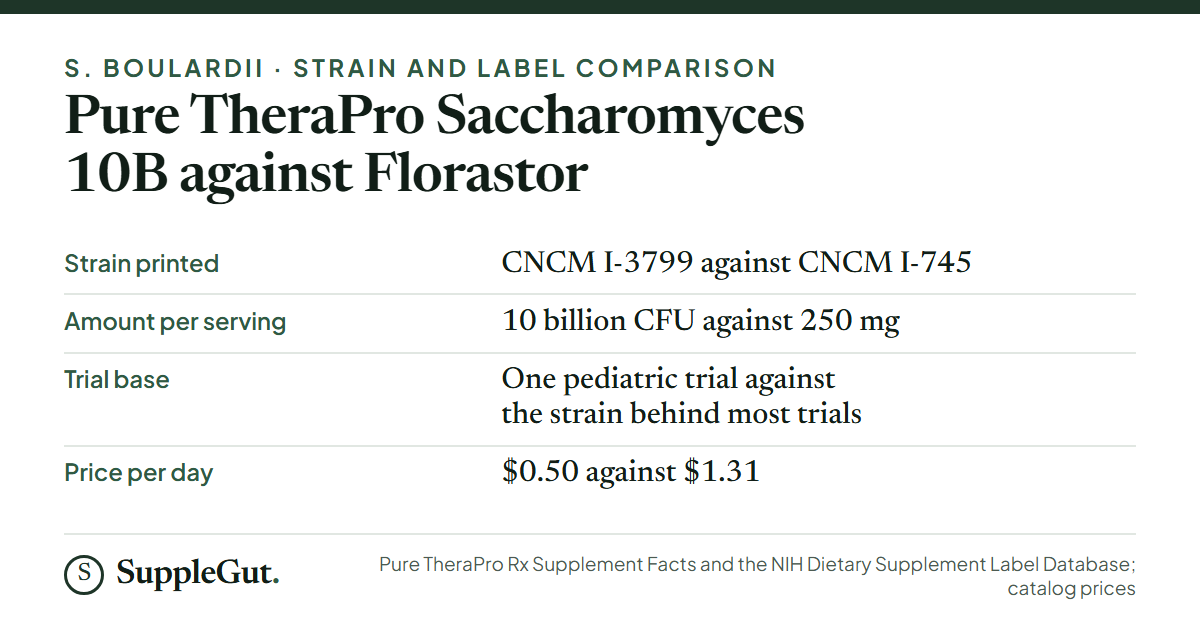
Pure TheraPro Rx Saccharomyces 10B is a capsule of one organism, the probiotic yeast Saccharomyces boulardii, sold mainly on Amazon. What sets it apart from the yeast most people know, Florastor, is the strain: the label prints CNCM I-3799 under the trademarked name Lynside, not the CNCM I-745 behind Florastor and behind most of the trials the yeast is known for. This page sets out what the label and the lot certificate show, what has and has not been tested in that strain, how the directions disagree with each other, and what the reviews report.
What Pure TheraPro Saccharomyces 10B is, and what it is not
The Supplement Facts panel lists a single active: Lynside Saccharomyces boulardii CNCM I-3799, 500 mg, stated as 10 billion CFU, for a serving of two capsules. The bottle holds 120 capsules, so the panel counts 60 servings. The only other ingredient is the hypromellose capsule. There is no filler, no magnesium stearate and no prebiotic, which separates it from NOW’s capsule (inulin and guar gum), from Jarrow’s (a prebiotic added) and from Florastor’s, which the NIH label database shows with lactose and magnesium stearate. The panel does not say whether 10 billion CFU is the count at manufacture or at expiry. The brand’s footnote says full potency is guaranteed until the expiration date when stored properly.
It is a dietary supplement, not a drug: the panel is a Supplement Facts panel, and the label carries the standard statement that the claims have not been evaluated by the FDA. The label also prints a free-from line that lists “yeast” among the exclusions, although the active ingredient is a yeast; the line is reproduced here as printed on the brand page and the 2024 label.
The strain: I-3799 is not Florastor’s strain
Florastor’s label prints S. boulardii CNCM I-745 at 250 mg per capsule and no CFU figure. Pure TheraPro prints CNCM I-3799 at 10 billion CFU. They are the same species, but the research record does not treat the two strains as interchangeable. In 2012 the European Food Safety Authority assessed a health claim from the maker of I-3799 about reducing gastrointestinal discomfort in adults. It noted that none of the human studies supplied used I-3799; the applicant said they used Biocodex’s strain (the Florastor lineage) and that the two were equivalent by PCR. EFSA found the evidence insufficient to show that the strains are identical and concluded that a cause and effect relationship could not be established for I-3799 (EFSA NDA Panel, EFSA Journal, 2012).
A second detail concerns the label itself. An earlier version of this product’s label, filed in the NIH Dietary Supplement Label Database, printed a different strain code (DBVPG 6763, sold as Biootic). The current label prints I-3799. We could find no statement from the brand on whether the two codes describe the same supply, and neither the brand page nor the Amazon listing mentions the change.
The trial of the product, and the trial of the strain
We found no trial of this product, on PubMed or in the ClinicalTrials.gov registry. For the strain, there is one placebo-controlled trial of I-3799 given alone, and it was in children. In a multicenter double-blind trial of 100 infants and children aged 3 to 36 months with acute diarrhea, those given I-3799 at 5 billion CFU twice a day for five days (10 billion a day, the same as one serving of this label) recovered in 65.8 hours against 95.3 hours on placebo, with the first semisolid stool arriving 23.5 hours earlier, on top of standard rehydration care (Mourey et al., Pediatric Infectious Disease Journal, 2020). That is a real difference in a defined group: young children with infectious diarrhea. It is not an adult trial and not a trial of everyday gut symptoms.
A second pediatric trial gave I-3799 together with a spore-forming bacterium, Bacillus subtilis CU-1, to 180 children aged 6 months to 5 years with acute watery diarrhea. Diarrhea lasted 54.16 hours against 59.48 on placebo, and stool frequency did not differ (Ghosh et al., Pediatric Gastroenterology, Hepatology & Nutrition, 2021). Because it is a two-organism product, it says little about I-3799 alone. We found no adult placebo-controlled trial of I-3799 alone.
The class-level evidence
Most of what is said about S. boulardii comes from the species as a whole, and mostly from the Florastor strain. A meta-analysis of 21 randomized trials in 4,780 people found antibiotic-associated diarrhea in 18.7% of controls against 8.5% of people taking the yeast, a number needed to treat of 10. Split by age, the rates were 20.9% to 8.8% in children and 17.4% to 8.2% in adults. C. difficile-associated diarrhea was lower in children (relative risk 0.25) but not significantly in adults (0.8); the abstract does not list the strain used in each trial (Szajewska and Kołodziej, Alimentary Pharmacology & Therapeutics, 2015). An earlier review of 27 trials in 5,029 patients reached a similar conclusion for antibiotic-associated and traveler’s diarrhea in adults and called the evidence for IBS and C. difficile recurrence promising but needing more trials (McFarland, World Journal of Gastroenterology, 2010). In 269 children given 250 mg twice a day with antibiotics, diarrhea occurred in 8% against 23% (Kotowska et al., Alimentary Pharmacology & Therapeutics, 2005).
Not every trial was positive. In 275 hospitalized adults with a mean age of about 79, antibiotic-associated diarrhea occurred in 15.1% of those given S. boulardii and 13.3% on placebo, and the authors concluded it was not effective in preventing it in that group (Pozzoni et al., American Journal of Gastroenterology, 2012). The class-level numbers are the case for the species; whether they carry over to I-3799 is the open question EFSA raised.
Set side by side, the four S. boulardii products in this catalog read as follows.
| Product | Strain printed | Amount printed | Trial base | Price per day |
|---|---|---|---|---|
| Pure TheraPro Rx Saccharomyces 10B | CNCM I-3799 | 10 billion CFU per 2 capsules | One pediatric trial of the strain | $0.50 |
| Florastor | CNCM I-745 | 250 mg per capsule, no CFU | Strain behind most of the cited trials | $1.31 |
| NOW Foods | I-3799 as printed | 5 billion CFU per capsule | Same strain as Pure TheraPro | $0.45 |
| Jarrow | Not named | 5 billion viable cells per capsule | Species level | $0.28 to $0.32 |
For the longer treatment of the Florastor strain and its alternatives, see the generic Florastor guide.
How to take it
The sources disagree on the daily amount. The panel’s serving is two capsules, which is 10 billion CFU. The brand page and the Amazon text say two capsules one to two times daily, which is 10 to 20 billion CFU a day. The 2024 label in the NIH database says one or two capsules a day, and an earlier label said one to two. All of them allow it with or without food. Amazon’s title also says 30 servings for the 120-capsule bottle, while the panel counts 60. A buyer is choosing between three printed versions of the dose, and the daily cost moves with the choice (see below).
The brand adds that the capsules may be opened and mixed into water, juice or applesauce and taken immediately, not heated, and that someone who reacts can drop to a quarter of a capsule and build up. The trials that gave the yeast alongside antibiotics ran for the length of the course; the pediatric diarrhea trial ran five days. We found no trial that tested it for chronic symptoms at this dose.
Side effects and who should not take it
The label advises people taking medication, children and women who are pregnant or nursing to consult a healthcare practitioner before use. It says not to use the product with severe immune suppression, and to take it at least two hours before or after any antifungal medicine, because an antifungal can act on a yeast. The brand page also describes it as suitable for children over one year, which sits beside the label line that children should check with a practitioner first. For general probiotic effects, see the probiotic side effects guide.
In the reviews, side effects are the most mixed topic. Amazon’s summary of review text counts 57 mentions of side effects, 23 positive and 34 negative, the negative ones naming stomach pain, bloating, nausea and heartburn. One reviewer reports itching, dizziness and weakness after the second capsule and returned the bottle.
What the testing certificate shows
The brand links a certificate of analysis on the Amazon listing and on its own page. The one we read covers lot 23269, made in 2024 with an expiry about three years and eight months later. It reports yeast and mold under 10 cfu/g, with Staphylococcus aureus, Salmonella and E. coli negative in 10 g, and arsenic, cadmium, lead and mercury under their stated limits. The CFU row lists 36 billion per serving against a specification of 10 billion, but the method column reads “Confirmed by Manufacturing Process”, which is not a plate count in that table. The certificate carries a “3rd party certified” seal, is signed by a QC manager and does not name an outside laboratory. We found no NSF, USP or Informed Choice mark for the product.
What the reviews say
The Amazon listing shows 4.6 out of 5 from 4,189 ratings, 82% of them five-star and 4% one or two stars. The brand’s own page shows 4.8 from 173 reviews; that page is hosted by the brand. We found no Trustpilot profile or Better Business Bureau listing for it, so there is no independent complaint record beyond Amazon. Praise clusters in three places: use during or after antibiotics and after C. difficile, a price roughly half of Florastor’s, and a one-ingredient capsule that is easy to swallow. The complaints are the side effects above and a smaller group saying it did nothing (44 of 282 effectiveness mentions are negative). Several reviewers drop capsules into juice to see whether it ferments as a test of viability; that is not a label or laboratory test, and the label does not support it.
Prices, subscriptions and refunds
The 120-capsule bottle is $29.97 on Amazon, which is $0.50 a day at the panel’s one serving, or $0.45 with Subscribe & Save. The brand site charges $28.97 ($0.48 a day) or $24.62 with a 15% subscription ($0.41). The 60-capsule bottle is $18.97 ($0.63 a day) and the 240-capsule bottle $44.97 ($0.37). At the two-capsules-twice-daily direction on the brand page and Amazon text, every figure doubles, and the Amazon price becomes $1.00 a day. Florastor is $1.31 a day in this catalog.
The brand states that a subscription can be modified or canceled at any time. On refunds its own pages differ: the product page shows a “90 Day Return Guarantee”, while the policy page and footer say 60 days. The policy text reads that opened supplements qualify only for store credit, that refunds apply to a first purchase of an unopened bottle with prior approval and carry a 25% restocking fee, that it allows one supplement per customer per household, and that buying several units may disqualify a refund. Purchases on Amazon follow Amazon’s rules, where the item is listed as non-returnable unless damaged or defective. In the reviews we read, which is a small sample, none reported unexpected charges or a refused refund.
Who this product is for
- Someone who wants a one-ingredient yeast capsule with the strain code printed and nothing in it beyond the capsule shell.
- Someone comparing routes on price: one panel serving a day costs about 38% of Florastor’s catalog price on Amazon.
- Someone who accepts the strain question: adult trial evidence comes mostly from another strain, and the trial of this one was in children.
If the aim is the strain with the longest trial record, that is Florastor; the Culturelle vs Florastor comparison covers how a yeast differs from a bacterial probiotic. For choosing between a yeast and a bacterial product, the which probiotic guide and the quiz start from the symptom. The CFU guide explains what a count on a label does and does not predict.
The products in this catalog
Common questions
Does Pure TheraPro Saccharomyces 10B work?
No trial of this product was found. Its strain, CNCM I-3799, was tested in one trial of 100 children with acute diarrhea, where recovery took 65.8 hours against 95.3 on placebo, and no adult trial of that strain alone was found. Across 21 trials in 4,780 people, S. boulardii as a species cut antibiotic-associated diarrhea from 18.7% to 8.5%, but most of that evidence is not tied to this strain.
Is Pure TheraPro Saccharomyces the same as Florastor?
Same species, different strain. Florastor prints CNCM I-745 and Pure TheraPro prints CNCM I-3799. A 2012 European Food Safety Authority assessment found the evidence insufficient to show the two are identical, so trials run on Florastor’s strain cannot be assumed to apply here.
How much Pure TheraPro Saccharomyces should be taken in a day?
The printed directions disagree. The panel’s serving is two capsules (10 billion CFU), the brand page and Amazon text say two capsules one to two times daily, and the 2024 label in the NIH database says one or two capsules a day. The pediatric trial used 10 billion CFU a day, the same as one panel serving.
What are the side effects and who should avoid it?
The label says not to use it with severe immune suppression, to take it at least two hours apart from antifungal medicines, and to consult a practitioner if taking medication, pregnant, nursing or giving it to a child. On Amazon, 34 of 57 side-effect mentions are negative, naming stomach pain, bloating, nausea and heartburn.
How much does it cost compared with Florastor?
The 120-capsule bottle is $29.97 on Amazon, or $0.50 a day at one serving, and $0.45 with Subscribe & Save. The brand site charges $28.97 ($0.48 a day) or $24.62 on a subscription. Florastor is $1.31 a day in this catalog. At the two-servings-a-day direction the Pure TheraPro figures double.
Is Pure TheraPro Saccharomyces third-party tested?
The brand links a certificate of analysis for lot 23269 showing negative microbial tests and heavy metals under their limits. The CFU line on it is marked as confirmed by the manufacturing process rather than counted, and no outside laboratory is named. We found no NSF, USP or Informed Choice mark.
What is the refund policy?
The brand’s product page says 90 days and its policy page says 60. Opened bottles qualify for store credit only, and a refund on an unopened first purchase carries a 25% restocking fee. On Amazon the item is non-returnable unless damaged or defective.
Sources
- Mourey F, Sureja V, Kheni D, et al. "A Multicenter, Randomized, Double-blind, Placebo-controlled Trial of Saccharomyces boulardii in Infants and Children With Acute Diarrhea." Pediatric Infectious Disease Journal, 2020;39(11):e347–e351. PubMed 32796401
- Ghosh A, Sundaram B, Bhattacharya P, et al. "Effect of Saccharomyces boulardii CNCM-I 3799 and Bacillus subtilis CU-1 on Acute Watery Diarrhea: A Randomized Double-Blind Placebo-Controlled Study in Indian Children." Pediatric Gastroenterology, Hepatology & Nutrition, 2021;24(5):423–431. PubMed 34557395
- EFSA Panel on Dietetic Products, Nutrition and Allergies. "Scientific Opinion on the substantiation of a health claim related to Saccharomyces cerevisiae var. boulardii CNCM I-3799 and reducing gastro-intestinal discomfort." EFSA Journal, 2012;10(7):2801. doi.org/10.2903/j.efsa.2012.2801
- Szajewska H, Kołodziej M. "Systematic review with meta-analysis: Saccharomyces boulardii in the prevention of antibiotic-associated diarrhoea." Alimentary Pharmacology & Therapeutics, 2015;42(7):793–801. doi.org/10.1111/apt.13344
- McFarland LV. "Systematic review and meta-analysis of Saccharomyces boulardii in adult patients." World Journal of Gastroenterology, 2010;16(18):2202–2222. doi.org/10.3748/wjg.v16.i18.2202
- Kotowska M, Albrecht P, Szajewska H. "Saccharomyces boulardii in the prevention of antibiotic-associated diarrhoea in children: a randomized double-blind placebo-controlled trial." Alimentary Pharmacology & Therapeutics, 2005;21(5):583–590. doi.org/10.1111/j.1365-2036.2005.02356.x
- Pozzoni P, Riva A, Bellatorre AG, et al. "Saccharomyces boulardii for the prevention of antibiotic-associated diarrhea in adult hospitalized patients: a single-center, randomized, double-blind, placebo-controlled trial." American Journal of Gastroenterology, 2012;107(6):922–931. doi.org/10.1038/ajg.2012.56
- NIH Dietary Supplement Label Database: Saccharomyces 10B, current and earlier label versions, and the Florastor label. dsld.od.nih.gov/label/305966
- Pure TheraPro Rx: product page, certificate of analysis, directions, warnings, prices and return policy. purethera.com
- Amazon listing for Pure Therapro Rx Saccharomyces 10B (ASIN B00JK30A1M): label image, price, ratings and review summary. amazon.com
Not sure which product fits your situation?
This guide covers the mechanics. The quiz takes your specific symptoms, routine and preferences and matches you to one product from the catalog.
Take the quiz →