Guide
Does Republic of Tea Get Relief work? One 1,275 mg blend of five herbs, anise at the center of the research, and no trial of the bag
Quick answer
Does Republic of Tea Get Relief work? No trial of this tea was found. Anise carries the research among its five herbs: 3 g of powder after each meal helped 107 people with dyspepsia, and oil capsules helped 120 people with IBS, but 50 g a day of aniseed did not change bloating in 225 people. A bag holds 1,275 mg of all five herbs together, with no per-herb amounts printed. Amazon shows 4.7 from 153 ratings, and the brand’s own page shows 4.88 from 134 reviews.
Get Relief (No. 9) is a caffeine-free tea from The Republic of Tea’s Be Well line: 36 bags of rooibos with cinnamon, anise, peppermint and stevia, sold for “gas and bloating.” It is a tea, which is a food, and the tin also carries a Supplement Facts panel and the words “Herbal Supplement.” The panel lists one number for all five herbs, so this page sets that number beside the trials on each herb, then covers steeping, the pregnancy line, the reviews and the cost of a cup.
What one bag holds: five herbs in a 1,275 mg blend
The tin’s Supplement Facts panel names a serving as one tea bag (1.3 g) and prints this:
| Line on the panel | Per tea bag |
|---|---|
| Proprietary blend | 1.3 g (1,275 mg) |
| Organic rooibos (leaf), cinnamon (bark), anise (seed), peppermint (leaf), stevia (leaf) | No separate amounts |
| Other ingredients | Natural cinnamon flavor |
A tin of 36 bags weighs 46.8 g, which is 1.3 g a bag, so the flavor takes up about 25 mg. That is our arithmetic, not a printed figure. The herbs run from rooibos to stevia in the list, but the brand does not say the order follows weight, so how much anise or peppermint sits in a cup is not something the panel answers. Only the rooibos is marked organic, and the tea is not stated to be organic as a whole.
The brand’s own copy credits the cinnamon with getting “digestive juices going,” the peppermint with soothing and the anise with sending gas on its way, each with an FDA asterisk and the standard disclaimer. The brand’s tags include gluten free, kosher and “Sugar Free,” and there is no contains line or facility statement for milk, wheat, egg, soy, tree nuts, fish or sesame. Amazon’s “allergen-free” field has no matching text on the tin.
No trial of the bag, and anise as the herb with the most human work
A PubMed search on the brand name, and on the five herbs together as a tea, returned no trial of Get Relief. The five herbs have uneven records. Anise has three human gut trials, none of them of tea. Peppermint has trials of oil. Cinnamon has one trial, of oil capsules, with a null result. Rooibos has no human gut trial.
Anise: three trials, three results, three formats
The dyspepsia trial is the strongest result for any herb in this blend. In 107 patients with postprandial-distress functional dyspepsia, 3 g of anise powder after each meal, three times a day, was compared with corn starch for four weeks. The severity score was 2.44 against 13.05 at week 4 and 1.08 against 13.30 at week 12, P = 0.0001 at week 4, with no conflict of interest declared (Ghoshegir et al., Journal of Research in Medical Sciences, 2015). A 2023 Cochrane review of non-Chinese herbal medicines for functional dyspepsia lists this as a single study of 107 participants, with an effect of −2.30 (95% CI −2.79 to −1.80) and low certainty (Báez et al., Cochrane Database of Systematic Reviews, 2023).
The IBS trial gave 120 patients enteric-coated capsules of anise oil, three a day, against placebo and against a peppermint oil product for four weeks. Symptom-free rates were 75% on anise oil, 35% on placebo and 52.5% on the peppermint oil, with a number needed to treat of 4 (Mosaffa-Jahromi et al., Journal of Ethnopharmacology, 2016). The capsules are built to carry oil past the stomach, which a steeped bag does not do.
The bloating result points the other way. In 225 adults with gut symptoms from COVID-19, 25 g of aniseed powder twice a day for two weeks improved abdominal pain, appetite and diarrhea, but bloating did not change (relative risk 0.87, 95% CI 0.72 to 1.05), and nausea did not either (Mosaffa-Jahromi et al., Frontiers in Pharmacology, 2024). Bloating is the symptom on the front of the tin.
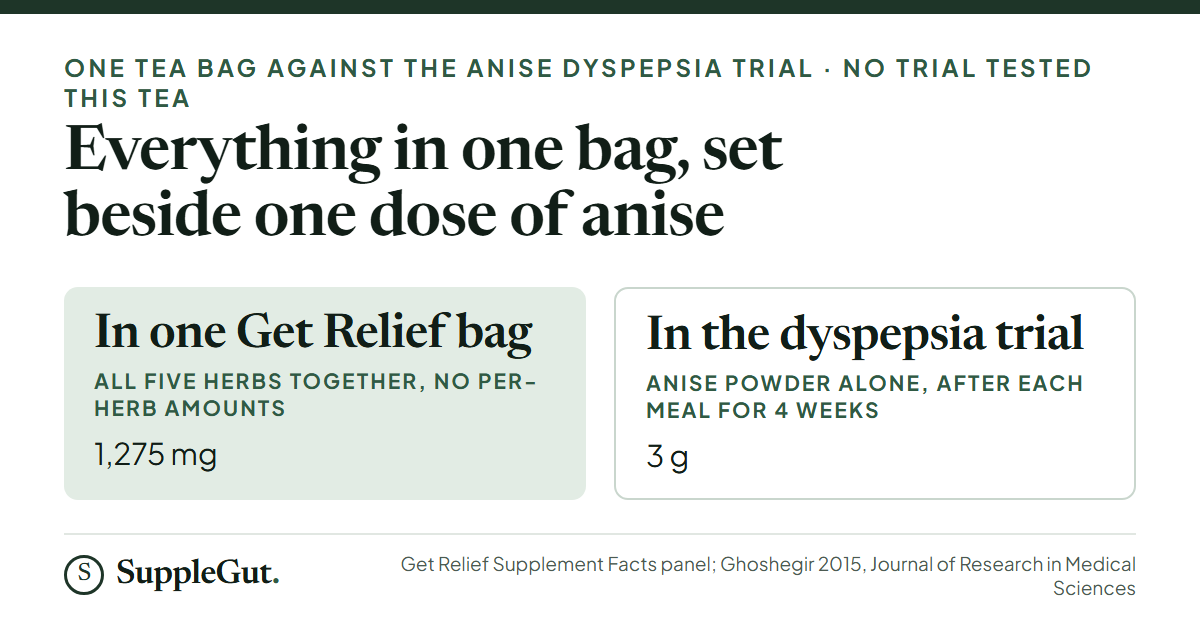
The doses are the gap. Three grams of anise at a meal is about 2.4 times the 1,275 mg in the whole bag, and the dyspepsia trial gave 9 g a day, about seven bags’ weight of herbs. The COVID trial’s 50 g a day is roughly 39 times a bag. No trial used an amount as small as one bag, and none tested a tea.
Cinnamon, peppermint, rooibos and stevia
Cinnamon. The one trial we could find gave standardized cinnamon oil soft capsules or sesame oil to 64 people with functional dyspepsia for six weeks. Both groups improved from baseline, with no significant difference between them (Zobeiri et al., Evidence-Based Complementary and Alternative Medicine, 2021). No trial of cinnamon bark tea for a gut symptom turned up.
Peppermint. A 2006 review found trials of peppermint tea absent (McKay and Blumberg, Phytotherapy Research, 2006). The IBS evidence is for oil: 10 trials in 1,030 patients, with a number needed to treat of 4 for global symptoms and 7 for abdominal pain, and very low quality evidence (Ingrosso et al., Alimentary Pharmacology & Therapeutics, 2022). The peppermint tea guide goes through them.
Rooibos. We found no human gut trial. A 2024 laboratory review of green rooibos in two zebrafish gut-inflammation models notes sparse scientific evidence for the traditional gut claim (Pretorius and Smith, Journal of Ethnopharmacology, 2024).
Steeping a cup
The brand’s directions: bring fresh water to a rolling boil, pour 6 oz over one bag and steep 5 to 7 minutes. Amazon’s listing adds that iced tea uses double the tea. The brand gives no daily amount and no timing. Its copy compares the cup to an after-dinner mint, and reviewers describe drinking it after a meal or after overindulging.
The pregnancy line and what reviewers report
The brand’s page and Amazon’s safety field say not to use the tea during pregnancy or lactation without the advice of a healthcare practitioner. The tin says to consult a physician if pregnant or nursing. No medication line or medical-condition line is printed.
Across the reviews we read, we found no pattern of side effects; the complaints concern taste.
Ratings: 4.7 on Amazon, 4.88 on the brand’s page
Amazon shows 4.7 out of 5 from 153 ratings on the 36-bag tin, with 84% five-star, 8% four, 6% three, 1% two and 1% one, and the listing is sold by The Republic of Tea. Amazon’s summary of review text counts 20 mentions of digestive effects (17 positive, 3 negative), 17 of taste (all positive) and 8 of flavor (all positive).
The brand’s own page runs a review app that shows 4.88 from 134 reviews (125 five-star, 6 four, 2 two and 1 one), gathered over about 15 years. Those 134 reviews are the brand’s own, and none is syndicated from elsewhere, so they are a different record from Amazon’s 153 independent ratings. The Amazon “see all reviews” page needs sign-in, so only the summary and featured snippets were read.
- Praise: calming bloating after a heavy meal (one reviewer says the bloat went away after the first cup), a good after-dinner cup, and a cinnamon, mint and anise flavor with no caffeine that needs no sugar.
- Complaints: stevia or a sweetened taste, an anise-forward cup with a milder peppermint than hoped, and a few buyers unsure it does anything for digestion.
A cup by route
| Where | Price | Bags | Per cup |
|---|---|---|---|
| Amazon, tin | $15.00 | 36 | $0.42 |
| Brand site, tin | $13.75 | 36 | $0.38 |
| Brand site, refill bag | $13.25 | 36 | $0.37 |
| Brand site, bulk bag | $83.75 | 250 | $0.34 |
The brand’s site lists free shipping on orders over $59 in the contiguous United States and a “Sip by Sip Auto Ship” program with free shipping, though we could not read its discount or cancellation terms. Its returns page pledges “complete satisfaction, guaranteed” and accepts returns within 30 days of delivery with a return authorization number, with return shipping paid by the buyer, and refunds or exchanges go to the original payment method. On Amazon the tin carries a food-safety note in place of a return window. None of the reviews or Trustpilot posts we read raised a billing or refund problem.
Get Relief beside Get It Going, Gas Relief and plain peppermint
The brand’s Get It Going (No. 2) lists senna, a stimulant laxative, and is a different tea for a different purpose. Get Relief has no senna. Among other teas in the catalog, the Traditional Medicinals Gas Relief tea prints 300 mg of each of five herbs (caraway, coriander, chamomile, lemon balm and peppermint) at $0.44 a cup and 4.5 from 1,766 ratings on Amazon. The Traditional Medicinals peppermint tea holds one herb at 1,500 mg a bag and shows 4.7 from 3,922 ratings.
| Get Relief | TM Gas Relief | TM peppermint | |
|---|---|---|---|
| Herbs | Five, plus stevia in the blend | Five | One |
| Printed per bag | 1,275 mg for all five | 300 mg of each herb | 1,500 mg |
| Amazon rating | 4.7 from 153 | 4.5 from 1,766 | 4.7 from 3,922 |
A per-herb figure is what lets a trial dose be set beside a bag, and Get Relief does not print one. No trial compares any of these teas. The fennel tea guide and the bloating and gas guide cover the wider evidence.
Who this blend suits
- Someone who wants a sweet, spiced cup after dinner and likes cinnamon, anise and mint together.
- Someone who wants a caffeine-free tea with no stimulant laxative in it.
- Someone comfortable with stevia in the blend and with a single combined figure in place of per-herb amounts.
A reader who prefers a tea with a stated amount for each herb can look at the teas above, and the quiz starts from symptoms and goals.
The products in this catalog
Common questions
Is there any evidence that Get Relief tea eases gas and bloating?
No trial of this tea turned up in PubMed. The research on its herbs used powders, oils and capsules at doses many times larger than one bag, and the one trial that measured bloating after aniseed found no change. On Amazon’s review summary, 17 of 20 mentions of digestive effects are positive.
What exactly is in one tea bag?
One proprietary blend of 1.3 g (1,275 mg) holds organic rooibos leaf, cinnamon bark, anise seed, peppermint leaf and stevia leaf, with natural cinnamon flavor listed separately. The panel prints no amount for any single herb. Only the rooibos is marked organic.
Does it contain senna or caffeine?
It holds neither. Rooibos is naturally caffeine free, and the list has no senna, cascara, aloe latex or other stimulant laxative. The brand’s Get It Going tea is a separate product that lists senna.
Is Get Relief tea sweetened?
Stevia leaf is the last herb in the blend, and the brand tags the tea “Sugar Free.” A few reviewers on the brand’s page say it tastes sweeter than they wanted, while Amazon’s summary counts 8 of 8 mentions of flavor as positive.
Is Get Relief tea safe in pregnancy?
The brand’s page says not to use it during pregnancy or lactation without a practitioner’s advice, and the tin asks pregnant or nursing women to consult a physician. No medication or condition warning is printed. The reviews read show no pattern of side effects.
How long do you steep it, and can it be iced?
The brand says to pour 6 oz of boiling water over one bag and steep 5 to 7 minutes. For iced tea, Amazon’s listing says to double the tea. Reviewers describe an after-dinner cup, and some drink it iced.
What does a cup cost?
$0.42 a cup on Amazon ($15.00 for 36 bags), $0.38 for the tin on the brand’s site ($13.75) and $0.37 for the refill bag ($13.25). The brand’s 250-bag bag is $83.75, about $0.34 a cup.
Sources
- Ghoshegir SA, et al. “Pimpinella anisum in the treatment of functional dyspepsia: a double-blind, randomized clinical trial.” Journal of Research in Medical Sciences, 2015;20(1):13–21. PubMed 25767516
- Mosaffa-Jahromi M, et al. “Efficacy and safety of enteric coated capsules of anise oil to treat irritable bowel syndrome.” Journal of Ethnopharmacology, 2016;194:937–946. PubMed 27815079
- Mosaffa-Jahromi M, et al. “Efficacy and safety of aniseed powder for treating gastrointestinal symptoms of COVID-19: a randomized, placebo-controlled trial.” Frontiers in Pharmacology, 2024;15:1331177. PubMed 38292939
- Zobeiri M, et al. “Evaluation of the effectiveness of cinnamon oil soft capsule in patients with functional dyspepsia: a randomized double-blind placebo-controlled clinical trial.” Evidence-Based Complementary and Alternative Medicine, 2021;2021:6634115. PubMed 34093719
- Báez G, et al. “Non-Chinese herbal medicines for functional dyspepsia.” Cochrane Database of Systematic Reviews, 2023;6:CD013323. PubMed 37323050
- McKay DL, Blumberg JB. “A review of the bioactivity and potential health benefits of peppermint tea (Mentha piperita L.).” Phytotherapy Research, 2006;20(8):619–633. PubMed 16767798
- Ingrosso MR, Ianiro G, Nee J, et al. “Systematic review and meta-analysis: efficacy of peppermint oil in irritable bowel syndrome.” Alimentary Pharmacology & Therapeutics, 2022;56(6):932–941. PubMed 35942669
- Pretorius L, Smith C. “Green rooibos (Aspalathus linearis) promotes gut health: insight into mechanisms.” Journal of Ethnopharmacology, 2024;319(Pt 3):117379. PubMed 37923252
- The Republic of Tea Get Relief: product page, Supplement Facts panel image, safety testing page and returns page. republicoftea.com
- Amazon listing for The Republic of Tea Be Well Get Relief No. 9 (ASIN B001B2SRF6), with ingredients, safety information, price, ratings and review summary. amazon.com
Which product is right for you?
This page explains how the products work. The quiz does the matching: it takes your symptoms, routine and preferences and names one product.
Take the quiz →