
Guide
Does Sandhu Herbals Magnesium Complex work for constipation? Six forms, one 500 mg figure, and the oxide trials
Quick answer
Does Sandhu Herbals Magnesium Complex work for constipation? No trial of this product exists. Its panel lists 500 mg of magnesium from six forms with no per-form amounts, which is 1.43 times the NIH 350 mg limit for supplemental magnesium. Only magnesium oxide has constipation trials: 1.5 g a day, about 905 mg of magnesium, beat placebo in two Japanese trials (70.6% against 25.0%; 68.3% against 11.7%), and this label is about 55% of that magnesium with the oxide share unprinted. No citrate or glycinate constipation trial turned up. Amazon shows 4.6 from 962 ratings, mostly about sleep and cramps.
Sandhu Herbals Magnesium Complex is a two-capsule-a-day magnesium and zinc supplement from Sun Botanicals in Livermore, California, sold on Amazon for sleep, muscle recovery and relaxation and advertised on Facebook and Instagram for constipation. What sets it apart from the magnesium sold next to it is a panel that adds six forms of magnesium into one number, 500 mg, and does not say how much of each is in the capsule. This page sets out what the label prints, what that arithmetic implies, what the constipation trials tested, and what the reviews say.
What Sandhu Herbals Magnesium Complex is, and what it is not
The Supplement Facts panel lists, per serving of two capsules, 500 mg of magnesium (119% of the daily value) “as magnesium bisglycinate, oxide, aspartate, citrate, lysinate glycinate, malate”, and 10 mg of zinc (91%) as zinc monomethionine chelate. The other ingredients are the vegetable-cellulose capsule, microcrystalline cellulose and magnesium stearate. The bottle front reads “500 mg elemental magnesium” and lists the forms in a different order from the panel, with glycinate first and oxide fifth. The panel does not call this a proprietary blend, but no amount is printed for any single form. The brand page’s own description names a slightly different list, with no oxide in it, while the panel and the ads both include oxide.
It is a dietary supplement with a Supplement Facts panel, not a laxative with a Drug Facts panel. It is also not the magnesium sold on sandhus.com: that site’s “Magnesium Complex” is a separate 90-capsule product described as magnesium citrate and magnesium oxide, from a similarly named company, Sandhu Products. No document we read says the two companies are one; the Sandhu’s Fiber+ guide covers a product from that site.
What the 500 mg implies about the oxide
The panel states elemental magnesium, the mineral itself, and the 119% matches that: 500 mg against the 420 mg daily value. Each form carries a different share of its weight as magnesium. By molecular weight the share is about 60.3% in magnesium oxide, 16.2% in anhydrous magnesium citrate, 15.5% in malate, 14.1% in bisglycinate and 8.4% in aspartate. Suppose all 500 mg came from the non-oxide forms, at the highest of those figures, 16.2%. The serving would then need at least 3.1 g of magnesium compound (500 divided by 0.162), and two capsules are unlikely to hold that: a typical capsule holds under about 1 g.
That is our inference from the arithmetic, not a statement on the label. It points to a large share of the 500 mg being magnesium oxide, the form with the constipation trials, even though the front of the bottle leads with glycinate. The label does not let a buyer check it.
The trial of the product itself
There is none. We searched PubMed and ClinicalTrials.gov for the product and found no record, and no ingredient on the panel is a branded one with its own studies. The benefit lines on the bottle and the Amazon listing, such as “supports restful sleep”, are brand claims rather than results. The constipation claim appears only in the brand’s social ads, which say “Noticeably Easier in 4 Weeks” in one version and a 72-hour result in another. Neither the label nor the Amazon listing makes a constipation claim, and the Amazon page text does not use the word.
The evidence: only oxide has constipation trials
Two placebo-controlled trials in Japan tested magnesium oxide at 1.5 g a day for 28 days, given as 0.5 g three times a day. In the first, 34 women with mild to moderate chronic constipation took oxide or placebo; overall improvement was reported by 70.6% on oxide against 25.0% on placebo (P = 0.015), with more spontaneous bowel movements, softer stool form and a shorter colonic transit time. The rate of complete spontaneous bowel movements did not differ significantly (Mori et al., 2019). In the second, 90 adults, 93% of them women, were split between senna 1.0 g, oxide 1.5 g and placebo; overall improvement was 68.3% on oxide, 69.2% on senna and 11.7% on placebo (P < 0.0001) (Morishita et al., 2021).
A 2023 pooled analysis of eight trials of food, vitamin and mineral supplements in 787 adults counted those two as its magnesium oxide trials and found 68% responding against 19% on control (relative risk 3.32, 95% CI 1.59 to 6.92) (van der Schoot et al., 2023). The 2023 American Gastroenterological Association and American College of Gastroenterology guideline gives a conditional recommendation to magnesium oxide, among other treatments (Chang et al., 2023).
For the other five forms, we searched PubMed for placebo-controlled trials of magnesium citrate and of magnesium glycinate in constipation and found none; the results were bowel-preparation and unrelated studies. That is “none found”, not “none exist”. NIH notes that aspartate, citrate, lactate and chloride forms tend to be absorbed better than oxide. The glycinate and bisglycinate forms are marketed for absorption and gentleness. Magnesium that stays in the gut is what holds water there, so none of this is evidence about a laxative effect. Zinc has no constipation trial cited here.
The trials tested plain oxide at about 905 mg of magnesium, in three doses, for 28 days. This label has 500 mg of magnesium from six forms in one dose, and the oxide share is not printed.
Label dose against trial dose and the NIH limit
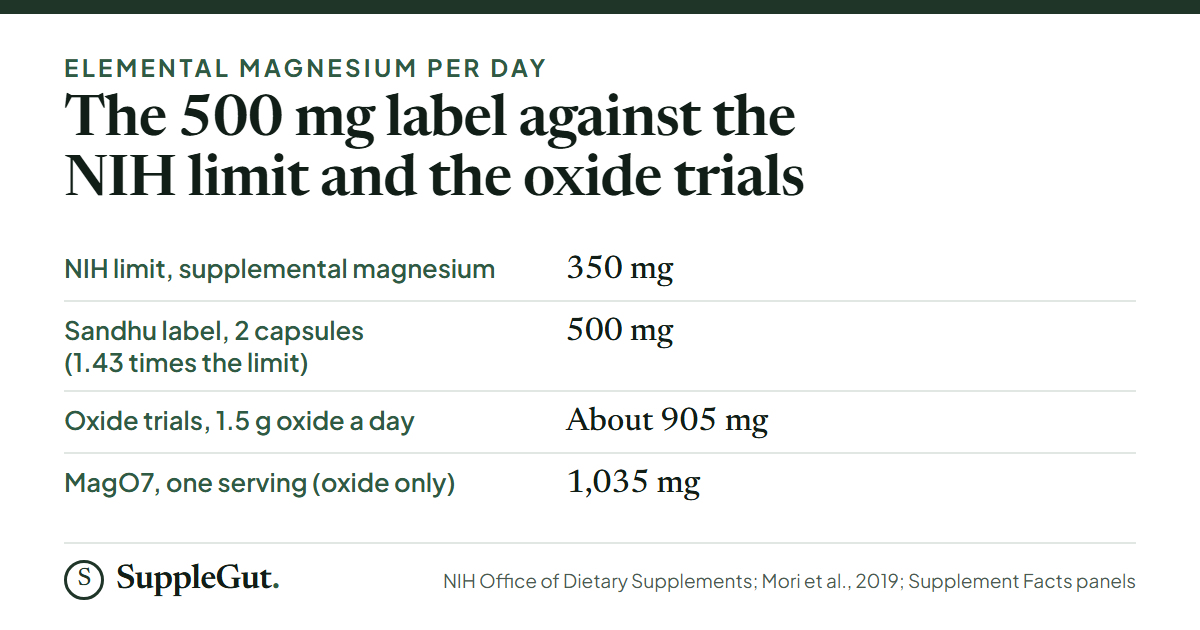
The trial dose of 1.5 g of oxide is about 905 mg of magnesium (1.5 g times 0.603). The label’s 500 mg is 55% of that. Against the NIH Tolerable Upper Intake Level for supplemental magnesium, 350 mg a day for adults, the full serving is 1.43 times the limit and one capsule, 250 mg, is 0.71 times. NIH sets that limit on diarrhea, so a laxative dose is expected to exceed it. For comparison, one serving of MagO7, an oxide-only capsule, is 1,035 mg, covered in the MagO7 guide.
How to take it
The directions are two capsules a day, preferably with food or as directed by a health care provider; the label does not say to split them. The trials split the oxide into three doses a day. The trials ran 28 days, and one of the ads says four weeks, while the other promises a result in 72 hours. Amazon reviewers who write about sleep describe taking it an hour or so before bed, and one took a single capsule.
Side effects and who should not take it
NIH says high doses of magnesium from supplements or medications can cause diarrhea, nausea and abdominal cramping, and that the risk of toxicity rises with impaired kidney function. It also notes that magnesium may interact with oral bisphosphonates, tetracycline and quinolone antibiotics, and that diuretics and proton pump inhibitors can affect magnesium status. The bottle carries only a general caution to consult a health care provider if pregnant, nursing, taking medications or with a medical condition. It has no kidney warning, no laxative warning and no medicine-spacing instruction. The NIH notes above are not on the label.
Among Amazon reviewers the recurring complaint is stomach cramping. In Amazon’s review summary, stomach irritation draws 11 mentions, of which 7 are negative; one reviewer reports “severe stomach cramping” that woke them at night. Others call it strong, and 9 of 47 effectiveness mentions are negative. One reviewer reports a rise in blood pressure; the cause is not established from one review.
What the reviews say
Amazon shows 4.6 from 962 ratings (81% five-star, 11% four, 4% three, 1% two, 3% one), pooled across the 60-count, 120-count and two-pack sizes of the listing. The praise is for night-time leg and muscle cramps (35 of 40 mentions positive), for sleep (32 of 36 positive) and for having several forms of magnesium at a low price (12 of 13 positive). Constipation is not a theme in the reviews we could read; one top review says it brought regular bowel movements, and the summary adds that another reviewer says it keeps their bowels working well. Review text beyond the top eight is behind a sign-in, and Reddit and Walmart could not be read.
The brand site shows 4.6 from 55 reviews on a widget it hosts. All 55 are dated within five months of 2025, and 45 of them are dated before the Shopify product page was created and before the Amazon listing first appeared. None is from the following year. Not one mentions magnesium, sleep, cramps, bowels, stomach or digestion; they describe packaging, capsule size and directions. We found no Trustpilot profile and no Better Business Bureau listing. The brand-site score therefore says little about how the product works.
Refund terms
Three different statements apply, depending on where the capsules were bought. The ads promise a “30-day money-back guarantee”. The brand’s refund policy gives 90 days from purchase for a refund or exchange with proof of purchase, a return label paid by the brand, and processing within five days. Amazon lists the bottle as non-returnable for food-safety reasons, with a claim route through Your Orders for damaged or defective items. The ads link to a one-page site whose only link goes to the Amazon listing, and the 30-day wording does not appear on the Amazon listing or the brand’s refund policy. We found no billing or refund complaints on any source we could read, which is an absence of data. Amazon offers Subscribe & Save with no fees; the brand’s product page has no subscription option.
Who it suits, and when something else fits
- Someone who wants one magnesium capsule product for sleep and cramps and has no kidney condition or interacting medicine to check first.
- Someone comfortable that the label does not give the amount of any form, including oxide.
- Someone who will keep to two capsules a day and stop if stomach cramping or loose stools appear.
For constipation specifically, a product that prints the form and dose can be matched to the trials. Nature Made Magnesium Oxide is a plain oxide tablet, and Natural Vitality CALM is a magnesium citrate powder. Psyllium vs magnesium for constipation sets the two approaches side by side, and the constipation treatments guide lists what has the strongest trial support. The quiz starts from symptoms instead of products.
Cost
On Amazon, 120 capsules is $24.99, or $0.42 a day at two capsules (60 servings). Subscribe & Save is $22.49, about $0.37 a day. On the brand site the same 120 capsules is $26.99, or $0.45 a day, with free shipping on orders over $50.
The products in this catalog
Common questions
Does Sandhu Herbals Magnesium Complex work for constipation?
No trial of this product was found. Plain magnesium oxide at 1.5 g a day beat placebo in two Japanese trials of 28 days (70.6% against 25.0% in 34 women; 68.3% against 11.7% in 90 adults), at about 905 mg of magnesium. This label gives 500 mg from six forms with no per-form amounts, and we found no placebo-controlled constipation trial of citrate or glycinate. Amazon reviewers write mostly about sleep and leg cramps.
What forms of magnesium are in it, and how much of each?
The panel lists magnesium bisglycinate, oxide, aspartate, citrate, lysinate glycinate and malate as one 500 mg figure, plus 10 mg of zinc. No amount is printed for any form. By molecular weight, 500 mg could not come from the non-oxide forms alone in two capsules, so a large share is likely oxide; that is an inference from arithmetic, not a label statement.
Is 500 mg of magnesium a day too much?
NIH sets 350 mg a day as the upper limit for supplemental magnesium, based on diarrhea, so two capsules at 500 mg are 1.43 times that limit. One capsule is 250 mg, 0.71 times the limit. NIH says higher doses can cause diarrhea, nausea and abdominal cramping, and that toxicity risk rises with impaired kidney function.
What side effects do people report?
Stomach cramping and upset is the main complaint on Amazon: 7 of 11 stomach mentions in the review summary are negative, and one reviewer reports severe cramping. Some call it strong, and a few say it did not work. The bottle has no kidney or laxative warning, only a general ask-your-doctor caution.
Can I return it, and is the 30-day guarantee real?
The ads promise a 30-day money-back guarantee. The brand site’s refund policy gives 90 days with a prepaid return label, and Amazon lists the bottle as non-returnable for food-safety reasons. The ads link to a page whose only link goes to Amazon, and the 30-day wording is not on the Amazon listing or the brand’s policy.
How much does it cost?
Amazon lists 120 capsules at $24.99, which is $0.42 a day at two capsules, or $22.49 on Subscribe & Save. The brand site sells the same 120 capsules for $26.99, $0.45 a day, with free shipping over $50.
Does it interact with medicines?
NIH says magnesium may interact with oral bisphosphonates, tetracycline and quinolone antibiotics, and that diuretics and proton pump inhibitors can affect magnesium status. The bottle carries no medicine-spacing instruction, only a general caution to consult a health care provider if taking medications. See the psyllium vs magnesium comparison for the alternative approach.
Sources
- Mori S, Tomita T, Fujimura K, et al. "A Randomized Double-blind Placebo-controlled Trial on the Effect of Magnesium Oxide in Patients With Chronic Constipation." Journal of Neurogastroenterology and Motility, 2019;25(4):563–575. doi.org/10.5056/jnm18194
- Morishita D, Tomita T, Mori S, et al. "Senna Versus Magnesium Oxide for the Treatment of Chronic Constipation: A Randomized, Placebo-Controlled Trial." American Journal of Gastroenterology, 2021;116(1):152–161. doi.org/10.14309/ajg.0000000000000942
- van der Schoot A, Creedon A, Whelan K, Dimidi E. "The effect of food, vitamin, or mineral supplements on chronic constipation in adults: A systematic review and meta-analysis of randomized controlled trials." Neurogastroenterology & Motility, 2023;35(11):e14613. doi.org/10.1111/nmo.14613
- Chang L, Chey WD, Imdad A, et al. "American Gastroenterological Association–American College of Gastroenterology Clinical Practice Guideline: Pharmacological Management of Chronic Idiopathic Constipation." Gastroenterology, 2023. pubmed.ncbi.nlm.nih.gov/37211380
- NIH Office of Dietary Supplements. "Magnesium: Fact Sheet for Health Professionals": upper limit, diarrhea, kidney function, medicine interactions and form absorption. ods.od.nih.gov
- Amazon listing: Supplement Facts panel image, price, return terms, ratings and review summary. amazon.com/dp/B0FSPCSL1H
- Brand page: label, forms, price and review widget. sandhuherbals.com; refund policy
- Sandhu’s (sandhus.com) Magnesium Complex product data, for the separate citrate and oxide product. sandhus.com
- Meta Ad Library, advertiser Sandhu Herbals, ad IDs 1223408226657417 and 936967892793908: the constipation and 72-hour claims and the 30-day guarantee. facebook.com/ads/library
Not sure which product fits your situation?
This guide covers the mechanics. The quiz takes your specific symptoms, routine and preferences and matches you to one product from the catalog.
Take the quiz →