
Guide
Does Sandhus Fiber+ work? Two fibers at their trial doses, and what those trials measured
Quick answer
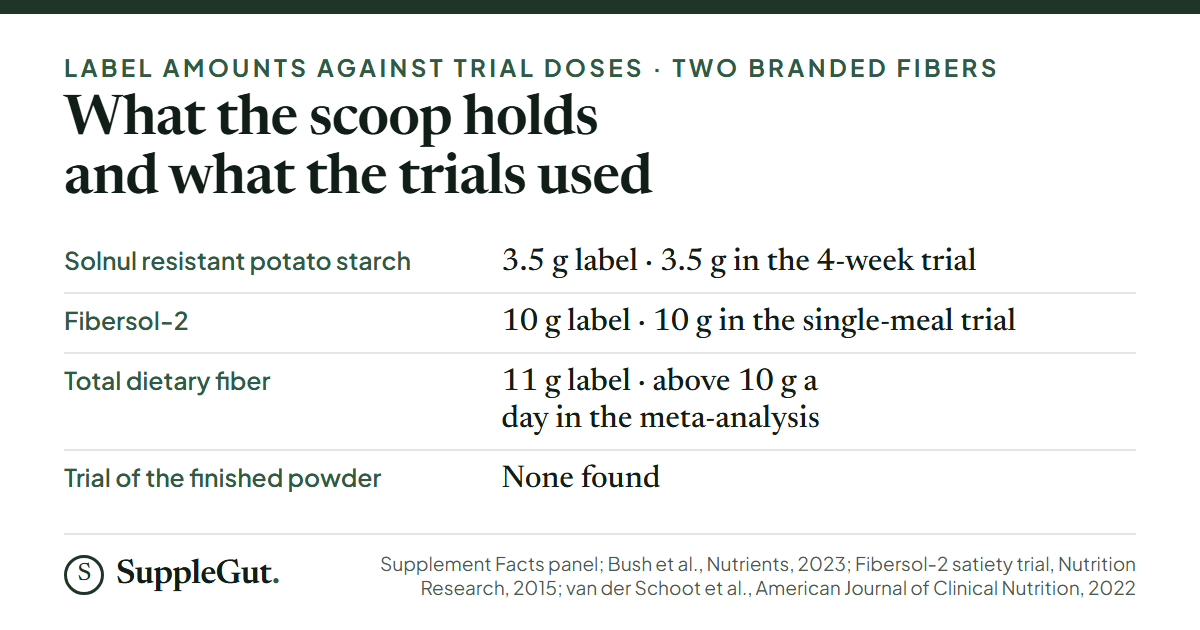
Does Sandhus Fiber+ work? No trial of Fiber+ itself was found. Its two ingredients are each at the dose a trial used: Solnul resistant potato starch at 3.5 g changed gut bacteria and stool type in healthy adults over four weeks (funded by its maker), and Fibersol-2 at 10 g with one meal raised fullness for 1.5 to 2 hours in 19 adults. The 11 g of fiber is just above the 10 g a day threshold from a constipation meta-analysis, but that review singled out psyllium and pectin, not these two fibers.
Sandhus Fiber+ Prebiotic Fiber Boost is an unflavored powder with two ingredients and nothing else: Fibersol-2, a digestion-resistant maltodextrin, and Solnul, a resistant potato starch. What sets it apart from the fiber on the next shelf is that both amounts are printed and both match the doses used in published trials. What those trials measured is a different question from whether the powder fixes constipation, and this page sets the two side by side.
What Fiber+ is, and what it is not
The Supplement Facts panel lists one scoop (13.5 g), 30 servings per container and 25 calories. Dietary fiber is 11 g (39% of the daily value). Under it the panel prints 10 g of Soluble Vegetable Fiber (Corn) (Fibersol-2) and 3.5 g of Resistant Potato Starch (Solnul), and Other Ingredients reads “None.” There is no proprietary blend, sweetener or flavor, and no bacteria: this is a fiber, not a probiotic.
The arithmetic is worth a look. The two ingredients add up to 13.5 g, which is the whole scoop, while the fiber line says 11 g, so about 2.5 g of the ingredient weight is counted as something other than dietary fiber. The panel does not say what. The trial literature calls Fibersol-2 a digestion-resistant maltodextrin; the label prints it as soluble vegetable fiber from corn, and the brand’s FAQ calls it soluble corn fiber, which is a separate ingredient class with its own trials.
The names are a small puzzle. The container image and page title read “SFG Biome Fiber+,” the store is branded Sandhus Nutrition, and the company behind both and the Amazon seller is Sandhu Products Inc. The brand states third-party testing of every batch for potency and purity in an NSF/ANSI 455-2 audited facility; no laboratory is named and we saw no product certificate, since the audit covers the facility, not this powder. Gluten, soy and dairy are listed as absent, while egg, tree nuts, fish and sesame are not addressed.
The trial of the product itself
There is none. PubMed returned no records for Fiber+ or SFG Biome, and ClinicalTrials.gov returned no study of it. The brand’s page shows “Real User Insights,” such as 86% feeling fuller between meals and 83% reporting regular bowel movements, footnoted “based on volunteer feedback.” No number of volunteers is given and there is no placebo group, so these are survey percentages, not trial results. The brand’s product gallery also carries an image headed “Clinically Studied Ingredients,” a brand claim; it cites the two ingredient trials described next.
The evidence for the ingredients
Solnul resistant potato starch (3.5 g on the label). A randomized, double-blind, placebo-controlled trial gave healthy adults 3.5 g, 7 g or a digestible corn starch placebo for four weeks (75 randomized, 70 analyzed). Bifidobacterium and Akkermansia rose significantly more than on placebo at 3.5 g, and both diarrhea-type and constipation-type bowel movements were significantly lower at that dose; 7 g acted like 3.5 g. The label dose equals the lower trial dose. The trial was sponsored by the starch’s maker, and its authors include an employee of the company (Bush et al., Nutrients, 2023). A secondary analysis of the same trial found that neither the starch nor placebo had significant effects on mean bowel-symptom scores, in people who reported low symptoms at baseline (Bush and Alfa, BMC Nutrition, 2024). So the trial shows a change in bacteria and in stool type in healthy people, and no change in symptom scores. We found no trial of Solnul in people with constipation or IBS.
Fibersol-2 (10 g on the label). A randomized, double-blind, placebo-controlled crossover trial gave 19 healthy adults a single meal with 0 g, 5 g or 10 g. After 10 g, hunger was delayed and satiety increased for 1.5 to 2 hours, and the gut hormones PYY and GLP-1 were higher; 0 g and 5 g did not do this (Fibersol-2 satiety trial, Nutrition Research, 2015). It tested one meal, not daily use, and it measured fullness, not bowel habit. We read only its abstract, so who funded it is not confirmed here.
For bowel outcomes there is a pooled review of the ingredient class. A systematic review of 29 randomized trials of resistant maltodextrin found it significantly increased stool volume and stool frequency compared with placebo, with evacuation sensation tending to improve (Clinical and Experimental Gastroenterology, 2018). The abstract does not give the doses, so the label’s 10 g cannot be compared with them.
What the constipation evidence says about 11 g
A meta-analysis of 16 randomized trials in 1,251 adults with chronic constipation found that fiber supplements helped 66% of responders against 41% on control (relative risk 1.48), with the clearest effect above 10 g a day and at four weeks or more. The fibers it named as having significant effects were psyllium and pectin, and flatulence was higher with fiber (van der Schoot et al., American Journal of Clinical Nutrition, 2022).
Fiber+ clears the 10 g mark by 1 g, but the fibers in it are resistant maltodextrin and resistant potato starch, neither of which that review named. The constipation evidence for fiber in general does not transfer automatically to a particular fiber.
How to take it
The label directions are one scoop a day, mixed into 8 ounces of water or a beverage of choice. The brand’s FAQ suggests any time of day and mixing into water, smoothies, protein shakes, coffee, yogurt or oatmeal, and says that if you are new to fiber you should start slowly and build up to a full serving. That FAQ also says the powder mixes into hot drinks and baked recipes, which conflicts with the panel’s own line that the powder should not be exposed to high temperatures or added to cooked foods. Where the two disagree, the panel is the label. The brand says many people notice regularity within 12 to 48 hours; that is a brand claim with no trial behind it. The Solnul trial ran four weeks, so a fair test of this kind of fiber is a month at a steady amount.
Side effects and who should not take it
The panel, the brand page and the Amazon text carry no pregnancy, nursing, medication, age or medical-condition warning that we could find. The brand’s FAQ states that it does not recommend its products for children. The expected effect of any fermentable fiber is gas, particularly when the amount rises fast: the constipation meta-analysis measured higher flatulence with fiber (standardized difference 0.80), and a trial of 20 g a day of a related soluble corn fiber reported a mild laxative effect with more flatulence and rumbling (Journal of Nutrition, 2013). The brand describes Fiber+ as gentle on the stomach; that is its claim.
What the reviews say
The two review pools disagree on how much weight to give them. The brand’s own page, through a Yotpo widget, shows 4.83 from 35 reviews: 29 five-star and 6 four-star, none lower. The widget reports none of the 35 as verified buyers, and all of them are dated weeks before the product page was created, so they were attached to it from somewhere else. They are short and similarly worded, and the widget carries the brand’s disclaimer that it does not verify the claims made in reviews. We treat that score as low confidence.
Amazon shows 4.0 from 143 ratings (62% five-star, 17% one-star), and it is independent of the brand. Two cautions apply. The review text is behind a sign-in, so the reasons for the one- and two-star ratings are unknown. And the listing’s summary of customer comments speaks of an MCT oil powder, which suggests ratings may be pooled across the company’s products. We found no Trustpilot profile and no BBB listing, and Reddit could not be read.
The recurring praise on the brand page is no taste, dissolving without clumps and being gentle on the stomach, with some mention of a steadier routine. There is no recurring complaint in the readable reviews, because there are no readable reviews below four stars.
The refund terms and where to buy
The brand product page has no subscription selector. Its Returns page offers a refund or replacement within 90 days of the order, with proof of receipt, and a refund to the original payment method within three business days of receipt. Amazon marks the product non-returnable. A single bottle can be bought on either route. Shipping from the brand is stated as free over $50 on one page and over $40 on another.
Who Fiber+ is for
- Someone who wants a two-ingredient, unflavored fiber with a gram amount for each and nothing added.
- Someone who wants fiber at doses used in the published trials for gut bacteria and fullness, understanding those trials were in healthy adults.
- Someone adding fiber slowly to a diet low in it, mixed into a cold or warm drink.
If the goal is constipation specifically, the trials that name a fiber point to psyllium and pectin; the constipation evidence guide sets out the options and which psyllium husk to buy covers that route. For single-ingredient fibers, Benefiber (wheat dextrin, covered in the Benefiber guide), Tomorrow’s Nutrition Sunfiber and Bob’s Red Mill Potato Starch are the plain alternatives. The Bariatric Fusion guide covers another powder built around Solnul, and the probiotic or fiber guide compares the two routes. The quiz starts from symptoms instead of products.
Cost
On the brand site one 30-serving bottle is $44.95, about $1.50 a day; two are $87.90 and three are $130.85, about $1.45 a day each. On Amazon the same product is $29.99, about $1.00 a day, or $26.99 on Subscribe & Save, about $0.90 a day. The brand-site single-bottle price is 50% above Amazon’s one-time price.
The products in this catalog
Common questions
Does Sandhus Fiber+ work?
No trial of Fiber+ was found. Solnul at 3.5 g raised Bifidobacterium and Akkermansia in healthy adults over four weeks, and Fibersol-2 at 10 g with a meal increased fullness for 1.5 to 2 hours in 19 healthy adults. A review of fiber in chronic constipation found the clearest effect above 10 g a day, with psyllium and pectin named as significant, and this product uses other fibers.
Is Sandhus Fiber+ safe, and does it cause gas?
The label text we read carries no pregnancy, medication or medical-condition warning, and the brand says to start slowly if you are new to fiber and to drink plenty of water. The constipation meta-analysis found more flatulence with fiber supplements overall, and a trial of a related soluble corn fiber at 20 g a day reported more flatulence than the control. The brand’s FAQ does not recommend its products for children.
What is in Sandhus Fiber+?
One 13.5 g scoop lists 10 g of Fibersol-2, a digestion-resistant maltodextrin from corn that the label calls soluble vegetable fiber, and 3.5 g of Solnul resistant potato starch. The panel counts 11 g of dietary fiber (39% of the daily value), and Other Ingredients reads None. There is no sweetener, flavor or proprietary blend.
How much does Sandhus Fiber+ cost?
The brand site sells one 30-serving bottle for $44.95, about $1.50 a day, and three for $130.85, about $1.45 a day. Amazon lists the same product at $29.99, about $1.00 a day, or $26.99 on Subscribe & Save. The brand-site price is 50% higher than Amazon’s one-time price.
Can I put Fiber+ in hot drinks or baked goods?
The panel says the powder should not be exposed to high temperatures or added to foods that are cooked, to maintain its properties. The brand’s FAQ says it mixes into hot or cold drinks and even baked recipes. The two statements conflict, and the panel is the label.
Can I return Sandhus Fiber+?
The brand’s Returns page offers a refund or replacement within 90 days of the order, with proof of receipt, refunded to the original payment method. Amazon lists the product as non-returnable. We found no Trustpilot profile or BBB listing to check how refunds go in practice.
Is it called SFG Biome or Sandhus Nutrition?
Both appear. The container image and page title read SFG Biome Fiber+ Prebiotic Fiber Boost, the store is branded Sandhus Nutrition, and the company that runs it and sells on Amazon is Sandhu Products Inc. Amazon titles the listing SFG Fiber+ Prebiotic Gut Super Blend.
Sources
- Bush JR, Baisley J, Harding SV, et al. "Consumption of Solnul Resistant Potato Starch Produces a Prebiotic Effect in a Randomized, Placebo-Controlled Clinical Trial." Nutrients, 2023;15(7):1582. PubMed 37049425
- Bush JR, Alfa MJ. Secondary analysis of the Solnul resistant potato starch trial: bowel symptom scores. BMC Nutrition, 2024. PubMed 39605008
- Fibersol-2 digestion-resistant maltodextrin, satiety and gut hormones with a meal: randomized crossover trial in 19 healthy adults. Nutrition Research, 2015. PubMed 25823991
- Resistant maltodextrin and bowel movements: systematic review and meta-analysis of 29 randomized trials. Clinical and Experimental Gastroenterology, 2018. PubMed 29535547
- van der Schoot A, Drysdale C, Whelan K, Dimidi E. "The effect of fiber supplementation on chronic constipation in adults: an updated systematic review and meta-analysis of randomized controlled trials." American Journal of Clinical Nutrition, 2022. PubMed 35816465
- Polydextrose and soluble corn fiber: fecal wet weight and tolerance in healthy adults, randomized crossover trial. Journal of Nutrition, 2013. PubMed 23427334
- Brand page: label, directions and price. sandhus.com; brand returns page and quality page
- Amazon listing: price, ratings and listing text. amazon.com
Not sure which product fits your situation?
This guide covers the mechanics. The quiz takes your specific symptoms, routine and preferences and matches you to one product from the catalog.
Take the quiz →