
Guide
Does Silver Fern Bloat & Gas Relief work? The five enzymes, the trials at the label dose and the FODMAP group it leaves out
Quick answer
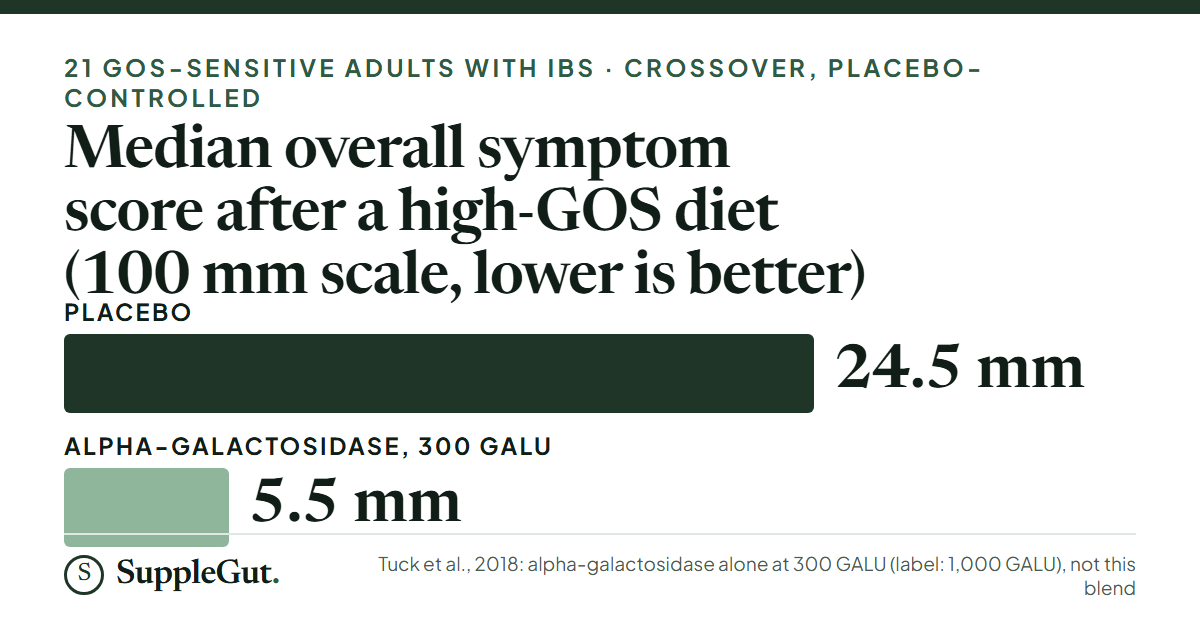
Does Bloat & Gas Relief work? No trial of this product or of its five-enzyme combination was found. Alpha-galactosidase at 300 GALU (label: 1,000) cut overall symptoms from 24.5 to 5.5 mm in 21 galacto-oligosaccharide-sensitive adults with IBS, lactase cut breath hydrogen by 55% in 47 people with lactose malabsorption at 13,500 units (label: 10,000 ALU), and xylose isomerase eased pain and nausea but not bloating in 65 people with fructose malabsorption. Inulinase and pectinase have no human symptom trial, and no enzyme here acts on polyols. Reviews are mixed: 4.3 from 68 on Amazon, 4.1 from 114 on the brand site.
Bloat & Gas Relief is a 30-capsule bottle of five digestive enzymes from Silver Fern Brand, LLC, sold as “The FODMAP Solution” and meant to be taken with a meal. What sets it apart from a single-enzyme product is the combination: each enzyme is matched by the brand to a different food carbohydrate. This page sets out the label, what each enzyme’s trials found and at what dose, and what the reviews show.
What Bloat & Gas Relief is, and what the label leaves out
One capsule holds a 640 mg proprietary blend of five enzymes, each given as activity units rather than milligrams: inulinase 700 U, pectinase 210 Endo PGU, alpha-galactosidase 1,000 GALU, Tolerase L 10,000 ALU and glucose isomerase 750 U. The units are not all the same kind (“U” is not defined, “Endo PGU” is a pectinase unit, “GALU” a galactosidase unit and “ALU” an acid lactase unit), and the weight of each enzyme in the 640 mg is not printed. The other ingredients are a hypromellose (vegetable) capsule, magnesium stearate and bamboo silica. There are no herbs, probiotics or other actives. The label states it contains no dairy, wheat, corn, rice, soy or artificial colors or flavors, with no facility statement.
Tolerase L is a trademarked acid lactase from Aspergillus oryzae, according to its supplier DSM-firmenich; the label does not print the supplier, and the sources of the other four enzymes are not printed either.
The five enzymes and what each is aimed at
| Enzyme | Label amount | Carbohydrate the brand matches it to | Human trial of the enzyme found |
|---|---|---|---|
| Inulinase | 700 U | Inulin, in onions, bananas, garlic, artichokes | No symptom trial found |
| Pectinase | 210 Endo PGU | Pectin, in apples, peaches, carrots, tomatoes | No symptom trial found |
| Alpha-galactosidase | 1,000 GALU | Legume-type oligosaccharides, in beans, peas, cabbage, whole grains, broccoli | Yes, 300 and 1,200 GALU |
| Tolerase L (lactase) | 10,000 ALU | Lactose | Yes, other lactase products |
| Glucose isomerase | 750 U | Fructose, converted into glucose | Yes, as xylose isomerase |
No enzyme on the label acts on polyols such as sorbitol and mannitol, and the brand does not describe any of the five as doing so. Polyols are one of the FODMAP groups, so a product sold as “The FODMAP Solution” leaves that one uncovered. We found no trial of any multi-enzyme FODMAP blend for bloating.
The trials of each enzyme against the label dose
Alpha-galactosidase. In a crossover trial at Monash University, 31 adults with IBS who produce hydrogen followed a three-day low-FODMAP diet and then three days of high galacto-oligosaccharide (GOS) food, with 300 GALU of enzyme, 150 GALU or placebo. In the 21 who were GOS-sensitive, the full dose cut median overall symptoms from 24.5 to 5.5 mm on a 100 mm scale (P = 0.006) and bloating from 20.5 to 6.5 (P = 0.017); breath hydrogen did not differ (P = 0.597) (Tuck et al., 2018). In 8 healthy volunteers eating 420 g of cooked beans, 1,200 GalU reduced breath hydrogen and flatulence, and 300 and 1,200 GalU both reduced the total symptom score (Di Stefano et al., 2007). The label’s 1,000 GALU sits between the two trial doses.
Lactase. In 47 adults with lactose malabsorption on a breath test, three chewable lactase tablets of 4,500 FCC units each (13,500 units) before a 25 g lactose load cut cumulative breath hydrogen by 55% against placebo over 180 minutes (58.15 against 102.64 ppm at 180 minutes, P = 0.025); symptom scores were lower at most time points, though the authors note symptoms and hydrogen did not track each other (Baijal and Tandon, 2020). In 60 lactose-intolerant patients, tilactase normalized the breath test and improved clinical scores against placebo (Ojetti et al., 2010). The label’s 10,000 ALU is below the 13,500 units in the first trial, and neither trial used Tolerase L by name; we have not verified that the unit types compare.
Glucose isomerase. The trial used xylose isomerase, the same enzyme under its other name. In 65 patients with fructose malabsorption given 25 g of fructose in water, the median breath-hydrogen area was 885 against 2,071 ppm/240 min, and abdominal pain (0.7 against 1.3) and nausea (0.2 against 0.6) improved on a 0 to 10 scale. Bloating did not differ significantly (P = 0.053) (Komericki et al., 2012). We did not find the capsule dose, so it cannot be compared with the label’s 750 U, and pure fructose in water is not a meal.
Inulinase and pectinase. We found no human symptom trial of either as a supplement. A registered trial of a different product, FODZYME, is recruiting with no results posted (NCT07591584). The Tuck trial’s own conclusion describes alpha-galactosidase as an “adjunct therapy to the low FODMAP diet”.
Each trial measured one enzyme against one carbohydrate in a measured challenge, not five enzymes against a mixed meal. The label does not say how much of each enzyme survives stomach acid in a non-enteric capsule.
How to take Bloat & Gas Relief
The label says take 1 capsule with food. Reviewers describe taking one before or at the start of a trigger meal, and one writes that it works when taken before eating and less well after symptoms appear. One reviewer takes one with every meal, which at three a day finishes a bottle in 10 days. The brand calls it short-term on its page and also suggests 4 to 6 months, then use as needed; we found no data on long-term use.
Side effects and who should not take it
The label caution reads: pregnant or nursing mothers, children under 18 and individuals with known medical conditions should consult a physician before using this or any other supplement. Among the 114 reviews on the brand’s site, a handful report diarrhea, more gas or abdominal pain after starting; the keyword “diarrhea” appears in 3. Amazon’s own summary of its reviews calls the side effects mixed.
What the reviews say
The brand’s own site shows 4.1 from 114 reviews (60% five-star, 13% four, 14% three, 4% two, 10% one), 98 of them flagged verified buyers and none flagged incentivized. Amazon shows 4.3 from 68 ratings (71%, 12%, 6%, 5%, 6%), with review text behind a sign-in; its summary describes mixed experiences, some finding it effective and others not. The brand’s Trustpilot page has 2 reviews across all its products and is unclaimed.
The recurring praise is relief after a trigger food such as garlic when the capsule is taken first, eating out more easily, and a quick effect. The recurring complaint, in 31 of the 114 brand-site reviews at one to three stars, is no effect, followed by worse gas or diarrhea in a few and the price per capsule. One reviewer notes the foods that trouble them do not all fall into the FODMAP groups. One reviewer reports a nine-week shipping wait.
Subscription and refund terms
The brand’s subscription takes 15% off with deliveries every 4, 6 or 8 weeks, and its Subscribe and Save page says plans can be modified, paused or canceled at any time through a login; it gives no billing terms or minimum. The return policy accepts unopened products within 30 days of delivery with a 5% restocking fee, does not accept opened products and does not refund shipping. A separately sold “satisfaction guarantee insurance” allows a return within 90 days of order. Amazon marks the listing non-returnable.
Who Bloat & Gas Relief is for
- Someone whose gas and bloating follow identifiable meals with beans, onion, garlic, dairy or fruit, and who will take a capsule at the start of those meals.
- A person on a low-FODMAP diet who wants an enzyme for the occasional meal outside it, understanding that the trial of that approach was an adjunct to the diet.
- Someone with no sensitivity to polyols, which none of the five enzymes addresses.
The digestive enzymes guide and the enzymes versus probiotics guide cover when each approach fits. Single-enzyme products are on the Beano and Lactaid pages, and a different multi-enzyme FODMAP blend on the FODZYME page.
Cost
One bottle is $43.47 on the brand site, which is $1.45 a day at one capsule; shipping is free over $49, and the charge under that is calculated at checkout. Two bottles are $76.41 ($1.27 a day). On subscription one bottle is $36.95 ($1.23 a day) and two are $64.95 ($1.08). Amazon lists $48.48 one time ($1.62 a day), $43.63 on Subscribe & Save ($1.45) and $82.96 for two bottles ($1.38). At one capsule per meal, three a day, one bottle costs $4.35 a day at the brand’s one-time price.
The products in this catalog
Common questions
Does Silver Fern Bloat & Gas Relief work?
No trial of this product was found. Single-enzyme trials exist for alpha-galactosidase (300 GALU eased symptoms in galacto-oligosaccharide-sensitive IBS patients), lactase (55% lower breath hydrogen in lactose malabsorption) and xylose isomerase (less pain and nausea in fructose malabsorption), but none for inulinase or pectinase and none for a blend. Reviews split: 4.3 from 68 ratings on Amazon and 4.1 from 114 on the brand site, with 31 of those 114 at one to three stars.
What enzymes are in Bloat & Gas Relief, and what does each do?
Inulinase (700 U) is aimed at inulin in onions and garlic, pectinase (210 Endo PGU) at pectin in apples and carrots, alpha-galactosidase (1,000 GALU) at the oligosaccharides in beans and cabbage, Tolerase L (10,000 ALU) at lactose, and glucose isomerase (750 U) at fructose. They sit in one 640 mg proprietary blend with no per-enzyme weight. None of the five is described as acting on polyols such as sorbitol and mannitol.
Is Bloat & Gas Relief safe, and what are its side effects?
The label says pregnant or nursing mothers, anyone under 18 and people with known medical conditions should consult a physician. A handful of reviewers report diarrhea, gas or abdominal pain after starting. The label says it contains no dairy, wheat, corn, rice, soy or artificial colors or flavors, and prints no statement for egg, fish, tree nuts or sesame; the sources of the enzymes are not printed.
How do you take Bloat & Gas Relief, and when?
The label says one capsule with food. Reviewers who report relief describe taking it before or at the start of a trigger meal, and one says it works less well once symptoms have started. A bottle lasts 30 days at one capsule a day and 10 days at one with every meal.
How much does Bloat & Gas Relief cost?
One 30-capsule bottle is $43.47 on the brand site, which is $1.45 a day at one capsule, with free shipping only over $49. Two bottles are $76.41, and the subscription takes 15% off ($36.95 for one bottle). Amazon lists $48.48 one time and $43.63 on Subscribe & Save. Taken with every meal, a bottle costs $4.35 a day at the brand’s one-time price.
Bloat & Gas Relief vs FODZYME or a single-enzyme product?
This blend has five enzymes with activity units printed. FODZYME is a different blend, with a fructan-degrading enzyme, a galacto-oligosaccharide enzyme and lactase, and has a randomized trial registered with no results posted. Single-enzyme products such as Beano and Lactaid match the enzyme trials more directly. For the wider picture, see the digestive enzymes guide.
Who makes Bloat & Gas Relief, and what is the refund policy?
Silver Fern Brand, LLC, which has sold this product since 2021. The brand accepts unopened products within 30 days of delivery with a 5% restocking fee, does not accept opened products, and does not refund shipping; a separately sold satisfaction guarantee at checkout allows a return within 90 days of order. Amazon marks the listing non-returnable.
Sources
- Tuck CJ, Taylor KM, Gibson PR, Barrett JS, Muir JG. “Increasing Symptoms in Irritable Bowel Symptoms With Ingestion of Galacto-Oligosaccharides Are Mitigated by α-Galactosidase Treatment.” American Journal of Gastroenterology, 2018;113(1):124–134. doi.org/10.1038/ajg.2017.245
- Di Stefano M, Miceli E, Gotti S, Missanelli A, Mazzocchi S, Corazza GR. “The effect of oral alpha-galactosidase on intestinal gas production and gas-related symptoms.” Digestive Diseases and Sciences, 2007;52(1):78–83. doi.org/10.1007/s10620-006-9296-9
- Baijal R, Tandon RK. “Effect of lactase on symptoms and hydrogen breath levels in lactose intolerance: A crossover placebo-controlled study.” JGH Open, 2020;5(1):143–148. doi.org/10.1002/jgh3.12463
- Ojetti V, Gigante G, Gabrielli M, et al. “The effect of oral supplementation with Lactobacillus reuteri or tilactase in lactose intolerant patients: randomized trial.” European Review for Medical and Pharmacological Sciences, 2010;14(3):163–170. PubMed 20391953
- Komericki P, Akkilic-Materna M, Strimitzer T, Weyermair K, Hammer HF, Aberer W. “Oral xylose isomerase decreases breath hydrogen excretion and improves gastrointestinal symptoms in fructose malabsorption – a double-blind, placebo-controlled study.” Alimentary Pharmacology & Therapeutics, 2012;36(10):980–987. doi.org/10.1111/apt.12057
- ClinicalTrials.gov record NCT07591584, FODZYME crossover trial (recruiting, no results). clinicaltrials.gov/study/NCT07591584
- DSM-firmenich, Tolerase L infographic. dsm.com
- Brand page: label, directions, enzyme descriptions and price (silverfernbrand.com/products/bloat-gas-relief); return policy (silverfernbrand.com/pages/return-policy); subscription page (silverfernbrand.com/pages/subscribe-and-save)
- Amazon listing: price, ratings and returns text (amazon.com/dp/B09FVNDYDY)
Not sure which product fits your situation?
This guide covers the mechanics. The quiz takes your specific symptoms, routine and preferences and matches you to one product from the catalog.
Take the quiz →