
Guide
Does Silver Fern Postbiotic+ work? A lysine butyrate blend with no trial of its own
Quick answer
Does Silver Fern Postbiotic+ work? We found no trial of the product or of its lysine butyrate. Trials of other butyrate salts show symptom benefit in some IBS groups and no difference in a pediatric inflammatory bowel disease trial, and the beta-glucan and heat-treated Lactococcus lactis in it have trials in immunity, not gut symptoms. Amazon shows 4.4 from 33 ratings for the stick pack.
Silver Fern Brand Postbiotic+ is a three-ingredient “postbiotic” blend sold as a strawberry-lemonade stick pack and as a capsule: L-lysine butyrate, an algae beta-glucan and heat-treated Lactococcus lactis cells. No trial of the finished product or of its butyrate ingredient was found. This page covers the label, the nearest trials for each ingredient, the directions, the reviews, the price and the refund terms.
What Postbiotic+ is, and what it is not
The stick-pack Supplement Facts panel lists three ingredients, each with its own weight and no proprietary blend: 1,000 mg of BIOMEnd (L-lysine butyrate), 200 mg of BetaVia Pure (algae beta-1,3-glucan) and 36 mg of Immuse (Lactococcus lactis strain Plasma, listed as 100 billion cells). One stick is 2 g, a box holds 30, and the other ingredients are natural lemon and strawberry flavors, bamboo silica, MCT oil powder (palm) and stevia leaf extract. The capsule version has the same three lines at the same amounts per serving of six capsules, with calcium (350 mg) and phosphorus (295 mg) from the dicalcium phosphate in the capsule, and a bottle holds 180 capsules.
It is not a probiotic in the live-bacteria sense. The L. lactis cells are heat-treated and non-viable, which is why the label gives a cell count and not CFU. The brand’s own page leads with immune, metabolic and whole-body claims more than gut symptoms.
The label prints the weight of the lysine salt, not the weight of butyrate in it. If the salt is one lysine to one butyric acid, butyric acid is about 37.6% of its weight, so 1,000 mg would supply about 370 mg. That figure is our arithmetic, not a label claim, and it depends on a salt ratio and purity the label does not state.
Is there a trial of Postbiotic+ itself?
We found none. Searches of PubMed and ClinicalTrials.gov for the brand name and for BIOMEnd returned no trial of this product or of that ingredient under its name. The one registry entry that bears on the butyrate form is NCT06700785, a pharmacokinetic comparison of lysine butyrate, sodium butyrate and tributyrin in 10 apparently healthy men, each given a single dose, with plasma butyrate measured from 20 to 210 minutes. It is listed as completed, has no results posted, no publication was found, and it does not name BIOMEnd or this product. It measures blood levels, not symptoms.
The ingredient’s maker describes BIOMEnd as the lysine salt of butyric acid, patent-pending and fully soluble in liquid, and trade-press coverage names Postbiotic+ as a consumer use of it; neither article cites a study. The brand’s page says it looked at tributyrin and sodium butyrate and that they “didn’t perform like we needed them to,” and calls BIOMEnd the most bioavailable butyrate ingredient. Those are brand statements, and the page cites no study for them.
The butyrate trials, and what they used
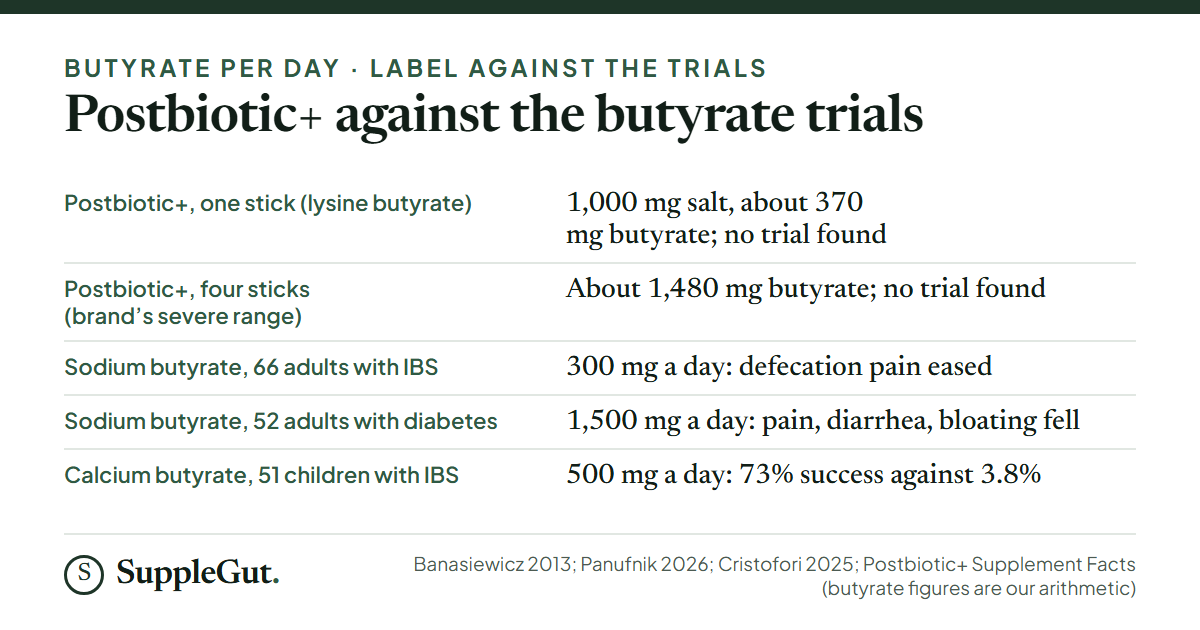
Every butyrate trial we found tested a sodium or calcium salt, or a mixture. None tested lysine butyrate. The butyrate-equivalent figures below are our arithmetic on a butyrate basis.
| Trial | People and length | Form and dose | Result |
|---|---|---|---|
| Banasiewicz 2013 | 66 adults with IBS, 12 weeks | Microencapsulated sodium butyrate, 300 mg a day (about 240 mg butyrate) | Pain during defecation fell at 4 weeks; urgency and bowel habit better at 12 weeks; abdominal pain, flatulence and severity not significantly reduced |
| Gąsiorowska 2024 | 120 adults with IBS, 12 weeks | Two capsules a day, each equal to 150 mg sodium butyrate, with five probiotic strains and scFOS | Adequate relief at 4 weeks 64.7% vs 42.0%; no significant difference in IBS-SSS or IBS-QOL; a mixture |
| Panufnik 2026 | 52 adults with type 2 diabetes and IBS, 12 weeks | Microencapsulated sodium butyrate, 1.5 g a day (about 1,190 mg butyrate) | Abdominal pain, diarrhea and bloating fell; registered retrospectively; a diabetic group |
| Cristofori 2025 | 51 children with IBS, 8 weeks | Calcium butyrate, 500 mg a day (about 410 mg butyrate) | Treatment success 73% vs 3.8%; a children’s trial |
| Pietrzak 2022 | 72 children with newly diagnosed IBD, 12 weeks | Sodium butyrate, 150 mg twice a day (about 240 mg butyrate) | No difference in remission or disease activity |
Two more studies are smaller or mechanistic. A pilot of microencapsulated sodium butyrate in 49 people with inflammatory bowel disease found more short-chain-fatty-acid-producing bacteria and better quality of life in ulcerative colitis over two months (Facchin et al., 2020). A colonoscopy model that bathed a section of colon in butyrate for 90 minutes found less bile-acid-induced permeability in biopsies from 17 people with IBS; it was not oral and not a symptom trial (Scharf et al., 2025).
Against those doses, one stick of Postbiotic+ is about 370 mg of butyrate-equivalent, above the roughly 240 mg of the 300 mg sodium butyrate trials and a little below the roughly 410 mg of the children’s calcium butyrate trial. At the brand’s four-stick direction it is about 1,480 mg, above the roughly 1,190 mg of the diabetes trial. Because the trials used other salts, often microencapsulated, the comparison is by weight only. A 2026 review notes that results may depend on the delivery technology, release profile and dose as well as the active ingredient (Caban et al.), and a 2020 review argues that the usual 150 to 300 mg doses may be low against estimated daily demand (Banasiewicz et al.). The label gives no release or absorption data.
The other butyrate catalog pages set out their own labels: Return Healthy Double Butyrate (guide), Tesseract ProButyrate (guide) and BodyHealth Tributyrin (guide). No study compares any of them with Postbiotic+. On tributyrin itself, the one human crossover we found used a butyrate and hexanoate triglyceride in 12 men with overweight and did not move its secondary outcomes (van Deuren et al., 2022); we found no tributyrin trial in IBS.
The other two ingredients and their trials
BetaVia Pure (algae beta-glucan, 200 mg). The brand describes it as derived from Euglena gracilis, at more than 95% beta-1,3-glucans. No trial under that name was found. The nearest trials used other Euglena products. In 34 endurance-trained adults, 367 mg a day of a Euglena fermentate with more than 50% beta-1,3-glucan for 90 days was followed by fewer self-reported sick days than placebo (1.46 vs 4.79, p = 0.041); the authors included employees of the maker, and the trial was in athletes and measured upper-respiratory symptoms (Evans et al., 2019). In a second trial, 700 mg a day of Euglena powder for 8 weeks improved natural killer cell activity in healthy adults (Park et al., 2023). The label’s 200 mg of beta-glucan is a different amount of a different ingredient from both.
Immuse (L. lactis strain Plasma, 36 mg, 100 billion cells). This is the strain also called LC-Plasma and JCM5805. Its trials are about immunity, infection and fatigue, not gut symptoms:
- 213 volunteers took a yogurt made with the strain, or a placebo drink, for 10 weeks in winter; cumulative days of cough and feverishness were lower on the strain (Sugimura et al., 2015).
- Vietnamese schoolchildren in grades 1 to 3 had fewer cumulative days absent for respiratory and gut illness on the strain than on a control beverage, and fewer days with diarrhea in the last four weeks (Thu et al., 2022).
- 37 athletes took capsules of heat-killed cells containing 100 billion cells a day for 14 days of hard training; cumulative days of fatigue were fewer than on placebo (Komano et al., 2023).
The last trial used the same cell count as the label. Several of these trials have authors from the strain’s developer, and none was in a group defined by digestive complaints. No trial of the three ingredients together was found.
How to take it
The stick panel gives a serving of one stick, mixed into 3 to 4 oz of water. The brand adds that it is best taken 30 to 60 minutes before a meal. The brand’s page sets directions by severity: one stick a day for mild issues; two for moderate, one with the first meal and one with the last; four for severe, two with each of those meals. It also says not to exceed two sticks at one time. The brand says most people start to notice benefits in six to eight weeks, with major changes at about 12 weeks. That timing is the brand’s statement, and no trial of the product tested it.
The capsule directions are six capsules daily with or without food. The brand’s severity-based range is written for the stick pack, and the stick panel itself prints one stick as the serving.
Sticks or capsules
The two formats carry the same three lines at the same weights per serving. The sticks are flavored with natural lemon and strawberry flavors and sweetened with stevia leaf extract. The capsules need six a day and add 350 mg of calcium and 295 mg of phosphorus from the filler, 27% and 24% of the Daily Value. The reviews on the brand page are not labeled by format, and the Amazon reviews we read are all for the stick-pack (“powder”) style. The capsule listing on Amazon has one rating, and its listing text says 30 capsules while the brand’s bottle holds 180, so the two disagree on count.
The smell and the taste
The brand says Postbiotic+ has “a white cheddar like smell,” calls this normal, and says it does not affect the flavor. Reviewers agree on the smell. Ten of the 36 reviews on the brand page mention it, and Amazon’s review summary says several customers describe it as cheese-like. Opinion on the taste is mixed. Some reviewers say it tastes like strawberry lemonade, and others dislike it. Return terms for opened packs are covered below.
Side effects and who should check first
Both panels carry the same caution: pregnant or nursing mothers, children under 18 and people with known medical conditions should consult a physician before use. No medication-specific warning is printed. The brand page says it is unaware of interactions with prescription medications and asks people to consult a doctor before use. It also says that when gut ingredients are taken at effective doses, some discomfort can occur as the body adjusts, and suggests cutting the dose by half for two weeks.
The panels print no allergen statement, no free-from line and no facility statement, so milk, wheat, egg, soy, tree nuts, fish and sesame are unaddressed, and the MCT oil powder in the sticks is labeled “palm” without naming its carrier. Anyone with a food allergy can ask the brand before buying. The usual effects and when to stop are in the probiotic side effects guide.
What the reviews say
The stick-pack listing on Amazon shows 4.4 out of 5 from 33 ratings: 75% five-star, 5% four, 13% three, none at two stars and 7% one. The capsule listing shows 5.0 from one rating. The brand’s own page runs a review app (Yotpo) showing 4.72 from 36 reviews, with 30 five-star, 2 four-star and 4 three-star; only 6 are marked as verified buyers, and none is marked incentivized. Nine of the 36 date from the launch month, and one reviewer writes that they did the pre-launch testing. Trustpilot’s profile for the brand’s website was an unclaimed profile with two reviews, and Supp.co shows no reviews.
Reviewers who like it describe better digestion, less bloating and regularity without a laxative; fewer colds and less inflammation; and a taste that is better than the smell suggests. The complaints are the smell, slow or no effect, price (“limited benefit for cost” in one three-star review) and that Amazon will not take it back. We found no billing complaints in the reviews we read. That is a small sample, and it is not evidence that none exist.
Price, subscription and refund terms
A 30-stick pack is $64.65 on the brand site, about $2.16 a day at one stick, and $71.48 on Amazon ($2.38 a day); Amazon’s Subscribe & Save price is $64.33 ($2.14). The brand offers three subscription plans, delivering every 4, 6 or 8 weeks, each 15% off, which works out to about $54.95 and $1.83 a day. The capsule bottle is $62.29 on the brand site ($2.08 a day) and $70.48 on Amazon. Free shipping on brand orders starts at $49.
The price depends on the dose. At the brand’s moderate direction of two sticks a day it is about $4.31 a day at the brand price, and at four sticks it is about $8.62 a day ($9.53 on Amazon).
The brand’s refund terms, as published: unopened products can be returned within 30 days of delivery, opened products are not accepted, and returns carry a 5% restocking fee. A separately purchased “satisfaction guarantee insurance” allows a no-questions return within 90 days of the order. Both Amazon listings are marked non-returnable for food-safety reasons unless damaged or defective. The brand’s Subscribe and Save page says a subscription can be modified, paused or cancelled at any time. We did not determine whether a subscription is preselected on the product page.
Because opened packs cannot be returned, a first purchase of the 30-stick pack is a commitment of at least the price above, and the brand says most people notice benefits at six to eight weeks, longer than the 30 days a single box covers at one stick a day.
Who Postbiotic+ is for
- Someone who wants a butyrate product with every ingredient weighed on the label and accepts that the butyrate form has no published trial of its own.
- Someone interested in butyrate alongside an immune-focused beta-glucan and heat-treated cells, the combination the brand leads with.
- Someone who prefers a flavored drink mix and is comfortable with a cheese-like smell, or who prefers six capsules a day.
- Someone planning one stick a day. The brand’s two- and four-stick directions raise the daily cost to about $4.31 and $8.62 at the brand price.
If the main question is symptoms, the quiz starts from them. The brand’s live-bacteria product has its own page, Silver Fern Brand Ultimate Probiotic.
The products in this catalog
Common questions
Does Silver Fern Postbiotic+ work?
No trial of this product or of its lysine butyrate ingredient was found. Trials of other butyrate salts show symptom benefit in some IBS groups and no difference in a pediatric inflammatory bowel disease trial. On Amazon the stick pack holds 4.4 from 33 ratings, and reviewers who like it mention digestion, colds and inflammation.
What is in Silver Fern Postbiotic+?
One stick holds 1,000 mg of BIOMEnd (L-lysine butyrate), 200 mg of BetaVia Pure (algae beta-1,3-glucan) and 36 mg of Immuse, heat-treated Lactococcus lactis strain Plasma at 100 billion cells. The capsule version has the same three at the same amounts per six capsules, plus calcium and phosphorus from dicalcium phosphate. The panel does not say how much butyric acid is in the lysine salt; by our arithmetic it is about 370 mg.
How much does Silver Fern Postbiotic+ cost per day?
A 30-stick pack is $64.65 on the brand site and $71.48 on Amazon, about $2.16 and $2.38 a day at one stick. The brand’s own directions run up to four sticks a day for severe issues, which would be $8.62 a day at the brand price. Brand subscriptions take 15% off, and the capsule bottle is $62.29.
Is Silver Fern Postbiotic+ a probiotic?
No. Its Lactococcus lactis cells are heat-treated and non-viable, which is why the label gives a cell count (100 billion cells) and not CFU. The other two ingredients are lysine butyrate and an algae beta-glucan.
Silver Fern Postbiotic+ vs tributyrin or sodium butyrate: what is the difference?
Postbiotic+ uses L-lysine butyrate, which its maker says dissolves fully in water; the brand says it chose it over tributyrin and sodium butyrate but cites no study. A registry entry comparing the three in 10 men (NCT06700785) has no results posted. Return Healthy Double Butyrate and Tesseract ProButyrate use other forms, and no study compares them with it.
Does Silver Fern Postbiotic+ smell bad?
The brand says it has “a white cheddar like smell” that does not affect the flavor. Ten of 36 brand-page reviews mention the smell, and Amazon’s review summary says several customers describe it as cheese-like. Opinion on the taste is mixed.
Can I return Silver Fern Postbiotic+?
The brand accepts unopened products within 30 days of delivery with a 5% restocking fee and does not accept opened returns, unless a separately purchased satisfaction guarantee insurance applies. Both Amazon listings are marked non-returnable unless damaged or defective.
How many sticks of Postbiotic+ should I take a day?
The panel serving is one stick. The brand’s page runs from one stick a day for mild issues to two for moderate and four for severe, and says not to exceed two sticks at one time. It suggests cutting the dose by half for two weeks if discomfort occurs. The label advises checking with a physician if you are pregnant, nursing, under 18 or have a medical condition.
Sources
- Banasiewicz T, Krokowicz Ł, Stojcev Z, et al. “Microencapsulated sodium butyrate reduces the frequency of abdominal pain in patients with irritable bowel syndrome.” Colorectal Disease, 2013;15(2):204–209. PMID 22738315. pubmed.ncbi.nlm.nih.gov/22738315
- Gąsiorowska A, Romanowski M, Walecka-Kapica E, et al. “Efficacy and Safety of a Mixture of Microencapsulated Sodium Butyrate, Probiotics, and Short Chain Fructooligosaccharides in Patients with Irritable Bowel Syndrome.” Journal of Clinical Medicine, 2024;14(1):6. PMID 39797089. doi.org/10.3390/jcm14010006
- Panufnik P, Więcek M, Szwarc P, et al. “Effect of microencapsulated sodium butyrate on abdominal symptoms and carbohydrate metabolism in patients with type 2 diabetes: a randomized placebo-controlled trial.” Scientific Reports, 2026;16(1). PMID 41974937. doi.org/10.1038/s41598-026-47309-9
- Cristofori F, Calabrese FM, Iacobellis I, et al. “Calcium butyrate efficacy in pediatric irritable bowel syndrome: Randomized placebo-controlled multiomics-based clinical trial.” Journal of Pediatric Gastroenterology and Nutrition, 2025;81(3):551–561. PMID 40635319. doi.org/10.1002/jpn3.70154
- Pietrzak A, Banasiuk M, Szczepanik M, et al. “Sodium Butyrate Effectiveness in Children and Adolescents with Newly Diagnosed Inflammatory Bowel Diseases-Randomized Placebo-Controlled Multicenter Trial.” Nutrients, 2022;14(16):3283. PMID 36014789. doi.org/10.3390/nu14163283
- Facchin S, Vitulo N, Calgaro M, et al. “Microbiota changes induced by microencapsulated sodium butyrate in patients with inflammatory bowel disease.” Neurogastroenterology & Motility, 2020;32(10):e13914. PMID 32476236. doi.org/10.1111/nmo.13914
- Scharf MW, Forsgård RA, Prado SBR, et al. “Acute effects of butyrate on intestinal permeability in patients with irritable bowel syndrome assessed by a novel colonoscopy research model.” Gut Microbes, 2025;17(1):2545414. PMID 40810534. doi.org/10.1080/19490976.2025.2545414
- van Deuren T, et al. Butyrate and hexanoate triglyceride crossover in 12 men with overweight. Frontiers in Nutrition, 2022. PMID 36687671. pubmed.ncbi.nlm.nih.gov/36687671
- Caban M, Pikus E, Czarnecka-Chrebelska K, et al. “Use of Sodium Butyrate and Its Microencapsulated Forms in Intestinal Diseases-Current Clinical Approach.” Digestive Diseases and Sciences, 2026;71(5):1626–1639. PMID 41238998. doi.org/10.1007/s10620-025-09536-4
- Banasiewicz T, Domagalska D, Borycka-Kiciak K, Rydzewska G. “Determination of butyric acid dosage based on clinical and experimental studies - a literature review.” Przeglad Gastroenterologiczny, 2020;15(2):119–125. PMID 32550943. doi.org/10.5114/pg.2020.95556
- Evans M, Falcone PH, Crowley DC, et al. “Effect of a Euglena gracilis Fermentate on Immune Function in Healthy, Active Adults: A Randomized, Double-Blind, Placebo-Controlled Trial.” Nutrients, 2019;11(12):2926. PMID 31816842. doi.org/10.3390/nu11122926
- Park SY, Kim KJ, Jo SM, et al. “Euglena gracilis (Euglena) powder supplementation enhanced immune function through natural killer cell activity in apparently healthy participants: A randomized, double-blind, placebo-controlled trial.” Nutrition Research, 2023;119:90–97. PMID 37769481. doi.org/10.1016/j.nutres.2023.09.004
- Sugimura T, Takahashi H, Jounai K, et al. “Effects of oral intake of plasmacytoid dendritic cells-stimulative lactic acid bacterial strain on pathogenesis of influenza-like illness and immunological response to influenza virus.” British Journal of Nutrition, 2015;114(5):727–733. PMID 26234407. doi.org/10.1017/S0007114515002408
- Thu NN, Mai TT, Trang TTT, et al. “Impact of Infectious Disease after Lactococcus lactis Strain Plasma Intake in Vietnamese Schoolchildren: A Randomized, Placebo-Controlled, Double-Blind Study.” Nutrients, 2022;14(3):552. PMID 35276914. doi.org/10.3390/nu14030552
- Komano Y, Fukao K, Shimada K, et al. “Effects of Ingesting Food Containing Heat-Killed Lactococcus lactis Strain Plasma on Fatigue and Immune-Related Indices after High Training Load.” Nutrients, 2023;15(7):1754. PMID 37049594. doi.org/10.3390/nu15071754
- ClinicalTrials.gov NCT06700785, “A Pharmacokinetic Comparison of Three Butyrate Products.” clinicaltrials.gov
- NutraShure, BIOMEnd ingredient coverage. nutritionaloutlook.com; nutritionaloutlook.com
- Silver Fern Brand Postbiotic+: product page, both Supplement Facts panels, subscription plans, price and return policy. silverfernbrand.com; return policy
- Amazon listings for the stick pack (ASIN B0DV237N6J) and the capsule (ASIN B0GRKN814M): price, ratings, star split and review text. amazon.com
- Trustpilot profile for silverfernbrand.com; Supp.co product page. trustpilot.com; supp.co
Not sure which product fits your situation?
This guide covers the mechanics. The quiz takes your specific symptoms, routine and preferences and matches you to one product from the catalog.
Take the quiz →