
Guide
Does SoWell Fiber work? Five grams of fiber, GLP-1 constipation and what the trials show
Quick answer
Does SoWell Fiber work? No trial of SoWell Fiber has been published, and no trial of any fiber supplement in people on GLP-1 medicines exists. The packet prints 5 g of fiber from a proprietary blend with no grams given for psyllium, guar gum or pectin, while the 2022 constipation meta-analysis found the clearest effect above 10 g a day. Constipation is common on the drugs, 24% against 11% on placebo for Wegovy, and reviewers on the brand page and Amazon mostly report staying regular, with clumping the main complaint.
SoWell Fiber is an apple cinnamon fiber drink mix in single-serve stick packs, sold by SoWell and marketed to people taking GLP-1 medicines such as semaglutide and tirzepatide. The brand’s founder is Dr. Alexandra Sowa, whom the brand presents as a dual board certified obesity medicine and internal medicine physician. What sets it apart from the fiber on the next shelf is the audience it is built for and the extras in the packet: magnesium and a spore-forming probiotic alongside the fiber. This page sets out what the label prints, what the constipation trials say about the dose, what the GLP-1 drug labels report, and what the reviews and terms show.
What SoWell Fiber is, and what it is not
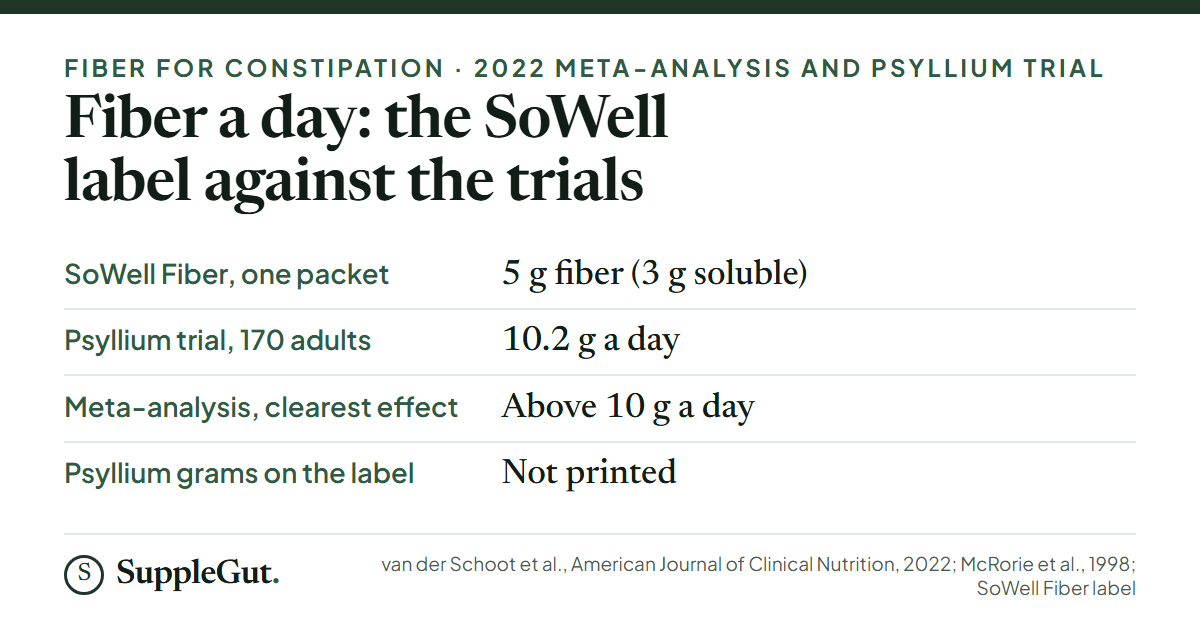
One packet weighs 6.9 g and prints 5 g of dietary fiber, 3 g of it soluble, with 25 calories and 6 g of carbohydrate. The fiber comes from a Proprietary Fiber Blend of 5,100 mg that names four ingredients: psyllium husk powder, guar gum powder, apple pectin and Ceylon cinnamon bark. The label does not give the grams of each, so the amount of psyllium in a packet is not printed. Because the blend weighs 5,100 mg and the fiber total is 5 g, psyllium alone is under 5.1 g, and by how much is not stated.
The packet adds 100 mg of magnesium as magnesium glycinate (24% of the daily value), 35 mg of sodium and 7.5 billion CFU of Bacillus subtilis, printed as Sporevia with the code ATCC12226. Citric acid, natural apple and cinnamon extract and stevia leaf extract make up the rest. It is vegan and gluten-free by the brand’s own badges; no milk, soy, nut or facility statement was found on the brand page, Amazon or Swanson. It carries a Supplement Facts panel, not a Drug Facts panel, so it is sold as a dietary supplement rather than an over-the-counter fiber laxative.
The probiotic code deserves a note. Trade press and a published safety paper identify Kerry’s Sporevia as Bacillus subtilis MB40, a strain Kerry licensed in 2021, and we could find no source that links Sporevia to ATCC 12226. Either the label code or the trade-press code is wrong, or the printed number is an error; the brand does not explain it. The brand page also spells the species “Bacillus Subtillus” in its ingredient text.
The trial of the product itself
There is none. We searched PubMed and ClinicalTrials.gov for SoWell and found no study of the product. The brand’s own page cites class-level papers on fiber, psyllium and magnesium rather than a trial of this formula. Whatever evidence the packet has sits with its ingredients, and the nearest match, a trial of a fiber supplement in people taking GLP-1 medicines, does not exist either: a PubMed search of psyllium or fiber with semaglutide, tirzepatide or GLP-1 returned only trials of the drugs themselves. The brand’s position that the fiber is designed for GLP-1 users rests on the reasoning that these drugs slow stomach emptying and that constipation is a common result.
How common constipation is on GLP-1 medicines
The FDA-approved labels give the figures. For Wegovy (semaglutide 2.4 mg), constipation was reported by 24% of people against 11% on placebo. For Zepbound (tirzepatide), it was 17% at 5 mg, 14% at 10 mg and 11% at 15 mg against 5% on placebo. The pooled analysis of the three main semaglutide 2.4 mg trials found the same 24.2% against 11.1%, reported that most gastrointestinal events were mild to moderate and temporary, and found 4.3% of people stopped the drug permanently because of gastrointestinal events of any kind (Wharton et al., 2022). A 2025 network meta-analysis of 39 studies in 33,354 people without diabetes found semaglutide and liraglutide associated with a higher risk of constipation (Ismaiel et al., 2025).
A 2022 multidisciplinary expert consensus puts constipation on these drugs at 4 to 12% in general and up to 25 to 35% in some obesity trials, with onset mostly in the first 16 weeks and particularly the first 28 days, and a median duration of 47 days in one obesity cohort. It also notes that people on these drugs tend to drink less. Its advice is to increase mobility, water and fiber, to consider stool softeners, to raise fiber gradually once symptoms ease, and to tell the prescriber if symptoms persist despite those steps (Gorgojo-Martinez et al., 2022). A 2025 joint advisory from four nutrition and obesity medicine societies calls nutritional and medical management of these side effects critical; its abstract gives no dose or product for fiber supplements.
The evidence for the fiber, and the dose
The main evidence is a 2022 meta-analysis of 16 randomized trials in 1,251 adults with chronic constipation. Across all fibers, 66% of 473 people responded against 41% of 329 on control (risk ratio 1.48, 95% CI 1.17 to 1.88). Psyllium and pectin had significant effects, stool frequency and consistency improved, and flatulence increased with fiber. The effect was clearest at doses above 10 g a day and treatment of four weeks or longer (van der Schoot et al., American Journal of Clinical Nutrition, 2022).
Two older studies fill in the picture. A 1998 trial in 170 adults with chronic constipation gave psyllium at 5.1 g twice a day, 10.2 g in all, and compared it with the stool softener docusate over two weeks: stool water content rose 2.33% on psyllium against 0.01% on docusate, and bowel movements reached 3.5 a week against 2.9 in the second week (McRorie et al., 1998). A 2011 review of six randomized trials found that soluble fiber improved global symptoms in 86.5% of people against 47.4% on placebo, with 3.8 stools a week after treatment against 2.9 at baseline, while the authors noted the limited quality of the trials (Suares and Ford, 2011).
Set against those figures, a SoWell packet prints 5 g of total fiber, half the daily amount the meta-analysis found clearly effective, and the psyllium inside it is under 5.1 g. The trials do not test 5 g, and none tested this blend, so they neither show that a packet works nor that it does not. One packet a day is the label direction; the trial doses would take two or more.
For guar gum, apple pectin and cinnamon, the fiber meta-analysis does not separate out a result for the blend, and the grams of each are not printed, so the trial evidence cannot be matched to the packet. How a label dose of psyllium lines up with the trial doses is worked through in the ColonBroom guide.
The magnesium and the probiotic
The 100 mg of magnesium is 29% of the 350 mg upper limit that the NIH sets for magnesium from supplements. We found no trial of magnesium glycinate for constipation. The magnesium trials in the constipation literature used magnesium oxide at roughly 900 to 1,000 mg a day, a different and more laxative form at a much larger dose. The NIH fact sheet notes magnesium can reduce the absorption of some antibiotics and osteoporosis drugs; the label does not mention this.
For the probiotic, the published human trials of B. subtilis MB40 do not look at constipation. A 2023 placebo-controlled trial in 115 adults carrying Staphylococcus aureus gave 250 mg a day for 30 days and cut stool S. aureus by 96.8% and nasal S. aureus by 65.4%; that dose is 3.3 times the 75 mg on the label (Piewngam et al., 2023). A 2021 trial in 100 healthy adults at 5 billion CFU a day for four weeks found no significant overall difference from placebo in bloating, abdominal discomfort or gas (Penet et al., 2021), and a safety paper covering 10 billion CFU a day found it well tolerated (Spears et al., 2021). The label’s 7.5 billion CFU sits between those two doses. No trial of the strain in constipation, or in people on GLP-1 medicines, was found.
How to take SoWell Fiber
The brand’s directions: empty one packet into a shaker bottle, add 8 to 12 ounces of water, shake until the drink thickens and drink it quickly. It is taken once a day, at any time; the brand suggests after dinner because the magnesium glycinate has a relaxing effect. The thickening is the psyllium and guar gum forming a gel, which is why the directions say to drink fast. The meta-analysis authors point to at least four weeks as the treatment length in the trials, so a month is the shortest fair test. The label has no instruction about food.
Side effects and who should check first
The only label warning we found is “Do not use if individual packets are opened.” We found no pregnancy, nursing, medication, age or choking warning in the text of the brand page, the Amazon listing or the Swanson listing, though the panel image was not read at full size. Psyllium products sold under a Drug Facts panel usually carry such warnings, and the brand’s direction to use 8 to 12 ounces of water works toward the same end. The meta-analysis found more flatulence with fiber, and the first days on any new fiber commonly bring gas or bloating.
On GLP-1 medicines, the consensus advice above is that constipation persisting despite water, activity and fiber is a reason to contact the prescriber. A 2026 safety review of these drugs lists gallbladder disease, gastroparesis and bowel obstruction among the reported gastrointestinal complications that may warrant caution in susceptible people. Persistent severe constipation or abdominal pain is a reason to contact the prescriber rather than to add more fiber, and the label does not say so.
What the reviews say
On the brand’s own page, the review widget shows 4.9 from 53 reviews: 48 five-star, 3 four-star and 2 three-star, with none below three. Forty-five are marked verified buyers, and the first 15 are dated within weeks of launch. This is the brand’s own widget, so it is self-hosted. Amazon shows 4.3 from 48 ratings, 70% five-star and 8% one-star, and its text beyond the summary snippets sits behind sign-in. The brand’s Trustpilot profile has no reviews, and Swanson shows no rating.
The recurring praise is taste, described as apple cider with cinnamon, then staying regular on a GLP-1 medicine (11 of the 53 brand reviews mention a GLP-1 drug) and the individual packets for travel. One reviewer reports no constipation for months on a GLP-1 trial, then constipation within a week of switching to Metamucil. The recurring complaints are clumping when the water is too cold or too little or the shake is short, cost against other fiber (one reviewer calls Metamucil a lot cheaper per serving), and one report of an unwanted subscription. The widget’s own “results” attribute averages lower than its flavor and quality attributes.
The subscription and refund terms
The brand’s subscription takes 10% off with free shipping and no commitment, and perks such as a free gift on every third order reset if you cancel. The Terms of Use say a subscription can be cancelled any time up to 48 hours before the renewal processing date, through the account or by emailing support. The return policy says the brand cannot accept returns on opened or unopened products; incorrect or damaged items can be reported within 7 days of delivery, and it states no money-back guarantee. Amazon lists the fiber as non-returnable. Single packs can be bought without a subscription on the brand site, on Amazon and at Swanson.
Who SoWell Fiber is for
- Someone on a GLP-1 medicine who wants a fiber drink with a flavor and will drink it the minute it is mixed.
- Someone who wants one stick pack a day rather than measuring a scoop.
- Someone happy to take a fixed 5 g packet and, if needed, a second one, since the trial doses start above 10 g a day.
When the trial dose is the priority, the single-ingredient psyllium powders print their grams: see NOW Foods psyllium husk powder and the Metamucil sugar-free powder, and the psyllium husk vs Metamucil comparison. Sunfiber is partially hydrolyzed guar gum, a tasteless low-FODMAP fiber with a different mechanism. The quiz starts from symptoms instead of a product.
Cost
On the brand site the 14-pack is $34.99, or $2.50 a day, and the 28-pack is $64.99, or $2.32 a day. Subscribing takes 10% off: $31.49 for 14 packs ($2.25 a day) and $58.49 for 28 ($2.09 a day). Amazon lists the 14-pack at $32.29 ($2.31 a day) and Swanson at $34.99 ($2.50 a day). Free shipping on the brand site applies to orders over $100 and to subscriptions. Per-day prices for the other fibers named above are on their own product pages.
The products in this catalog
Common questions
Does SoWell Fiber work for constipation on Ozempic, Wegovy or Zepbound?
No trial of SoWell Fiber, or of any fiber supplement in people on GLP-1 medicines, was found. In trials of fiber for chronic constipation (16 trials, 1,251 adults), 66% responded against 41% on control, with the clearest effect above 10 g a day, and a packet prints 5 g. Reviewers on the brand page and Amazon mostly report staying regular on semaglutide or tirzepatide.
How common is constipation on GLP-1 medicines?
The FDA labels report constipation in 24% of people on Wegovy against 11% on placebo, and 17%, 14% and 11% at the 5, 10 and 15 mg Zepbound doses against 5% on placebo. A 2022 expert consensus places it at 4 to 12% in general and up to 25 to 35% in some obesity trials, mostly in the first 16 weeks. It advises water, activity and fiber, and telling the prescriber if it persists.
What is in SoWell Fiber, and how much psyllium is in a packet?
A 6.9 g packet prints 5 g of fiber (3 g soluble) from a 5,100 mg proprietary blend of psyllium, guar gum, apple pectin and Ceylon cinnamon, plus 100 mg of magnesium as glycinate and 7.5 billion CFU of Bacillus subtilis. The grams of each fiber are not printed, so psyllium is only known to be under 5.1 g. The strain code printed, ATCC12226, differs from MB40, the code trade press gives Sporevia.
Which fiber suits constipation on a GLP-1 medicine?
No study ranks fibers for people on GLP-1 medicines. For chronic constipation in general, the meta-analysis found significant effects for psyllium and pectin, and the psyllium trial doses started at 10.2 g a day. The psyllium husk vs Metamucil comparison sets out single-ingredient options.
Is SoWell Fiber safe, and what are the side effects?
The only label warning found is not to use it if the packet is opened, and no pregnancy, medication or choking warning appeared in the label text read. The meta-analysis found more flatulence with fiber, and the NIH notes magnesium can reduce absorption of some antibiotics and osteoporosis drugs. Persistent severe constipation or abdominal pain on a GLP-1 medicine is a reason to contact the prescriber.
Why does SoWell Fiber clump, and how do you mix it?
The brand says to empty one packet into a shaker bottle with 8 to 12 ounces of water, shake until it thickens and drink quickly, because psyllium and guar form a gel. Several reviewers report clumps with too little water or too short a shake, and one used warm water. Others stir it into yogurt.
How much does SoWell Fiber cost, and can I cancel or get a refund?
The 14-pack is $34.99 ($2.50 a day) and the 28-pack $64.99 ($2.32 a day) on the brand site, 10% less on subscription; Amazon lists 14 packs at $32.29. A subscription can be cancelled up to 48 hours before the renewal processing date. The brand states it cannot accept returns on opened or unopened products, and Amazon marks it non-returnable.
Sources
- van der Schoot A, Drysdale C, Whelan K, Dimidi E. "The Effect of Fiber Supplementation on Chronic Constipation in Adults: An Updated Systematic Review and Meta-Analysis of Randomized Controlled Trials." American Journal of Clinical Nutrition, 2022;116(4):953–969. PMID 35816465. doi.org/10.1093/ajcn/nqac184
- Suares NC, Ford AC. "Systematic review: the effects of fibre in the management of chronic idiopathic constipation." Alimentary Pharmacology & Therapeutics, 2011. PMID 21332763. pubmed.ncbi.nlm.nih.gov/21332763
- McRorie JW, Daggy BP, Morel JG, et al. "Psyllium is superior to docusate sodium for treatment of chronic constipation." Alimentary Pharmacology & Therapeutics, 1998;12(5):491–497. PMID 9663731. pubmed.ncbi.nlm.nih.gov/9663731
- Gorgojo-Martinez JJ, et al. Expert consensus on managing gastrointestinal adverse events in people treated with GLP-1 receptor agonists. Journal of Clinical Medicine, 2022. PMID 36614945. pubmed.ncbi.nlm.nih.gov/36614945
- Wharton S, et al. Pooled gastrointestinal tolerability analysis of semaglutide 2.4 mg in the STEP 1 to 3 trials. Diabetes, Obesity and Metabolism, 2022. PMID 34514682. pubmed.ncbi.nlm.nih.gov/34514682
- Ismaiel A, et al. Network meta-analysis of gastrointestinal adverse events with GLP-1 receptor agonists in people without diabetes. International Journal of Obesity, 2025. PMID 40804463. pubmed.ncbi.nlm.nih.gov/40804463
- Mozaffarian D, et al. Joint advisory on nutrition during GLP-1 therapy (ACLM, ASN, OMA, TOS). American Journal of Clinical Nutrition, 2025. PMID 40450457. pubmed.ncbi.nlm.nih.gov/40450457. Kunutsor SK, Seidu S. Safety review of GLP-1 medicines. Drugs, 2026. PMID 41351656. pubmed.ncbi.nlm.nih.gov/41351656
- FDA prescribing information, adverse reactions: Wegovy and Zepbound, constipation rates, via openFDA. Wegovy label, Zepbound label
- Piewngam P, et al. Phase 2 trial of Bacillus subtilis MB40 and Staphylococcus aureus colonization. Lancet Microbe, 2023. PMID 36646104. pubmed.ncbi.nlm.nih.gov/36646104. Penet C, et al. Trial of B. subtilis MB40 in healthy adults, Alternative Therapies in Health and Medicine, 2021. PMID 31719214. pubmed.ncbi.nlm.nih.gov/31719214. Spears JK, et al. Safety of B. subtilis MB40, Nutrients, 2021. PMID 33668992. pubmed.ncbi.nlm.nih.gov/33668992
- NIH Office of Dietary Supplements. Magnesium fact sheet for health professionals. ods.od.nih.gov
- SoWell Fiber: label, directions, price, reviews and terms. brand page, terms of use, return policy; Swanson listing; Amazon listing
Not sure which product fits your situation?
This guide covers the mechanics. The quiz takes your specific symptoms, routine and preferences and matches you to one product from the catalog.
Take the quiz →