Guide
Does Triple Mint probiotic tea work? Three mint herbs, an uncounted probiotic and no trial of the tea
Quick answer
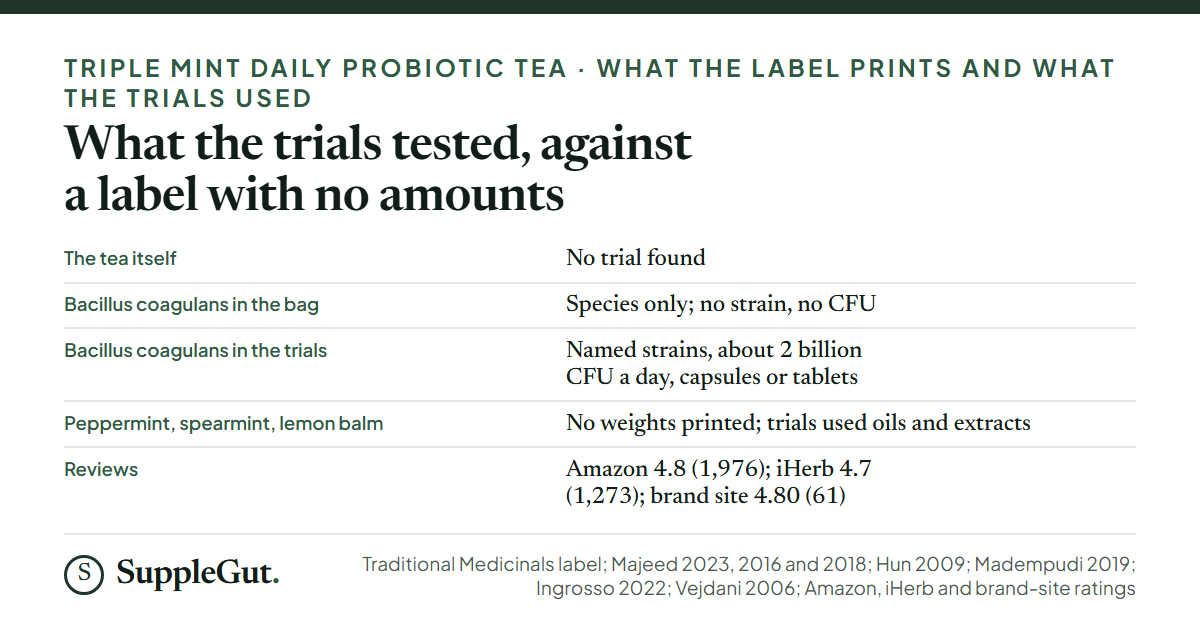
Does Triple Mint probiotic tea work? No trial of the tea was found. Trials of named Bacillus coagulans strains, mostly at 2 billion CFU a day in capsules or tablets, found less bloating and abdominal pain in IBS and in adults with gas and bloating, but the label names only the species and prints no CFU, and no study shows how many spores survive a 10-minute steep. The herbs’ trials used peppermint oil and lemon balm extracts, not tea. Amazon shows 4.8 from 1,976 ratings, iHerb 4.7 from 1,273, and the brand’s own site 4.80 from 61, of which 38 came from a free-sample program.
Traditional Medicinals Organic Triple Mint Daily Probiotic Tea is a 16-bag box of lemon balm, peppermint and spearmint leaf with the spore-forming probiotic Bacillus coagulans added. The probiotic is the unusual part for a tea, and it is also the part the label says least about. This page covers the ingredient list, what has and has not been tested, whether spores make it through hot water, the herbs’ trials, the brewing directions, the label’s cautions, the reviews and the price per cup.
Four ingredients, no amounts, and a new name
The panel lists a serving as one tea bag (making 8 fl oz), 16 servings a box, and zeros for calories, fat, sodium, carbohydrate and protein. The ingredients, in order, are organic lemon balm leaf, organic peppermint leaf, organic spearmint leaf and Bacillus coagulans, certified organic by CCOF. No amount is printed for any of the four: no milligrams for the herbs and no CFU (colony-forming units, the usual count of live cells) for the probiotic. The 24 g box holds 16 bags, so a bag weighs 1.5 g in total, probiotic included. There is no caffeine, no sweetener and no laxative herb. The organism is named by species only, with no strain designation; some recent papers use the name Weizmannia coagulans for the same species.
The product has been renamed. The box now reads “Triple Mint Daily Probiotic” with a “Formerly Peppermint Delight” badge, and the brand’s page carries the line “New look, same great formula.” Amazon titles the listing “Organic Triple Mint” without the word probiotic, though its bullets and its ingredient attributes name the probiotic and B. coagulans. Reviews on Amazon and on the brand’s site reach back to the Peppermint Delight years; the brand’s earliest review is from 2018.
The brand says the formula is unchanged under the new name, so this page reads the older ratings as covering the same tea. The box calls it an “Herbal Tea,” and the brand’s panel provider still titles the panel “Supplement Facts.”
What has been tested: no tea bag, and strains in capsules
No trial of this tea was found. A PubMed search for “Triple Mint” and “Peppermint Delight” with probiotic tea returned nothing, and the brand cites no study. The brand’s stated use is that the tea “supports healthy digestion.” Its page makes no claim about gas, bloating or constipation.
The trials that exist are of B. coagulans strains with names, taken as capsules or tablets, mostly at 2 billion CFU a day:
- 70 adults with functional gas and bloating, strain MTCC 5856, four weeks, randomized, double-blind and placebo-controlled; 66 finished. The indigestion score on the GSRS (a gastrointestinal symptom rating scale) fell from 8.91 to 3.06 on the strain (P < .001) against 9.42 to 8.43 on placebo (P = .11) (Majeed et al., Medicine (Baltimore), 2023).
- 36 people with newly diagnosed diarrhea-predominant IBS, 18 per group, the same strain as a tablet for 90 days alongside standard care. Bloating, vomiting, diarrhea, abdominal pain and stool frequency were lower than on placebo (p < 0.01) (Majeed et al., Nutrition Journal, 2016).
- 40 people with depression and IBS, the same strain at 2 billion CFU for 90 days; depression scores and IBS quality of life improved (p = 0.01) (Majeed et al., Food & Nutrition Research, 2018).
- 44 people with IBS, strain GBI-30, 6086, once a day for eight weeks. Abdominal pain and bloating scores improved from baseline in the treated group at all seven weekly comparisons (P < 0.01). Baseline values differed between the groups, so the analysis was within each group, and the author called the data preliminary (Hun, Postgraduate Medicine, 2009).
- 136 randomized adults with IBS, strain Unique IS2 at 2 billion CFU or placebo for eight weeks, with improvement in abdominal discomfort or pain and in complete spontaneous bowel movements. The authors work for the manufacturer (Madempudi et al., Scientific Reports, 2019).
The three MTCC 5856 papers come from authors at Sami-Sabinsa and Sabinsa, the strain’s owner. None of the five trials used a tea, and each named its strain.
Two gaps keep a bag from borrowing those results. First, the bag’s label gives the species and nothing else, and the trials are strain-specific. An older grocery listing for this tea footnotes the organism as “Lactospore,” a registered trademark of Sabinsa, and the trial papers tie LactoSpore to MTCC 5856. The brand’s current page and the Amazon listing carry no such footnote, so the strain behind today’s box is not confirmed by the label. Second, the label prints no CFU, so there is no way to compare a bag with the 2 billion in the trials. The CFU guide covers how counts are read, and the B. coagulans trials in the Biome Protect guide are set out against a capsule that does print its count.
Do the spores come through a ten-minute steep?
We found no data on that, for this tea or for a comparable bag. B. coagulans is a spore-former, and a spore is the heat-tolerant form of the organism; the 2023 trial paper calls MTCC 5856 “thermostable.” That describes the strain in the paper, not this tea, and it does not say how many spores remain after a bag sits in freshly boiled water for 10 minutes, or how many are in the cup to begin with.
The label does not fill that in. It gives no CFU at manufacture or through the expiry date, and no testing laboratory or certificate of analysis is named; the only certifications stated are organic (CCOF and USDA) and kosher. So the count in a cup is unmeasured on the label, and the dose in the trials cannot be matched to it even if survival is high.
The mint and lemon balm herbs: oils and extracts, not cups
The herbal trials were also run in other forms. Peppermint has the largest record, and it is in oil capsules. A 2022 meta-analysis pooled 10 randomized trials in 1,030 people with IBS: the relative risk of not improving was 0.65 for global symptoms (number needed to treat 4) and 0.76 for abdominal pain (number needed to treat 7), with more adverse events on the oil, and the authors rated the quality of evidence very low (Ingrosso et al., Alimentary Pharmacology & Therapeutics, 2022). For leaf, a 2006 review found that “human studies of peppermint leaf are limited and clinical trials of peppermint tea are absent” (McKay and Blumberg, Phytotherapy Research, 2006). The peppermint tea guide sets out why capsule results do not carry over to a cup.
Lemon balm and spearmint appear together in one small trial. In 32 people with IBS, an extract of lemon balm, spearmint and coriander (Carmint) was given for eight weeks with loperamide or psyllium, depending on bowel pattern. Severity of abdominal pain (P = 0.016) and of bloating (P = 0.02) was lower than on placebo; the authors called it a pilot study (Vejdani et al., Digestive Diseases and Sciences, 2006). Coriander is not in this tea, and the product was an extract. Lemon balm was also one of three herbs in an extract given to 93 breastfed infants with colic, where daily crying fell from 201 to 77 minutes against 199 to 170 on placebo (Savino et al., Phytotherapy Research, 2005); that was a blend in infants. A PubMed search for spearmint tea or infusion with gut outcomes returned no human study.
The brand’s own herb notes say lemon balm “supports digestion and helps calm frazzled nerves,” peppermint is “aiding digestion,” and spearmint is “perfectly sweet without an overpoweringly minty flavor.” Those are the brand’s statements.
Brewing it the way the box says
The directions: pour 8 oz of freshly boiled water over one tea bag, cover, steep for 10 minutes, squeeze the bag, and enjoy up to three cups a day. The 10 minutes is shorter than the 10 to 15 minutes printed for the brand’s other teas. The label does not say whether to drink it with food. At three cups a day a 16-bag box lasts a little over five days.
Side effects and the label’s cautions
The cautions printed on the panel read: consult a health care practitioner before use if you are pregnant or breastfeeding, if you have an immune-compromised condition, gallstones, bile duct obstruction, hiatal hernia or acid reflux. It adds that this product may cause drowsiness. The 2006 peppermint review notes that caution has been urged for peppermint oil in people with reflux, hiatal hernia or kidney stones. No medication line is printed on the panel.
No pattern of side effects appears in the reviews read. One brand-site review from 2024 says a child went to the bathroom after drinking it, and it is the only such report among the 61. The general effects of probiotics and when to stop are in the probiotic side effects guide.
What reviewers say, venue by venue
Amazon shows 4.8 out of 5 from 1,976 ratings on the 16-bag listing sold and shipped by Amazon.com: 88% five-star, 8% four, 3% three, 0% two and 1% one. Amazon’s review summary counts 116 mentions of flavor (107 positive), 111 of taste (105 positive), 32 of soothing (31 positive), 18 of value for money (17 positive) and 11 each of aroma and health benefits. iHerb lists 4.7 from 1,273 reviews. No probiotic-specific theme appears in Amazon’s topic list.
The brand’s own site shows 4.80 from 61 reviews on its review app, 60 of them marked verified buyer, dated from 2018 through 2025. That feed is hosted by the brand, and 38 of the 61, posted in 2021, carry the line “This review was collected as part of a free sample program.” Those 38 average 4.76; the other 23 average 4.87.
Praise falls into three groups: a strong mint flavor that is not bitter, an evening or after-dinner cup with a calming feel, and an upset stomach settling. Complaints are fewer. About five of the 61 brand-site reviews say they noticed no effect from the tea or the probiotic, at least four of them collected through the 2021 sample program. One 4-star reviewer notes that the box gives no amount of probiotic per bag. On flavor, 9 of the 116 Amazon mentions are negative, and two brand-site reviewers found the mint too mild or needed sugar. We found no subscription or refund complaint in the brand-site reviews or on Trustpilot, whose profile for the brand is unclaimed and has two reviews, neither about this tea.
Price per cup
| Where | Price | Bags | Per cup |
|---|---|---|---|
| Amazon.com, one box | $5.88 | 16 | $0.37 |
| iHerb, one box | $6.99 | 16 | $0.44 |
| Brand site, one box | $7.49 | 16 | $0.47 |
| Brand site, 3-pack | $20.97 | 48 | $0.44 |
| Brand site, 6-pack | $41.94 | 96 | $0.44 |
At the directed three cups a day, that is about $1.10 a day at the Amazon price, $1.31 at iHerb and $1.40 for a single box on the brand’s site. The brand also offers a subscription (every 1, 2, 3 or 6 months, cancellable up to 48 hours before shipment); the discount is not stated in the page text.
Triple Mint beside plain peppermint tea and a probiotic capsule
Against the brand’s peppermint tea. The Organic Peppermint Tea is one herb, and its label prints the amount, 1,500 mg of peppermint leaf a bag. Triple Mint adds spearmint, lemon balm and the probiotic and prints no amounts. Amazon shows 4.7 from 3,922 ratings for the peppermint tea against 4.8 from 1,976 here, and the Amazon price per cup is the same $0.37. Neither tea has a trial as a tea.
Against a capsule. A B. coagulans capsule such as Thorne Bacillus Coagulans prints an amount, 133 mg a capsule, and names the species, though its listing does not name the strain either. A capsule is taken once; the tea is directed up to three times a day. No study compares a probiotic tea with a capsule, and the trials above used capsules or tablets.
Who this tea suits
- Someone who wants a caffeine-free mint tea for after dinner or the evening, which is what the reviews praise most.
- Someone content with a probiotic whose dose and strain are not printed, since the finished tea has no trial.
- Someone outside the label’s caution groups, or who has checked with a practitioner, and who is aware of the drowsiness warning before driving or working.
To start from a symptom instead, the which probiotic guide and the quiz are the places to begin.
Products this guide draws on
Common questions
Is there any research showing Triple Mint probiotic tea helps digestion?
No study of this tea was found, and the brand cites none. The research is on Bacillus coagulans strains in capsules and tablets, and on peppermint oil and herb extracts. Reviewers rate the tea 4.8 from 1,976 ratings on Amazon, mostly for flavor and a settled stomach, and about five of the 61 brand-site reviewers noticed no effect.
How many CFU are in one Triple Mint tea bag?
The label does not say. It lists Bacillus coagulans as the fourth ingredient with no CFU and no strain, and prints no weight for any ingredient. The box holds 24 g across 16 bags, so a bag weighs 1.5 g including the probiotic. The strain trials used about 2 billion CFU a day.
Is Triple Mint the same tea as Peppermint Delight?
The box says “Formerly Peppermint Delight” and the brand’s page says “New look, same great formula.” The ingredients listed are lemon balm, peppermint, spearmint and Bacillus coagulans. Older reviews on Amazon and the brand’s site were written under the earlier name.
Does boiling water kill the probiotic in this tea?
No data on this tea were found. The organism is a spore-former, and the strain MTCC 5856 is described in its 2023 trial paper as thermostable, but that is a different matter from how many spores remain after the box’s 10-minute covered steep in freshly boiled water. The label prints no count before or after brewing.
Who should talk to a practitioner before drinking Triple Mint tea?
The label asks for a practitioner’s advice first if you are pregnant or breastfeeding, or have an immune-compromised condition, gallstones, bile duct obstruction, hiatal hernia or acid reflux. It also says the tea may cause drowsiness. It prints no medication warning.
What does a cup of Triple Mint tea cost?
A 16-bag box is $5.88 on Amazon.com, about $0.37 a cup, $6.99 on iHerb, about $0.44, and $7.49 on the brand’s store, about $0.47. The brand’s 3-pack and 6-pack work out to about $0.44 a cup. At the directed three cups a day, a box lasts a little over five days.
What does the probiotic add compared with plain peppermint tea?
Triple Mint adds spearmint, lemon balm and Bacillus coagulans to peppermint and prints no amounts, while the brand’s peppermint tea is one herb at 1,500 mg of leaf a bag. Neither has a trial as a tea. The probiotic’s dose in Triple Mint is not stated, so what it adds cannot be measured from the label.
Sources
- Majeed M, Nagabhushanam K, Paulose S, Arumugam S, Mundkur L. “The effects of Bacillus coagulans MTCC 5856 on functional gas and bloating in adults: A randomized, double-blind, placebo-controlled study.” Medicine (Baltimore), 2023;102(9):e33109. PubMed 36862903
- Majeed M, Nagabhushanam K, Natarajan S, et al. “Bacillus coagulans MTCC 5856 supplementation in the management of diarrhea predominant Irritable Bowel Syndrome: a double blind randomized placebo controlled pilot clinical study.” Nutrition Journal, 2016;15:21. PubMed 26922379
- Majeed M, Nagabhushanam K, Arumugam S, Majeed S, Ali F. “MTCC 5856 for the management of major depression with irritable bowel syndrome: a randomised, double-blind, placebo controlled, multi-centre, pilot clinical study.” Food & Nutrition Research, 2018;62. PubMed 29997457
- Hun L. “Bacillus coagulans significantly improved abdominal pain and bloating in patients with IBS.” Postgraduate Medicine, 2009;121(2):119–124. PubMed 19332970
- Madempudi RS, Ahire JJ, Neelamraju J, Tripathi A, Nanal S. “Randomized clinical trial: the effect of probiotic Bacillus coagulans Unique IS2 vs. placebo on the symptoms management of irritable bowel syndrome in adults.” Scientific Reports, 2019;9:12210. PubMed 31434935
- Ingrosso MR, Ianiro G, Nee J, et al. “Systematic review and meta-analysis: efficacy of peppermint oil in irritable bowel syndrome.” Alimentary Pharmacology & Therapeutics, 2022;56(6):932–941. PubMed 35942669
- McKay DL, Blumberg JB. “A review of the bioactivity and potential health benefits of peppermint tea (Mentha piperita L.).” Phytotherapy Research, 2006;20(8):619–633. PubMed 16767798
- Vejdani R, Shalmani HRM, Mir-Fattahi M, et al. “The efficacy of an herbal medicine, Carmint, on the relief of abdominal pain and bloating in patients with irritable bowel syndrome: a pilot study.” Digestive Diseases and Sciences, 2006;51(8):1501–1507. PubMed 16868824
- Savino F, Cresi F, Castagno E, Silvestro L, Oggero R. “A randomized double-blind placebo-controlled trial of a standardized extract of Matricariae recutita, Foeniculum vulgare and Melissa officinalis (ColiMil) in the treatment of breastfed colicky infants.” Phytotherapy Research, 2005;19(4):335–340. PubMed 16041731
- Traditional Medicinals: product page, ingredient and caution panel, directions and price. traditionalmedicinals.com
- Amazon listing for Traditional Medicinals Organic Triple Mint (ASIN B07Q2YYMRJ): ingredient attributes, price, ratings and review summary. amazon.com
- iHerb listing for the 16-bag box: price and review count. iherb.com
Which product is right for you?
This page explains how the products work. The quiz does the matching: it takes your symptoms, routine and preferences and names one product.
Take the quiz →