Guide
Chinese herbal medicine in the United States and Europe: practitioners, products, regulation and evidence
Quick answer
How is Chinese herbal medicine regulated in the United States and Europe? In the United States most states regulate acupuncture, and Chinese herbal products are sold as dietary supplements under DSHEA (1994), generally without FDA approval before sale. In Europe, Directive 2004/24/EC offers a registration for traditional herbal medicines that needs 30 years of use, 15 of them in the EU, and a 2022 review counted 7 Chinese herbal products registered through it. A 1998 California survey found undeclared drugs or heavy metals in 83 of 260 patent medicines (32%).
Chinese herbal medicine reached the United States and Europe as imported products and as a professional field attached to acupuncture, without the state system it has in China. This guide covers how it arrived, how practitioners are certified, how products are regulated in each place, what the contamination surveys found, how Japan’s Kampo differs, how brands position their products and what trials in Western populations show. The system itself is explained in What is traditional Chinese medicine? and its vocabulary in the glossary guide; the TCM section lists the rest of the series.
How it arrived
As reported, the route ran through acupuncture. James Reston of the New York Times had his appendix removed in Peking in 1971, and wrote that acupuncture needles two nights later eased the pressure and distension in his stomach within an hour. After President Nixon’s visit in 1972, White House physicians came home with accounts of acupuncture anesthesia, the public was excited and the medical profession was skeptical. The American Society of Anesthesiologists warned against premature use, the NIH announced a research program in 1972, and an NIH committee asked for more controlled studies. Most states that acted in those years treated acupuncture as a medical procedure for physicians; Nevada passed a law that created a licensing board and did not require applicants to be physicians (Taylor, 1973).
Practitioners and licensure
The NCCIH says most states and the District of Columbia regulate acupuncture practice and most require certification from the NCCAOM, the national certifying body. The NCCAOM, whose website now sits at ncbahm.org, says its certification or exam scores are used for licensure in 46 states plus the District of Columbia. Herbs are certified separately: the NCCAOM offers a Chinese herbology credential, and its state page lists Illinois, Massachusetts, New Jersey, Ohio and the District of Columbia as requiring herbology or Oriental medicine certification to practice herbs, with Pennsylvania and Vermont requiring the herbology exam alone. So in some states Chinese herbal medicine is practiced under the acupuncture license, and in others it needs a further credential. The NCCIH advises asking any practitioner about training and experience.
Products as dietary supplements
In the United States Chinese herbal products are dietary supplements under the Dietary Supplement Health and Education Act of 1994 (DSHEA). The FDA’s own summary is that manufacturers are responsible for substantiating the safety of their ingredients and the claims they make, that they generally need no FDA approval before selling, and that the FDA acts against an unsafe product after it reaches the market (FDA backgrounder). Disease claims move a product out of the supplement category. In a 2019 warning letter, the FDA found that website and label claims made 13 ActiveHerb and Guang Ci Tang products, among them the Huo Xiang Zheng Qi formula Stomacare, unapproved new drugs, and separately cited labels that did not name the plant part in English (FDA, 2019).
Safety: aristolochic acid, adulteration and metals
Aristolochic acid. In 1993 a Brussels team reported nine women under 50 with rapidly progressive kidney fibrosis after a slimming regimen that had added two Chinese herbs in 1990 (Vanherweghem et al., Lancet, 1993). A manufacturing error had replaced Stephania tetrandra with Aristolochia fangchi; among 39 patients who agreed to preventive surgery, 18 (46%) had urothelial carcinoma, and a cumulative dose over 200 g carried a higher risk (Nortier et al., NEJM, 2000). The FDA’s Import Alert 54-10, which trade press dated to 2000 and which was revised in 2001, allows detention of products containing Aristolochia species and certain Asarum, Cocculus and Thottea species; the alert says past outbreaks arose when a plant was mislabeled or Chinese names were misinterpreted.
Adulteration and metals. The surveys describe the products sampled and do not extend to every product:
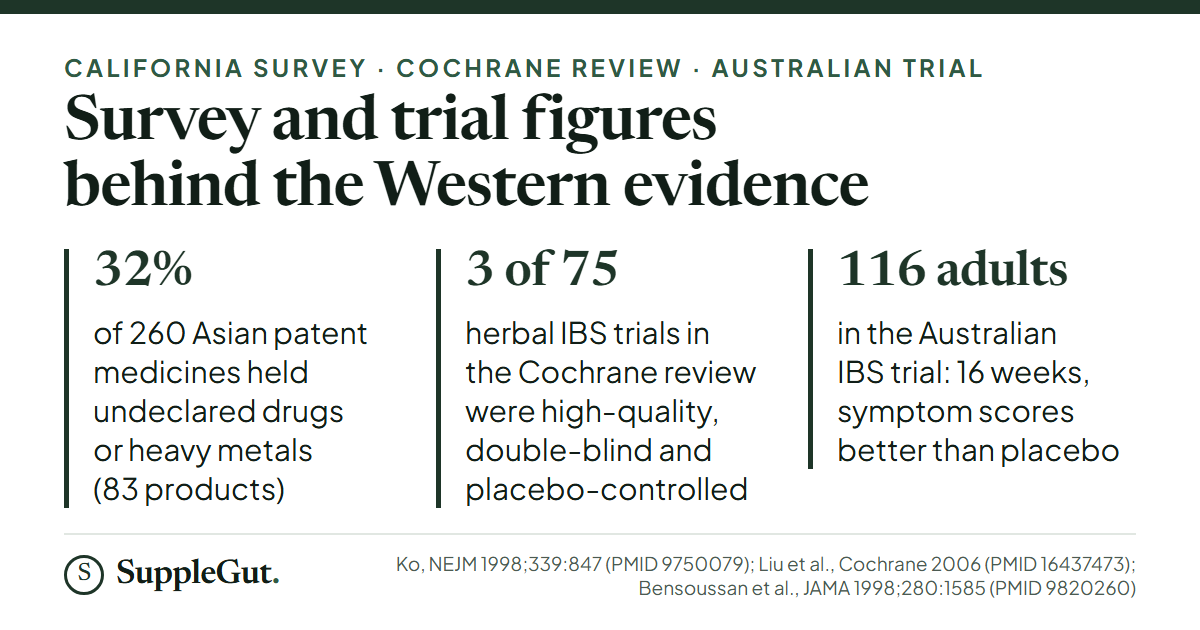
- Ko, 1998. The California health department tested 260 Asian patent medicines from retail herbal stores; at least 83 (32%) held undeclared pharmaceuticals or heavy metals, 23 had more than one adulterant, and only 14 of the 31 with pharmaceuticals declared them (Ko, NEJM, as summarized by Relias Media).
- Ernst, 2002. A systematic review found 18 case reports, 2 case series and 4 analytical studies of Chinese herbal medicines adulterated with conventional drugs; one Taiwan report found 24% of samples contaminated with at least one drug (Ernst, Journal of Internal Medicine).
- Martena, 2010. Of 292 Ayurvedic, Chinese and Tibetan preparations bought in the Netherlands, 186 (64%) contained mercury, arsenic or lead, fewer than 20% of labels suggested it, and 59 (20%) were likely to exceed safety limits at the labeled dose (Martena et al.).
- Harris, 2011. All 334 raw herb samples from China, covering 126 species, held at least one metal, and 36.7% of the 294 tested held pesticides; under the likely scenario of use, 3 samples (1%) for metals and 14 (5%) for pesticides could add to a person’s exposure (Harris et al.).
What a buyer can check is limited: Latin names and plant parts, a Supplement Facts panel with amounts, and a third-party heavy-metal result from the brand. Are Chinese herbal supplements safe? goes through the surveys and case reports.
Europe
Directive 2004/24/EC created a simplified registration for traditional herbal medicinal products. The EMA describes it as covering products with at least 30 years of use, including 15 in the EU, for mild conditions, without medical supervision and not injected; no safety and efficacy trials are required. A review counted 7 Chinese herbal products registered this way, 5 single herbs and 2 multi-herb products (Wang et al., Chinese Medicine, 2022). The 15-year rule is one reason: a Chinese formula with documented use only in China does not meet it, and another review found that the main reason non-European herbal substances were left out of EU monographs was unmet directive requirements. In the UK the Traditional Herbal Registration scheme covers products, not practitioners, and Chinese medicine practitioners are not subject to compulsory registration (Barrister Magazine).
Japan’s Kampo, the contrast
Japan covers Kampo formulas under national health insurance: 148 prescriptions (Kono et al., 2015), of 212 formulas approved for clinical use (Okamoto et al., 2014). A multicenter placebo-controlled trial of rikkunshito, the Japanese name for Liu Jun Zi Tang, randomized 247 patients with functional dyspepsia to 2.5 g three times a day for 8 weeks. Responders were 33.6% against 23.8% on placebo (P=0.09, not statistically significant); epigastric pain improved more (P=0.04) (Suzuki et al., 2014).
The market
Brands sit in two channels, and the facts they state about themselves differ:
- Plum Flower is a teapill line of Mayway, which says it has operated since 1969 and sells to registered business accounts; the same teapills appear on Amazon through third-party sellers. A Calm Stomach label lists 8 pills as a serving, from a 1,360 mg extract blend.
- Kan Herb Company of Santa Cruz sells Kan Traditionals, its largest line of classical formulas, and Kan Herbals, 25 formulas created by Ted Kaptchuk; its site says consumer products are sold through licensed practitioners.
- Health Concerns says it was the first company to manufacture Chinese herbal products in the United States for practitioners, and also sells to the public through its store and Amazon; Quiet Digestion is labeled a modified Bao He Wan.
- Sun Ten describes itself as a Chinese herbal extracts company and contract manufacturer selling granules and capsules to practitioners and consumers.
- Snap Dynasty sells modern versions of classic formulas to the retail market and says each formula is batch-tested for heavy metals, pesticides and microbes; Stomach Chi is a Xiang Sha Liu Jun Zi Tang with perilla.
What trials in Western populations show
The Australian IBS trial randomized 116 adults who met the Rome criteria to individualized formulas (38), a standard formula (43) or placebo (35), five capsules three times daily for 16 weeks. Bowel symptom scores improved against placebo as rated by patients (P=.03) and gastroenterologists (P=.001); individualized formulas were no more effective than the standard one, and at follow-up 14 weeks later only the individualized group had kept its improvement (Bensoussan et al., JAMA, 1998). The 2006 Cochrane review pooled 75 randomized trials with 7,957 participants and tested 71 herbal medicines; only three double-blind, placebo-controlled trials were of high quality. Against placebo, a standard Chinese formula, individualized Chinese herbal medicine and Tong Xie Yao Fang improved global symptoms, and no serious adverse events were reported; the authors advise caution with the less rigorous trials (Liu et al., 2006). The trial tables are in Does Chinese herbal medicine work for IBS? and TCM formulas for digestion: what the trials show.
The products in this catalog
Common questions
Are Chinese herbal practitioners licensed in the United States?
Acupuncture is regulated in most states and the District of Columbia, and most require NCCAOM certification, according to the NCCIH; the NCCAOM says 46 states plus the District of Columbia use its certification or exams. Herbal practice sits under those licenses in some states, and some require the separate Chinese herbology credential.
How are Chinese herbal products regulated in the United States?
They are dietary supplements under DSHEA (1994). Manufacturers are responsible for substantiating safety and claims and generally need no FDA approval before selling, and the FDA acts after a product reaches the market. Disease claims can make a product an unapproved drug, as in the FDA’s 2019 warning letter to ActiveHerb.
What is the FDA’s aristolochic acid import alert?
Import Alert 54-10 allows the FDA to detain products containing Aristolochia species and certain Asarum, Cocculus and Thottea species. It followed Belgian cases of kidney failure in women who took slimming pills in which Stephania tetrandra had been replaced by Aristolochia fangchi; 18 of 39 patients who had preventive surgery (46%) had urothelial carcinoma.
Can Chinese herbal products be registered as traditional herbal medicines in Europe?
Under Directive 2004/24/EC a product needs 30 years of use including 15 in the EU, for mild conditions. A 2022 review counted 7 Chinese herbal products registered this way, 5 single herbs and 2 multi-herb products.
How many Chinese patent medicines contain undeclared drugs or heavy metals?
A California survey found undeclared drugs or heavy metals in 83 of 260 Asian patent medicines (32%), and a Dutch survey found mercury, arsenic or lead in 186 of 292 Asian traditional preparations (64%), with 59 (20%) likely to exceed safety limits. The surveys describe the products sampled and do not extend to every product.
How does Japan handle Kampo differently?
Japan covers 148 Kampo prescriptions under national health insurance, mostly as standardized extracts prescribed by physicians. Elsewhere, including the United States, Chinese formulas are sold as supplements without that coverage. A trial of rikkunshito in 247 patients showed 33.6% responders against 23.8% on placebo, which did not reach significance (P=0.09).
What do trials in Western populations show?
An Australian trial of 116 adults with IBS found symptom scores better on Chinese herbal formulas than placebo over 16 weeks. The Cochrane review of 75 trials, 7,957 participants, found some formulas improved global symptoms but rated only three trials as high quality. Does Chinese herbal medicine work for IBS? has the detail.
Sources
- Taylor HD. 1973 talk on acupuncture in the United States, posted by Quackwatch. Reston, Nixon, the NIH program, Nevada. quackwatch.org/acupuncture/hx/taylor
- NCCIH. “Traditional Chinese Medicine: What You Need To Know.” State regulation of acupuncture, NCCAOM certification. nccih.nih.gov
- NCCAOM, at ncbahm.org: press page (46 states plus the District of Columbia) and state licensure page (herbology requirements by state).
- FDA. “Backgrounder: Final Rule, Current Good Manufacturing Practices (CGMPs) for Dietary Supplements.” Manufacturer responsibility under DSHEA. fda.gov
- FDA. Warning letter to ActiveHerb Technology, Inc., WL 574615. fda.gov
- Vanherweghem JL, et al. “Rapidly progressive interstitial renal fibrosis in young women: association with slimming regimen including Chinese herbs.” Lancet, 1993;341:387–391. PMID 8094166. pubmed.ncbi.nlm.nih.gov/8094166
- Nortier JL, et al. “Urothelial carcinoma associated with the use of a Chinese herb (Aristolochia fangchi).” NEJM, 2000;342:1686–1692. PMID 10841870. pubmed.ncbi.nlm.nih.gov/10841870
- FDA. Import Alert 54-10. accessdata.fda.gov/cms_ia/importalert_141.html; dating of the 2000 alert and 2001 revision from trade press: SupplySide Supplement Journal.
- Ko RJ. “Adulterants in Asian patent medicines.” NEJM, 1998;339:847 (letter). PMID 9750079. pubmed.ncbi.nlm.nih.gov/9750079; figures from Relias Media.
- Ernst E. “Adulteration of Chinese herbal medicines with synthetic drugs: a systematic review.” Journal of Internal Medicine, 2002;252:107–113. PMID 12190885. pubmed.ncbi.nlm.nih.gov/12190885
- Martena MJ, et al. “Monitoring of mercury, arsenic, and lead in traditional Asian herbal preparations on the Dutch market and estimation of associated risks.” Food Additives & Contaminants Part A, 2010;27:190–205. PMID 19890755. pubmed.ncbi.nlm.nih.gov/19890755
- Harris ES, et al. “Heavy metal and pesticide content in commonly prescribed individual raw Chinese Herbal Medicines.” Science of the Total Environment, 2011;409:4297–4305. PMID 21824641. pubmed.ncbi.nlm.nih.gov/21824641
- EMA. “Herbal medicinal products.” Traditional use registration, 30 years including 15 in the EU. ema.europa.eu
- BASG (Austrian Federal Office for Safety in Health Care). “Herbal medicinal products: Directive 2004/24/EC.” Conditions of the simplified registration. basg.gv.at
- Wang M, et al. “Key quality factors for Chinese herbal medicines entering the EU market.” Chinese Medicine, 2022. Seven registered Chinese herbal products. pmc.ncbi.nlm.nih.gov/articles/PMC8861989
- “Non-European traditional herbal medicines in Europe: A community herbal monograph perspective.” Journal of Ethnopharmacology, 2014. sciencedirect.com
- “Chinese Medicine in the UK at a Regulatory Crossroads.” Barrister Magazine. barristermagazine.com
- Kono T, et al. “Complementary and synergistic therapeutic effects of compounds found in Kampo medicine: analysis of daikenchuto.” Frontiers in Pharmacology, 2015;6:159. frontiersin.org
- Okamoto H, et al. “Yokukan-san: a review of the evidence for use of this Kampo herbal formula in dementia and psychiatric conditions.” Neuropsychiatric Disease and Treatment, 2014;10:1727–1742. pmc.ncbi.nlm.nih.gov/articles/PMC4168872
- Suzuki H, et al. “Randomized clinical trial: rikkunshito in the treatment of functional dyspepsia: a multicenter, double-blind, randomized, placebo-controlled study.” Neurogastroenterology and Motility, 2014;26(7):950–961. PMID 24766295. pubmed.ncbi.nlm.nih.gov/24766295
- Bensoussan A, et al. “Treatment of irritable bowel syndrome with Chinese herbal medicine: a randomized controlled trial.” JAMA, 1998;280(18):1585–1589. PMID 9820260. pubmed.ncbi.nlm.nih.gov/9820260
- Liu JP, et al. “Herbal medicines for treatment of irritable bowel syndrome.” Cochrane Database of Systematic Reviews, 2006;(1):CD004116. PMID 16437473. pubmed.ncbi.nlm.nih.gov/16437473
- Brand pages: Mayway mayway.com and Calm Stomach Teapills; kanherb.com; healthconcerns.com and Quiet Digestion; sunten.com; snapdynasty.com.
Which product is right for you?
This page explains how the products work. The quiz does the matching: it takes your symptoms, routine and preferences and names one product.
Take the quiz →