Guide
Does Chinese herbal medicine work for IBS? The Cochrane review, the JAMA trial and what came after
Quick answer
Does Chinese herbal medicine work for IBS? The evidence is mixed. In the 1998 JAMA trial of 116 people, 67% on a standard formula reported global improvement against 31% on placebo. The Cochrane review of 75 trials and 7,957 people judged three double-blind placebo trials high quality and the rest generally low. Pooled placebo trials in IBS-D give a relative risk of 1.62, but two placebo trials of one formula, Tong Xie Yao Fang, gave 57.5% against 37.5% and then 79.2% against 70.8%.
Chinese herbal medicine is among the most-tested complementary treatments for irritable bowel syndrome, and the trials do not agree with one another. This guide covers the 1998 JAMA trial, the Cochrane review of 75 trials, the meta-analyses and placebo trials since, berberine in IBS-D, the problem that individualized prescribing poses for trial design, and how the evidence sits next to peppermint oil and psyllium. The formulas are taken one by one in Classic Chinese digestive formulas: what the trials show. For background see What is traditional Chinese medicine? and the glossary of key concepts for the gut; the TCM section lists the whole series.
The JAMA trial of 1998
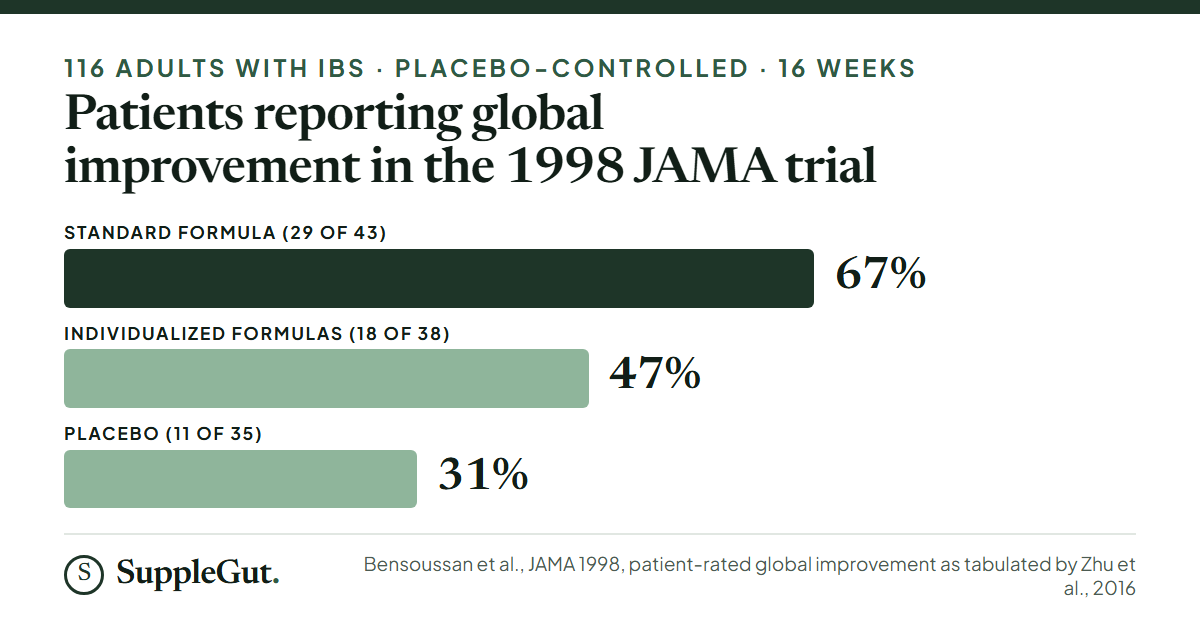
A Sydney group randomized 116 people who met the Rome criteria for IBS, recruited through two teaching hospitals and five gastroenterology practices, to three arms: a standard Chinese herbal formula (43 people), a formula written for each person by a herbalist (38), or placebo (35). Everyone took five capsules three times a day for 16 weeks, and patients, gastroenterologists and herbalists were all blinded (PMID 9820260).
Compared with placebo, the two active arms improved on the bowel symptom scale as rated by patients (p = 0.03) and by gastroenterologists (p = 0.001), and on global improvement as rated by patients (p = 0.007) and gastroenterologists (p = 0.002). The individualized formulas were no more effective than the standard one. Fourteen weeks after treatment ended, only the individualized group had kept its improvement. As tabulated in later reviews, patient-rated global improvement was 29 of 43 on the standard formula, 18 of 38 on the individualized formulas and 11 of 35 on placebo, the placebo arm having been split across the two comparisons as 6 of 18 and 5 of 17 (PMID 27547226). The Cochrane review re-analyzed the trial with 99% confidence intervals and rated it good quality: the standard formula’s relative risk for patient-rated global improvement was 2.15 (99% CI 1.07 to 4.32) and the individualized formulas’ was 1.51 (99% CI 0.69 to 3.29); at the 14-week follow-up the standard formula’s effect on the bowel symptom scale was no longer significant. Two people left the trial because of discomfort, one with upper abdominal discomfort and one with headaches.
The Cochrane review of 2006
Liu and colleagues searched through 2004, and Chinese journals through 2003, with no language limit. They found 75 randomized trials with 7,957 participants testing 71 different herbal medicines (PMID 16437473). Three double-blind, placebo-controlled trials were of high methodological quality, and the quality of the rest was generally low. Against placebo, a standard Chinese formula, individualized Chinese herbal medicine, the German combination STW 5 and its variant STW 5-II, the Tibetan formula Padma Lax, Tong Xie Yao Fang and an Ayurvedic preparation improved global symptoms. Against conventional treatment in 65 trials of 51 herbal medicines, 22 showed a statistically significant benefit and 29 did not differ. The authors concluded that some herbal medicines may improve IBS symptoms, that positive findings from less rigorous trials need caution because of inadequate methods and small samples, and that some deserve high-quality trials. Only 18 of the 75 trials (24%) reported adverse events, and the review did not draw a conclusion on safety.
Meta-analyses and trials since
| Review | Scope | Headline result | Quality note |
|---|---|---|---|
| Shi et al. (PMID 18200670) | 22 studies, 25 herbal medicines, 1,279 patients | Global improvement in 8 reports using 9 medicines | 4 studies good quality, 18 poor |
| Zhu et al. (PMID 27547226) | 14 double-blind placebo trials in IBS-D, 1,551 patients | Global symptoms RR 1.62 (95% CI 1.31 to 2.00); number needed to treat 3.6 | Most trials in China, published in Chinese; heterogeneity I² 59% |
| Zheng et al. (PMID 34385918) | 10 trials, 2,501 patients; 8 against placebo | Adequate relief RR 1.76 (95% CI 1.33 to 2.33); against pinaverium 1.10 (0.99 to 1.22) | 7 trials low risk of bias; I² 81% |
| Liang et al. (PMID 36091782) | 11 trials of Tong Xie Yao Fang, 985 adults with IBS-D | One placebo trial RR 1.53 (1.09 to 2.16); against drugs 1.12 (1.02 to 1.22) | 10 of 11 high risk of bias |
The Tong Xie Yao Fang placebo trials split. In 160 adults with IBS-D, adequate relief over four weeks was 57.5% on the granules against 37.5% on placebo (PMID 29856472). In 96 adults over eight weeks, the response was 79.2% against 70.8% (ratio 1.12, 95% CI 0.89 to 1.41), and the authors suggested symptoms fell in both arms regardless of treatment (PMID 39870499). The formula contains atractylodes, white peony, orange peel and saposhnikovia. A separate Australian trial tested a standardized seven-ingredient extract in 125 people with constipation-predominant IBS across 13 centers: for 8 weeks, adequate relief was greater on the extract (p = 0.010, per-protocol, 50 against 58 people) and so was stool consistency, but abdominal pain did not differ (p = 0.692; PMID 26133902).
Berberine in IBS-D
Berberine is an isolated alkaloid from plants such as coptis, not a formula, and its IBS trial is placebo-controlled. In Shanghai, 196 people with IBS-D were recruited and 132 randomized to berberine hydrochloride, 400 mg a day delivered twice daily, or placebo for 8 weeks, followed by a 4-week washout. Berberine reduced the frequency of diarrhea (p = 0.032), abdominal pain (p < 0.01) and urgent need to defecate (p < 0.01) more than placebo, and symptom score, anxiety, depression and quality of life moved in the same direction at p < 0.05 (PMID 26400188). It is one single-center trial. The berberine page covers the wider trial record.
The problem of individualized prescribing
In traditional practice the herbalist chooses and adjusts herbs for the pattern found on examination, and that is hard to test. A trial can give everyone one fixed formula, which tests the formula but not the tailoring, or let a herbalist write each prescription, which tests the tailoring but cannot be repeated exactly. The JAMA trial did both and found no extra benefit from individualizing at the end of treatment, though the individualized arm held its gains at the 14-week follow-up. Whether practitioners agree on the pattern is a separate question. In a University of Maryland study, three licensed acupuncturists examined the same 40 people with rheumatoid arthritis and agreed on the diagnosis 31.7% of the time, while 91.7% of their prescriptions matched the textbook for the diagnosis each had chosen (PMID 15992224); we found no equivalent study in IBS.
Pattern labels appear in IBS-D trials too. Zhu et al. grouped formulas by the pattern they target: those described as soothing the liver and invigorating the spleen gave a relative risk of 1.42 (95% CI 1.08 to 1.86) and those described as warming the kidney and invigorating the spleen gave 2.06 (95% CI 1.71 to 2.47). One trial had added heat-clearing herbs the authors judged unsuited to the syndrome, and leaving it out lowered heterogeneity from 59% to 0% with a ratio of 1.82 (95% CI 1.60 to 2.08).
How this compares with peppermint oil and psyllium
| Treatment | Pooled evidence | Result |
|---|---|---|
| Peppermint oil (IBgard guide) | 12 trials, 835 patients (PMID 30654773) | Global symptoms RR 2.39 (95% CI 1.93 to 2.97); pain RR 1.78 (1.43 to 2.20); number needed to treat 3 and 4 |
| Psyllium and soluble fiber (loose-stools guide) | 14 fiber trials, 906 patients (PMID 25070054); 275-person psyllium trial (PMID 19713235) | Soluble fiber RR of remaining symptomatic 0.83 (0.73 to 0.94), number needed to treat 7; psyllium 57% against 35% adequate relief in month one |
| Chinese herbal medicine in IBS-D | 14 double-blind placebo trials, 1,551 patients (PMID 27547226) | Global symptoms RR 1.62 (95% CI 1.31 to 2.00); number needed to treat 3.6 |
The three bodies of evidence differ in kind. Peppermint oil and psyllium are single ingredients tested at set doses, and the American College of Gastroenterology 2021 guideline grades peppermint oil as a weak, low-certainty option for overall symptoms (PMID 33315591). The Chinese trials mostly test multi-herb formulas: the Cochrane review counted 71 different herbal medicines, and a Tong Xie Yao Fang review found the herb ratios varied between trials with no justification given. Most of the IBS-D placebo trials in the pooled analysis were conducted in China and published in Chinese.
Safety in the IBS trials
Adverse events were reported unevenly. A meta-analysis of seven placebo-controlled trials with 1,512 participants found treatment-related events more common on the herbal arm (RR 1.51, 95% CI 1.14 to 2.00), mostly mild: nausea, constipation, diarrhea, bloating, with some rash and raised liver enzymes (PMID 34385918). Against pinaverium the rates did not differ, and the IBS-D placebo meta-analysis found no difference (PMID 27547226). An earlier review put the incidence at 2.97% (PMID 18200670), and the Cochrane review found adverse events were reported in fewer than a quarter of trials. Liver injury has been reported with some Chinese formulas outside IBS trials, including bupleurum-based Xiao Chai Hu Tang (PMID 24844799). Are Chinese herbal supplements safe? goes through the case reports, contaminants and herb-specific risks, and TCM in the United States and Europe covers how the products are regulated.
“Improvement” is defined differently across these trials: global relief rated by the patient, a cure-rate category, a symptom-score drop. Ratios from different definitions are not interchangeable, so the table above compares the shape of the evidence, not a head-to-head result.
The catalog entries behind this guide
Common questions
Does Chinese herbal medicine work for IBS?
The evidence is mixed. The 1998 JAMA trial of 116 people found two herbal formulas ahead of placebo, the Cochrane review judged three of 75 trials high quality, and pooled placebo trials in IBS-D gave a relative risk of 1.62 for global symptoms. Two placebo trials of one formula, Tong Xie Yao Fang, gave 57.5% against 37.5% and then 79.2% against 70.8%.
What did the Cochrane review conclude?
It included 75 trials with 7,957 participants and 71 different herbal medicines, judged three double-blind placebo-controlled trials high quality and the rest generally low, and concluded that some herbal medicines may improve IBS symptoms but that positive findings from less rigorous trials need caution. It did not conclude on safety because adverse events were reported in 18 of the 75 trials.
Which Chinese formula has been tested for IBS-D?
Tong Xie Yao Fang has the most: two double-blind placebo trials of 160 and 96 adults plus a review of 11 trials. Huo Xiang Zheng Qi oral liquid had a 212-person placebo trial, and Shen Ling Bai Zhu San has a review of 13 trials in IBS. The formulas guide has the numbers.
Does berberine help IBS?
One placebo-controlled trial, in Shanghai, randomized 132 people with IBS-D to berberine hydrochloride or placebo for 8 weeks. Diarrhea frequency (p = 0.032), abdominal pain frequency (p < 0.01) and urgency (p < 0.01) fell more on berberine. We found no second trial of the same design.
How does the evidence compare with peppermint oil?
Peppermint oil has a meta-analysis of 12 trials in 835 patients with a relative risk of 2.39 for global symptoms, and Chinese herbal medicine has 14 double-blind placebo trials in 1,551 IBS-D patients with a relative risk of 1.62. The peppermint trials test one ingredient at set doses; the Chinese trials test many different formulas. Does IBgard work? covers peppermint oil.
Are Chinese herbs safe to take for IBS?
In the trials, adverse events were mostly mild digestive effects, and a 1,512-participant meta-analysis found them more common on herbs than placebo (relative risk 1.51) but not more common than on pinaverium. Case reports of liver injury exist for some formulas outside the IBS trials. Are Chinese herbal supplements safe? has the sources.
Sources
- Bensoussan A, Talley NJ, Hing M, Menzies R, Guo A, Ngu M. “Treatment of irritable bowel syndrome with Chinese herbal medicine: a randomized controlled trial.” JAMA, 1998;280(18):1585–1589. pubmed.ncbi.nlm.nih.gov/9820260
- Liu JP, Yang M, Liu YX, Wei M, Grimsgaard S. “Herbal medicines for treatment of irritable bowel syndrome.” Cochrane Database of Systematic Reviews, 2006;(1):CD004116. Trial data for Bensoussan 1998 and adverse-event reporting from the full text. pubmed.ncbi.nlm.nih.gov/16437473; pmc.ncbi.nlm.nih.gov/articles/PMC12522099
- Shi J, Tong Y, Shen JG, Li HX. “Effectiveness and safety of herbal medicines in the treatment of irritable bowel syndrome: a systematic review.” World Journal of Gastroenterology, 2008;14(3):454–462. pubmed.ncbi.nlm.nih.gov/18200670
- Zhu JJ, et al. “Efficacy of Chinese herbal medicine for diarrhea-predominant irritable bowel syndrome: a meta-analysis of randomized, double-blind, placebo-controlled trials.” Evidence-Based Complementary and Alternative Medicine, 2016;2016:4071260. Bensoussan 1998 counts as extracted in Table 2 and text. pubmed.ncbi.nlm.nih.gov/27547226
- Zheng H, et al. “Chinese herbal medicine for irritable bowel syndrome: a meta-analysis and trial sequential analysis of randomized controlled trials.” Frontiers in Pharmacology, 2021;12:694741. pubmed.ncbi.nlm.nih.gov/34385918
- Liang SB, et al. “Systematic review and meta-analysis of Chinese herbal formula Tongxie Yaofang for diarrhea-predominant irritable bowel syndrome.” Frontiers in Pharmacology, 2022;13:904657. pubmed.ncbi.nlm.nih.gov/36091782
- Chen M, et al. “Randomised clinical trial: Tong-Xie-Yao-Fang granules versus placebo for patients with diarrhoea-predominant irritable bowel syndrome.” Alimentary Pharmacology & Therapeutics, 2018;48(2):160–168. pubmed.ncbi.nlm.nih.gov/29856472
- Liang SB, et al. “Chinese herbal formula Tongxie Yaofang granules for diarrhoea-predominant irritable bowel syndrome: a randomised, double-blind, placebo-controlled, phase II trial.” BMJ Open, 2025;15(1):e088410. pubmed.ncbi.nlm.nih.gov/39870499
- Bensoussan A, et al. “Efficacy of a Chinese herbal medicine in providing adequate relief of constipation-predominant irritable bowel syndrome: a randomized controlled trial.” Clinical Gastroenterology and Hepatology, 2015;13(11):1946–1954. pubmed.ncbi.nlm.nih.gov/26133902
- Chen C, et al. “A randomized clinical trial of berberine hydrochloride in patients with diarrhea-predominant irritable bowel syndrome.” Phytotherapy Research, 2015;29(11):1822–1827. pubmed.ncbi.nlm.nih.gov/26400188
- Zhang GG, et al. “Variability in the traditional Chinese medicine (TCM) diagnoses and herbal prescriptions provided by three TCM practitioners for 40 patients with rheumatoid arthritis.” Journal of Alternative and Complementary Medicine, 2005;11(3):415–421. pubmed.ncbi.nlm.nih.gov/15992224
- Alammar N, et al. “The impact of peppermint oil on the irritable bowel syndrome: a meta-analysis of the pooled clinical data.” BMC Complementary and Alternative Medicine, 2019;19:21. pubmed.ncbi.nlm.nih.gov/30654773
- Moayyedi P, et al. “The effect of fiber supplementation on irritable bowel syndrome: a systematic review and meta-analysis.” American Journal of Gastroenterology, 2014;109(9):1367–1374. pubmed.ncbi.nlm.nih.gov/25070054
- Bijkerk CJ, et al. “Soluble or insoluble fibre in irritable bowel syndrome in primary care? Randomised placebo controlled trial.” BMJ, 2009;339:b3154. pubmed.ncbi.nlm.nih.gov/19713235
- Lacy BE, et al. “ACG clinical guideline: management of irritable bowel syndrome.” American Journal of Gastroenterology, 2021;116(1):17–44. pubmed.ncbi.nlm.nih.gov/33315591
- Teschke R, et al. “Herbal hepatotoxicity: an update on traditional Chinese medicine preparations.” Alimentary Pharmacology & Therapeutics, 2014;40(1):32–50. pubmed.ncbi.nlm.nih.gov/24844799
Still deciding between products?
The guide gives the background. For a single answer, the quiz asks about your symptoms, your routine and what you have tried, then names one product.
Take the quiz →