Guide
Does Banyan Easy Digest work? A 45 to 55 percent alcohol bitters extract, and what its herbs show
Quick answer
Does Banyan Easy Digest work? No study of this extract turned up. Its herbs have trials, mostly of oils or standardized extracts: peppermint oil across 10 IBS trials, anise oil in 120 people, a licorice extract over 30 days. The bottle gives one 500 mg herb figure per mL for nine herbs. The only rating we found is 4.94 from 34 reviews on Banyan’s own page, with no Amazon listing to set beside it.
Easy Digest is a liquid, not a tablet: a 1 fl oz amber dropper bottle of Banyan Botanicals’ digestive bitters, nine herbs drawn into water and organic grain alcohol at a stated strength of 1:2. It is the one product in Banyan’s digest line that is not sold by dosha, and its herb list reads as much like a European bitters formula as an Ayurvedic one. This page covers the panel, the alcohol, the trials in the forms the herbs were tested in, and a rating that exists on one page only.
A 1:2 extract in grain alcohol
| On the bottle panel | As printed |
|---|---|
| Serving | 1 mL (30 drops); 30 servings in the bottle |
| Proprietary blend | 500 mg, herb weight equivalent |
| Herb strength ratio | 1:2 |
| Other ingredients | Deionized water, organic grain alcohol (45–55%) |
| Per-herb amounts | Not printed |
| Latin names | Not printed; common names only |
The nine herbs, in the order the panel prints them: coriander seed, fennel seed, anise seed, licorice root, cardamom seed, peppermint leaf, celery seed, gentian root and ginger rhizome, all marked organic. US rules put blend components in descending order of weight, so coriander is the heaviest and ginger the lightest, with no ratio to read. A strength of 1:2 means 1 g of dried herb to every 2 mL of extract, which fits the 500 mg of herb weight in a 1 mL serving. Split evenly, that is about 56 mg of each herb per serving, our arithmetic and not a label figure. Banyan’s Pitta Digest label prints Latin names for several of the same common names, but this bottle does not, so the species of anise, peppermint and gentian is something we could not confirm.
The bottle prints a Banyan address in Albuquerque and certification by Organic Certifiers. It prints no country of manufacture in the photos we read, unlike the tablets in the line.
The alcohol, in numbers
At 45 to 55 percent, a 1 mL serving holds 0.45 to 0.55 mL of ethanol, about 0.36 to 0.43 g, and the three servings the bottle allows come to roughly 1.1 to 1.3 g in a day. Banyan’s page says the product is not for use in pregnancy or lactation, and the bottle repeats the pregnancy line. One reviewer notes that people who avoid alcohol altogether may not want it. The drops go into water or juice, which dilutes them in the glass but does not change the amount.
Not sold by dosha, and not a classical formula
Vata Digest and Pitta Digest are each tied to a dosha, Ayurveda’s constitutional categories. Easy Digest is not. Banyan calls it a fast-acting blend of herbs traditionally used to support the digestive process, taken before meals to stoke the appetite and kindle the digestive fire (agni), or after eating for a comfortable post-meal experience. Its energetics line classes the blend as pungent, sweet and bitter in taste, slightly heating in action and sweet after digestion, balancing for vata and kapha and possibly aggravating pitta in excess. Those are the tradition’s categories, not measurements. Banyan names no classical formula and prints no Sanskrit names, so there is no traditional recipe to hold it against. See the Ayurveda section for how the system sorts herbs.
The European bitters parallel
Strip the dosha language and the herb list is a familiar one. Gentian and peppermint are bitter and aromatic plants; fennel, anise, coriander, cardamom and celery seed are carminative seeds; ginger and licorice complete the set. That mix is a familiar one from European digestive bitters, which are alcohol-based liquids taken in small amounts around a meal. Banyan does not make that comparison itself, and its framing is Ayurvedic, so we draw it as a parallel and not a lineage. For gentian we found studies of its bitter taste on appetite and on gastric blood flow (PMIDs 27829482 and 24802704), which are not trials in dyspepsia, and no human dyspepsia trial of cardamom or gentian extracts.
The trials, by the form each herb was tested in
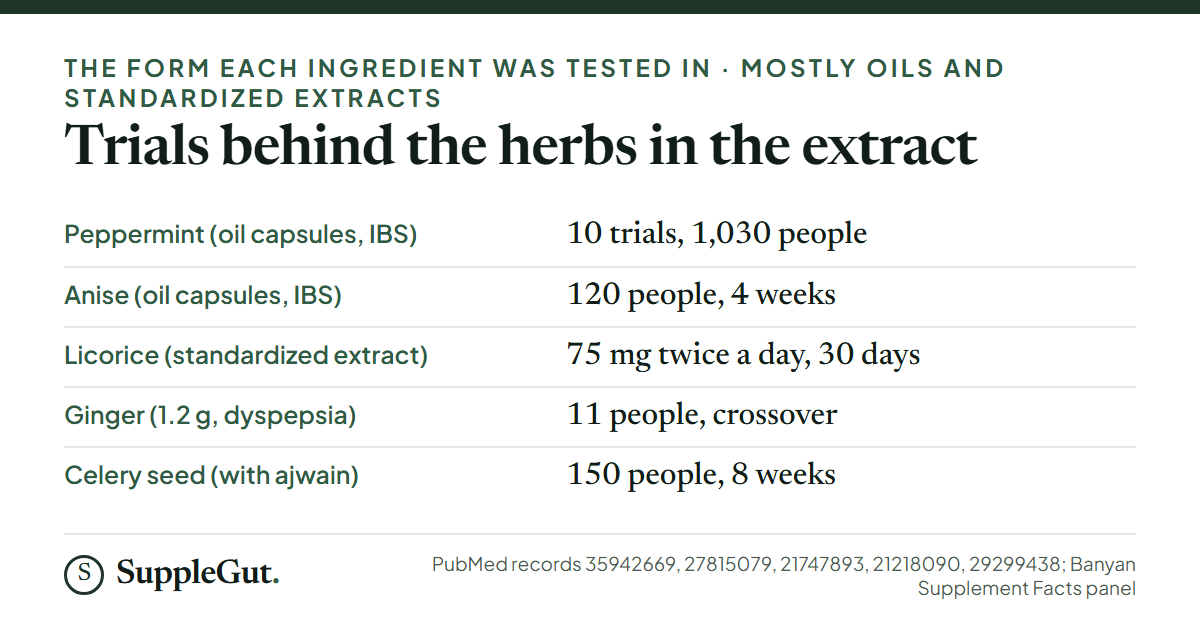
PubMed holds no entry for Easy Digest, and Banyan as an author affiliation alongside Ayurveda returned nothing. The herbs have trials, mostly of oils or standardized extracts, and we found none of a 1:2 alcohol extract like this one.
- Peppermint. A meta-analysis of 10 trials and 1,030 people with IBS found peppermint oil left fewer people without improvement in global symptoms (relative risk 0.65, 95% CI 0.43 to 0.98, number needed to treat 4), with more adverse events than placebo (relative risk 1.57); the authors rate the evidence very low in quality. These were capsules of the oil, not leaf extract (PMID 35942669). The IBgard guide covers a peppermint oil product in detail.
- Anise. In 120 people with IBS, three enteric-coated anise oil capsules a day for 4 weeks left 75% symptom-free against 35% on placebo and 52.5% on a peppermint oil product, by intention to treat (PMID 27815079).
- Licorice. GutGard, a standardized extract, at 75 mg twice a day for 30 days lowered functional dyspepsia scores against placebo (P ≤ 0.05) (PMID 21747893).
- Ginger. In 11 people with functional dyspepsia, 1.2 g of ginger moved gastric half-emptying from 16.1 to 12.3 minutes without changing symptoms (PMID 21218090).
- Fennel, coriander and celery seed. Curcumin plus fennel oil cut IBS severity 50.05% against 26.12% on placebo in 121 people (PMID 27308645); the Carmint coriander blend helped pain and bloating in 32 people with IBS (PMID 16868824); celery plus ajwain beat placebo and omeprazole in 150 people with dyspepsia (PMID 29299438).
The Cochrane review of non-Chinese herbal medicines for functional dyspepsia (41 trials, 4,477 people, 27 herbs) reports peppermint plus caraway oil as probably giving a large improvement at 4 weeks (two studies, 210 people, moderate certainty; caraway is not in this bottle), licorice at one study of 50 people and anise at one study of 107, the latter at low certainty (PMID 37323050).
Most trial doses ran from 75 mg to several grams a day of an oil or extract. A serving of Easy Digest carries 500 mg of herb weight across nine herbs, about 56 mg each if equal, and three servings a day is 1,500 mg in total. The trials show what the herbs can do in their studied forms; none of them tested this extract.
Safety: licorice, alcohol and the metals surveys
The label says not to use it during pregnancy and asks nursing mothers, people on medications and people with a medical condition to consult a practitioner. Licorice is one of the nine herbs, and NCCIH ties its glycyrrhizin to serious effects at small amounts in people with high blood pressure or heart or kidney conditions; the licorice share of the blend is unprinted. Peppermint carried more adverse events than placebo in the IBS trials above, as an oil.
On metals, Banyan says its herbs and products are tested at independent labs for arsenic, cadmium, lead and mercury and meet ANSI 173 and AHPA guidelines; no lab, limits, results or certificate for this bottle turned up. A 2008 survey of 193 Ayurvedic medicines bought online found detectable lead, mercury or arsenic in 20.7% (Saper et al., JAMA, 2008). The extract lists no mineral or metal ingredient, and the survey describes the class, not this bottle.
In the US it is a dietary supplement under DSHEA (1994); the state licenses no Ayurvedic practitioners. In India Ayurveda has a BAMS degree and the AYUSH ministry. A buyer can check the common names (printed), the Supplement Facts panel (present) and a batch certificate (none found). Are Ayurvedic supplements safe has the wider record.
Drops, timing and price
The bottle: 30 drops in water or juice, one to three times a day, shaken well. The page: 30 drops in water two to three times a day, before or after meals. We could not tell which is current. A bottle costs $16.99 for 30 servings, $0.57 each, which is $0.57 to $1.70 a day on the bottle’s range and $1.13 to $1.70 on the page’s. Ayurveda.com’s store and Blue Sky Vitamin list the same price; we found no Amazon listing. Banyan offers AutoShip and a 90-day return, with return shipping paid by the customer.
One rating, hosted by the brand
Banyan’s Judge.me widget shows 4.94 from 34 reviews; of the 32 readable, 30 are five-star and 2 four-star, none lower. Nothing independent sits beside that, and the widget notes that reviews mentioning symptoms or medical conditions are not published. Reviewers praise the taste (“warming and flavorful”), a small bottle that travels, and comfort after meals. The two complaints are a licorice flavor one reviewer found hard to take, softened by lemon, and the alcohol. We read no billing or cancellation complaints.
Who Easy Digest is for, and the neighbors in the line
- Someone who prefers a liquid taken by the drop to a tablet, and is content with alcohol as the solvent.
- Someone who likes bitters before meals and wants an extract of carminative seeds with gentian.
- Someone choosing within the line: Vata Digest is a warming tablet and Pitta Digest a cooling one, each sold by dosha.
The product page is Banyan Botanicals Easy Digest.
The products in this catalog
Common questions
How much alcohol is in a serving of Easy Digest?
The panel prints organic grain alcohol at 45 to 55 percent, and a serving is 1 mL, or 30 drops. That is 0.45 to 0.55 mL of ethanol, about 0.36 to 0.43 g by our arithmetic. Three servings in a day come to roughly 1.1 to 1.3 g.
Is Easy Digest sold by dosha like Vata Digest and Pitta Digest?
No. Its page speaks of appetite and digestive fire (agni) instead of a dosha, and its only dosha wording is the energetics line: balancing for vata and kapha, and it may aggravate pitta in excess. Banyan does not call it a classical formula. See the key concepts guide for the terms.
How many drops, and when?
The bottle says 30 drops in water or juice, one to three times a day. The product page says 30 drops in water two to three times a day, before or after meals, and Banyan told a customer to use half a cup of warm or room-temperature water. Taken before a meal, Banyan describes it as raising digestive fire; after a meal, as supporting post-meal comfort.
Is there an independent rating for it?
We found none. The 4.94 from 34 reviews comes from a review widget hosted on Banyan’s page, which says it does not publish reviews that mention symptoms or medical conditions. Six of the reviews are dated 2007 to 2012, older than the other listings, and we could not confirm where they started.
What does Easy Digest cost?
A 1 fl oz bottle of 30 servings is $16.99 on Banyan’s site and at two other online stores we found, or $0.57 a serving. At the bottle’s one to three servings a day that is $0.57 to $1.70 a day, and at the page’s two to three a day $1.13 to $1.70. At three servings a day a bottle lasts 10 days.
Does the licorice in it matter for blood pressure?
NCCIH says glycyrrhizin can cause serious effects at small amounts in people with high blood pressure or heart or kidney conditions, and that large amounts in pregnancy are unsafe. The panel does not print how much of the 500 mg is licorice, and the label has no licorice line of its own. Anyone in those groups can show the panel to a pharmacist.
Sources
- Banyan Botanicals: Easy Digest liquid extract product page (Supplement Facts, directions, energetics, price, Judge.me reviews), bottle panel photographs, and refund policy. banyanbotanicals.com
- Cochrane review, non-Chinese herbal medicines for functional dyspepsia (41 trials, 4,477 people). PMID 37323050. pubmed.ncbi.nlm.nih.gov/37323050
- Meta-analysis of peppermint oil in IBS, 10 randomized trials, 1,030 people. PMID 35942669. pubmed.ncbi.nlm.nih.gov/35942669
- Trial of enteric-coated anise oil in 120 people with IBS. PMID 27815079. pubmed.ncbi.nlm.nih.gov/27815079
- Trial of GutGard licorice extract in functional dyspepsia, PMID 21747893; ginger crossover trial in 11 people, PMID 21218090. 21747893; 21218090
- Curcumin plus fennel oil in 121 people with IBS (PMID 27308645); Carmint in 32 people with IBS (PMID 16868824); celery plus ajwain in 150 people (PMID 29299438). 27308645; 16868824; 29299438
- Gentian bitter-taste studies on appetite and gastric blood flow. PMIDs 27829482 and 24802704. 27829482; 24802704
- NCCIH: licorice root, safety of glycyrrhizin. nccih.nih.gov/health/licorice-root
- Saper RB, Phillips RS, Sehgal A, et al. “Lead, mercury, and arsenic in US- and Indian-manufactured Ayurvedic medicines sold via the Internet.” JAMA, 2008. PMID 18728265. pubmed.ncbi.nlm.nih.gov/18728265; Ministry of Ayush, India. ayush.gov.in
- Ayurveda.com store listing for Banyan Easy Digest (price). store.ayurveda.com
One answer for your symptoms
If this page raised more questions than it settled, the quiz asks the ones that matter for you and answers with one product.
Take the quiz →