Guide
Does Banyan Vata Digest work? Ten spices under one 1,000 mg weight, and what the trials of each show
Quick answer
Does Banyan Vata Digest work? No study of this tablet or of the hingvastak formula in people turned up; the one formula study we could find used rats. Ginger, asafoetida and black cumin each have a small human trial in functional dyspepsia, using one ingredient at a time, while the label prints one 1,000 mg weight for all ten items. Amazon shows 4.6 from 125 ratings and Banyan’s own review widget 4.65 from 51.
Vata Digest is Banyan Botanicals’ warming tablet, a hingvastak-type spice blend that the brand sells for gas, bloating and slow digestion in what it calls a vata constitution. The panel puts all ten of its ingredients under a single weight, 1,000 mg of proprietary blend per two tablets, so what sets the label apart is the figure it holds back: how much of each spice a tablet contains.
Ten items under one weight
The bottle holds 90 tablets, 45 servings of two, and the Supplement Facts panel reads Proprietary Blend 1000 mg with no Daily Value. US labeling rules list the parts of a blend from heaviest to lightest, which puts amla first and asafoetida last, but they give no ratio. Two 500 mg tablets weigh the same 1,000 mg as the blend, so the gum acacia binder and the extra amla powder named as other ingredients cannot be separated from that figure. Split evenly across ten items it would be about 100 mg each; that is our arithmetic, and the real split is unpublished.
| Printed order | Ingredient | Latin name on the panel |
|---|---|---|
| 1 | Amla fruit (Banyan: Amalaki) | Phyllanthus emblica |
| 2 | Cumin seed | Cuminum cyminum |
| 3 | Black pepper fruit | Piper nigrum |
| 4 | Celery seed (Banyan: Ajamoda) | Apium graveolens |
| 5 | Ginger rhizome | Zingiber officinale |
| 6 | Black cumin seed | Nigella sativa |
| 7 | Long pepper fruit (Banyan: Pippali) | Piper longum |
| 8 | Mineral salt | Not identified |
| 9 | Fenugreek seed | Trigonella foenum-graecum |
| 10 | Asafoetida resin | Ferula assa-foetida |
The bottle prints Made in India, certified organic by QAI, “made with 99% organic herbs,” and Fair for Life status for 78% of the ingredients. The page lists the tablet as free of gluten, soy and dairy. Celery seed is not one of the US major allergens, though it is on the European Union list. The panel says only “Mineral Salt” for the eighth item; rock salt is the salt named in the traditional formula, but Banyan does not say which it uses. No bhasma, metal or gem ingredient is printed.
What hingvastak is, and how far this tablet follows it
Banyan’s page calls the product “also known as hingvastak,” a classical Ayurvedic formula of herbs and spices including ajamoda, cumin and ginger. Hingvashtaka is the asafoetida-led spice formula of the texts. Banyan sells a Hingvastak powder separately, and the tablet departs from it: it adds amla and black cumin and drops other items. Since neither product prints a ratio, the tablet reads as a hingvastak-type blend, not the classical recipe.
Three of the ten are the pungent trio the tradition groups as trikatu: ginger, black pepper and long pepper. Asafoetida, cumin and celery seed are the other kitchen spices; fenugreek and black cumin are seeds used in the same cooking.
Vata, cold and dry: Banyan’s vocabulary
Ayurveda describes three doshas, constitutional principles the texts use to sort people and symptoms, and vata is the one tied to movement and to the qualities of cold, light and dry. Banyan writes that in excess these qualities “inhibit proper digestive function and create discomfort after eating, like gas, bloating, and hard stools.” Its vata guide lists strained elimination, gas, bloating and dry, hard stools among the signs. That is the tradition’s account in its own terms. A dosha is not something a blood test or scan measures, and every trial below enrolled people by diagnosis, not by dosha. The key concepts guide explains doshas and agni, the digestive fire, and the Ayurveda section lists the rest of the series.
The energetics line applies the same logic to the herbs. In Banyan’s classification the blend has a pungent and salty taste (rasa), a heating action (virya) and a pungent after-digestion effect (vipaka). The tradition pairs a heating, pungent blend with cold, dry vata, which is why Banyan calls it balancing for vata and kapha and says it may aggravate pitta. “Heating” is a classification, not a measured temperature.
Has the tablet or the classical formula been tested in people?
PubMed holds no entry for Vata Digest, and a search on Banyan’s name with Ayurveda in the author affiliation returned nothing. The only formula-level study we could find tested hingwashtak churna, the classical powder, in rats: an aqueous extract at 750 mg/kg cut gastric lesions by 84.96% and 91.12% in two ulcer models, against 95.54% and 95.2% for ranitidine (PMID 16784118). It is animal work on the classical powder, not the tablet.
The ingredients, one trial at a time
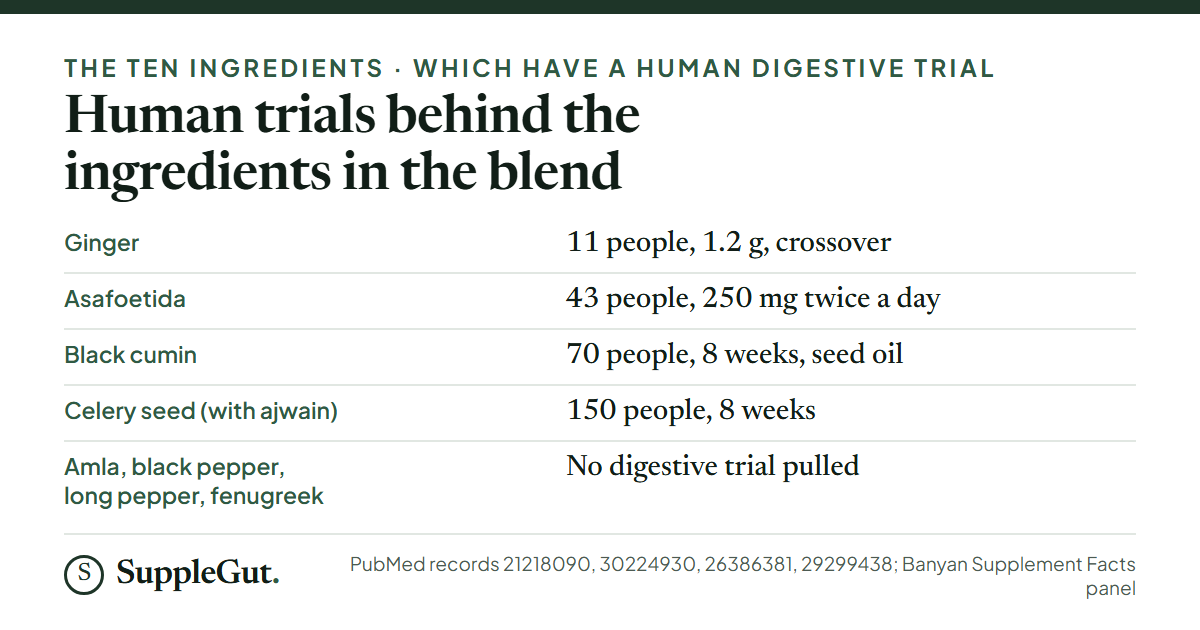
- Ginger. In 11 people with functional dyspepsia, a randomized double-blind crossover of 1.2 g ginger against placebo, gastric half-emptying took 12.3 minutes against 16.1 (P ≤ 0.05), with no change in symptoms or gut hormones (PMID 21218090). A systematic review of ginger in digestive disorders found a divided 1,500 mg daily dose helped nausea and that trials for other conditions were few (PMID 30680163).
- Asafoetida. In 43 people with functional dyspepsia, 250 mg twice a day of a food-grade asafoetida formulation against placebo for 30 days improved validated scores in about 81% of the asafoetida group, with no adverse events reported (PMID 30224930).
- Black cumin. In 70 people with functional dyspepsia, 5 mL a day of a honey-based seed-oil formulation for 8 weeks lowered the dyspepsia severity index against placebo (P < 0.001) (PMID 26386381).
- Celery seed. In 150 people with functional dyspepsia, an Iranian traditional remedy of celery plus ajwain, taken for 8 weeks, lowered symptom severity and frequency more than placebo or omeprazole from week 4. It was a combination with ajwain, not celery alone (PMID 29299438).
- Cumin. In 57 people with irritable bowel syndrome, 20 drops a day of cumin essential oil was followed by less pain, bloating and urgency, but the series had no comparison group (PMID 24829694).
The Cochrane review of non-Chinese herbal medicines for functional dyspepsia (41 trials, 4,477 people, 27 herbs) lists black cumin among the herbs that may improve symptoms (one study of 70 people, high certainty) and asafoetida too (one study of 43, low certainty), while noting black cumin may add little against other treatments (PMID 37323050). For amla, black pepper, long pepper and fenugreek we pulled no digestive trial.
Each trial used one ingredient, an oil or a formulation at its own dose, from 500 mg a day of asafoetida to 1.2 g of ginger. One serving here is 1,000 mg across ten items, and even four tablets a day would be 2,000 mg, about 200 mg each if split evenly. The trials describe what an ingredient can do at a studied dose; none measures this tablet.
Safety: what is printed, what is tested, what is regulated
The label says the tablet is “not to be used during pregnancy” and asks nursing mothers, people taking medications and people with a medical condition to consult a practitioner first. That is the only warning printed; no ingredient-specific one appears. Banyan lists the blend as heating, which it says may aggravate pitta.
On metals, Banyan states that all its herbs and products are tested for arsenic, cadmium, lead and mercury by independent labs and that they fall within ANSI 173 and AHPA guidelines. It names no lab and posts no limits, results or certificate for this tablet; the two certificate pages we tried returned errors. The published context is a survey of 193 Ayurvedic medicines bought online in 2005, where 20.7% (95% CI 15.2 to 27.1) carried detectable lead, mercury or arsenic, 21.7% of US-made products against 19.5% of India-made ones (Saper et al., JAMA, 2008). The FDA has separately warned that unapproved Ayurvedic products can contain lead, mercury and arsenic. Those findings concern the class, not this tablet, and this one prints no mineral, bhasma or metal ingredient.
In the United States the tablet is a dietary supplement under the Dietary Supplement Health and Education Act of 1994, so it is sold on the maker’s own label responsibility, and no state licenses practitioners of Ayurveda. In India Ayurveda is a state-recognized system with a degree (BAMS) and a ministry, AYUSH. What a buyer can check here: the Latin names (printed), a Supplement Facts panel (present), and a batch certificate (none found). Are Ayurvedic supplements safe covers the wider record.
Servings, timing and price
Banyan’s directions: take 1 to 2 tablets once or twice daily, before meals to support appetite or after meals to support digestion, so the range runs from one to four tablets a day. The serving on the panel is two. A bottle is $28.99 on Banyan’s site and on Amazon: $0.64 a day at two tablets, and $0.32 to $1.29 across the label range. Banyan offers AutoShip with a stated 15% banner, free shipping over $60 and otherwise $5.95, and a 90-day return in which the customer pays return shipping.
Reviewer reports
On Amazon the tablet holds 4.6 from 125 ratings, split 78% five-star, 14% four, 3% three, 1% two and 4% one. Banyan’s page runs a Judge.me widget at 4.65 from 51 reviews, of which 33 are readable in the page data (27 five-star, 3 four, 1 three, 1 two, 1 one). That feed is hosted by the brand, and its code carries a notice that reviews mentioning symptoms or medical conditions are not published.
Praise centers on less bloating and gas, a warm, settled feeling, and Banyan’s customer service. Complaints are fewer: one reviewer reported more gas and burping, others a subtle or partial effect, and one an order that never arrived. We found no billing or auto-ship complaints in the reviews we read.
Who Vata Digest is for, and the neighbors in the line
- Someone who wants a spice-based tablet in the hingvastak style and is comfortable with one blend weight in place of ten amounts.
- Someone who takes the tradition’s vocabulary as a guide, since Banyan matches this blend to vata and kapha.
- Someone comparing the line: Pitta Digest is the cooling counterpart, and Easy Digest is a liquid extract not sold by dosha.
The product page is Banyan Botanicals Vata Digest.
Products this guide draws on
Common questions
Does Vata Digest help with gas and bloating?
No trial of the tablet has been published that we could find. Single ingredients in it have small studies in functional dyspepsia, and reviewers on Amazon and on Banyan’s page often write of less bloating and a settled stomach. Banyan’s own review summary also notes that a few buyers saw more gas at first or little benefit.
Why are the herbs listed under one weight instead of one by one?
The panel is a proprietary blend: it prints a total of 1,000 mg per two tablets and names ten items under it without giving their amounts. The printed order runs from heaviest to lightest, so amla is the largest part and asafoetida the smallest, but no ratio can be worked out. Banyan customer care is the only route to the figures.
Is Vata Digest the same thing as Banyan’s Hingvastak powder?
They are related, not identical. Banyan describes Vata Digest as also known as hingvastak, and it sells a Hingvastak powder separately. The tablet adds amla and black cumin and leaves out some of the classical items, and neither product publishes a ratio.
Who is told not to take it?
The label says not to use it during pregnancy, and to speak to a practitioner first if nursing, taking medications or living with a medical condition. Banyan’s own energetics line calls the blend heating and says it may aggravate pitta, a term from the same tradition for heat in the digestion. See are Ayurvedic supplements safe for the wider safety record.
What does a day of Vata Digest cost?
A 90 tablet bottle is $28.99 on Banyan’s site and on Amazon. At two tablets a day that is 45 days, or about $0.64 a day. The label allows one to two tablets once or twice a day, which makes the range $0.32 to $1.29 a day.
Does Banyan publish its metals test results?
Banyan states that its herbs and products are tested for arsenic, cadmium, lead and mercury at independent labs and meet ANSI 173 and AHPA guidelines. We found no lab name, limits, results or batch certificate for this tablet on the brand’s site.
Sources
- Banyan Botanicals: Vata Digest product page (Supplement Facts, directions, energetics, price, Judge.me reviews), quality-control and testing page, and refund policy. banyanbotanicals.com
- Hingwashtak churna, aqueous extract, in rat ibuprofen and ethanol ulcer models. PubMed record, PMID 16784118. pubmed.ncbi.nlm.nih.gov/16784118
- Randomized double-blind crossover of 1.2 g ginger in 11 people with functional dyspepsia (PMID 21218090), and systematic review of ginger in gastrointestinal disorders (PMID 30680163). pubmed.ncbi.nlm.nih.gov/21218090; pubmed.ncbi.nlm.nih.gov/30680163
- Double-blind trial of asafoetida formulation, 250 mg twice a day for 30 days, 43 people with functional dyspepsia. PMID 30224930. pubmed.ncbi.nlm.nih.gov/30224930
- Trial of Nigella sativa seed-oil formulation for 8 weeks, 70 people with functional dyspepsia. PMID 26386381. pubmed.ncbi.nlm.nih.gov/26386381
- Cochrane review, non-Chinese herbal medicines for functional dyspepsia (41 trials, 4,477 people). PMID 37323050. pubmed.ncbi.nlm.nih.gov/37323050
- Uncontrolled series of cumin essential oil in 57 people with IBS (PMID 24829694), and trial of celery plus ajwain in 150 people with functional dyspepsia (PMID 29299438). pubmed.ncbi.nlm.nih.gov/24829694; pubmed.ncbi.nlm.nih.gov/29299438
- Saper RB, Phillips RS, Sehgal A, et al. “Lead, mercury, and arsenic in US- and Indian-manufactured Ayurvedic medicines sold via the Internet.” JAMA, 2008. PMID 18728265. pubmed.ncbi.nlm.nih.gov/18728265
- FDA: warning about heavy metal poisoning associated with certain unapproved Ayurvedic drug products. fda.gov; Ministry of Ayush, India (the ministry for Ayurveda). ayush.gov.in
- Amazon listing for Banyan Botanicals Vata Digest (price, rating, star split). amazon.com/dp/B0057ZFDLY
Want this narrowed to one product?
Reading is one thing, choosing is another. Answer the quiz and it weighs your own symptoms and routine and picks one product.
Take the quiz →