Guide
Does Banyan Pitta Digest work? A cooling nine-herb blend, with guduchi and licorice in it
Quick answer
Does Banyan Pitta Digest work? No study of this blend turned up. Amla alone, at 2 g a day, eased heartburn and regurgitation in a 68-person trial, and a licorice extract lowered dyspepsia scores over 30 days, but the tablet gives one 1,000 mg weight for nine herbs. Guduchi has a published liver-injury case series and licorice contains glycyrrhizin, and the label prints the amount of neither. Amazon shows 4.5 from 199 ratings.
Pitta Digest is the cooling counterpart in Banyan Botanicals’ digest line: nine herbs in a two-tablet, 1,000 mg proprietary blend, built on amla and guduchi with the cumin, coriander and fennel seeds the brand also sells as a tea. Banyan sells it for the heat and sharpness it links to excess pitta after meals. This page reads the panel, sets each herb beside the trials we could find, and then covers two ingredients that carry published safety reports the label does not mention.
Nine herbs and one weight
The Supplement Facts panel reads Proprietary Blend 1000 mg for a serving of two tablets, with no Daily Value, and the herbs below it in a printed order that US rules set from heaviest to lightest. Amla is first and cinnamon last, though no ratio follows from the order. The blend equals the weight of two 500 mg tablets, so the gum acacia binder and the added amla powder in the other ingredients are folded into that same figure. Split evenly the blend gives about 111 mg a herb, our arithmetic and not a label number.
| Printed order | Herb | Latin name on the panel |
|---|---|---|
| 1 | Amla fruit (Banyan: Amalaki) | Phyllanthus emblica |
| 2 | Guduchi, labeled Indian Tinospora stem | Tinospora cordifolia |
| 3 | Cumin seed | Cuminum cyminum |
| 4 | Coriander seed | Coriandrum sativum |
| 5 | Fennel seed | Foeniculum vulgare |
| 6 | Celery seed (Banyan: Ajamoda) | Apium graveolens |
| 7 | Licorice root | Glycyrrhiza glabra |
| 8 | Cardamom pod | Elettaria cardamomum |
| 9 | Cinnamon bark | Cinnamomum verum |
All nine are marked certified organic, and the bottle prints Made in India, certified organic by QAI, and Fair for Life status for 61% of the ingredients. The page calls it free of gluten, soy and dairy and suitable for vegans. No bhasma, mineral or metal ingredient is printed.
Heat, sharpness and digestive fire: Banyan’s account of pitta
In Ayurveda pitta is the dosha of fire and water, digestion and transformation, and the texts treat a strong digestive fire (agni) as healthy up to a point. Banyan puts the limit this way: “when it’s too strong, that excess heat can cause overactive digestion and feelings of discomfort,” with sensations of heat, sharpness and discomfort after eating. Its pitta guide lists a burning digestion and an overactive metabolism among the signs. These are the tradition’s descriptions. Nothing in them is a lab value, and the trials below enrolled people by a Western diagnosis such as reflux or dyspepsia. For the vocabulary in full, see the key concepts guide, and for the section as a whole, Ayurveda on SuppleGut.
By Banyan’s classification the blend tastes bitter, sweet and pungent (rasa), acts as cooling (virya) and finishes sweet after digestion (vipaka). The brand calls it balancing for all doshas, especially pitta, and says it promotes digestion “without aggravating pitta.” The Amazon listing calls cumin, coriander and fennel Ayurveda’s famous digestive trio and sells that trio as a tea. Banyan gives the blend no classical formula name, and Banyan’s page says guduchi contains berberine; we did not check that claim or its amount.
The trials, herb by herb
- Amla. In 68 people with non-erosive reflux disease, two 500 mg amla tablets twice a day after meals for 4 weeks cut the frequency and severity of heartburn and regurgitation more than placebo (P < 0.001). The tablets were amla alone (PMID 29526236).
- Licorice. GutGard, a trademarked flavonoid-rich extract of Glycyrrhiza glabra, at 75 mg twice a day for 30 days lowered functional dyspepsia scores against placebo at days 15 and 30 (P ≤ 0.05). The abstract gives no participant number, and the product is a standardized extract, not plain root (PMID 21747893).
- Fennel. Curcumin plus fennel essential oil, two capsules twice a day for 30 days in 121 people with mild to moderate IBS, cut symptom severity by 50.05% against 26.12% on placebo; 25.9% were symptom-free against 6.8%. It was a combination with curcumin, and an oil (PMID 27308645).
- Coriander. Carmint, an extract of lemon balm, spearmint and coriander, added to loperamide or psyllium for 8 weeks in 32 people with IBS, left pain and bloating lower than placebo (P = 0.016 to 0.002) (PMID 16868824).
- Cumin and celery seed. Cumin essential oil in a 57-person series without a comparison group, and celery plus ajwain in 150 people with dyspepsia over 8 weeks (PMID 24829694; PMID 29299438).
The Cochrane review of non-Chinese herbal medicines for functional dyspepsia (41 trials, 4,477 people) lists licorice among herbs that may improve symptoms against placebo (one study of 50 people, moderate certainty) and cinnamon oil as making little or no difference (one study of 51, low certainty; an oil, not the bark in this tablet). It does not list cumin, coriander, fennel, cardamom, guduchi or amla (PMID 37323050). For cardamom, guduchi and cinnamon bark we found no human digestive trial; PubMed returns rodent and tissue work for cardamom.
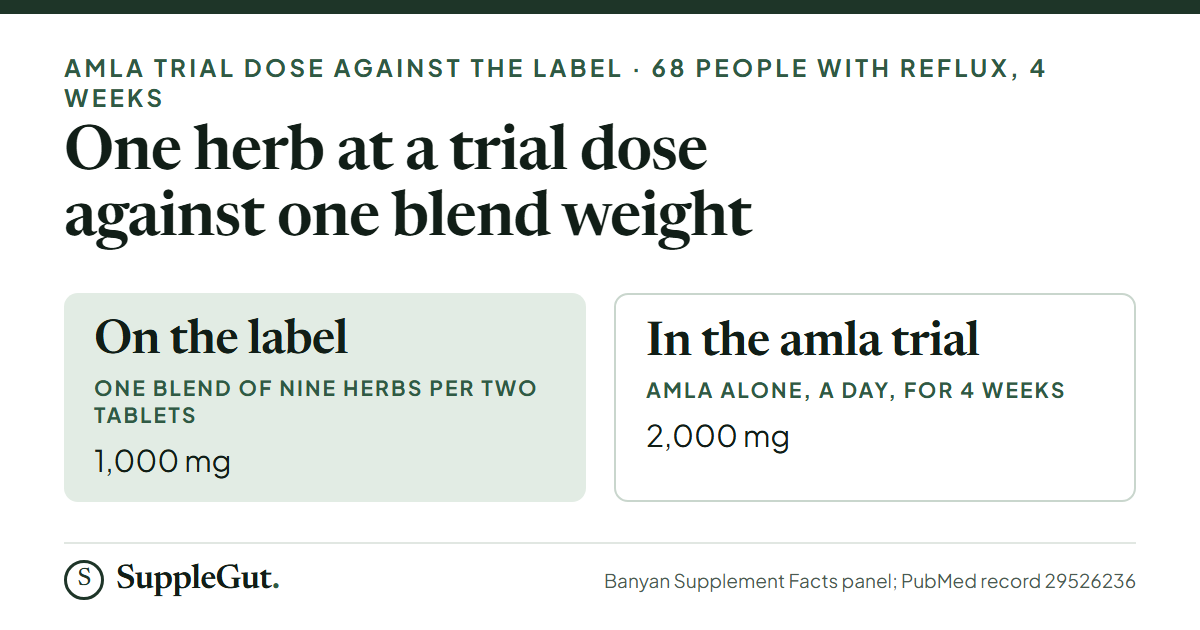
The trials used 75 mg to 2 g a day of one herb or extract. The tablet gives 1,000 mg across nine herbs per serving, and the most the label allows, four tablets, is a 2,000 mg blend. The amla trial is the only one whose daily dose even matches the blend weight, and amla there was the whole dose.
Safety: guduchi, licorice and the metals surveys
Guduchi. A 13-center Indian study described 43 people with herb-induced liver injury linked to Tinospora cordifolia, known as giloy; symptoms began a median of 46 days after first use, the link was rated probable in 67.4%, and some cases had autoimmune features (PMID 35037744). Further case reports and commentary followed (PMIDs 34511809, 35068778, 37273324). The abstracts do not give the doses or the products, so they say nothing about the guduchi in this tablet, whose amount is unprinted.
Licorice. The compound glycyrrhizin in licorice root can cause serious effects, which the NIH’s National Center for Complementary and Integrative Health links to small amounts in people with high blood pressure or heart or kidney conditions, and to large amounts in pregnancy. The panel gives licorice root an unprinted share of the 1,000 mg, and the label has no licorice-specific line; it carries the pregnancy, nursing, medication and medical-condition warning and nothing more.
Metals. Banyan states that it tests for arsenic, cadmium, lead and mercury at independent labs and follows ANSI 173 and AHPA guidelines, with no lab, limits or certificate published for this tablet. In a survey of 193 Ayurvedic medicines bought online, detectable lead, mercury or arsenic turned up in 20.7%, and in 40.6% of the products that combine herbs with metals (rasa shastra) against 17.1% of the rest; 75% of the metal-containing products claimed good manufacturing practice (Saper et al., JAMA, 2008). Pitta Digest lists no such metal ingredient, and the survey is class context.
In the US this is a supplement under DSHEA (1994), and Ayurvedic practitioners hold no state license; in India the system is state-recognized, with a BAMS degree and the AYUSH ministry. What a buyer can check: Latin names (printed), a Supplement Facts panel (present), a batch certificate (none found). Are Ayurvedic supplements safe sets out the wider record.
Servings, timing and price
The brand’s directions: 1 to 2 tablets once or twice daily, before meals to support appetite or after meals to support digestion, which allows one to four tablets in a day; the panel’s serving is two. A 90 tablet bottle costs $27.99 on Banyan’s site and $29.99 on Amazon, so $0.62 a day at two tablets and $0.31 to $1.24 over the full range. Banyan lists AutoShip under a 15% banner and a 90-day return with return shipping paid by the customer.
Reviewer reports
Amazon shows 4.5 from 199 ratings (75% five-star, 12% four, 5% three, 4% two, 4% one), and Banyan’s own Judge.me widget shows 4.70 from 44, with 33 readable: 25 five-star, 7 four-star and 1 two-star. Some of the Judge.me reviews describe a Pitta bundle or other Banyan products, so the pool is not only this tablet, and the only two-star objects to wording in a Banyan video about pitta, not to the tablet.
Reviewers praise a cooling effect after rich or spicy meals, easier digestion overall, and a gentle, pleasant-tasting tablet with a fresh herb smell. One found the full dose too intense and settled on two a day, one noted the color change described above, and one in Italy reported difficult customs clearance. We found no billing complaints, and one reviewer says they are now on auto-ship.
Who Pitta Digest is for, and the neighbors in the line
- Someone who wants a seed-based, cooling-classified blend in tablet form and accepts one weight for nine herbs.
- Someone who has read the guduchi and licorice reports and wants to put the label’s unprinted amounts to Banyan before buying.
- Someone comparing the line: Vata Digest is the warming blend, and Easy Digest is an alcohol extract not sold by dosha.
The product page is Banyan Botanicals Pitta Digest.
The entries this page refers to
Common questions
Does Pitta Digest cool the stomach?
Cooling is Banyan’s classification, not a measurement: the page lists the blend as cooling in action (virya) and balancing for all doshas, especially pitta. Reviewers write of it calming things after fiery meals, which is their experience of it. No trial of the tablet tested that.
Is guduchi in Pitta Digest linked to liver problems?
Guduchi (Tinospora cordifolia, also called giloy) was tied to herb-induced liver injury in a 43-person Indian study, with symptoms a median of 46 days after first use and a probable link in 67.4% of cases. The doses and products in those reports are not stated in the abstract, so they cannot be compared with this tablet. The panel prints no guduchi amount.
Should anyone with high blood pressure avoid the licorice in it?
NCCIH says glycyrrhizin in licorice can cause serious effects, at small amounts in people with high blood pressure or heart or kidney conditions, and that large amounts in pregnancy are unsafe. The tablet contains licorice root at an unprinted amount, and the label carries only the standard pregnancy, nursing and medication line. Anyone in those groups can bring the panel to a pharmacist.
How does the amla trial compare with the tablet?
The trial gave 68 people two 500 mg amla tablets twice a day, 2 g of amla a day, for 4 weeks. Four Pitta Digest tablets, the top of the label range, make 2,000 mg of a blend in which amla is one of nine herbs. The two cannot be matched dose for dose.
How much does Pitta Digest cost a day?
A 90 tablet bottle is $27.99 on Banyan’s site and $29.99 on Amazon. At the two tablets a day on the panel that is 45 days, about $0.62 a day, and the label range of one to four tablets spans $0.31 to $1.24 a day.
Why did one reviewer say the tablets changed color?
An Amazon reviewer wrote that the tablets are now brownish where they used to be greenish, and easier to swallow. That is one reviewer’s observation, and we found no statement from Banyan about a change in the formula.
Sources
- Banyan Botanicals: Pitta Digest product page (Supplement Facts, directions, energetics, price, Judge.me reviews), quality-control and testing page, and refund policy. banyanbotanicals.com
- Randomized double-blind trial of amla tablets, 2 g a day for 4 weeks, in 68 people with non-erosive reflux disease. PMID 29526236. pubmed.ncbi.nlm.nih.gov/29526236
- Trial of GutGard licorice extract, 75 mg twice a day for 30 days, in functional dyspepsia. PMID 21747893. pubmed.ncbi.nlm.nih.gov/21747893
- Trial of curcumin plus fennel essential oil in 121 people with IBS. PMID 27308645. pubmed.ncbi.nlm.nih.gov/27308645
- Carmint (lemon balm, spearmint, coriander) in 32 people with IBS, PMID 16868824; cumin essential oil in 57 people, PMID 24829694; celery plus ajwain in 150 people, PMID 29299438. 16868824; 24829694; 29299438
- Cochrane review, non-Chinese herbal medicines for functional dyspepsia (41 trials, 4,477 people). PMID 37323050. pubmed.ncbi.nlm.nih.gov/37323050
- Thirteen-center Indian study of herb-induced liver injury linked to Tinospora cordifolia, 43 people. PMID 35037744 (related reports PMIDs 34511809, 35068778, 37273324). pubmed.ncbi.nlm.nih.gov/35037744
- NCCIH: licorice root, safety of glycyrrhizin. nccih.nih.gov/health/licorice-root
- Saper RB, Phillips RS, Sehgal A, et al. “Lead, mercury, and arsenic in US- and Indian-manufactured Ayurvedic medicines sold via the Internet.” JAMA, 2008. PMID 18728265. pubmed.ncbi.nlm.nih.gov/18728265; Ministry of Ayush, India. ayush.gov.in
- Amazon listing for Banyan Botanicals Pitta Digest (price, rating, star split, reviews). amazon.com/dp/B001FAROHQ
From the general to your case
The trials above are the general case. The quiz applies them to yours: symptoms, medicines, routine, and what you have already tried.
Take the quiz →