
Guide
Does Daily Nouri work? Three coded strains with trials behind them, and a label that prints no count
Quick answer
Does Daily Nouri work? We found no trial of the capsule itself. Its three strain codes were tested in a four-week placebo-controlled trial of 60 healthy adults, where a diarrhea score fell more than on placebo, and in IBS trials of 84 and 55 people, where quality-of-life scores improved but overall symptom relief did not differ in the larger one. The label prints no CFU, so the dose cannot be compared with the trial’s 3 billion. Amazon shows 4.5 from 259 ratings.
Daily Nouri Digestive Support Probiotic is a once-a-day capsule holding three coded bacterial strains, wrapped in an outer capsule of plant oil. What sets it apart is the strains: the same trio has human trials behind it, none of them on this product. This page covers the label, the trials, the reviews, the price, and how this Nouri differs from the one in the Instagram ads.
What Daily Nouri Digestive Support is, and what it is not
The Supplement Facts panel lists two blends. The “Floradapt Intensive G.I. Blend” names Lactobacillus plantarum KABP-022, Lactobacillus plantarum KABP-023 and Pediococcus acidilactici KABP-021; the “Omega 3,6,9 Blend” comes from Ahiflower seed oil. A serving is one capsule, a bottle holds 30, and the capsule is a capsule-in-capsule: an inner probiotic capsule inside an outer one made of the oil. The box also reads “2x effective delivery” and “clinically supported,” which are the brand’s claims.
All three strains carry a code, and the trial paper identifies them with culture-collection deposits (CECT 7483, 7484 and 7485). The deposit numbers come from the paper, not the label. The panel prints no CFU, per strain or in total, and no weight for the omega blend; the amount and %DV columns are blank. The brand lists it as vegan, gluten-free and dairy-free.
The brand’s product page FAQ and Amazon’s ingredient field still list a different, five-strain formula (L. plantarum UALp-05, L. acidophilus UALa-01, B. lactis UABla-12, B. longum UABl-14 and B. bifidum UABb-10). The current label image and the page’s own key-ingredients list show the three KABP strains, so we read the five-strain text as left over from an earlier formula. Older ratings may describe the earlier “Digestive Health Probiotic.”
Is there a trial of Daily Nouri itself?
We found none. Searches for the brand name and the three strain codes turned up no trial of this capsule, and the brand’s “2x” delivery claim cites no study on the page we read. The brand’s FAQ says several clinical trials are underway; no results were found. The evidence sits with the strains.
The trials of the three strains
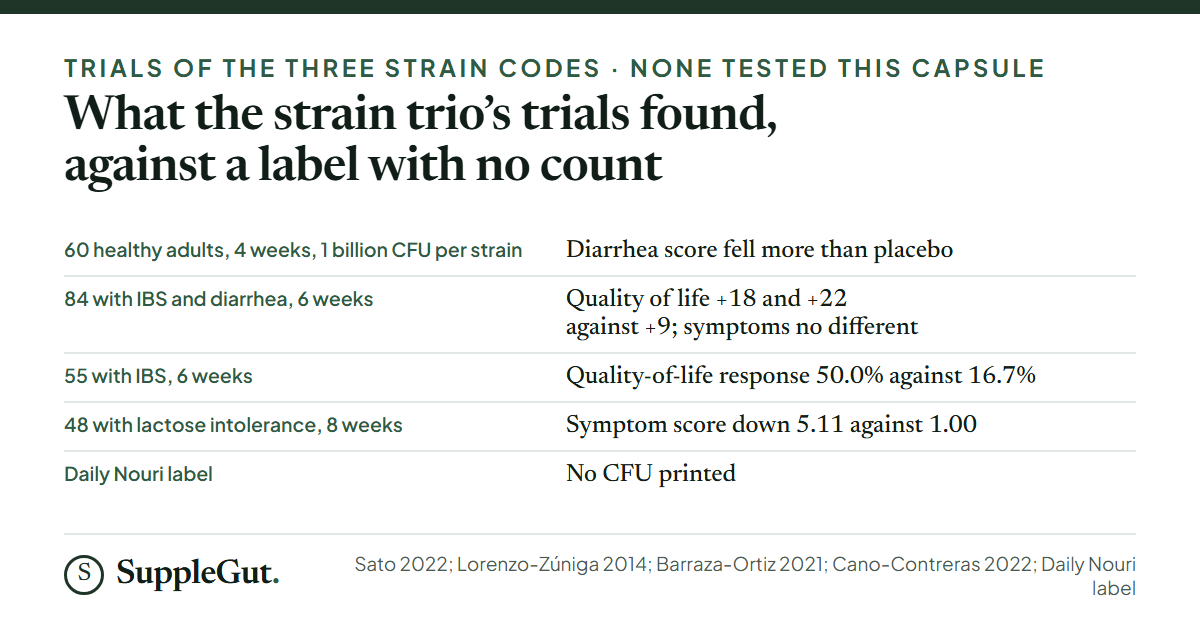
The closest match to the label is a randomized, double-blind, placebo-controlled trial of the exact codes, KABP-021, 022 and 023. It enrolled 60 healthy Japanese adults living under stressful conditions, 30 on the capsule and 30 on placebo, all of whom finished. They took one capsule a day for four weeks at 1 billion CFU per strain, 3 billion in all. A diarrhea score fell more on the capsule than on placebo, a mental-health score improved, and the paper reports a correlation between the diarrhea improvement and the abundance of Faecalibacterium, a gut bacterium. Other abdominal and constipation scores did not differ between groups. The authors are employees of Kaneka Corporation, which appears to market the strain codes (Sato et al., Heliyon, 2022).
The same trio, under the codes I.31 and i3.1, has three smaller trials in people with gut conditions:
- 84 people with IBS and diarrhea, six weeks, high dose, low dose or placebo. IBS quality-of-life scores rose 18 and 22 points on the two doses against 9 on placebo, and gut-specific anxiety improved more. Symptom relief did not differ between groups, which makes this the largest trial of the trio and the one with the mixed result (Lorenzo-Zúñiga et al., World Journal of Gastroenterology, 2014).
- 55 people with IBS, six weeks, the probiotic with or without an antispasmodic. A quality-of-life response was reached by 50.0% on the probiotic and 68.4% on the combination against 16.7% on placebo, and an abdominal-pain response by 38.9%, 57.9% and 16.7% (Barraza-Ortiz et al., Digestive Diseases, 2021).
- 48 adults with lactose intolerance, eight weeks. Total symptom score after a lactose challenge fell 5.11 points against 1.00 on placebo, while the breath-test result did not differ between groups (Cano-Contreras et al., Journal of Clinical Gastroenterology, 2022).
Put together, that is one four-week trial in healthy adults and three small trials in IBS and lactose intolerance, none of which tested this capsule, its oil or its delivery claim. The label prints no count to compare with the 3 billion CFU of the healthy-adult trial.
For context, a 2023 meta-analysis of 82 randomized trials in 10,332 adults with IBS rated the certainty of benefit from combination probiotics for global symptoms, abdominal pain and bloating as very low (Goodoory et al., Gastroenterology, 2023). What a CFU count does and does not predict is covered in the CFU guide.
How to take it
The label gives one capsule a day, with or without food, and the capsule is shelf-stable. The brand directs taking it once daily for at least 12 weeks, three times the length of the healthy-adult trial and twice that of the IBS trials. The brand’s own FAQ says mild gas or bloating in the first week or two is common as the gut adjusts, and tells people to stop if anything persists.
Side effects and who should check first
The panel prints no warnings. The brand’s FAQ advises talking to a healthcare provider before taking any supplement during pregnancy or breastfeeding, and asking a provider about timing if you take prescription medication, including antibiotics. On Amazon, 5 of 21 digestibility mentions in the review summary are negative, and individual reviewers describe bloating, diarrhea and cramps in the second week. The usual effects and when to stop are in the probiotic side effects guide.
What the reviews say
Amazon shows 4.5 out of 5 from 259 ratings: 75% five-star, 12% four, 6% three, 4% two and 3% one. Amazon’s summary of review text counts 41 mentions of effectiveness (37 positive), 21 of digestibility (16 positive) and 6 of taste (3 positive, 3 negative). Praise centers on less bloating within days to weeks, a capsule that is easy to swallow and easy on the stomach, and the citrus smell of the capsule. The complaints are digestive upset in the second week, the taste or smell, a dark label on a dark jar that is hard to read.
The brand’s own page runs a review app showing 4.9 from 97 reviews. That is a review feed the brand hosts, and the five reviews we read on its first page carry the older product name. Trustpilot has an unclaimed profile for dailynouri.com with no reviews, so there is no independent billing or refund record for the brand to read.
Not the same Nouri as the Instagram ads
Instagram ads for a “Nouri” send people to try-nouri.com. That site is run by a different business and sells a breath capsule, which its own FAQ says is not a probiotic. Its Trustpilot profile shows 11 reviews, all one star, about an unexpected membership charge and refund requests. We found no link between that business and dailynouri.com, whose Daily Nouri products are the ones on this page.
Price, the subscription and the refund terms
A 30-capsule bottle is a 30-day supply. It is $29.99 on the brand site, which is $1.00 a day, and $29.69 on Amazon ($0.99). A brand subscription takes 10% off, about $0.90 a day, and Amazon’s Subscribe & Save price is $26.72 ($0.89).
The brand’s published terms: a subscription ships every 30 days with free shipping, and can be paused, skipped or cancelled from the account page before the next billing date, with a reminder email before each renewal. A 30-day satisfaction guarantee is available by emailing the brand within 30 days of delivery. The refund policy page also says an item must be unused and in its original packaging, and it does not say how an opened bottle is handled. Amazon lists the item as non-returnable unless damaged or defective. Single bottles can be bought without subscribing.
Who Daily Nouri is for
- Someone whose main complaint is loose stools or stress-related gut upset, the outcomes where the strain trio’s trial moved a score.
- Someone who wants strains with codes and their own trials and accepts that the label prints no count.
- Someone willing to take one capsule daily for several weeks.
For a single, well-studied strain with a printed count, see Culturelle and Jarrow IBS 299v. Seed DS-01 has a trial of its finished capsule, and the BIOHM guide sets out another named-strain blend. If loose stools are the main issue, the loose stools guide starts from the symptom, as do the which probiotic guide and the quiz.
The products in this catalog
Common questions
Does Daily Nouri Digestive Support Probiotic work?
No trial of this capsule was found. Its three strain codes were tested in a four-week placebo-controlled trial of 60 healthy adults, where a diarrhea score fell more than on placebo, and in IBS trials of 84 and 55 people with mixed results. On Amazon, 37 of 41 effectiveness mentions in the review summary are positive.
What strains and how many CFU are in Daily Nouri?
The label lists L. plantarum KABP-022, L. plantarum KABP-023 and Pediococcus acidilactici KABP-021 in a capsule-in-capsule with Ahiflower oil. It prints no CFU and no omega amount. The healthy-adult trial of the same codes used 1 billion CFU per strain, and the brand’s page and Amazon’s ingredient field still list an earlier five-strain formula.
Is Daily Nouri safe, and what are the side effects?
The brand says mild gas or bloating in the first week or two is common, and advises stopping if anything persists. It advises talking to a provider if you are pregnant, breastfeeding or taking prescription medication, including antibiotics. On Amazon, 5 of 21 digestibility mentions are negative, and some reviewers describe cramps and diarrhea in the second week.
How much does Daily Nouri cost?
A 30-capsule bottle is a 30-day supply. It is $29.99 on the brand site ($1.00 a day) and $29.69 on Amazon ($0.99). A brand subscription takes 10% off, about $0.90 a day, and Amazon Subscribe & Save is $26.72 ($0.89).
Can you cancel Daily Nouri and get a refund?
The brand states a 30-day satisfaction guarantee by email within 30 days of delivery, and says a subscription can be paused, skipped or cancelled before the next billing date. Its refund policy page also says items must be unused and in original packaging, without saying how an opened bottle is handled. Amazon orders are non-returnable unless damaged or defective.
Is the Nouri advertised on try-nouri.com the same as Daily Nouri?
We found no link between them. try-nouri.com is run by a different business and sells a breath capsule that its own FAQ says is not a probiotic. Its Trustpilot profile shows 11 reviews, all one star, about an unexpected membership charge and refunds, while dailynouri.com’s Trustpilot profile has no reviews.
How does Daily Nouri compare with Culturelle?
Daily Nouri has three coded strains (two L. plantarum and a Pediococcus) in a capsule-in-capsule with plant oil and prints no CFU. Culturelle is built on the single strain Lactobacillus rhamnosus GG. The strains and trial bases differ, so a trial of one does not carry over to the other. The Culturelle page has its label.
Sources
- Sato T, Honda S, Tominaga Y, et al. “A probiotic blend improves defecation, mental health, and productivity in healthy Japanese volunteers under stressful situations.” Heliyon, 2022;9:e10614. PubMed 36185155
- Lorenzo-Zúñiga V, Llop E, Suárez C, et al. “I.31, a new combination of probiotics, improves irritable bowel syndrome-related quality of life.” World Journal of Gastroenterology, 2014;20(26):8709–8716. PubMed 25024629
- Barraza-Ortiz DA, Pérez-López N, Medina-López VM, et al. “Combination of a Probiotic and an Antispasmodic Increases Quality of Life and Reduces Symptoms in Patients with Irritable Bowel Syndrome: A Pilot Study.” Digestive Diseases, 2021;39(3):294–300. PubMed 32810850
- Cano-Contreras AD, Minero Alfaro IJ, Medina López VM, et al. “Efficacy of i3.1 Probiotic on Improvement of Lactose Intolerance Symptoms: A Randomized, Placebo-controlled Clinical Trial.” Journal of Clinical Gastroenterology, 2022;56(2):141–147. PubMed 33136781
- Barbaro MR, et al. The three strains in a cell model of IBS permeability changes. Gut Microbes, 2025. PubMed 39817446
- Goodoory VC, Khasawneh M, Black CJ, et al. “Efficacy of Probiotics in Irritable Bowel Syndrome: Systematic Review and Meta-analysis.” Gastroenterology, 2023;165(5):1206–1218. PubMed 37541528
- Daily Nouri: product page, label image, FAQ, subscription and refund pages, and price. dailynouri.com
- Amazon listing for Daily Nouri Digestive Support Probiotics (ASIN B07M93FFMK): ingredient field, price, ratings and review summary. amazon.com
- try-nouri.com: product page and FAQ; Trustpilot profile for try-nouri.com. trustpilot.com
Not sure which product fits your situation?
This guide covers the mechanics. The quiz takes your specific symptoms, routine and preferences and matches you to one product from the catalog.
Take the quiz →