
Guide
Does BIOHM Total Probiotic work? One brand-collaborated trial, four house strain codes, and a yeast in the mix
Quick answer
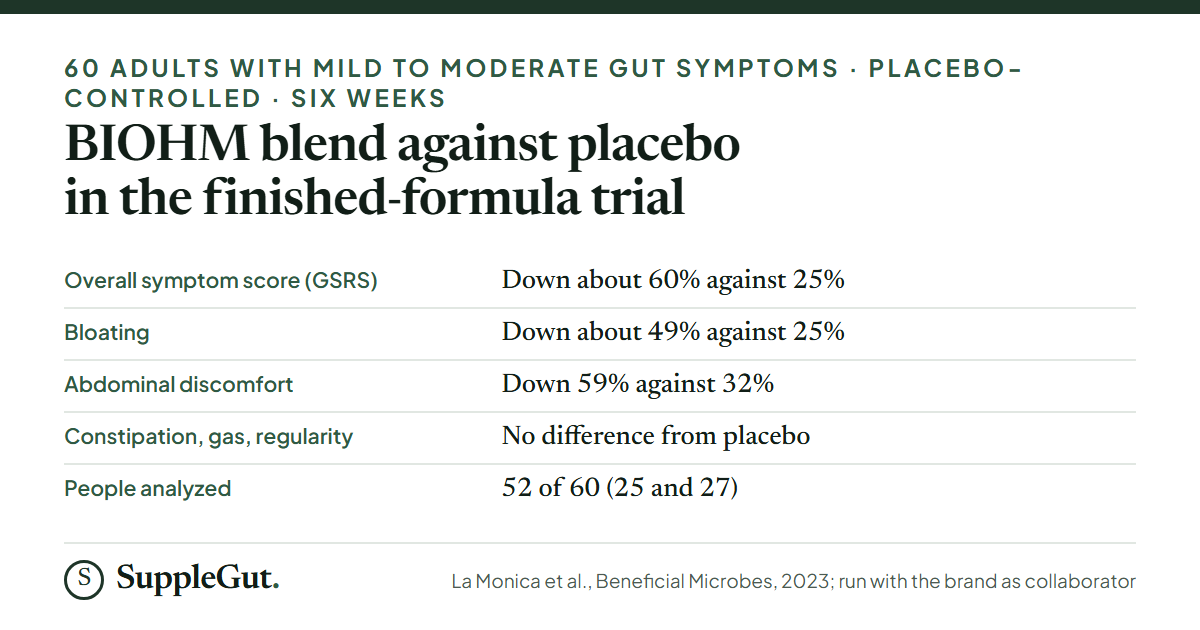
Does BIOHM Total Probiotic work? One randomized trial of the finished capsule (60 adults with mild to moderate gut symptoms, 52 analyzed, six weeks) found the overall symptom score fell about 60% against 25% on placebo, bloating about 49% against 25%, and abdominal discomfort 59% against 32%. Constipation, gas and regularity did not differ from placebo. The brand collaborated on the trial and no independent replication was found. Amazon shows 4.5 from 877 ratings.
BIOHM Total Gut Probiotic is a once-a-day capsule that pairs three bacteria with a yeast, Saccharomyces boulardii, and an enzyme, amylase, in one blend. What sets it apart is a randomized trial of the finished formula, one the brand collaborated on. This page covers what the label prints and leaves out, what the trial found, what the yeast adds to the caution list, and what the reviews and subscription terms show.
What BIOHM Total Gut Probiotic is, and what it is not
The Supplement Facts panel lists one proprietary blend, BIOHM FX, at 660 mg, stated as 30 billion CFU at the time of manufacture. Inside it, in print order, are Lactobacillus acidophilus 16axg, Saccharomyces boulardii 16mxg, Lactobacillus rhamnosus 18fx, Bifidobacterium breve 19bx and amylase. The other ingredients are hypromellose and microcrystalline cellulose; a serving is one capsule and the bottle holds 30.
All four organisms carry a code, but the codes are the brand’s own trademarks, and the label prints no culture-collection accession number. The brand’s site says its founder’s team obtained the strains from the American Type Culture Collection, a claim a reader cannot check from the bottle. The label also prints no count for any single organism and no amount for the amylase. The brand’s own trial paper fills both gaps: 12.8 billion CFU each of L. acidophilus and L. rhamnosus, 3.0 billion of S. boulardii, 1.3 billion of B. breve, and 500 SKB of amylase. That puts about 85% of the count in the two Lactobacillus strains and about 10% in the yeast.
The trial of the finished capsule
In a randomized, double-blind, placebo-controlled trial, 60 adults with mild to moderate gut symptoms on the Gastrointestinal Symptom Rating Scale (GSRS) were assigned to one capsule a day of the blend (29 people) or placebo (31) for six weeks. Fifty-two were analyzed, 25 on the blend and 27 on placebo. The overall GSRS score fell about 60% on the blend against about 25% on placebo. Bloating fell about 49% against 25%, and abdominal discomfort 59% against 32%. Those three group differences were statistically significant, and the capsule was reported as very well tolerated (La Monica et al., Beneficial Microbes, 2023).
What did not separate from placebo: constipation, gas and stool regularity improved over time in both groups, with no significant difference between them. For a shopper whose main complaint is one of those, the trial does not show a gain over placebo.
The brand’s product page describes the trial as 60 healthy adults; the paper describes people with mild to moderate gut symptoms. The trial registry lists the brand as a collaborator, and the founder, whom the brand presents as a mycologist directing a university medical mycology center, is a co-author of the follow-up paper, whose conflict statement calls him a founding partner of the company. We found no replication by a group unconnected to the brand.
The trial capsule may also differ from today’s: the registry describes a 575 mg blend, and the paper lists rice maltodextrin, vegetable cellulose and magnesium stearate, while the current label prints 660 mg with hypromellose and microcrystalline cellulose. We could not confirm whether the actives and carrier match. Six weeks also says nothing about month three.
The other BIOHM studies
A second paper sequenced stool samples from the same 52 participants. On the blend, a baker’s-yeast species, Saccharomyces cerevisiae, rose about 200-fold and its prevalence went from roughly 20% to roughly 60%, and two potential pathogens fell more than 150-fold. The link to symptoms is exploratory, and the paper discloses a grant from the brand (Ghannoum et al., Life, 2024). An earlier open-label study of 49 volunteers over four weeks, with no placebo group, reported a fall in Candida abundance and called the finding preliminary (Ghannoum et al., Current Issues in Molecular Biology, 2021).
A second randomized trial is registered: 141 participants, BIOHM FX at 1 billion CFU, at 3 billion CFU, or placebo, with change in GSRS as the main outcome. It has no results posted and no publication that we could find. Its two doses are one thirtieth and one tenth of this capsule’s 30 billion.
The “digestive plaque” claim
The brand’s argument is that bacteria and fungi form films together in the gut and that amylase helps break them down. The papers behind that sit in the laboratory and in mice. One showed that a filtrate from the probiotic combination reduced Candida-containing biofilms in a dish (Hager et al., mBio, 2019). Another gave the blend, with and without amylase, to mice with Crohn’s-like ileitis over 56 days (Di Martino et al., Inflammatory Bowel Diseases, 2023). We found no human trial showing that dietary amylase breaks down a gut biofilm, so the mechanism is a hypothesis.
The yeast and who should check first
One of the four organisms, S. boulardii, is a yeast. A 2023 systematic review of Saccharomyces bloodstream infections found 108 cases, and 73 of them (67.6%) were in patients who had been given S. boulardii probiotics. Risk factors included intensive care stays (31.5%) and tube or intravenous feeding (29.6%); these were hospital patients, not healthy people taking a capsule at home (Vinayagamoorthy et al., Medical Mycology, 2023). The bottle’s warning is the general line to consult a healthcare provider if pregnant, nursing, taking medication or with a medical condition. Common effects are in the probiotic side effects guide.
For the yeast as a species, see the Pure TheraPro guide and the Florastor alternatives guide. A 2023 meta-analysis of 82 trials found very low certainty of benefit from combination probiotics in IBS for global symptoms, pain and bloating (Goodoory et al., Gastroenterology, 2023).
How to take it
The bottle says one capsule daily with food, and that the capsule can be opened and mixed into food or a drink. The trial ran six weeks; one bottle is 30 days. Amazon’s ingredient text names the blend “PathoBiome” and lists an enteric coating, neither of which is on the brand’s current label.
What the reviews say
On Amazon the listing shows 4.5 out of 5 from 877 ratings, 78% of them five-star and 9% one or two stars. Amazon’s summary of review text counts 142 mentions of effectiveness (129 positive) and 149 of digestibility (129 positive), and 71 mentions of value, 38 positive and 33 negative. Praise centers on less bloating and a capsule gentler than other probiotics; complaints are price and no change after a bottle.
The brand’s own review widget shows 4.76 from 497 reviews on the product page, while the widget’s feed holds 459, and we could not reconcile the counts. Of the 459, 127 are flagged as incentivized and only 11 date from 2025 or 2026.
The brand’s Trustpilot profile is brand-wide, mostly about its gut test kit, with subscription and cancellation complaints, and says little about the capsule.
Price, the subscription and the refund terms
A bottle is $34.99 on the brand site, which is $1.17 a day, and $34.97 on Amazon. The brand shows $29.74 on subscription ($0.99 a day), and Amazon’s Subscribe & Save price is $27.98 ($0.93). At the same catalog measure Florastor is $1.31 a day and Seed DS-01 is $2.00.
The brand’s published terms: subscriptions charge every 4 weeks, which for a 30-day bottle means each one arrives about two days early; they can be edited, skipped or cancelled before renewal from the account page; and a 60-day money-back guarantee is available by email request. Amazon lists the item as non-returnable unless damaged or defective. A single bottle can be bought without subscribing. The billing complaints we read are older: auto-ship gaps, a year paid for with three months shipped, and account login trouble.
Who BIOHM Total Gut Probiotic is for
- Someone whose main complaints are bloating and abdominal discomfort, the outcomes where the trial separated from placebo.
- Someone who wants the probiotic with a trial of its own formula and accepts that the brand collaborated on it.
- Someone comfortable with a blend that prints one CFU figure and no per-organism counts.
For a yeast on its own, see Florastor and Jarrow. Seed DS-01 also has a trial of its finished capsule, set out in the Seed guide. The CFU guide explains what a count predicts, and the which probiotic guide and the quiz start from the symptom.
The products in this catalog
Common questions
Does BIOHM Total Probiotic work?
One randomized, placebo-controlled trial of the formula (60 adults with mild to moderate gut symptoms, 52 analyzed, six weeks) found larger drops than placebo in the overall symptom score, bloating and abdominal discomfort, but not in constipation, gas or regularity. The brand collaborated on the trial and we found no independent replication. On Amazon, 78% of 877 ratings are five-star.
What strains are in BIOHM Total Probiotic?
The label lists L. acidophilus 16axg, S. boulardii 16mxg, L. rhamnosus 18fx and B. breve 19bx, plus amylase, in one 660 mg blend of 30 billion CFU at manufacture. The codes are the brand’s own trademarks with no culture-collection number, and the label prints no per-organism count or amylase amount. The trial paper gives 12.8, 12.8, 3.0 and 1.3 billion CFU and 500 SKB of amylase.
Is BIOHM Total Probiotic safe, and what are the side effects?
The label advises consulting a healthcare provider if pregnant, nursing, taking medication or with a medical condition, and the trial reported the capsule as very well tolerated. One organism is a yeast, S. boulardii; a 2023 review of 108 cases of Saccharomyces bloodstream infection found most were in patients given S. boulardii probiotics, mainly critically ill hospital patients. On Amazon, 20 of 149 digestibility mentions are negative.
What is the “digestive plaque” claim?
The brand says amylase helps break down films formed by bacteria and fungi in the gut. The supporting papers are a laboratory study of biofilms in a dish and mouse studies. We found no human trial showing it happens in the gut, and the six-week trial measured symptoms and stool microbes, not biofilms.
How much does BIOHM Total Probiotic cost?
A 30-capsule bottle is a 30-day supply. It is $34.99 on the brand site ($1.17 a day) and $34.97 on Amazon, or $27.98 with Subscribe & Save ($0.93 a day). The brand shows $29.74 on subscription, which is $0.99 a day.
Can you cancel BIOHM and get a refund?
The brand states a 60-day money-back guarantee by email request, and says a subscription, which charges every 4 weeks, can be edited, skipped or cancelled before renewal from the account page. Older brand-site reviews describe auto-ship gaps and a prepaid year that shipped three months of product. Amazon purchases are non-returnable unless damaged or defective.
How does BIOHM compare with Florastor?
BIOHM combines two Lactobacillus strains, a Bifidobacterium and S. boulardii with amylase in one 30 billion CFU blend, while Florastor is a single-yeast capsule. BIOHM has one trial of its own formula, run with the brand’s collaboration; the S. boulardii evidence is for other products and mostly for antibiotic-associated diarrhea. The Pure TheraPro guide covers the yeast side.
Sources
- La Monica MB, Raub B, Lopez HL, et al. “A probiotic amylase blend reduces gastrointestinal symptoms in a randomised clinical study.” Beneficial Microbes, 2023;14(5):459–476. PubMed 38350481
- Ghannoum MA, Elshaer M, Al-Shakhshir H, et al. “A Probiotic Amylase Blend Positively Impacts Gut Microbiota Modulation in a Randomized, Placebo-Controlled, Double-Blind Study.” Life, 2024;14(7):824. PubMed 39063578
- Ghannoum MA, McCormick TS, Retuerto M, et al. “Evaluation of Microbiome Alterations Following Consumption of BIOHM, a Novel Probiotic.” Current Issues in Molecular Biology, 2021;43(3):2135–2146. PubMed 34940122
- Hager CL, Isham N, Schrom KP, et al. “Effects of a Novel Probiotic Combination on Pathogenic Bacterial-Fungal Polymicrobial Biofilms.” mBio, 2019;10(2). PubMed 30940712
- Di Martino L, Osme A, Ghannoum M, et al. “A Novel Probiotic Combination Ameliorates Crohn’s Disease-Like Ileitis by Increasing Short-Chain Fatty Acid Production and Modulating Essential Adaptive Immune Pathways.” Inflammatory Bowel Diseases, 2023;29(7):1105–1117. PubMed 36715169
- Vinayagamoorthy K, Pentapati KC, Prakash H. “Epidemiology of Saccharomyces fungemia: A systematic review.” Medical Mycology, 2023;61(2). PubMed 36806741
- Goodoory VC, Khasawneh M, Black CJ, et al. “Efficacy of Probiotics in Irritable Bowel Syndrome: Systematic Review and Meta-analysis.” Gastroenterology, 2023;165(5):1206–1218. PubMed 37541528
- ClinicalTrials.gov: NCT05614726 (the 60-person trial) and NCT06782945 (the registered 141-person trial). clinicaltrials.gov
- NIH Dietary Supplement Label Database: Total Probiotic, label record 319953. api.ods.od.nih.gov
- BIOHM Health: product page, label images, price, subscription and returns pages. biohmhealth.com
- Amazon listing for BIOHM Total Probiotic (ASIN B081TL9RFL): ingredient text, price, ratings and review summary. amazon.com
Not sure which product fits your situation?
This guide covers the mechanics. The quiz takes your specific symptoms, routine and preferences and matches you to one product from the catalog.
Take the quiz →