Guide
Does GutPersonal The Digester work? Pancreatin, betaine HCl and pepsin against the enzyme trials
Quick answer
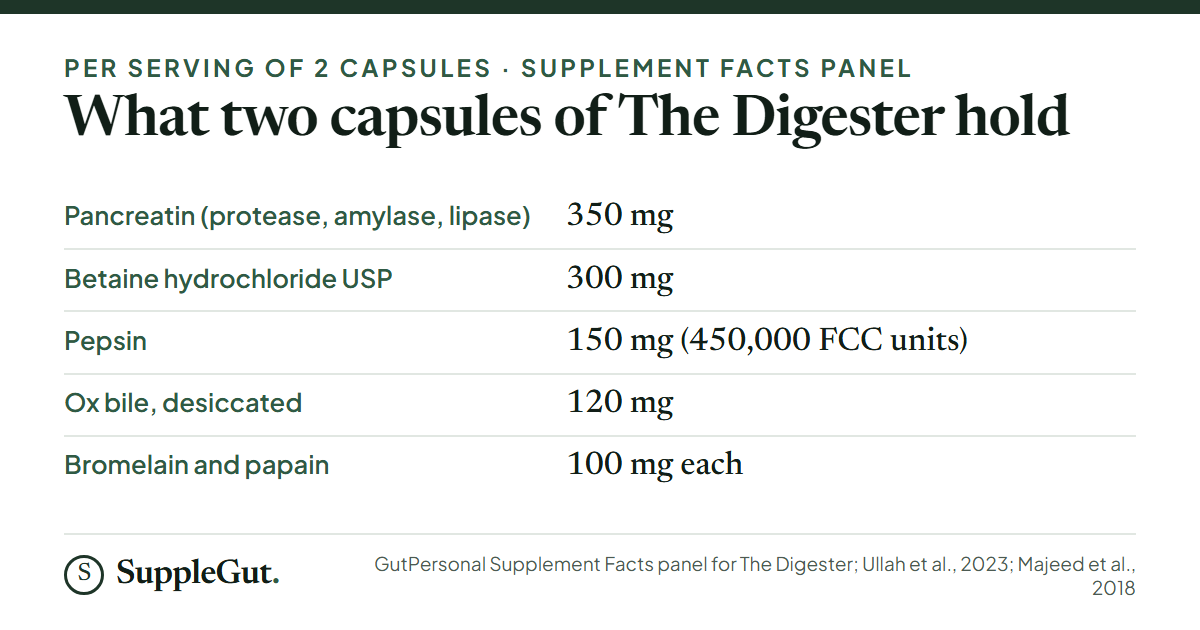
Does The Digester work for bloating? No study of this product turned up. The two placebo-controlled dyspepsia trials of enzyme supplements used fungal multi-enzyme blends at 400 mg and 150 mg a day, not pancreatin, betaine HCl or pepsin. Two capsules here hold 350 mg of pancreatin, 300 mg of betaine HCl and 150 mg of pepsin. The brand’s own review widget shows 4.71 from 21 reviews, and 10 of the 21 mention bloating.
The Digester is GutPersonal’s before-meal enzyme capsule, sold for post-meal bloating and indigestion. What sets it apart from most enzyme bottles is the formula: pancreatin, ox bile, bromelain and papain share the capsule with betaine hydrochloride and pepsin, which add acid, and every one prints its own amount. This page sets that panel beside the trials of enzyme supplements in dyspepsia, then covers the dose, the cautions, the reviews and the price.
Six actives, each with its own amount
The brand’s panel is headed Supplement Facts, with a serving of two capsules and 45 servings to the bottle. It contains no proprietary blend. Per serving it prints 350 mg of pancreatin, which it breaks into 70,000 USP units of protease, 70,000 USP units of amylase and 5,600 USP units of lipase; 300 mg of betaine hydrochloride; 150 mg of pepsin (450,000 FCC units); 120 mg of desiccated ox bile; 100 mg of bromelain from pineapple (240 GDU); and 100 mg of papain (600,000 USP units). Add them up and the six actives come to 1,120 mg a serving. Activity units are given for the pancreatin enzymes, pepsin, bromelain and papain, but not for the ox bile or the betaine hydrochloride. The panel also lists 15 mg of sodium.
The other ingredients are the gelatin capsule, microcrystalline cellulose, magnesium stearate and calcium silicate. There are no sweeteners and no laxative herbs. The page markets the product as “Dietitian-Developed,” carries a “Clinically Researched” badge that cites no study, and shows a “Third-Party Tested” badge without naming a laboratory.
Gelatin, ox bile and pancreatin all come from animals, and the page does not say which. By its ingredients The Digester is not vegetarian or vegan.
Enzyme trials in dyspepsia used a different blend
A PubMed search for the brand and the product name returned nothing relevant, so nobody has published a trial of The Digester. The nearest evidence is two small placebo-controlled trials of enzyme supplements in functional dyspepsia, and both used a blend made by fungal fermentation. In 120 adults, two capsules a day of a multi-enzyme blend at 200 mg a capsule for two months gave better scores than placebo on the Nepean Dyspepsia Index, a pain scale and a sleep index, with no side effects reported (Ullah et al., Biomedicine & Pharmacotherapy, 2023). In 40 patients, a branded multienzyme complex at 50 mg three times a day for 60 days improved all the dyspepsia scores against placebo, with P values from 0.0401 to 0.0033 (Majeed et al., Journal of Medicinal Food, 2018). The authors of that second trial are employed by or linked to the ingredient maker.
Neither trial used pancreatin, betaine HCl, pepsin, bromelain or papain. The trial doses came to 400 mg and 150 mg of blend a day; one serving of The Digester holds 1,120 mg of actives, and three servings a day hold 3,360 mg. A 2013 review of drug therapy for functional dyspepsia noted that enzymes have been used for it and judged the evidence of effectiveness not adequate (J Dig Dis, 2013). Our PubMed search for pancreatin in people without pancreatic insufficiency returned 391 records; we did not find one identified as a randomized trial for post-meal bloating in otherwise healthy adults, but we did not read the full list. For the broader picture, do digestive enzymes work covers the trials by enzyme type.
The acid half of the formula
Betaine hydrochloride and pepsin are not digestive enzymes in the pancreatic sense. Betaine HCl is a source of hydrochloric acid and pepsin is the stomach’s own protein-splitting enzyme, and together they are sold as stomach acid support. The bottle front reads “Powerful Digestive Enzymes & Stomach Acid Support,” and the brand says low stomach acid and missing enzymes cause post-meal bloating and that replacing them eases it. The page cites no study for that.
The one PubMed record we found for the pair as a supplement is a case report of a 76-year-old man after esophagus surgery who took 500 mg of betaine HCl with 23.5 mg of pepsin before protein meals (Journal of Medicinal Food, 2024). It describes one patient and is not a study of safety or benefit. Nothing printed says how much enzyme activity survives stomach acid; the capsule is plain gelatin, not delayed-release. For a capsule that is only betaine HCl and pepsin, the HCL Guard guide covers that format.
Two capsules before every meal, up to six a day
The directions read “Take 2 capsules before each meal.” The page says the product is safe for daily use and can also be taken as needed for heavier meals or eating out, and that a missed pre-meal dose can be taken during or right after the meal, with earlier better. At three meals that is six capsules a day, and a 90-capsule bottle lasts 15 days. Reviewers describe taking one or two before each meal or before big meals, so real use varies. The page gives no length for a fair test; the two trials above ran 60 days and two months.
Side effects, ulcers and acid-reducing medicine
The panel image and the product page carry no warning text beyond the standard FDA disclaimer, and the side of the bottle was not visible in the photo we read. The page says nothing on pregnancy or breastfeeding. Because the formula adds betaine hydrochloride and pepsin, a person with a stomach ulcer or gastritis, or one taking an acid-reducing medicine, can ask a clinician or pharmacist before starting. Among the 21 reviews, nausea or stomach upset appears in two and no other side effect is described.
The page lists the product as free from gluten, dairy, soy, GMOs and artificial fillers. It prints no “contains” line and no facility statement, and it does not speak to egg, tree nuts, fish or sesame. Anyone avoiding animal-derived ingredients or pineapple can note that pancreatin, ox bile, gelatin and bromelain are on the panel.
Twenty-one reviews, all on the brand’s own page
A Judge.me widget on the product page shows 4.71 out of 5 from 21 reviews: 18 five-star, 2 four-star, none at three or two stars, and 1 one-star. All 21 are flagged as verified buyers, and the brand has replied to 8. They run from 2022 to 2026. We found no Amazon, Walmart, Target or iHerb listing and no Trustpilot profile to set it against. The one-star review carries glowing text (“I no longer experience the bloating and gas post meal”), so that star entry may have been recorded wrongly.
Bloating comes up in 10 of the 21 reviews, gas in one and nausea or stomach upset in two. The praise is:
- less bloating and gas after meals;
- feeling better after dining out or big meals, with the capsules kept in a purse;
- a calmer stomach, and one reviewer who found it better than other enzymes they had used.
The criticism is thin. One five-star reviewer wrote that they had not noticed a difference yet, and another said it was hard to tell whether the benefit came from the enzymes or from the brand’s other products. Some reviews on this page mention other GutPersonal products, so not every line is about the enzymes.
$1.02 a serving, $3.06 a day at three meals
| Route | Price per bottle | Per serving | Per day at three meals |
|---|---|---|---|
| One time, 45 servings | $45.95 | $1.02 | $3.06 |
| 1-month delivery (10% off) | $41.36 | $0.92 | $2.76 |
| 3-month delivery (15% off) | $39.05 a month | $0.87 | $2.60 |
| 6-month delivery (20% off) | $36.76 a month | $0.82 | $2.45 |
The 3-month plan is $117.17 for three bottles and the 6-month plan $220.56 for six, both with free shipping. The product page pre-selects the 1-month delivery card, and One Time Purchase is a separate option. The brand also lists a $15 discount on a first order and free gifts at the second, fourth and sixth subscription orders. At one serving a day a bottle lasts 45 days, which is the $1.02 figure.
Refunds, as the brand prints them: 30 days to return unopened products for a full refund, an email to hello@gutpersonal.com for opened ones, and no refund of shipping. The Happy Gut Guarantee page describes a full refund on a first order within 30 days of purchase, for the first purchase of each product made through the brand’s site. None of the 21 reviews mentions charges or cancellation, and no independent review profile exists to check billing against.
Next to other enzyme capsules in the catalog
The nearest panels are other before-meal enzyme capsules. Designs for Health Digestzymes is also built around stomach acid, pancreatic enzymes and ox bile, at one capsule per meal. Enzymedica Digest Gold is a broad-spectrum enzyme capsule taken one with each meal. Healthy Gut HCL Guard is the acid pair on its own. No head-to-head trial of these formulas for bloating was found, so the differences here are in the label, not in measured effect. Digestive enzymes vs probiotics for bloating sets enzymes beside the other common choice.
GutPersonal sells other gut products beside this one, including a magnesium powder covered in the Miracle Worker guide and a separate Gluten + Dairy Digester at $59.95, whose panel we did not read.
Who The Digester is for
- Someone who wants every amount printed, including the pancreatin units, with no blend hiding the doses.
- Someone who takes an enzyme before large or restaurant meals and wants a formula that also adds pepsin and betaine HCl.
- Someone comfortable with evidence borrowed from other blends, since the dyspepsia trials tested a fungal mix.
- Someone content to buy direct, the only place the product turned up.
The quiz matches symptoms to products.
The products in this catalog
Common questions
Does The Digester help with bloating after meals?
We could find no trial of this product, and none of pancreatin for post-meal bloating in adults without pancreatic insufficiency. The brand’s review widget shows 4.71 from 21 reviews, and 10 of them mention bloating, mostly as less of it. Those reviews sit on the brand’s own page, so they are one feed and not an independent measure.
What is in two capsules, and is it vegetarian?
Two capsules print 350 mg of pancreatin, 300 mg of betaine hydrochloride, 150 mg of pepsin, 120 mg of ox bile, 100 mg of bromelain and 100 mg of papain, each with its own amount and no proprietary blend. The capsule is gelatin and the pancreatin and ox bile are animal-derived, so it is not vegetarian or vegan. The page does not name the source animal.
Do the digestive enzyme trials in dyspepsia apply to this formula?
Two small placebo-controlled trials found better dyspepsia scores on enzyme supplements, but both tested fungal multi-enzyme blends at 400 mg and 150 mg a day. Neither used pancreatin, betaine HCl, pepsin, bromelain or papain. A review of dyspepsia drug therapy judged the evidence for enzymes not adequate.
Who should check with a doctor before taking betaine HCl and pepsin?
Betaine hydrochloride and pepsin add acid, and the panel and product page print no warning about ulcers, gastritis or acid-reducing medicine. Someone with a stomach ulcer, or taking an acid reducer, can ask a clinician or pharmacist before starting. The page also says nothing on pregnancy.
What does The Digester cost per day?
A bottle of 90 capsules holds 45 servings of two and costs $45.95 one time, which is $1.02 a serving and $3.06 a day at three meals. The pre-selected 1-month plan is $41.36 a bottle, the 3-month plan $117.17 and the 6-month plan $220.56. At three meals a day one bottle lasts 15 days.
Can an opened bottle be returned?
The refund policy gives 30 days to return unopened products for a full refund and asks for an email to hello@gutpersonal.com about opened ones, with no refund of shipping. A separate Happy Gut Guarantee page describes a full refund on a first order within 30 days. None of the 21 reviews we read mentions charges or cancellation.
Is it sold on Amazon or other stores?
We found it on the brand’s own site only. Searches turned up no Amazon, Walmart, Target or iHerb listing carrying the brand name and no Trustpilot profile. The 4.71 rating exists only in the Judge.me widget on the brand’s page.
Sources
- Ullah et al. Randomized, double-blind, placebo-controlled trial of a multi-enzyme supplement in functional dyspepsia (120 adults, two months). Biomedicine & Pharmacotherapy, 2023. PMID 37976892. pubmed.ncbi.nlm.nih.gov/37976892
- Majeed et al. Placebo-controlled trial of a multienzyme complex in functional dyspepsia (40 patients, 60 days). Journal of Medicinal Food, 2018. PMID 30156436. pubmed.ncbi.nlm.nih.gov/30156436
- Review of drug therapy for functional dyspepsia. Journal of Digestive Diseases, 2013. PMID 23957752. pubmed.ncbi.nlm.nih.gov/23957752
- Case report of betaine hydrochloride with pepsin after esophagectomy. Journal of Medicinal Food, 2024. PMID 38695854. pubmed.ncbi.nlm.nih.gov/38695854
- GutPersonal: product page for The Digester (claims, directions, ingredients, free-from statement, price, subscription tiers, Judge.me reviews). gutpersonal.com
- GutPersonal: Supplement Facts panel image for The Digester. panel image
- GutPersonal refund policy and Happy Gut Guarantee pages. refund policy; Happy Gut Guarantee

Still deciding between products?
The guide gives the background. For a single answer, the quiz asks about your symptoms, your routine and what you have tried, then names one product.
Take the quiz →