
Guide
Does Move Easy work? Magnesium citrate, Cape aloe and triphala in one bedtime capsule
Quick answer
Does Move Easy work? Move Easy has 200 mg of magnesium as citrate and a 300 mg blend of triphala and Cape aloe per two capsules, with the aloe amount not printed. Magnesium oxide at about five times that elemental dose beat placebo in constipation trials, but we found no trial of this formula, of magnesium citrate for constipation, or of Cape aloe or triphala in people. Cape aloe is a stimulant laxative herb with a one-week limit in European guidance, and the only rating is 4.95 from 21 reviews on the brand’s own page.
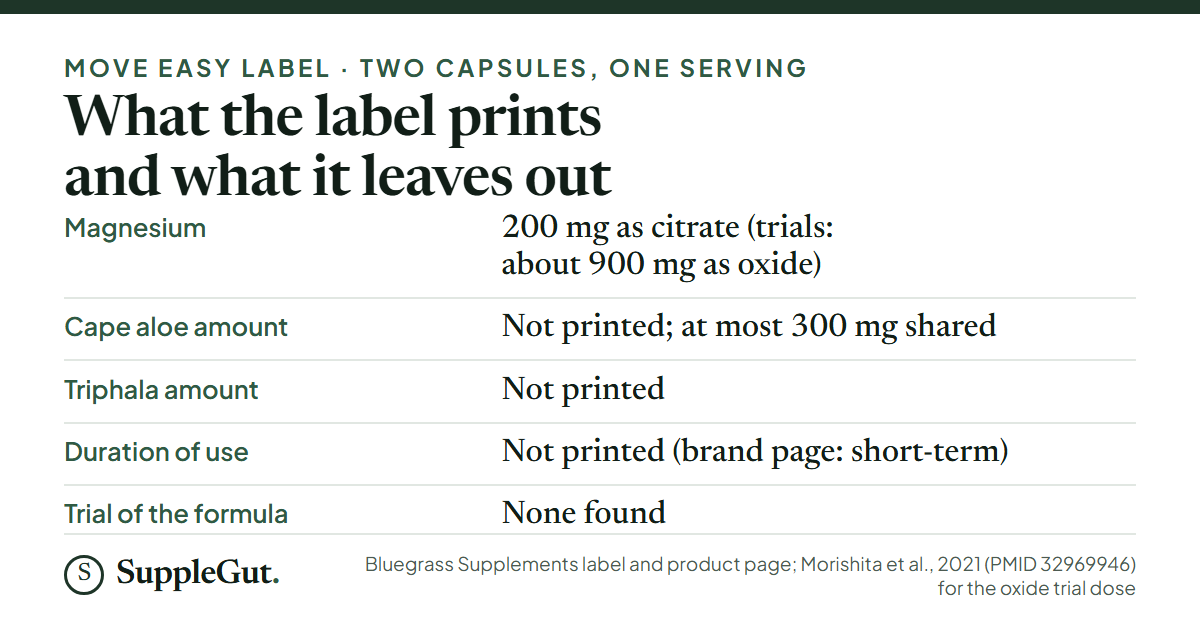
Move Easy is a bedtime capsule that combines three things: magnesium citrate, which is an osmotic laxative salt, Cape aloe (Aloe ferox), which is a stimulant laxative herb, and a triphala extract from three traditional Ayurvedic fruits. What sets it apart from the magnesium and fiber products it sits beside is the label: the aloe and the triphala share one 300 mg proprietary blend, so the amount of aloe is not printed. This page sets out the panel, what the research does and does not cover, how the directions compare with the brand’s own short-term wording and with the limits that apply to aloe, the reviews, the terms and the cost.
What Move Easy is, and what it is not
The serving is two capsules, with 30 servings in the 60-capsule bottle. The Supplement Facts panel lists 200 mg of magnesium as magnesium citrate (48% of the daily value), which is the elemental magnesium and the only disclosed amount, and a Botanical Proprietary Blend of 300 mg made of triphala extract (fruit of Emblica officinalis, Terminalia chebula and Terminalia belerica, standardized to 45% tannins) and Cape aloe (Aloe ferox) leaf. The other ingredients are the hypromellose capsule, stearic acid, magnesium stearate, silica and medium-chain triglyceride oil. There are no bacteria in it, and it is not a fiber.
The panel does not print the amount of Cape aloe, the amount of triphala, the form of the aloe (leaf powder, extract or dried juice), or any aloin or hydroxyanthracene content. Because the 300 mg is shared, the aloe is at most 300 mg and could be far less. At one capsule, the dose is half of every printed figure: 100 mg of magnesium and 150 mg of blend. The panel is a Supplement Facts panel, not a Drug Facts panel, so Move Easy is sold as a dietary supplement. The brand sells it on its own site; we could not find a listing on Amazon or at another retailer.
The panel, the other ingredients and the directions are word for word the same as those of XYMOGEN’s practitioner product ColonX as listed by a supplement dispensary. That is a label comparison only. We could not tell whether the two products share a manufacturer.
A stimulant laxative herb in a supplement
Cape aloe contains anthranoids such as aloin. Bacteria in the colon turn them into compounds that stimulate the bowel wall and reduce water absorption, which is how stimulant laxatives work. Magnesium citrate works differently: unabsorbed magnesium holds water in the intestine, which softens stool and speeds transit. So the capsule combines an osmotic laxative salt and a stimulant laxative herb, alongside triphala.
The brand describes it another way. Its FAQ answers “Is this a laxative?” with “Not in the traditional sense,” its ads say “No aggressive laxatives. No dependency” and describe Cape aloe as there “to bulk, hydrate, and move things along,” and the page says the aloe helps maintain normal transit time and stool bulk. Those are the brand’s descriptions. We found no dependency study of this product or of its blend.
Two regulatory positions bear on the aloe. In 2002 the US FDA ruled that aloe, including aloe extract, and cascara sagrada are “not generally recognized as safe and effective” as over-the-counter laxative ingredients, which is why neither is in a drugstore laxative. That rule concerns OTC drugs, and aloe remains on sale in dietary supplements. We did not assess whether any marketing claim for this product crosses into a drug claim. In Europe, the herbal committee’s monograph for aloe (mainly Aloe ferox) dried juice lists use for occasional constipation and sets a limit of not more than one week, with pregnancy, breastfeeding, bowel obstruction, inflammatory bowel disease, unexplained abdominal pain and severe dehydration as contraindications. The monograph covers dried juice preparations; this label says only “leaf” and does not say what form of the plant is used, so the comparison is to the class, not to a measured dose in this capsule. We read the European position through its summary pages rather than the full document.
LiverTox, the National Institutes of Health drug-injury database, lists rare cases of clinically apparent liver injury with oral aloe products, mostly of the hepatocellular type, with causality limited to case reports. We read that entry through a search summary.
The trial of the product itself
There is none. A PubMed search for Move Easy and for Bluegrass Supplements returned no records, ClinicalTrials.gov has no study of magnesium citrate with aloe and triphala, and we found no trial of ColonX. The research that exists is for the ingredients, and it covers some of them far better than others.
The evidence for the ingredients
Magnesium. The placebo-controlled constipation trials we found use magnesium oxide, not citrate. In a Japanese trial of 90 adults with chronic constipation, 1.5 g of magnesium oxide a day for 28 days left 68.3% improved against 11.7% on placebo (P below 0.0001), with no severe treatment-related adverse events (Morishita et al., American Journal of Gastroenterology, 2021). In 34 women given 0.5 g three times a day for 28 days, 70.6% improved against 25.0% on placebo (P = 0.015; Mori et al., Journal of Neurogastroenterology and Motility, 2019). A 2023 systematic review of eight supplement trials in 787 people found that the two magnesium oxide trials had 68% responders against 19% on control (risk ratio 3.32, 95% confidence interval 1.59 to 6.92) and about 3.7 more bowel movements a week (van der Schoot et al., Neurogastroenterology & Motility, 2023).
The dose gap matters. Magnesium oxide is about 60.3% elemental magnesium by weight, so 1.5 g is about 900 mg of elemental magnesium a day. Move Easy supplies 200 mg at two capsules and 100 mg at one, roughly a fifth of the trial dose or less, and as a different salt. We found no trial of magnesium citrate for chronic constipation in adults; the citrate trials that turn up in a search are colonoscopy bowel preparations at far higher doses. So the evidence supports the class of osmotic magnesium salts at a higher dose, not this amount.
Cape aloe. We found no human trial of its laxative effect. The only studies that came up were a rat study of aloe in loperamide-induced constipation and a rat toxicology paper (BMC Gastroenterology, 2010). Triphala. We found no placebo-controlled trial of triphala for constipation. The closest is an open-label study of 34 people taking a powder of psyllium husk, senna extract and triphala for 14 days, in which weekly bowel movements rose from 10.2 to 18.3, and a design that cannot separate triphala from the other two (Munshi et al., 2011). A four-week placebo-controlled pilot of 2,000 mg of triphala in 31 healthy people measured gut microbiota rather than stools (Peterson et al., 2020). Move Easy’s whole blend, aloe and triphala together, is at most 300 mg.
No trial of the combination of the three exists.
How to take Move Easy, and for how long
The directions printed with the product are: take one to two capsules at bedtime with 8 oz of water, or as directed by a healthcare professional. They give no duration. The brand’s FAQ says magnesium citrate typically takes six to eight hours to work, which is the reason for the bedtime timing. Reviewers who describe slow results say it helped after about a week or over time rather than on the first night.
The brand’s own page words the duration differently from the directions. It says Move Easy “is intended for occasional, short-term use,” not as a daily long-term supplement, and to speak to a healthcare provider about chronic digestive issues. A nightly bedtime direction with no stated end, a brand page that says short-term, and a one-week limit for aloe in the European monograph do not line up, and the label does not say which governs. Anyone planning to use it more than a few nights in a row can ask a doctor or pharmacist how long is appropriate.
Side effects and who should not take it
The brand page says not to use Move Easy if pregnant or nursing, and to discontinue use if diarrhea or abdominal pain develops. The bottle photos on the brand site show the panel and ingredients only, so we could not confirm whether a printed warning block exists on the bottle. For comparison, ColonX as listed by the dispensary prints a different set of lines: keep out of reach of children, ask a doctor if symptoms worsen or persist for more than a few days, and ask a doctor first if pregnant or breastfeeding.
The known effects of this class are cramping, loose stools and diarrhea. The European aloe monograph lists bowel obstruction, inflammatory bowel disease, unexplained abdominal pain and severe dehydration as reasons not to use aloe. We found no medicine warning in any Bluegrass text. Magnesium can bind some medicines taken at the same time, such as some antibiotics and thyroid or osteoporosis drugs, and anthranoid laxatives can lower potassium, so a pharmacist can check the timing against any regular medicine. No reviewer among the 21 mentions cramping or diarrhea, but all 21 are on the brand’s own page, so that absence says little.
The brand’s “formulated to exclude” list covers wheat, gluten, yeast, soy, animal and dairy products, fish, shellfish, peanuts, tree nuts, egg, GMO-derived ingredients and artificial colors, sweeteners and preservatives. Sesame is not mentioned, and we found no facility or cross-contact statement.
The GLP-1 and bloating claims
The brand’s ads say Move Easy “was formulated to support smoother digestion during GLP-1 journeys” and list bloating, constipation and a heavy, stuck feeling. These are brand claims. We found no trial of any ingredient in the capsule for bloating, and none in people taking GLP-1 medicines. Anyone on one of those medicines with persistent constipation can raise it with the prescriber, who can weigh the other options. The GLP1 SOS guide covers another product sold to the same group.
Who formulated it
The product page calls Move Easy “physician-formulated” and does not name a physician. We found no About page, and the home page names nobody. The ads and the shipping policy use the name Bluegrass Precision Wellness, which public pages describe as a physician-led practice in Lexington, Kentucky. No page we read says which physician, if any, formulated this product. The page does not state third-party testing either.
What the reviews say
The only readable rating is the brand’s own: 4.95 out of 5 from 21 reviews on a review widget on the product page (20 five-star, one four-star). We found no Amazon listing, no Trustpilot profile for the brand’s site and no Better Business Bureau profile, so there is no independent product rating from any source. We did not read Reddit.
The recurring praise is that it worked where other things had not, including after years of constipation; that it is easy on the stomach, with one reviewer mentioning use after bariatric surgery; and that the price is fair and shipping fast. The only complaint is speed: the single four-star reviewer says it helped after about a week, and another says it is not instant relief. One review thanks a TikTok creator, so some buyers arrive through creator content. With 21 reviews on a self-hosted widget, there is no independent check and we could not tell whether the reviews are moderated.
The subscription and refund terms
The brand site sells one 60-capsule bottle at $35.00 one time or $29.75 on a monthly subscription (15% off), with free shipping and HSA/FSA eligibility through a payment partner. The subscription can be paused, skipped, edited or canceled at any time in the customer portal, and cancellation stops all future charges and deliveries; no minimum number of shipments is stated. Unopened products can be returned within 30 days of purchase for a full refund, with a prepaid return label on request and original shipping not refunded. We found no policy for opened product. Orders ship three to seven business days after processing. We found no billing or refund complaints, but there is no independent review platform where they would appear.
Who Move Easy is for
- Adults who want a bedtime capsule that combines a magnesium salt with a stimulant laxative herb and accept that the amount of the herb is not printed.
- Someone who plans occasional, short use, in line with the brand’s own page and the one-week limit in the European aloe monograph.
- Someone not pregnant or nursing and without bowel disease, unexplained abdominal pain or dehydration.
If a magnesium salt on its own is the goal, Natural Vitality CALM is magnesium citrate in a powder, and Nature Made Magnesium Oxide is the salt the constipation trials used; another magnesium oxide product is covered at does MagO7 work. Organic India Triphala is triphala alone. The treatments with the strongest evidence, and how psyllium and magnesium compare, are at constipation treatments with strong evidence and psyllium vs magnesium for constipation, and the quiz matches symptoms to products.
Cost
At the printed serving of two capsules and 30 servings a bottle, Move Easy costs $1.17 a day at the one-time price and $0.99 on the subscription. At one capsule a night, which the directions also allow, a bottle lasts 60 nights and works out at $0.58 a day one time and $0.50 subscribed. The amount of magnesium and of blend halves with the capsule count.
The products in this catalog
Common questions
Does Bluegrass Move Easy work?
Move Easy has 200 mg of magnesium as citrate and a 300 mg blend of triphala and Cape aloe per two capsules. Magnesium oxide at about 900 mg of elemental magnesium beat placebo in 28-day constipation trials (68.3% against 11.7% improved in 90 adults), but we found no trial of this formula, of magnesium citrate for constipation, or of Cape aloe or triphala in people. The 4.95 rating comes from 21 reviews on the brand’s own page.
Is Move Easy a laxative?
The brand answers “Not in the traditional sense,” yet Cape aloe is an anthranoid stimulant laxative herb and magnesium citrate is an osmotic laxative salt. The FDA decided in 2002 that aloe is not generally recognized as safe and effective as an OTC laxative ingredient, so it is not in drugstore laxatives, though it remains in supplements. The label does not print how much aloe is in the 300 mg blend.
Is Move Easy safe, and what are the side effects?
The brand’s page says it is for occasional, short-term use, not in pregnancy or while nursing, and to stop if diarrhea or abdominal pain develops. European guidance for aloe dried juice limits use to not more than one week and lists bowel disease, unexplained abdominal pain and pregnancy among the reasons not to use it. The printed directions say one to two capsules at bedtime with no stated duration.
How long can you take Move Easy?
The printed directions give no duration: one to two capsules at bedtime. The brand’s page calls it intended for occasional, short-term use and not a daily long-term supplement, and the European monograph for aloe dried juice says not more than one week. Anyone planning longer use can ask a doctor or pharmacist.
How much does Move Easy cost?
One 60-capsule bottle is $35.00 on the brand’s site, or $29.75 on a monthly subscription (15% off). At the printed serving of two capsules that is $1.17 a day ($0.99 on subscription), or $0.58 a day at one capsule a night. Unopened bottles can be returned within 30 days, and the subscription can be canceled at any time in the customer portal.
Who is the physician behind Move Easy?
The product page calls it “physician-formulated” but does not name the physician. The brand’s ads and shipping policy use the name Bluegrass Precision Wellness, which public pages describe as a physician-led practice in Lexington, Kentucky; no page we read says which physician formulated Move Easy.
Is Move Easy the same as XYMOGEN ColonX?
The Supplement Facts panel, other ingredients and directions match ColonX as a supplement dispensary lists it, word for word: 200 mg of magnesium as citrate and a 300 mg blend of triphala and Cape aloe. That is a label comparison, and we could not tell whether the two products share a manufacturer. For a magnesium oxide product with a trial-dose comparison see does MagO7 work.
Sources
- Morishita D, et al. "Senna versus magnesium oxide for the treatment of chronic constipation: a randomized, placebo-controlled trial." American Journal of Gastroenterology, 2021. PMID 32969946. pubmed.ncbi.nlm.nih.gov/32969946
- Mori S, et al. Randomized placebo-controlled trial of magnesium oxide in women with chronic constipation. Journal of Neurogastroenterology and Motility, 2019. PMID 31587548. pubmed.ncbi.nlm.nih.gov/31587548
- van der Schoot A, et al. Systematic review of dietary supplements for chronic constipation. Neurogastroenterology & Motility, 2023. PMID 37243443. pubmed.ncbi.nlm.nih.gov/37243443
- US Food and Drug Administration. Federal Register 67 FR 31125, 9 May 2002: aloe and cascara sagrada, not generally recognized as safe and effective for OTC laxative use. govinfo.gov
- European Medicines Agency. Aloes folii succus siccatus (Aloe barbadensis and various species, mainly Aloe ferox), herbal medicinal product: duration of use and contraindications. ema.europa.eu
- LiverTox. "Aloe Vera." National Institutes of Health. ncbi.nlm.nih.gov/books/NBK548634
- Munshi R, et al. Open-label study of a herbal powder containing psyllium husk, senna extract and triphala in constipation. Journal of Ayurveda and Integrative Medicine, 2011. PMID 22022157. pubmed.ncbi.nlm.nih.gov/22022157; Peterson CT, et al. Triphala pilot trial on gut microbiota. Journal of Alternative and Complementary Medicine, 2020. PMID 32955913. pubmed.ncbi.nlm.nih.gov/32955913
- Aloe ferox in loperamide-induced constipation in rats. BMC Gastroenterology, 2010. PMID 20723249. pubmed.ncbi.nlm.nih.gov/20723249
- XYMOGEN ColonX, label and printed warnings as listed by Fullscript. fullscript.com/catalog/products/colonx
- Bluegrass Supplements brand page: label, directions and price. bluegrassvitamins.com/products/move-easy; shipping and returns bluegrassvitamins.com/pages/shipping-and-returns; subscription terms bluegrassvitamins.com/pages/how-to-manage-your-subscription
Not sure which product fits your situation?
This guide covers the mechanics. The quiz takes your specific symptoms, routine and preferences and matches you to one product from the catalog.
Take the quiz →