
Guide
Does NutriKey Akkermansia GLP-1 Probiotic work? No trial of the capsule, a dose far below the Akkermansia trials, and 3.8 from 20 reviews
Quick answer
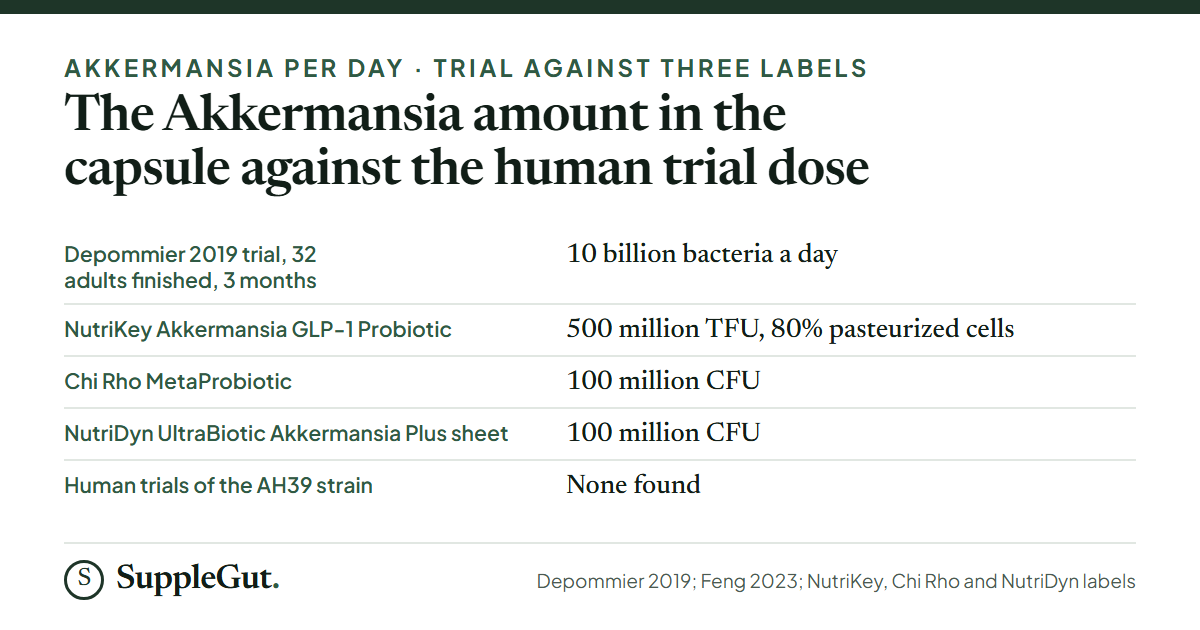
Does NutriKey Akkermansia GLP-1 Probiotic work? We found no trial of the capsule. Its Akkermansia strain, AH39, has only a laboratory and mouse study, and the human Akkermansia trials used a different strain at 10 billion bacteria a day against the capsule’s 500 million TFU. No trial measured GLP-1 or appetite for this blend. The brand’s own page shows 3.8 from 20 reviews, with half five-star and four of 20 one-star.
NutriKey Akkermansia GLP-1 Probiotic is a once-a-day capsule of five bacterial strains, one of them Akkermansia muciniphila, sold by a Minnesota weight-loss clinic company for appetite and cravings. What sets it apart is the Akkermansia: part of it is pasteurized, it carries a strain code, and the amount is a small fraction of what the human trials used. This page covers the label, the trials of each strain, the reviews, the price and the refund terms, and the other bottles that carry the same formula.
What NutriKey Akkermansia GLP-1 Probiotic is, and what it is not
NutriKey is the in-house brand of Nutritional Weight & Wellness, a company in St. Paul, Minnesota. Its online store also resells practitioner brands including Ortho Molecular, Metagenics, NutriDyn and Designs for Health. This product is a digestive-resistant capsule (hypromellose and gellan gum), sold as a 30-capsule bottle with one capsule a day. The Supplement Facts panel prints a count and a strain designation for every organism, with no proprietary blend:
| Organism on the panel | Per capsule |
|---|---|
| Bifidobacterium animalis HN019 | 10 billion CFU |
| Bifidobacterium animalis B420 | 10 billion CFU |
| Lactobacillus rhamnosus GG | 2 billion CFU |
| Akkermansia muciniphila AH39 (80% pasteurized cells and 20% live cells) | 500 million TFU |
| Clostridium butyricum 10 | 30 million CFU |
The other ingredients are microcrystalline cellulose, vegetable magnesium stearate and silica. The label carries gluten-free, dairy-free, vegetarian and non-GMO marks; it makes no statement about egg, soy, tree nuts, fish or sesame, and gives no facility statement. CFU counts live cells that can form colonies. TFU, total fluorescent units, is a count that also includes pasteurized cells, so the 500 million figure is not a count of live bacteria.
The brand’s product page text prints the Akkermansia line as “500 Million CFU,” while the Supplement Facts image prints TFU. We read the image as the label. The label does not say how many of the 500 million units come from the live 20%.
It is not a gut-symptom product on its face. The product name and the brand’s lead claims are about appetite, cravings and the hormone GLP-1, with weight goals named in the copy. Digestion and bloating appear in the brand’s benefit list as secondary claims.
Is there a trial of the capsule itself?
We found none. A PubMed search on the Akkermansia strain AH39 returned one paper, a laboratory and mouse study, and a ClinicalTrials.gov search on the product name returned nothing. The brand page cites no study for its GLP-1 claims. Its testing statement is general: it says all NutriKey brand supplements are made in certified GMP facilities and are third-party tested, but it names no laboratory and links no certificate of analysis. The evidence sits with the individual strains, at other doses and mostly in other populations.
The Akkermansia trials and the dose gap
The strain on the label, AH39, has one published paper: an in vitro lymph node model plus mice. Akkermansia cells activated an immune signal in the dish (interleukin-10), and oral AH39 changed the share of regulatory T cells in the lymph nodes and spleen of mice (Feng et al., Journal of Genetics and Genomics, 2023). We found no human trial of AH39.
The human trials of Akkermansia used other strains and measured metabolic outcomes:
- Depommier 2019. 40 overweight or obese, insulin-resistant adults were enrolled and 32 finished. They took 10 billion bacteria a day for three months, live or pasteurized. Against placebo, the pasteurized group had insulin sensitivity up 28.62%, insulin levels down 34.08% and total cholesterol down 8.68%. Body weight was down 2.27 kg, a difference that was not statistically significant (P = 0.091) (Depommier et al., Nature Medicine, 2019).
- Zhang 2025. 58 adults with overweight or obese type 2 diabetes took the strain AKK-WST01 or placebo for 12 weeks, with lifestyle guidance for both. Weight and HbA1c fell in both groups with no significant difference between them. Benefit appeared only in the subgroup with low baseline Akkermansia (Zhang et al., Cell Metabolism, 2025).
The capsule’s 500 million TFU is one-twentieth of the 10 billion bacteria a day in the 2019 trial. The two units are counted by different methods, so the comparison is approximate, and only 80% of the capsule’s Akkermansia is pasteurized cells. Both trials were in people with metabolic disease, and we found no Akkermansia trial for a gut symptom. The Double Wood guide sets out more of the human Akkermansia trials, and the Akka guide explains the units and carries the same AH39 strain code.
The other four strains and their trials
| Strain (dose in this capsule) | Trial | Result |
|---|---|---|
| B. animalis HN019 (10 billion CFU) | Waller 2011: 100 adults with functional gut symptoms, 14 days, 17.2 or 1.8 billion CFU | Whole-gut transit time fell from 49 to 21 hours (high dose) and 60 to 41 hours (low dose), with no change on placebo |
| B. animalis HN019 | Ibarra 2018: 228 adults with functional constipation, 28 days, 1 or 10 billion CFU | No significant difference in the main or secondary outcomes; a post hoc subset of 65 people with low stool frequency gained 2.0 and 1.7 bowel movements a week |
| B. animalis HN019 | Ala-Jaakkola 2025: multi-center, triple-blind, 8 weeks, functional constipation | Not found to be superior to placebo for complete spontaneous bowel movements |
| B. animalis B420 (10 billion CFU) | Stenman 2016: 225 overweight or obese adults, 6 months, 10 billion CFU a day | No significant difference in body fat in the intention-to-treat group |
| Clostridium butyricum (30 million CFU) | Sun 2018: 200 adults with IBS and diarrhea, 4 weeks | Symptom score change −62.12 against −40.74 on placebo (P = 0.038); responders 44.76% against 30.53% |
Three details change how to read the table. In the HN019 transit trial the doses were 17.2 and 1.8 billion CFU, and the capsule’s 10 billion falls between them; the later constipation trials did not repeat the transit result. In the B420 trial, the authors’ per-protocol analysis (134 people who met compliance and antibiotic criteria) showed B420 alone with a 3.0% fat-mass difference that was not significant (P = 0.28), and B420 with 12 g of polydextrose fiber with a 4.5% difference (P = 0.02). The capsule contains no polydextrose. The authors also report a post hoc factorial analysis that was significant for B420. The C. butyricum trial used a strain and dose that are not matched to the “10” on this label, in people with IBS-D.
For Lactobacillus rhamnosus GG, the capsule’s 2 billion CFU strain, the evidence we found is mainly in children: a meta-analysis of three trials in 167 children with irritable bowel syndrome found a treatment-success risk ratio of 1.70 (95% CI 1.27 to 2.27) (Horvath et al., Alimentary Pharmacology & Therapeutics, 2011). It is pediatric evidence.
The GLP-1 framing is a brand claim
The brand says the capsule naturally curbs cravings and raises the body’s production of GLP-1, a hormone it describes as signaling fullness. It also says B420 reduces abdominal fat and that C. butyricum makes butyrate for the colon lining. The capsule contains no GLP-1 compound; the name refers to the hormone the brand says the bacteria influence.
The trials above report insulin sensitivity, cholesterol, transit time, bowel movements and body fat. We found no trial measuring GLP-1 or appetite for this blend, and none in people taking this capsule. The brand’s mechanism may or may not hold at the capsule’s dose; the label and the published trials do not settle it.
How to take it, side effects and who should check first
The label directs one capsule daily, or as directed by a healthcare practitioner. The brand adds that evening is best for results, but that taking it daily and consistently matters more than the time of day. It does not say whether to take it with food. Storage is a cool, dry place or the refrigerator.
The label caution reads that anyone who is pregnant, nursing or taking medication should consult a healthcare practitioner before use, and the bottle is to be kept out of children’s reach. Among the 20 reviews on the brand’s page, single reviewers report vertigo that began after a couple of weeks (this reviewer says a neurologist suggested stopping), GERD symptoms, stomach cramps and bloating during the first weeks. The 2019 Akkermansia trial reported the supplement as safe and well tolerated at its dose. The usual effects of probiotics and when to stop are in the probiotic side effects guide.
What the reviews say
The only rating we found is the brand’s own: 3.8 out of 5 from 20 reviews, shown by the Judge.me review app on the product page. The split is 10 five-star, 5 four-star, none three-star, 1 two-star and 4 one-star, so half are five-star and a fifth are one-star. 19 of the 20 are flagged as verified buyers. We found no Amazon listing for the product or the brand, and we could not read Trustpilot.
The reviewers who praise it mostly describe less hunger between meals and fewer sugar cravings, and one describes less bloating along with a somewhat lower appetite. Complaints fall in three groups: no noticeable difference after weeks of use (including a two-month reviewer who saw no weight loss), side effects (vertigo, GERD symptoms, cramps), and price. One of the four one-star entries is about the store’s pricing and radio ads rather than the capsule. The reviews run from 2024 to 2026, and with 20 of them each entry moves the average noticeably.
Price and the refund terms
A 30-capsule bottle is $60.75 on the brand site, about $2.03 a day at one capsule a day. There is no subscription option, no bundle price on the product page, and no other retailer that we found. The store’s banners give a free-shipping threshold of $75 in one place and $50 in another, and say HSA and FSA funds can be used.
The brand’s pages describe the return terms three ways:
- Product page: a 60-day return guarantee. If the product does not deliver, the page says you get your money back.
- Refund policy: unopened, nonperishable items can be returned within 60 days, shipping is nonrefundable, and no refunds or exchanges are given on opened products. Returns are mailed to St. Paul, Minnesota.
- FAQ: any item can be returned for any reason within 60 days, and the brand reserves the right to reject returns it considers a repeated pattern or abuse of the policy.
The 60-day promise on the product page and the no-refund-on-opened-products line in the policy cannot both describe the same bottle. We could not tell from the pages which governs an opened capsule bottle. None of the 20 reviews mention a refund or billing problem.
The same formula under other names
NutriDyn’s practitioner sheet for UltraBiotic Akkermansia Plus (ND1194) lists the same five strains with the Akkermansia at 100 million CFU. The Chi Rho Chiropractic store in Morganfield, Kentucky sells a bottle called MetaProbiotic under its Legacy Pure label, and the store’s product record lists NutriDyn as vendor and tags it as a private label. Its panel matches NutriKey’s line for line for four strains (10 billion CFU of HN019, 10 billion of B420, 2 billion of LGG, 30 million of C. butyricum), and differs in the Akkermansia: 100 million CFU, with no statement about pasteurization, against NutriKey’s 500 million TFU with 80% pasteurized cells.
The NutriKey and Chi Rho SKUs share the same first six digits, but neither brand states who makes its bottle. MetaProbiotic sells for $58.99 for 30 capsules (about $1.97 a day), with a 10% monthly subscription and a 30-day guarantee on the first bottle of a first-time order. We found no ratings or reviews for it, so it is not scored on this site. Neither bottle has a trial of the finished capsule, so the strain trials above apply to both.
Who NutriKey Akkermansia GLP-1 Probiotic is for
- Someone who wants a five-strain capsule that includes Akkermansia and who has read that the Akkermansia amount is far below the trial doses, and that AH39 has no human trial.
- Someone comfortable with a rating that comes only from the brand’s own page and with return terms that read differently on three pages.
- Someone who is not pregnant or nursing, or who has checked with a healthcare practitioner, especially when taking medication.
Because the product is sold for appetite and cravings, and the quiz matches products to digestive symptoms and goals, this site lists it for browsing and does not return it as a quiz result. The other Akkermansia products in the catalog are Pendulum Akkermansia, Akka and Double Wood Akkermansia. What a CFU count does and does not predict is covered in the CFU guide.
The products in this catalog
Common questions
Does NutriKey Akkermansia GLP-1 Probiotic work?
No trial of this capsule was found. Its Akkermansia strain, AH39, has no human trial, and the human Akkermansia trials used 10 billion bacteria a day in people with metabolic disease, against the capsule’s 500 million TFU. The brand’s page shows 3.8 from 20 reviews; those who praise it mostly describe less hunger and fewer cravings, and 4 of 20 give one star.
What is in NutriKey Akkermansia GLP-1 Probiotic?
One capsule has Bifidobacterium animalis HN019 (10 billion CFU), B. animalis B420 (10 billion CFU), Lactobacillus rhamnosus GG (2 billion CFU), Akkermansia muciniphila AH39 (500 million TFU, 80% pasteurized cells and 20% live cells) and Clostridium butyricum 10 (30 million CFU). The other ingredients are the capsule, microcrystalline cellulose, magnesium stearate and silica.
Does Akkermansia GLP-1 Probiotic boost GLP-1?
The brand says it does. We found no trial measuring GLP-1 for this blend. The human Akkermansia trials report insulin sensitivity and cholesterol at 10 billion bacteria a day, and a 2025 trial of 58 adults with type 2 diabetes found no significant overall difference in weight or HbA1c.
How much does NutriKey Akkermansia GLP-1 Probiotic cost per day?
A 30-capsule bottle is $60.75 on the brand site, about $2.03 a day at one capsule a day. The product has no subscription option, and we found no Amazon listing.
What are the side effects?
Single reviewers on the brand’s page report vertigo, GERD symptoms, stomach cramps and bloating in the first weeks. The label advises consulting a healthcare practitioner if you are pregnant, nursing or taking medication. The probiotic side effects guide covers the usual effects.
Can I get a refund on NutriKey Akkermansia GLP-1 Probiotic?
The pages differ. The product page promises a 60-day money-back guarantee. The refund policy accepts unopened items within 60 days and gives no refunds or exchanges on opened products, with shipping nonrefundable and returns mailed to St. Paul, Minnesota. The FAQ says any item can be returned within 60 days for any reason.
Is NutriKey Akkermansia the same as Chi Rho MetaProbiotic?
The two carry the same five strains at the same counts except for the Akkermansia, which is 100 million CFU on the Chi Rho bottle and 500 million TFU (80% pasteurized cells) on NutriKey’s. NutriDyn’s practitioner sheet for UltraBiotic Akkermansia Plus lists the Chi Rho panel. Neither has a trial of the finished capsule.
Sources
- Depommier C, Everard A, Druart C, et al. “Supplementation with Akkermansia muciniphila in overweight and obese human volunteers: a proof-of-concept exploratory study.” Nature Medicine, 2019;25(7):1096–1103. PubMed 31263284
- Zhang Y, Liu R, Chen Y, et al. “Akkermansia muciniphila supplementation in patients with overweight/obese type 2 diabetes: Efficacy depends on its baseline levels in the gut.” Cell Metabolism, 2025;37(3):592–605. PubMed 39879980
- Feng S, Wang S, Qu D, et al. “Species- or genus-dependent immunostimulatory effects of gut-derived potential probiotics.” Journal of Genetics and Genomics, 2023;50(10):786–794. PubMed 36356718
- Waller PA, Gopal PK, Leyer GJ, et al. “Dose-response effect of Bifidobacterium lactis HN019 on whole gut transit time and functional gastrointestinal symptoms in adults.” Scandinavian Journal of Gastroenterology, 2011;46(9):1057–1064. PubMed 21663486
- Ibarra A, Latreille-Barbier M, Donazzolo Y, et al. “Effects of 28-day Bifidobacterium animalis subsp. lactis HN019 supplementation on colonic transit time and gastrointestinal symptoms in adults with functional constipation.” Gut Microbes, 2018;9(3):236–251. PubMed 29227175
- Ala-Jaakkola R, Forssten SD, Cheng J, et al. “Effect of an 8-Week Bifidobacterium lactis HN019 Supplementation on Functional Constipation: A Multi-Center, Triple-Blind, Randomized, Placebo-Controlled Trial.” Molecular Nutrition & Food Research, 2025;69(17):e70081. PubMed 40320938
- Stenman LK, Lehtinen MJ, Meland N, et al. “Probiotic With or Without Fiber Controls Body Fat Mass, Associated With Serum Zonulin, in Overweight and Obese Adults.” EBioMedicine, 2016;13:190–200. PubMed 27810310
- Sun YY, Li M, Li YY, et al. “The effect of Clostridium butyricum on symptoms and fecal microbiota in diarrhea-dominant irritable bowel syndrome.” Scientific Reports, 2018;8:2964. PubMed 29445178
- Horvath A, Dziechciarz P, Szajewska H. “Meta-analysis: Lactobacillus rhamnosus GG for abdominal pain-related functional gastrointestinal disorders in childhood.” Alimentary Pharmacology & Therapeutics, 2011;33(12):1302–1310. PubMed 21507030
- NutriKey: product page, Supplement Facts image, review widget, nutrikey.net; refund policy and FAQ
- Chi Rho (Legacy Pure) MetaProbiotic: product page, panel image and refund policy. shopchirho.com
- NutriDyn UltraBiotic Akkermansia Plus (ND1194) supplement sheet. nutridyn.com
Not sure which product fits your situation?
This guide covers the mechanics. The quiz takes your specific symptoms, routine and preferences and matches you to one product from the catalog.
Take the quiz →