
Guide
Does Nutrition Essentials Probiotic work? One spore organism, a CFU figure that changed, and trials of a different strain
Quick answer
Does Nutrition Essentials Probiotic work? We could find no trial of this tablet. Its one organism, Bacillus coagulans, is printed as Uni-BactCF-15 with no strain code, and the nearest trials are of a different-named strain at 2 billion CFU a day, funded by that strain’s maker. The label claims 900 billion CFU a bottle at manufacture, about 30 billion a serving, while earlier labels imply about 1 billion. Amazon shows 4.3 from 43,824 ratings across several label versions.
Nutrition Essentials Probiotic is a two-tablet-a-day product sold mainly on Amazon, built around one spore-forming organism, Bacillus coagulans, plus a small dose of lactase enzyme and a small dose of prebiotic fiber. The label prints that organism under a trademarked ingredient name rather than a strain code, and it states a CFU figure that does not match the figure printed on earlier versions of the same product. This page sets out what the panel says, what the trials of the nearest strain found, how the 43,824 Amazon ratings are made up, and what each route to buying it costs.
What Nutrition Essentials Probiotic is, and what it is not
The current bottle is titled “Probiotic 900B-C” and sold as a dietary supplement of 60 vegan tablets, with a serving of two tablets and 30 servings a bottle. The Supplement Facts panel lists three ingredients inside a proprietary blend that has a header but no total weight. Uni-BactCF-15 Probiotic (Bacillus coagulans) is 75 mg, Lactase LPH Enzyme is 8 mg, and Nutri-Fructo dietary fiber (fructooligosaccharide, or FOS) is 500 mg. The other ingredients are microcrystalline cellulose, dicalcium phosphate, stearic acid, croscarmellose sodium, silicon dioxide, vegetable magnesium stearate and hydroxypropyl methylcellulose. There are no sweeteners.
It is not a multi-strain Lactobacillus and Bifidobacterium formula. It lists one organism. “Uni-BactCF-15” is a trademark of Union Biotech Sciences, according to the panel’s footnote, and it is not a strain code of the kind that lets a reader look up a deposit or a trial: we found no culture-collection number printed and no specification sheet, trial or deposit record for Uni-Bact CF-15 anywhere. The lactase has no activity units printed, and the “GMP Certified” seal on the bottle is a manufacturing-practice claim, not a test of the contents.
Because B. coagulans forms spores, it is thought to pass through stomach acid and become active in the intestine, which is why the tablets are shelf stable and need no refrigeration. The brand’s own copy calls its strain “research-backed” and says it survives stomach acid, and an Amazon bullet says five times more reaches the gut than with Lactobacillus or Bifidobacterium products. Those are brand claims, and the pages that make them cite no source for them.
What the CFU figure says, and why it changed
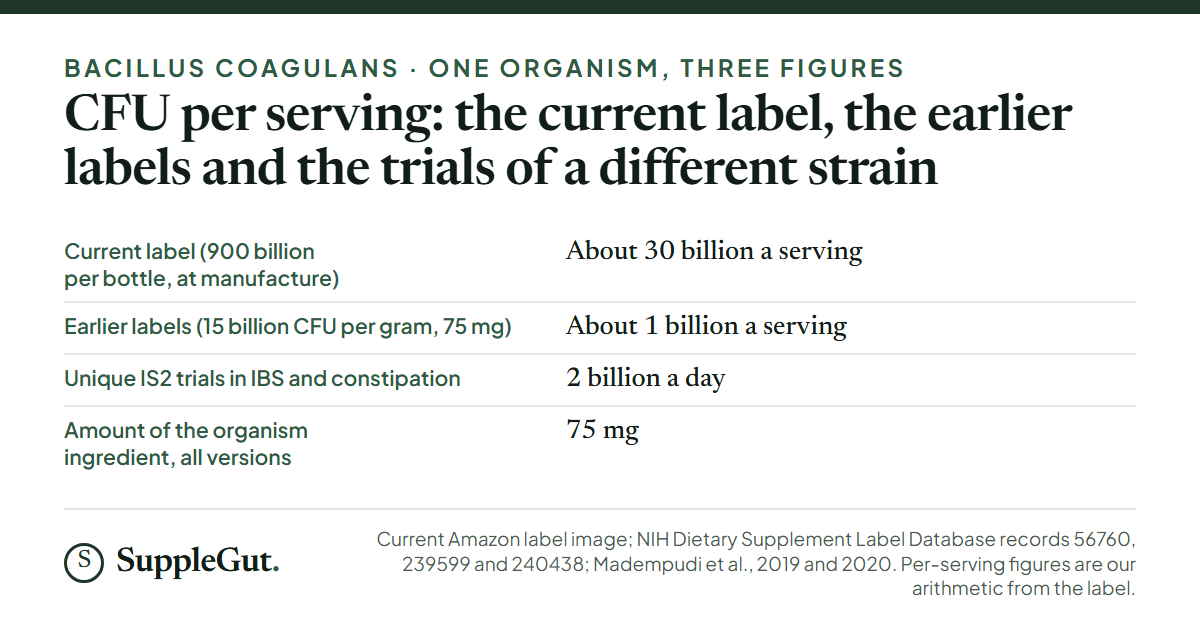
The panel headline is “900 Billion CFU per Bottle”, with a footnote that this is the amount formulated “at time of manufacturing”. Divided by 30 servings, that is about 30 billion CFU per two-tablet serving, or 15 billion at one tablet. No count at expiry is printed. Spread over the 75 mg of the organism ingredient, it implies about 400 billion CFU per gram.
Earlier labels tell a different story. In the NIH Dietary Supplement Label Database, the 2016, 2020 and 2021 labels of this product carry the same 75 mg of the B. coagulans ingredient with the note “15 B CFU/G”, which is 15 billion CFU per gram. At 75 mg that works out to about 1 billion CFU per serving, roughly thirtyfold lower than the current headline. We could not find a specification sheet for Uni-Bact CF-15 that would settle which figure is right, so both are reported as printed. For how to read these numbers in general, see how many CFU you need.
The ingredient names on the older labels differ too: the 2016 label names a strain called Unique IS-2, and the 2020 and 2021 labels name Uni-BactCF-15. The amounts (75 mg and 500 mg) and the 15 billion CFU per gram note are the same across them. No source says the two names are one strain, and that link is not assumed here.
The trial of the product itself
There is none. A PubMed search found no record under the brand name, no record of “Uni-Bact” at all, and no trial of B. coagulans combined with lactase and fructooligosaccharide in one product. ClinicalTrials.gov has no study registered under the brand, the ingredient name or the 900B-C name. The evidence below comes from a different-named strain, from the species, and from the other two ingredients.
The evidence for the organism
The closest trials are of B. coagulans Unique IS2, a strain deposited by Unique Biotech Ltd. In 136 adults with IBS (Rome III criteria), randomized to 2 billion CFU a day or placebo for eight weeks, the abdominal pain score fell from 8.2 to 3.4 on the probiotic against 8.3 to 6.7 on placebo. By the trial’s count, 45 of 53 people on the probiotic (84.9%) reached a 50% or greater pain reduction, against 7 of 55 on placebo (12.7%) (Madempudi et al., Scientific Reports, 2019). A second trial gave the same strain at the same dose for four weeks to 100 adults with functional constipation; bowel movements increased against placebo, and normal stool consistency was reported by 98% against 74% (Madempudi et al., Probiotics and Antimicrobial Proteins, 2020).
Three points limit what these trials say about this tablet. First, they are not trials of this strain name: nothing we read links Uni-Bact CF-15 to Unique IS2. Second, Unique Biotech funded the first trial in full and employs three of its authors, and the second has authors at the company. Third, the dose was 2 billion CFU a day, which sits between the two label figures: the current claim is about 15 times higher, and the older per-gram note is about half.
Other B. coagulans strains have their own small trials. GBI-30, 6086 improved abdominal pain and bloating scores from baseline in 44 people with IBS over eight weeks (Hun, Postgraduate Medicine, 2009), and in 61 adults with post-meal gas it beat placebo on abdominal pain by a small margin (p = 0.046) while the authors noted a strong placebo effect (Kalman et al., BMC Gastroenterology, 2009). At the level of the whole field, a 2023 meta-analysis of 82 IBS probiotic trials in 10,332 patients, only 24 of them at low risk of bias, rated the certainty of benefit as very low for combination probiotics and for Bacillus strains on global symptoms and on bloating or distension (Goodoory et al., Gastroenterology, 2023).
The fiber and the lactase
The 500 mg of FOS is a prebiotic: a fiber that gut bacteria, especially bifidobacteria, ferment. We found no trial of the branded ingredient. Dose studies of short-chain FOS in healthy adults tested 2.5, 5, 7.5 and 10 g a day for a week; bifidobacteria rose at every dose, and bloating was significantly more intense at 2.5 and 5 g a day, but not at 7.5 and 10 g (Bouhnik et al., Nutrition Journal, 2006). A separate study across 0 to 20 g found bifidobacteria rose at 10 and 20 g and not at 2.5 g (Bouhnik et al., Journal of Nutrition, 1999). The label’s 0.5 g is one fifth of the lowest dose tested, so those results do not describe it in either direction.
Lactase is the enzyme that splits lactose. The label gives 8 mg and no activity units, so the dose cannot be compared with lactase products or trials that state units. A crossover trial of lactase chewables in 47 adults with breath-test-confirmed lactose intolerance found lower symptom scores and 55% lower hydrogen on the enzyme than on placebo, but it used a different product in people selected for lactose intolerance, and its abstract does not give the dose (JGH Open, 2020). For the wider picture on enzymes, see do digestive enzymes work.
How to take it
The panel serving is two tablets. The directions on the current Amazon listing read “Take up to two (2) tablets daily with a meal”, so the wording allows one. The 2021 label said two tablets a day on an empty stomach, and the 2016 and 2020 labels said one or two tablets on an empty stomach, so the food instruction has reversed between versions. One Amazon reviewer likes the once-a-day dose; another who took one tablet instead of two reports gas and bloating. The label gives no basis for choosing between one tablet and two.
The Unique IS2 trials ran four and eight weeks, so a month at the label serving is the shortest test with any trial precedent. For general guidance on starting a probiotic, see probiotic side effects.
Side effects and who should not take it
The Amazon listing advises consulting a healthcare professional before use if you are pregnant, nursing, taking medication or have a medical condition, and discontinuing use if an adverse reaction occurs. The 2021 label added that it is not for children under 18; the current bottle’s age line was not visible in the listing images. Allergen information is thin: the listing says free from gluten, dairy and synthetic colors, with no “contains” statement and nothing about egg, soy, tree nuts, fish or sesame.
In Amazon’s own summary of the review text, side effects are a topic in 1,466 mentions, of which 1,084 are positive and 382 negative, which is 26% negative. Reviewers describe gas, bloating, cramping or an upset stomach in the negative ones. The Unique IS2 trials reported no severe adverse events, but they are not trials of this tablet. In the FOS dose study above, bloating was more intense at 2.5 and 5 g a day; the 0.5 g on this label is a fifth of the lower figure.
What the reviews say
The Amazon listing has run since 2014 and shows 4.3 from 43,824 ratings: 67% five-star, 17% four, 8% three, 3% two and 5% one. That one rating pool covers at least three label versions with different ingredient names, plus the current 900B-C panel, so the ratings cannot be tied to today’s formula. The brand site has no review widget, and we found no Trustpilot profile and no Better Business Bureau record under the brand or the company name.
Amazon’s topic summary counts 7,766 mentions of effectiveness, of which 1,224 (16%) are negative, 2,458 of digestive effects (126 negative), 1,178 of bloating (257 negative) and 1,018 of swallowability (342 negative, 34%). The recurring praise is less bloating, more regular bowel movements, a low price and a once-a-day routine. The recurring complaints are no effect, an upset stomach, and tablets reviewers call chalky and hard to swallow, with one saying a change in coating left them dissolving in the mouth.
One feature of the pool bears on how to read it. At least five of the roughly 25 review excerpts Amazon displays say the reviewer was given or promised “a free bottle” for writing a review. We did not find where the offer is made. It means some share of the 43,824 ratings was written after a free-product offer, though that share cannot be measured from what is visible.
Who makes Nutrition Essentials?
The Amazon seller of record is Canopus LLC, with a business address on Broadway in New York, selling as Nutrition Essentials with seller feedback of 4.9 from 25,003 lifetime ratings. The seller blurb describes the business as an authorized distributor of supplements made in the USA. The same company filed the “Nutrition Essentials Probiotic 900B-C” trademark application in 2025. The older labels in the NIH database say “Manufactured exclusively for Boost Marketing Group LLC” of Ada, Michigan. We found no link between Boost Marketing Group LLC and Canopus LLC: they may be one business under two names, or one may have bought the brand from the other, and no source we read says which.
The brand site, a Shopify store whose product variants carry the Amazon listing numbers, names no founder, doctor or staff and has no About page. The factory that makes the tablet is not named. The listing says every batch is tested for potency, but it names no laboratory, and we found no certificate of analysis and no NSF or USP mark. No active Meta ads for the brand turned up.
Cost, subscription and refunds
| Route | Price | Per day at 2 tablets | Per day at 1 tablet |
|---|---|---|---|
| Amazon, one bottle | $24.99 | $0.83 | $0.42 |
| Amazon Subscribe & Save (10% off) | $22.49 | $0.75 | $0.37 |
| Brand site, 1 bottle | $19.99 | $0.67 | $0.33 |
| Brand site, 3 bottles | $49.99 | $0.56 | $0.28 |
| Brand site, 6 bottles | $79.99 | $0.44 | $0.22 |
Amazon states “No fees, Cancel anytime” for Subscribe & Save and shows an extra coupon on a first subscription order. Amazon’s page marks the product non-returnable for food-safety reasons, with a refund or replacement if it arrives damaged or defective. The brand site has no subscription, and we found no refund or shipping policy page there (both addresses returned a not-found error). The brand page also reads “Sold out” in its markup while the store’s product feed lists all three bundles as available, and we could not resolve which is current.
Who this product suits
- Someone who wants a single spore-forming organism in a shelf-stable tablet and accepts that the strain name cannot be traced to a trial.
- Someone who wants lactase and a little fiber in the same tablet, understanding that the label gives no lactase activity and a fiber dose one fifth of the lowest dose studied.
- Someone who can swallow a large chalky tablet, since a third of the swallowability comments on Amazon are negative.
- Someone comparing other B. coagulans products: Thorne Bacillus Coagulans prints 2 billion CFU with no strain named and states NSF Contents Certified testing, and Digestive Advantage IBS prints one named strain, BC30, which has three small IBS trials.
A different organism class is covered by Culturelle Digestive Daily, which prints one named strain at 10 billion CFU. For choosing between types, see which probiotic to take, digestive enzymes vs probiotics for bloating, or start from symptoms with the quiz.
The products in this catalog
Common questions
Does Nutrition Essentials Probiotic work?
No trial of this tablet was found. Its single organism, Bacillus coagulans, is sold under the name Uni-BactCF-15, and the nearest trials are of a different-named strain (Unique IS2) at 2 billion CFU a day, funded by that strain’s maker; in 136 adults with IBS, abdominal pain scores fell from 8.2 to 3.4 against 8.3 to 6.7 on placebo. On Amazon 67% of 43,824 ratings are five-star, and about 16% of the comments on effectiveness are negative.
What is in Nutrition Essentials Probiotic?
Per two-tablet serving the panel lists 75 mg of Bacillus coagulans (Uni-BactCF-15), 8 mg of lactase enzyme with no activity units, and 500 mg of fructooligosaccharide fiber. The three sit in a proprietary blend with no total weight, and no strain code or deposit number is printed. The other ingredients are microcrystalline cellulose, dicalcium phosphate, stearic acid, croscarmellose sodium, silicon dioxide, magnesium stearate and hypromellose.
Does the tablet really contain 900 billion CFU?
The panel states 900 billion CFU per bottle at the time of manufacturing, which is about 30 billion per two-tablet serving, and prints no count at expiry. Earlier labels of the same product listed the same 75 mg ingredient at 15 billion CFU per gram, which works out to about 1 billion per serving. We found no specification sheet that settles which figure applies to the tablet in a current bottle.
Is Nutrition Essentials Probiotic safe, and what are the side effects?
The listing advises consulting a healthcare professional if you are pregnant, nursing, taking medication or have a medical condition, and stopping if an adverse reaction occurs. In Amazon’s review summary, 382 of 1,466 side-effect mentions are negative, with reviewers describing gas, bloating, cramping or an upset stomach. The Unique IS2 trials reported no severe adverse events, but they are not trials of this tablet. See also probiotic side effects.
How many tablets a day, and with food or on an empty stomach?
The panel serving is two tablets, and the current Amazon directions say to take up to two tablets daily with a meal. The 2021 label said two tablets a day on an empty stomach, and the 2016 and 2020 labels said one or two on an empty stomach. A third of the swallowability comments on Amazon are negative, describing large, chalky tablets.
How much does Nutrition Essentials Probiotic cost per day?
A 60-tablet bottle is $24.99 on Amazon, which is $0.83 a day at the panel’s two tablets, or $0.42 at one tablet. Amazon Subscribe & Save is $22.49 ($0.75 a day), and the brand site lists $19.99 for one bottle ($0.67 a day), $49.99 for three and $79.99 for six. The brand site has no subscription and no refund page; Amazon marks the product non-returnable except when damaged or defective.
Who makes Nutrition Essentials?
On Amazon the seller of record is Canopus LLC of New York, which also filed the “Nutrition Essentials Probiotic 900B-C” trademark application in 2025. Older labels in the NIH label database say “manufactured exclusively for Boost Marketing Group LLC” of Ada, Michigan, and we found no link between the two companies. The brand site names no owner or staff, the factory is not named, and no Trustpilot or Better Business Bureau profile was found.
Sources
- Madempudi RS, et al. Bacillus coagulans Unique IS2 in adults with irritable bowel syndrome: a randomized, double-blind, placebo-controlled trial (136 randomized, eight weeks, 2 billion CFU a day). Scientific Reports, 2019. PMID 31434935 (doi 10.1038/s41598-019-48554-x)
- Madempudi RS, et al. Bacillus coagulans Unique IS2 in functional constipation: a randomized, double-blind, placebo-controlled trial in 100 adults. Probiotics and Antimicrobial Proteins, 2020. PMID 30911991 (doi 10.1007/s12602-019-09542-9)
- Goodoory VC, et al. Efficacy of probiotics in irritable bowel syndrome: systematic review and meta-analysis of 82 trials. Gastroenterology, 2023. PMID 37541528
- Hun L. Bacillus coagulans significantly improved abdominal pain and bloating in patients with IBS. Postgraduate Medicine, 2009. PMID 19332970; Kalman DS, et al. Bacillus coagulans in post-meal gas symptoms: a randomized, double-blind, placebo-controlled trial. BMC Gastroenterology, 2009. PMID 19922649
- Bouhnik Y, et al. Short-chain fructo-oligosaccharide administration dose-dependently increases fecal bifidobacteria in healthy humans. Journal of Nutrition, 1999. PMID 9915885; Bouhnik Y, et al. The capacity of short-chain fructo-oligosaccharides to stimulate faecal bifidobacteria: a dose-response relationship study in healthy humans. Nutrition Journal, 2006. PMID 16569219
- Lactase chewable tablets in lactose intolerance: crossover placebo-controlled trial in 47 adults. JGH Open, 2020. PMID 33490624
- NIH Dietary Supplement Label Database: earlier label versions of Nutrition Essentials probiotic (ingredient names, amounts, “15 B CFU/G” note, directions, “Manufactured exclusively for Boost Marketing Group LLC”). label 56760, label 239599, label 240438
- Nutrition Essentials on Amazon: Supplement Facts image, listing text, directions, ratings, review summary and price. amazon.com/dp/B00L3JTHME
- Amazon seller profile for Nutrition Essentials (business name and address, seller feedback). amazon.com/sp; trademark record for the Probiotic 900B-C mark as indexed by Justia. trademarks.justia.com
- Nutrition Essentials brand page: product text, bundle prices and variants. nutritionessentials.com
Not sure which product fits your situation?
This guide covers the mechanics. The quiz takes your specific symptoms, routine and preferences and matches you to one product from the catalog.
Take the quiz →