
Guide
Does Totaria 5-in-1 work? Twenty-four species, 60 billion CFU, and four blends of 100 to 200 mg
Quick answer
Does Totaria 5-in-1 work? We could find no trial of Totaria 5-in-1. The label prints 60 billion CFU across 24 species with no strain designation and no per-organism count, plus four blends of 100 to 200 mg (fiber, postbiotics, 14 enzymes and six herbal extracts) with no amount for anything inside. An 82-trial review rated combination probiotics as very low certainty for global IBS symptoms and bloating. Amazon shows 4.5 from 1,246 ratings, at about $0.19 a day.
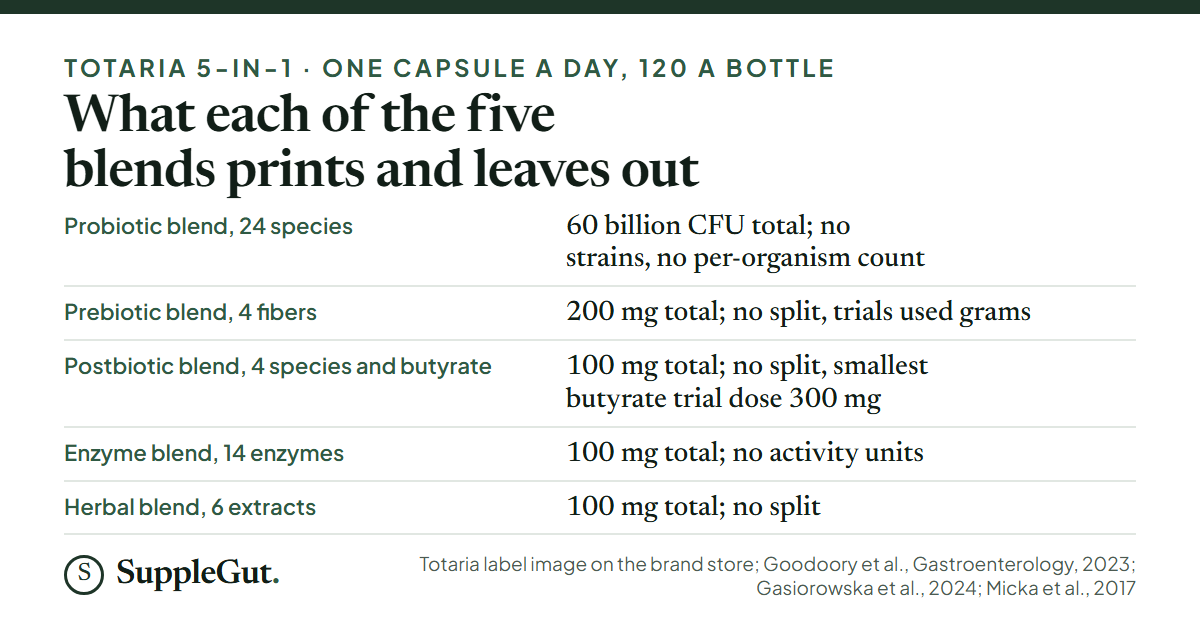
Totaria 5-in-1 is a once-a-day capsule that packs five kinds of ingredient into one: a 60 billion CFU probiotic blend of 24 species, a fiber blend, a “postbiotic” blend, 14 digestive enzymes and six herbal extracts. The label prints no strain, no per-organism count and no amount for anything inside the four small blends, which is the detail that decides whether any of it matches a trial. This page sets out what is printed, what the research says, and what the reviews and prices show.
What Totaria 5-in-1 is, and what the label leaves out
The bottle holds 120 capsules, one capsule is a serving, and the shell is vegetable cellulose. The Supplement Facts panel, read from the brand store’s own label image, lists five blends, and inside each no individual amount is printed.
| Blend | Total | Named inside | Left out |
|---|---|---|---|
| Probiotic Blend | 60 billion CFU | 24 organism names, from Bifidobacterium lactis to Saccharomyces boulardii | Every strain designation, any count per organism, any at-manufacture or at-expiry statement |
| Prebiotic Blend | 200 mg | Inulin (Jerusalem artichoke), galacto-oligosaccharides, acacia fiber, psyllium husk | The split among the four |
| Postbiotic Blend | 100 mg | B. longum, B. lactis, Bacillus subtilis and L. acidophilus, each marked “postbiotic”, plus sodium butyrate | The split, the cell count and the form of the butyrate |
| Digestive Enzyme Blend | 100 mg | 14 enzymes, including amylase, lipase, lactase, bromelain and papain | Activity units and the split |
| Digestive Support Blend | 100 mg | Fennel seed, ginger root, peppermint leaf, dandelion root, artichoke leaf, slippery elm bark (extract ratios 4:1 to 30:1) | The split |
The four small blends add up to 500 mg (200 + 100 + 100 + 100). Retail titles say “24 Strains”, but the panel lists 24 names and prints no strain on any. Two of them, B. lactis and B. animalis, overlap, since B. lactis is a subspecies of B. animalis.
The panel does not say whether the 60 billion is counted at manufacture or through the expiration date. Split evenly, 60 billion over 24 names would be about 2.5 billion each, though the label gives no split. The CFU guide explains why a total says little about any one organism.
The trial of the product itself
We could find none. A PubMed search returned only general probiotic papers, the NIH Dietary Supplement Label Database has no Totaria record, and no page we read cites a study. Retailer copy calls the probiotic “Clinically Studied”; that is a brand claim, with no study named. No ingredient carries a trademarked strain name, so there is no branded-ingredient trial to borrow from.
The evidence for the ingredients
Probiotics. The largest review of probiotics in irritable bowel syndrome pooled 82 randomized trials in 10,332 adults. It found moderate-certainty benefit on global symptoms only for Escherichia strains, and rated combination probiotics as very low certainty for global symptoms and bloating; certainty was low to very low across almost all analyses (Goodoory et al., Gastroenterology, 2023). Its results are strain-specific, so a label with no strains cannot be matched to them. A five-strain blend at 27.5 billion CFU a day, tested in 156 adults with bloating and constipation for two weeks, did not beat placebo on its main bloating measure (Airaksinen et al., Beneficial Microbes, 2019).
Fiber. Fiber trials use grams. In adults with constipation, 12 g a day of chicory inulin was tested for four weeks (Micka et al., 2017). Totaria’s 200 mg is shared among four fibers; if all of it were inulin it would be about 1.7% of that dose. For choosing between the two, see the probiotic or fiber guide.
What a postbiotic is: the 2021 consensus definition from the International Scientific Association for Probiotics and Prebiotics is a preparation of inanimate microorganisms, or their components, that confers a health benefit (Salminen et al., Nature Reviews Gastroenterology & Hepatology, 2021). The label marks four species “postbiotic”, which in that usage means inactivated cells, but gives no cell count or method, and the same four species also appear in the live blend. A named strain matters here as it does for live organisms: a benefit shown for one strain does not carry to another of the same species.
Sodium butyrate. The postbiotic blend also holds sodium butyrate. In 120 adults with IBS, two capsules a day of microencapsulated sodium butyrate (150 mg of sodium butyrate each) plus five probiotic strains gave adequate relief to 64.7% against 42.0% on placebo at four weeks (p = 0.023), with no significant difference on the main outcome at 12 weeks (Gasiorowska et al., Journal of Clinical Medicine, 2024). A 12-week trial in 66 adults with IBS found less pain on defecation at four weeks with microencapsulated butyrate added to standard therapy (Banasiewicz et al., Colorectal Disease, 2013). The smallest dose in those trials was 300 mg a day of sodium butyrate; Totaria’s whole postbiotic blend is 100 mg, and the label does not say whether the butyrate is microencapsulated.
Enzymes. There are 14 enzymes in 100 mg, about 7 mg each if split evenly, with no activity units. A 125-patient IBS trial of the enzyme alpha-galactosidase found no routine benefit over placebo, with more withdrawals on the enzyme (18 against 7); it is not one of Totaria’s 14 (Hillila et al., Scandinavian Journal of Gastroenterology, 2016). A branded blend, DigeZyme, at 50 mg three times a day for 60 days beat placebo on every dyspepsia score in 40 patients with functional dyspepsia (Majeed et al., Journal of Medicinal Food, 2018); that is 150 mg a day of a different blend. The digestive enzymes guide covers the wider enzyme evidence.
Herbal extracts. We found no trial of fennel, ginger, peppermint leaf, dandelion, artichoke and slippery elm together, or at an undisclosed dose inside 100 mg, which is about 17 mg each if split evenly. A 2018 meta-analysis of prebiotics, probiotics and synbiotics in IBS is the class-level reference for the fiber and probiotic pairing, and does not assess this formula either (Ford et al., 2018).
How to take it
The directions on the listings we read are one capsule a day with water, and reseller copy of the brand’s text adds “ideally with a meal”. The probiotic trials we cite ran from two to 12 weeks.
Side effects and what the label does not say
We found no warning panel on the label images, and no pregnancy, medication or immune-condition guidance on the pages we could read. The panel lists a yeast, Saccharomyces boulardii, Bacillus species, psyllium husk, bromelain, papain and lactase. Free-from statements (vegan, non-GMO, gluten-free, dairy-free, soy-free) appear only in reseller copy of the brand’s text, and we found no “contains” statement. General effects of probiotics are in the probiotic side effects guide.
Who makes it, and what the brand claims
We found no company name and no address. SuppCo lists the brand as Totaria Health, whose domain totariahealth.com is a parked page offered for sale; the store is at totaria.com. Retailer copy states a cGMP, FDA-registered facility and third-party testing, but we found no laboratory, certificate or testing seal.
What the reviews say
- Amazon: 4.5 from 1,246 ratings on the listing the candidate sweep read (ASIN B0FW4XNN8W). A second ASIN carries the same title, and we could not tell whether it is the same capsule.
- Walmart: 4.6 from 41 ratings, from a search summary of the listing.
- Brand store: no readable score.
- Trustpilot: 2.9 from 3 reviews for totaria.com, two of them one-star, on a profile the company has not claimed.
We could not read the Amazon or Walmart review text, so no recurring praise is recorded. The Trustpilot reviews concern orders, not the capsule: a broken seal, a bottle short by 66 capsules, and a buy-three-get-three bundle that arrived as one bottle.
Price
| Route | Price | Per day (1 capsule) |
|---|---|---|
| Amazon, 120 capsules | $22.31 | about $0.19 |
| Brand store, price options | $23.99 to $28.99 | Options unlabeled in the page we read |
| Reseller (vitanutrius.com) | $29.74 | about $0.25 |
We could not read the brand store’s subscription or refund terms.
Who Totaria 5-in-1 is for
- Someone who wants probiotics, fiber, enzymes and herbs in one capsule and will judge it by how they feel, since the label gives no strain or dose to look up.
- Someone comparing multi-species capsules: Vitalitown lists 36 organism names and 20 mg of enzymes with no strain codes, and MAV Nutrition lists 16 species with no strain codes.
- Someone who wants a single named strain: Culturelle Digestive Daily prints one.
See which probiotic to take, the Vitalitown guide or the quiz, which starts from symptoms.
The products in this catalog
Common questions
Does Totaria 5-in-1 work?
We could find no trial of Totaria 5-in-1. An 82-trial review of probiotics in IBS rated combination probiotics as very low certainty for global symptoms and bloating, and its results are strain-specific, while this label prints 24 species with no strain. The brand’s “clinically studied” wording is a claim, and no study is cited.
What is in Totaria 5-in-1, and what does the label not say?
One capsule holds a 60 billion CFU probiotic blend of 24 species, a 200 mg prebiotic blend of four fibers, a 100 mg postbiotic blend with sodium butyrate, 100 mg of 14 enzymes and 100 mg of six herbal extracts. No amount is printed for anything inside the four small blends, no strain for any organism, no per-organism count, and no enzyme units.
How many strains does Totaria 5-in-1 have?
Retail titles say 24 strains, but the label lists 24 organism names and prints no strain designation on any. Two of the names, B. lactis and B. animalis, overlap, since B. lactis is a subspecies of B. animalis. Without a strain code, a trial of a named strain cannot be matched to this capsule.
What is a postbiotic, and what is in Totaria’s postbiotic blend?
A postbiotic is a preparation of inactivated microorganisms or their components that confers a health benefit. The 100 mg blend marks four species as postbiotic and adds sodium butyrate, so the butyrate is below the 300 mg a day used in the smallest IBS trials we read. The label does not give a cell count or say how the cells were inactivated.
Does Totaria 5-in-1 have side effects or warnings?
We found no warning panel on the label images and no pregnancy or medication guidance on the pages we could read. The panel includes live yeast, Bacillus species, psyllium, bromelain, papain and lactase, and free-from statements appear only in reseller copy. Common early effects of probiotics are covered in the probiotic side effects guide.
How much does Totaria 5-in-1 cost?
Amazon shows $22.31 for 120 capsules, about $0.19 a day at one capsule. The brand store lists price options from $23.99 to $28.99, and a reseller lists $29.74. We could not read the brand store’s subscription or refund terms.
Who makes Totaria, and what do the reviews say?
We found no company name or address; totariahealth.com is a parked page and the store is totaria.com. Amazon shows 4.5 from 1,246 ratings and Walmart 4.6 from 41, while Trustpilot shows 2.9 from 3 reviews on an unclaimed profile. Those three reviews concern a broken seal, a short-filled bottle and a bundle that arrived as one bottle.
Sources
- Goodoory VC, Khasawneh M, Black CJ, Quigley EMM, Moayyedi P, Ford AC. Efficacy of probiotics in irritable bowel syndrome: systematic review and meta-analysis (82 randomized trials, 10,332 adults). Gastroenterology, 2023. PMID 37541528
- Airaksinen K, et al. Five-strain probiotic blend against placebo in 156 adults with bloating and constipation. Beneficial Microbes, 2019. PMID 31131616
- Gasiorowska A, et al. Microencapsulated sodium butyrate with probiotics in 120 adults with IBS. Journal of Clinical Medicine, 2024. PMID 39797089
- Banasiewicz T, et al. Microencapsulated sodium butyrate as add-on therapy in 66 adults with IBS. Colorectal Disease, 2013. PMID 22738315
- Hillila M, et al. Alpha-galactosidase in 125 patients with IBS. Scandinavian Journal of Gastroenterology, 2016. PMID 26133538
- Majeed M, et al. DigeZyme in 40 patients with functional dyspepsia. Journal of Medicinal Food, 2018. PMID 30156436
- Ford AC, et al. Systematic review with meta-analysis: the efficacy of prebiotics, probiotics, synbiotics and antibiotics in irritable bowel syndrome. Alimentary Pharmacology & Therapeutics, 2018. PMID 30294792
- Micka A, Siepelmeyer A, Holz A, Theis S, Schön C. Effect of consumption of chicory inulin on bowel function in healthy subjects with constipation (12 g a day). International Journal of Food Sciences and Nutrition, 2017. PMID 27492975
- Salminen S, et al. The International Scientific Association of Probiotics and Prebiotics (ISAPP) consensus statement on the definition and scope of postbiotics. Nature Reviews Gastroenterology & Hepatology, 2021. doi.org/10.1038/s41575-021-00440-6
- Brand page: label image, gallery and price options. totaria.com. Amazon listing, rating and price: amazon.com/dp/B0FW4XNN8W. Walmart listing: walmart.com. Trustpilot profile: trustpilot.com/review/totaria.com. Reseller page: vitanutrius.com. SuppCo brand page: supp.co/brands/totaria-health
Not sure which product fits your situation?
This guide covers the mechanics. The quiz takes your specific symptoms, routine and preferences and matches you to one product from the catalog.
Take the quiz →